MAZDA2
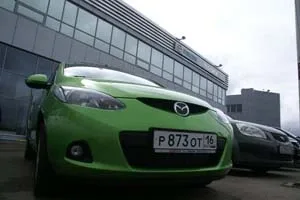
The Frog Princess
Engine — 1.5 AT
Max power — 103 hp/6000 rpm
Max torque — 137 Nm/4000 rpm
Max speed (km/h) — 168
Acceleration 0-100 km/h — 12.1
Fuel consumption (l/100 km):
city — 9.1
highway — 5.5
combined — 6.8
Transmission — 4-speed automatic
Front-wheel drive,
Front suspension MacPherson,
rear torsion beam
Length — 3885 mm
Width — 1695 mm
Height — 1475 mm
Curb weight — 1030 kg
Climate control, ABS+EBD,
8 airbags, alloy wheels, 4 electric windows, fog lights, leather steering wheel
Price $17,939 (143,505 UAH) including $355 (2,835 UAH) for "metallic"
Base price $15,357 (122,851 UAH) with automatic transmission
Mazda traces its lineage back to an unusual occupation for the automotive industry — the production of cork materials. That was the product line of the company founded in 1920 by Jujiro Matsuda. He was born in 1875 in Hiroshima Prefecture, the twelfth son of a fisherman's family. At twenty, Matsuda opened his own forge, but the business quickly failed. Eleven years later, he made a second attempt, obtained a patent for an air pump, but that venture also closed. After a series of unsuccessful business projects, in 1920 Matsuda, with a group of investors, acquired the bankrupt Hiroshima company Abemaki, which specialized in cork. The enterprise was renamed Toyo Cork Kogyo, and within a year Matsuda became its president. At that time, the company had nothing to do with automobiles and continued to produce building materials. It was this business that provided the financial foundation for future development. In 1927, the word "cork" was removed from the name, and the company became Toyo Kogyo, Ltd., reflecting the shift to industrial production. First, in the 1920s, a small experimental batch of motorcycles was assembled, and in 1929, machine tool production was mastered. In 1930, one of the company's motorcycles even won a race.
In 1931, Mazda began producing vehicles in a truly Japanese spirit — three-wheeled trucks with half-liter engines. The trademark chosen for them was the word Mazda — the name of the supreme god of light in Zoroastrianism, which also sounds similar to the founder's surname. From 1932, the trucks began to be exported to China. Before World War II, the company developed several passenger car concepts, but they never went into series production. After the war, despite the atomic bombing of Hiroshima, the Toyo Kogyo plant survived more than half intact, and by 1950, production of Type CT three-wheeled trucks with a 1157 cc engine resumed, along with compact fire engines and regular trucks. In 1952, Jujiro Matsuda passed away; a year earlier, his son Tenuji had taken over as president. The company began producing passenger cars only in 1960, when the prosperity of the Japanese began to grow. Today, Mazda focuses on small and medium-sized passenger models, as well as sports cars — management considers this direction the most promising. In matters of strategy and sales, the company works closely with Ford, although Ford does not interfere in production processes.
Mazda is a truly global manufacturer: assembly plants in 21 countries allow exporting cars to 120 nations.
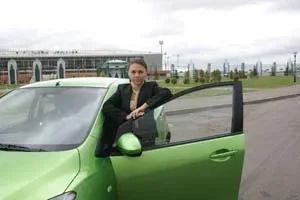
Diana Iskhakova
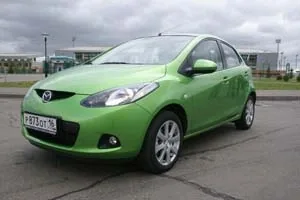
The Frog Princess — that's the comparison that came to mind at first glance at the new MAZDA2.
A small green car with an unusual appearance that, it seems, you just need to get used to. But inside — it's quite spacious and cozy.
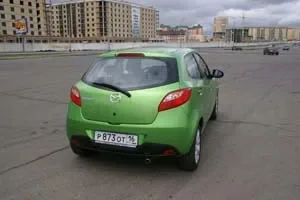
My acquaintance with the car began from the back row. Sitting there turned out to be spacious, knees don't touch anything. Two people are quite comfortable, but three would probably be a bit cramped, although cars of this class aren't designed for a noisy company. The only thing that upset me was the lack of handles above the doors. During active driving, I kept bumping my side and head against the door. However, you can just buckle up. Maybe it's a clever way to make passengers use seat belts? When I got out, I almost got dirty on the rear fender — it protrudes outward in an unusual way.
The ride in the back turned out to be soft and comfortable: bumps are not felt, street noise barely penetrates, but the engine makes a pleasant hum. That's a matter of taste, of course, but it gets me a bit excited.
Moving to the driver's seat, I got much more pleasure. I'll warn you right away: MAZDA2 is the first foreign car I've driven for more than 10–15 minutes. So I liked almost everything: electric power steering, softly shifting levers and buttons, automatic transmission, seat and steering column adjustments. In short, the car is made for the person, not the other way around. Lots of impressions, but I'll try to highlight the main ones.
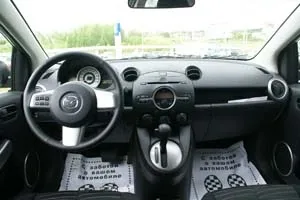
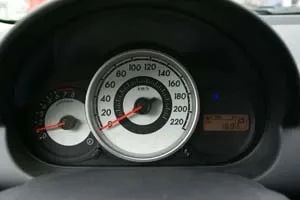
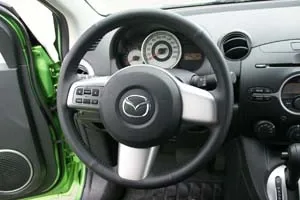
The instrument panel, in my opinion, is poorly designed: the white background of the speedometer and tachometer, to put it mildly, stands out from the interior. The left front pillar significantly obstructed visibility, but the side mirrors are large and give an excellent view. Overall, it was still difficult for me to navigate — perhaps I should have adjusted everything better to myself, or maybe it's just a matter of habit.
Highway driving for me is a boring activity; I don't like it and avoid it. And with an automatic, you can even doze off behind the wheel. By the way, in "Drive" mode, the gearbox, as it seemed to me, brakes slightly. If it were a manual, driving would be more fun. But in "Sport" mode, everything is much more active. This nimble little car gains speed imperceptibly: a couple of times I was surprised to notice the speedometer needle already approaching 130 km/h. I'm not used to such speeds and violations, so I immediately eased off the gas. The day was windy, and at high speed the car started to sway. Honestly, it got a bit scary.
Once in the city, I got the hang of it and truly appreciated the automatic transmission — all attention can be given to the road. City driving is a completely different matter. There's room to roam: traffic jams, intersections, roadworks, potholes, bumps, and "blondes." We overcame all these obstacles with the Princess easily. In traffic jams, we squeezed through narrow spots, seemed not to notice potholes, and the "blondes" envied us (just kidding, of course).
Overall impression: the car is lively, fit, and frankly feminine. Some of its characteristics combine strangely, and that, perhaps, would please only female drivers. I also like to speed and hooligan to good music. But for such a momentary weakness, I wouldn't shell out that hefty sum on the MAZDA2 price tag.

Vadim Sadykov, "Avtoclub-Kazan"
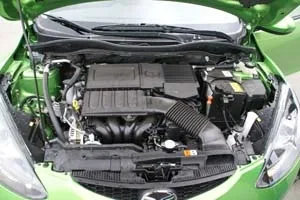
It must be admitted: the car is discussed very actively on the Internet, and many consider it the main competitor in the B class. Think it's mostly praised? Not at all. Quite a few people criticize both the design, the quality of finishing, and the price. But they don't talk so much about bad cars. So, there's a certain zest in it. What is it? At first glance — only the unusual 1.5 engine displacement, which is almost never found in the B class. Agree, 103 hp with a mass of 1030 kg is impressive. If the stakes are so high (some have already compared it to the Mercedes C-class), then we'll make corresponding demands.
Many people scold the interior: they say it's cheap, uncomfortable, and ugly. A matter of taste. Of course, there's no soft plastic here (and where would you find it even in the D class?), but I didn't notice anything clearly cheap. The finishing is simpler than in the Opel Corsa, but nothing more. Despite the five-door body, all the comforts go to the front passengers. Only two can fit in the back, knees are cramped, armrests are uncomfortable. In general, you can still ride in the back around the city, but on the highway — better not.
It's immediately noticeable that the wheels are somehow too small. Manager Denis suggests: R15. I look at the numbers on the tire: 185/55. Wow! Although, if you think about it, the rubber is low-profile. I wouldn't risk going into deep potholes at decent speed. Maybe such tires are good in Europe, but here? If you fiddle with a tire calculator, it turns out they are quite interchangeable with 175/65R14. The profile there is also lower than standard, but the durability on our roads will be higher. Why do they put low-profile tires on a car at all? There are two reasons. First, the smaller the diameter of the wheel assembly, the more briskly the car accelerates. For the Mazda2 with its 103 horses, this is fundamental: you need to squeeze out maximum drive and leave competitors behind. Second, the larger the wheel diameter, the sharper the handling. True, then the mass of the wheel assembly also grows, and that's an additional load on the suspension. Therefore, the conclusion is this: don't skimp and better order cast or forged wheels — they are noticeably lighter than stamped ones.
And do you know what's the main thing about this car? LIGHTNESS! It accelerates weightlessly, changes trajectory easily, and even crawling in city traffic is simple and not tiring. Of course, we also went out of town, found a road with a series of turns: it goes easily, writes corners perfectly, and the speed reserve feels huge. Surprisingly, on the highway it also behaved impeccably: it holds its course, overtaking "slow-moving" cars happens quickly and without fear. Behind the wheel on a long road — it's easy, but on the rear seat, perhaps, not so much. It was pleasing that at a hundred kilometers per hour the tachometer holds about 2500 rpm: very economical. Another point: the 4-speed automatic in normal mode (there's also "sport" and "L") is tuned sensibly: after shifting up at 6000 rpm, the needle drops to 4000 — right at the torque peak. Returning to the city, I decided to hooligan, drove in a ragged rhythm (passengers out of politeness endured my sharp starts and braking). And what to say? I liked it. The only thing I have a complaint about is the 4-speed automatic, it's too thoughtful when accelerating from low rpm.
And then I thought: who would buy this not-cheap little car? It's unlikely to be a solid man. Unless as a third (or even fifth) car in the family, for Sunday driving. I also can't imagine a middle-aged woman behind the wheel; she definitely doesn't need the drive. But girls will probably like this design. And, of course, young racer guys will take it with pleasure.
Alfred Mardanov, "Autoclub-Kazan"
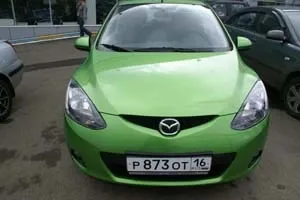
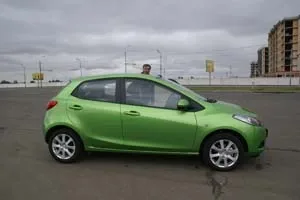
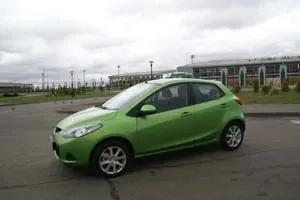
My first acquaintance with the "two" happened shortly before the test. I just walked into the showroom and asked to show me the car — I wanted to see it in person. Standing among other cars, it immediately stood out with its toxic green color and its appearance. The design, frankly, is not for everyone, but you can't deny: Mazda is recognizable at first glance, that's for sure. Cover the badge with your hand — and you still guess the image of the famous "Japanese woman". In general, Mazda in recent years has been gaining some charisma thanks to its signature style, the pinnacle of which I consider the design of the RX-8. And in this little one, features of the famous roadster are visible. Despite the fact that the car is originally from the small class, it is not devoid of a "muscular" appearance. Slanted headlights encroaching on the fenders, transitioning into stamped sides with a narrow glass line (reminiscent of BMW's relief), and the rear window tapering downward adds swiftness to the silhouette. When you sit in the cabin, the first thing that catches your eye is the frankly cheap plastic.
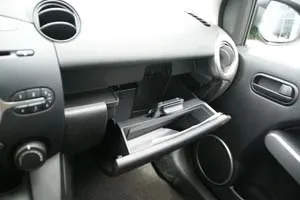
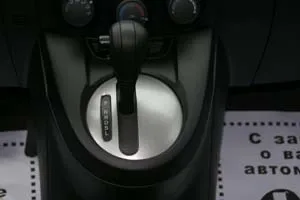
It was so unexpected that I was even taken aback, realizing what was happening for a second. Also, in a sporty style, the white dial, which stands out brightly and draws attention. The cabin is full of round elements, this is the main geometric figure around which the design theme is built, but why a rectangular screen is perched next to the speedometer is unclear. You'll say it's a trifle? And I would argue that in such matters there are no trifles. The automatic gearbox lever stands on a kind of pedestal, like in minivans. This shortens the path of the hand to the lever and frees up space between the seats, where you can put a small lady's handbag. The interior space is well thought out; a person above average height will sit comfortably behind the wheel, and there will be enough room above the head. There seem to be enough seat adjustments, but the steering wheel only adjusts for tilt, not reach. The glove box is interestingly organized: a separate box for A4 documents, which can be placed even without opening the lid. After sitting in the rear seats, I realized that there is also a lot of living space there; you can even argue with the MAZDA3. This is not surprising if you believe the numbers — that's how it is. After fidgeting enough on the seats and lamenting the cheap plastic, I was about to leave, and just before leaving, the manager said the key phrase: "But how it drives!!!". So let's check it on the test drive, I thought. And here it is, the test drive. What to say? The manager was right. The car runs very spiritedly and fun. Everything is at a decent level: handling, dynamics, brakes, and even sound insulation, which is completely unusual for this class. On the move, the car provokes speed and drive. The outdated four-speed automatic has a gear lock mode, and you can overtake any truck on the highway without fear of the automatic's thoughtfulness. Additionally, there is a sport mode; I didn't feel a difference in its operation, apparently, higher speeds are needed for that, but the "L" mode allows you to leave in the top three at the start, on par with more powerful cars. One thing bothers me: why does such a small car need such crazy agility. To maneuver in city traffic, you could get by with less. Personally, I wouldn't overpay for such a powerful engine and would choose a calmer unit. Unfortunately, the Mazda2 is offered only with one engine, but in two trims: Energy and Sport. Although, on the other hand, if you move away from the thesis that the Mazda2 is a women's car (well, bearded men drive the more feminine Grande Punto), then a quite harmonious picture of a car for a young man emerges. The character will be appropriate. But then the Sport version will be interesting. And regarding the plastic: when we took the car for the test, it no longer seemed so cheap, it just faded into the background. Moreover, the manufacturer assures that the plastic is made from environmentally friendly materials, which explains the complete absence of any odors in the cabin of a new car.
(C) "Autoclub-Kazan".