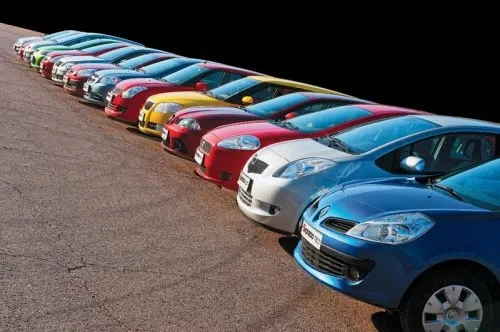
For the first time in Russian history, fourteen B-class representatives met at the Dmitrov test track to find out which of them deserves the title of the best. This large-scale comparative test involved the Chevrolet Aveo 1.4, Fiat Grande Punto 1.4, Honda Jazz 1.4i DSI, Hyundai Getz 1.4, Kia Rio 1.4, Mazda2 1.5 MZR, Mitsubishi Colt 1.3 Invite, Opel Corsa 1.4, Renault Clio 1.4 16V, Seat Ibiza 1.4 16V, Skoda Fabia 1.4 16V, Suzuki Swift 1.3, Toyota Yaris 1.3 VVT-i, and VW Polo 1.4 16V.
Unlike practical Europe, in the wealthy Russian market, B-class cars are hard to call bestsellers. Last year, this compact segment accounted for only nine percent of sales, while the traditionally most popular C-class took half of the market. However, the growth rate of the B-class is impressive: in 2007, it grew by 133% compared to the previous season, while the C-class only added 45%. This indicates that the Russian market is becoming more mature and approaching European standards. Buyers are gradually moving away from the Soviet habit of purchasing a car for all occasions, hence the slowdown in growth of the universal C-class against the backdrop of a sharp jump in SUV sales (+112%) and the B segment. It seems this trend will continue until the end of 2008.
In essence, this is the first mass test of cars in Russia. Reprints from European magazines do not correspond well to Russian reality, because cars supplied or assembled in our country differ significantly from their European counterparts. For example, the electronic stability control system ESP has long been the norm for this class in Europe, but here its installation is most often not even provided as an option. Of the fourteen test participants, ESP can only be installed on five — Skoda, VW, Mazda, Opel, and Fiat. Therefore, we are comparing exactly the "Russian" foreign cars, those offered in dealer showrooms.
For the tests, we chose cars costing up to 500 thousand rubles with the most popular 1.3–1.5 L engines and manual transmissions. Each car underwent a full cycle of tests according to the certification criteria of the German Association of Automobile Manufacturers (VDA) and European standards (ISO). The data obtained formed the basis of a summary table that allowed us to identify the strengths and weaknesses of each participant and compile a final rating.
Since these cars are often called "women's," we could not do without the opinion of the fair ladies. Three employees of our publishing house evaluated the B-class on a 10-point system in 13 categories. The results of the women's test did not always coincide with the experts' conclusions, but the girls were unusually unanimous. They unanimously chose the freshest and most cheerful car in terms of color — the Mazda2 received 25 top scores out of 39 possible. The following Honda Jazz and Fiat Grande Punto scored 13 and 12 top points, respectively. But one of the main test winners, the VW Polo, frankly did not appeal to the girls — only 10th place and not a single maximum score.
Nadezhda Goncharova, advertising manager, driving experience 2 years, drives a Honda Civic: "The obvious favorite is the Mazda2, its leadership is due to modern design and almost perfect handling. You can highlight the Seat, which attracts with its aggressive appearance. In terms of design, I like the Honda, in terms of acoustic comfort — the Fiat. Hopeless losers are the Kia with its unbearable squeak of plastic panels, reminiscent of the creations of the domestic auto industry, and the Hyundai, which does not meet my comfort criteria."
Yulia Shatilova, designer, driving experience 2 years, drives a Daewoo Matiz: "There were no outright failed cars among these. But there are those in which one or two elements stand out from the overall favorable impression. The Kia Rio, Fiat Grande Punto, and Chevrolet Aveo have terrible gearboxes with a long and uninformative lever travel. The most balanced are the Mazda2, Honda Jazz, and Opel Corsa."
Maria Balakireva, financial manager, driving experience 6 months, drives a Hyundai Accent: "The obvious leader is the Mazda2. A beautiful and very pleasant car! The Honda Jazz pleased with its dynamics and informative brakes. The Fiat Grande Punto — with its precision in control. The Hyundai Getz, Renault Clio, Chevrolet Aveo, and Mitsubishi Colt are clear outsiders."
Chevrolet Aveo. 367,000 RUB
The Aveo turned out to be the only B-class sedan in the test. The choice in favor of the four-door version is explained by two reasons. First, unlike most classmates, Aveo sedans are noticeably more popular than hatchbacks. Second, the updated five-door models presented at the Geneva Motor Show had not yet reached Russia by the time of the test, and testing the previous generation model before the start of sales of the new one did not make sense. The update of the sedans is not expected soon.
Due to objective reasons, the Chevrolet was not among the favorites, and it can be said that the car did not particularly disappoint, and in some ways even pleasantly surprised. Yes, huge body rolls — so large that when cornering, the rear right wheel sometimes lifts off the asphalt — did not allow the Aveo to show outstanding results. But at slightly lower speeds, the Chevrolet handles quite adequately. Given that this is one of the most budget-friendly cars in the test, some shortcomings, such as not very informative steering and an overly long gear lever travel, can be forgiven. Especially since a fairly powerful and the most high-revving engine provides decent acceleration dynamics.
In terms of trim quality and interior volume, the Aveo is one of the best in its class.
Advantages and disadvantages
+ Soft plastic interior trim, spacious cabin, good visibility.
- Large rolls in corners, long gear lever travel, weak safety equipment.
Specifications
Make and model — Chevrolet Aveo 1.4
Dimensions — 4310x1710x1505 mm
Trunk volume — 400 L
Engine — petrol, 1339 cm³, 94 hp/6200 rpm
Transmission — manual, 5-speed
Fuel consumption — 7.7 L per 100 km
Dynamics — max 176 km/h; 11.4 s to 100 km/h
Fiat Grande Punto. 382,500 RUB
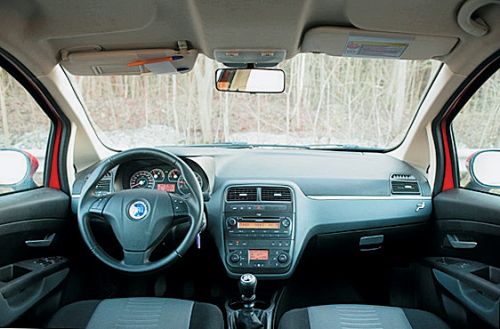
Fiat is one of the five test participants where ESP installation is available. However, even without the stability system, the car made a good impression. Very responsive steering and a moderately stiff suspension provide excellent handling. In this regard, the Fiat is definitely one of the leaders in its class. But the engine turned out to be insufficiently powerful. The interior is an acquired taste: a rather restrained and slightly angular style dominates here. The abundance of touch buttons on the center console only overloads perception. Visibility is ambiguous: the hood is almost invisible, but the side mirrors are very successful.
Expert - Kirill Kozyrev, 36 years old, test engineer, driving experience 14 years, drives an MB G300 T.
The sporty silhouette of the Fiat — a smooth line of the falling hood combined with elegant teardrop headlights — will not leave passersby indifferent. The compact external dimensions are deceptive: inside there is enough space for both front and rear passengers. The driving character fully matches the appearance. The steering wheel is so sensitive that it seems both front wheels are right in your palms, you feel every unevenness of the asphalt and the trajectory of movement. But the engine of the tested Fiat with a volume of 1.4 liters and a power of 77 hp turned out to be weak. Therefore, when choosing a Grande Punto, it is worth looking at the version with a 6-speed gearbox and a more powerful 95-horsepower 16-valve engine. The Grande Punto accelerates very slowly and tensely.
The steering wheel is so sharp that it feels like you are holding both front wheels in your hands.

Fiat Grande Punto
© Photo: Sergey Krestov, 5 Koleso
Advantages and disadvantages
+ Very sharp steering, good lateral support of seats, spacious glove box, possibility of installing ESP.
- Weak engine.
Specifications
Make and model - Fiat Grande Punto 1.4
Dimensions - 4030x1687x1490 mm,
Trunk volume - 275/1030 L
Engine - petrol, 1368 cm3, 77 hp/6000 rpm
Transmission - manual, 5-speed
Fuel consumption - 8.1 L per 100 km
Dynamics - max 165 km/h; 12.4 s to 100 km/h
Honda Jazz. 454,000 RUB.
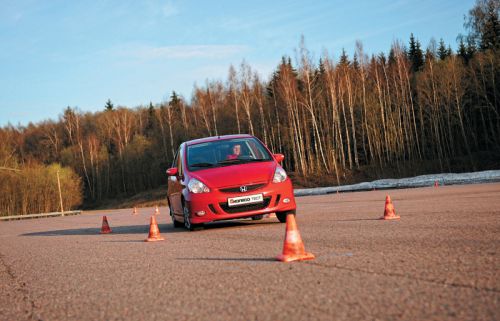
Honda Jazz
© Photo: Sergey Krestov, 5 Koleso
The appearance of the Jazz may seem a bit clumsy and angular to some. But it is hard to find fault with the Honda's interior. This is one of the most spacious cabins in its class! The perfectly readable instrument panel with three recessed cylindrical scales is complemented by elegant backlighting in an original brown-and-white color scheme.
The somewhat surreal design of the center console, as well as the non-standard joysticks for controlling the climate and audio system, look quite harmonious. The fairly large mirrors and transparent triangular "windows" in the front roof pillars noticeably improve visibility.
Expert - Vladimir Makkaveev, 30 years old, automotive journalist, driving experience 11 years, drives a Ford Focus. The engine is not the most powerful. But the suspension is almost ideal for a car of this class: it copes perfectly with bumps across almost the entire range of reasonable speeds, yet at the same time protects the Honda from nose dives during acceleration and braking. The stiffness on transverse joints combined with a sharp steering wheel gives very good handling: not "semi-racing" like the Fabia, Mazda, and Grande Punto, but quite sufficient for everyday use. Moreover, one gets the impression that the Jazz is capable of more if you install more suitable tires or increase the wheel diameter with a low profile, thereby reducing tire slip. Another plus for the Honda is low fuel consumption. Based on test results, the Jazz entered the top three most economical cars.
The Jazz is capable of more if you choose more suitable tires or increase the wheel size.<\/em>
Advantages and disadvantages<\/strong> <\/p>
 <\/a>
<\/a> Honda Jazz
© Photo: Sergey Krestov, 5 wheel<\/p> <\/div><\/div>
+ Comfortable suspension, sharp steering, modern interior design.
- Weak lateral support of seats, not the most powerful engine.
Technical specifications<\/strong>
Make and model - Honda Jazz 1.4i DSI
Dimensions - 3845x1675x1525 mm,
Trunk volume - 380\/1323 l
Engine - petrol, 1339 cm3, 83 hp\/5700 rpm
Transmission - manual, 5-speed
Fuel consumption - 7.4 l per 100 km
Dynamics - max 172 km\/h; 12.5 s to 100 km\/h
Hyundai Getz. 333,900 rub.<\/strong><\/p>
Hyundai Getz
© Photo: Sergey Krestov, 5 wheel<\/p> <\/div><\/div>The most affordable car in the test. A classic "women's" option, although many ladies may find the interior too cramped. But in terms of design, the interior is quite democratic and modern. There are successful solutions, such as a convenient mirror adjuster on the door panel and seat heating buttons located next to the handbrake lever. The central console as a whole also leaves a pleasant impression, which is spoiled only by the deliberately cheap air intake mode regulator at the bottom. Overall, credit should be given to the Getz - the interior trim does not look shabby and cheap. The instrument panel is without frills, but not overloaded and well readable. But the lack of lighting above the rearview mirror is a bit confusing: like in old Soviet cars, the bulb is in the center of the ceiling. The trunk volume is also pleasantly surprising: of course, not the largest in the class, but much larger than one could expect from a car of such dimensions. The mirrors are quite large, but the massive rear pillars greatly obstruct visibility. As for driving qualities, the 97-horsepower engine provides the little Getz with very decent acceleration dynamics. The suspension absorbs bumps well. But in handling, the car is still somewhat sluggish. The steering wheel is not very informative.
The 97-horsepower engine provides the Getz with decent acceleration dynamics. The suspension absorbs bumps well.
Advantages and disadvantages<\/strong>
+ Low price, good acceleration dynamics.
- Sluggish steering, overly narrow interior.

 <\/a>
<\/a>