
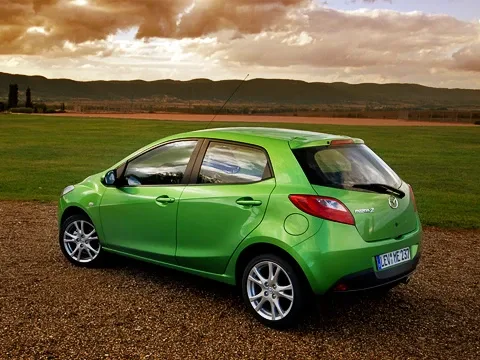
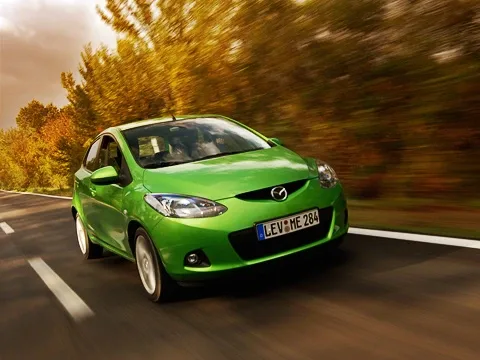
The Italians are lucky: any road between two villages is a true driver's delicacy, rivaling their famous pasta. For drivers, it's a celebration, and for everyone else, a serious test of the vestibular system. But even if passengers turn green, like my Mazda2, the car itself will feel excellent. Braking, heel-and-toe — and the "two" carves the corner again. And although on a straight it doesn't impress with supercar dynamics, in corners the light and nimble Mazda is simply magnificent. After all, it has become not only more powerful but also more compact.
In the supermini segment, there's now an obvious trend — turning any car into a bus. Just compare the old and new Renault Clio to understand everything. The same story with the Opel Corsa. So Mazda's engineers and marketers, who gave the green light to such a project, deserve credit — the new "two" swims against the current.
First, it doesn't look like a bus or a trolleybus, and that's already great. The car is 40 mm shorter and 55 mm lower than its predecessor. Second, for passive safety, it hasn't gained extra weight. On the contrary — it has lost 100 kilograms. And that's despite the Mazda2 having six airbags and all other attributes, even in the base version.
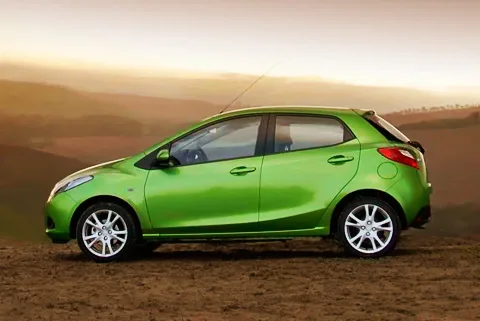
This result was achieved not only through reduced dimensions — that saved only four kilograms. The bulk of the "ballast" was thrown out of the body by using ultra-high-strength steels, which simultaneously increased rigidity and reduced weight. Plus, additional body reinforcements appeared, and the front strut brace is integrated into the structural framework. But when the engineers told me more about the "diet," I was thoroughly impressed. Even the door speakers with ferrite magnets instead of neodymium ones and lighter mounting saved 980 grams. Thinner hood hinges — another minus 690 grams. And so on in almost every detail. That's why the new Mazda2 turned out even lighter than the first-generation car. Aren't they maniacs?
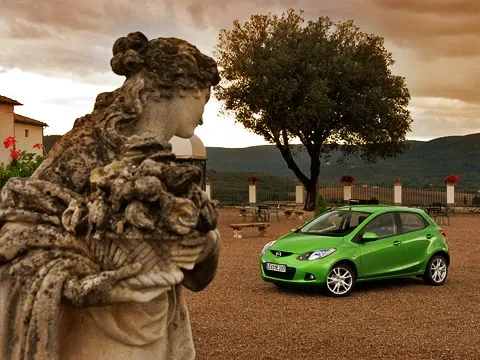
Girls really like the looks of the new Mazda2.
They immediately rejected aluminum or high-strength plastics, as in the MX-5 — otherwise they'd have to almost completely change the stamping equipment, and that's huge costs. After all, the Mazda2 is a mass-market car, and big hopes are placed on it.
The previous Mazda2 sold poorly in Europe — over four-plus years, only 150,000 units were sold. That's just one percent of a market where fifty players compete. Not much. But the new "two" should fix the situation — already next year they plan to sell 70,000 cars.
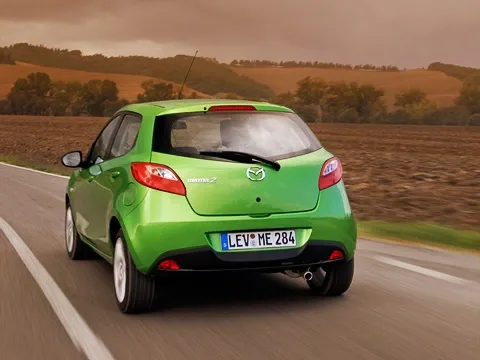
The main thing is that the car has completely changed its philosophy. This is stated by the project chief of the new Mazda2, Shigeo Mizuno: "The previous two generations tried to offer maximum space in the class and were big, tall, and, as a result, not too light. That meant worse dynamics and handling, high fuel consumption, and so on." No zoom-zoom, in short. "So when developing the new model, we took a different path — to make a compact and light car that, thanks to its low weight, would be even more agile and economical. And the main goal in tuning the chassis was driving pleasure."
And, I must say, on the roads of Tuscany, you begin to understand what these small and cheap cars with unexpectedly stiff suspension and lively handling are for. They are made for roads like these!
The 1.5-liter engine with 103 "horses" doesn't particularly inspire feats, but thanks to two short first gears, it accelerates the Mazda2 to "a hundred" with a bit extra. And that's all you need — the endless series of corners makes you press the brake as often as the gas.
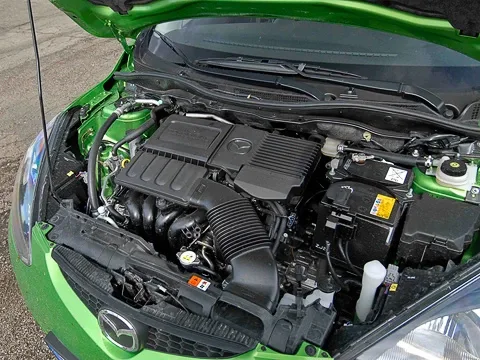
The 1.5-liter loves to be revved and is quite economical.
The somewhat stiff and short-throw clutch is typically Mazda. The pedals are positioned perfectly — heel-and-toe with simultaneous braking is very convenient. It's a pity the creators placed a tiny tachometer somewhere on the edge of the instrument cluster — you don't need a microscope to read the revs, but you'll have to squint. And the Japanese didn't splurge on lateral seat support either — and as we know, it's never superfluous on serpentines.
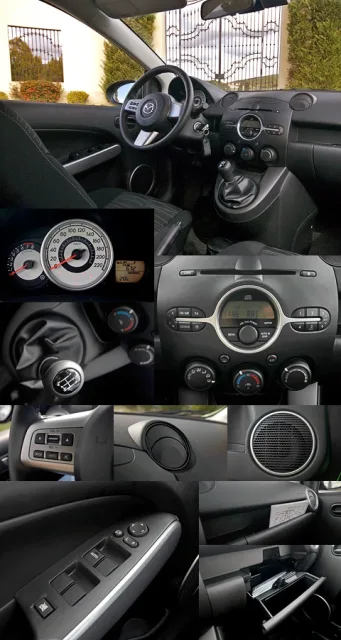
Overall, the interior looks decent, but such striking exterior deserves something more expressive. Although the steering wheel adjusts only for height, sitting is quite comfortable. But the instruments let down — they can't be called attractive, and only the speedometer is well readable. The glovebox is a find by Mazda's interior designers — it's two-layered, and you can put a road map or a stack of papers into it without opening it.
The steering wheel also slightly spoiled the fun. I desperately wanted more reactive force! And although what was there is actually a good option, such a sporty chassis deserves even better. As compensation, the "two" doesn't get knocked off course on bumps (Italians, as we know, aren't the most hardworking nation, and their road services are no exception). And on the highway, the car behaves quite confidently. Although instead of that, I'd prefer a more responsive steering wheel. After all, we love small driver's cars not for long marches, right?
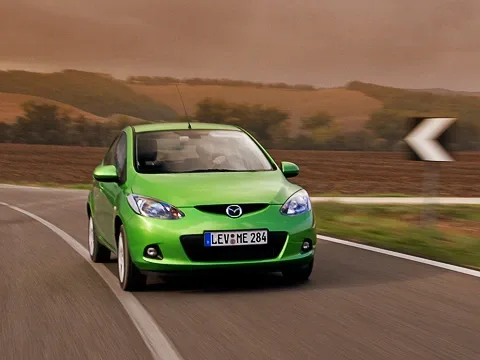
The body of the new Mazda2 is not only lighter — the moment of inertia has also decreased. So there are no problems with agility, especially on optional 16-inch wheels with low-profile tires. And even though there's a semi-independent torsion beam at the rear, it's tuned to "excellent." From corner to corner, I rejoiced at the quick responses, small body rolls, and surprising grip of this little car. And let the Mazda2 be a bit stiff, but it handles as it should. The Japanese made a good chassis! By the way, it's indeed the Japanese. As Mitsuru Wakiie told me, the Mazda2 platform, which will underpin the new Ford model (the Fiesta replacement), was developed in Hiroshima. Although the final polishing of its manners was done in Germany.
But in Russia, everything will be different. For example, we won't get the 1.3-liter engines. But that's not the main thing. The main thing is that this little thing will be positioned differently here.
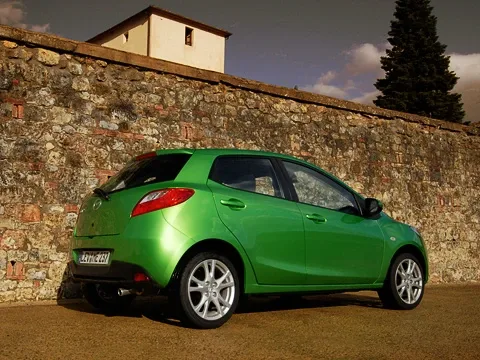
In short, the Mazda2 with its excellent chassis is doomed to the role of a decorative city car for girls. And the fact that the first cars will be delivered to us in April 2008, although Europeans will get them very soon, is no accident. The thing is, they'll start assembling the Mazda2 with a four-speed "automatic" in Japan only in January. By the time they ship it, by the time they certify it — it'll already be April. Got the hint?
The Russian representative office is betting primarily on the female audience. However, I'm sure girls will like the car. Its author, Ikua Maeda, the creator of the rotary RX-8, can count on an award again. The new Mazda2 is one of the main contenders for the title "Miss B-segment." You can pick a car to match, say, your handbag — the "two" is painted in nine different colors. Or you can just take the green one without thinking — it's beautiful, that's all! Besides, the Mazda3 has become so boring — half of your girlfriends drive them.
At the presentation, the Mazda folks showed many tables, graphs, and other charts. One interesting table caught my genuine attention. It showed how many same-class cars with "automatics" are sold here. That's how you can determine the "girly" essence of a particular model. So, it turns out that most B-class cars, even our compatriots fond of "automatics," buy with "manual." There are "unisex" cars — with manual gearboxes, they sell almost as many as with "automatics" — for example, Opel Corsa, Ford Fiesta, Mitsubishi Colt, and Peugeot 207. But there are also purely female cars — like the Toyota Yaris and Nissan Micra. In their case, almost 90% of customers choose "automatics" and other "robots." Apparently, that's exactly what Mazda's management is aiming for. That's why they'll launch the "Mazda-two" here only when it gets an "automatic."
Okay, but why did they choose the old good four-speed "automatic" with a torque converter? After all, on the Japanese market, the Mazda2 (known there as Demio) is available with a CVT. Moreover, for the 1.3-liter engine, the Demio can be ordered with either a CVT or an automatic transmission, and the price difference is just a couple of hundred dollars. So the CVT isn't that expensive to produce. "Then why don't we see it here?" I asked Mitsuru Wakiie over breakfast. "The problem is a shortage," he replied, sipping coffee. "We don't produce CVTs ourselves; we buy them from Aisin. They simply can't produce enough in time. But the 'automatic' is our own development..."
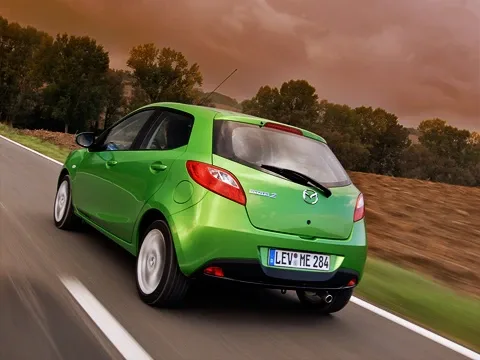
However, for such a compact car, this gearbox is quite sufficient. Those who become happy owners of a Mazda2 are unlikely to pay attention to the fact that there could be more gears, a tiny tachometer, or a somewhat empty steering wheel. What matters much more to them is practicality and convenience — and everything is in perfect order here. And although the Japanese did not increase the dimensions, it is not cramped inside — even for me, at my height of 190 cm, although the steering column adjusts only by height. In the back, it is also quite comfortable. Legroom is about the same as in the Mazda3, but the ceiling presses down. The trunk is not a record holder, but it is normal for this class: 250 liters in the normal state and 787 with the rear seats folded.
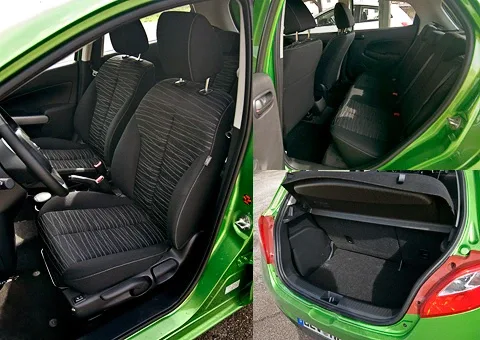
Those who like to drive fast on winding mountain roads will probably want more pronounced lateral support from the front seats, although the standard seats are not bad. Passengers of average height will have plenty of room in the back, but tall ones will have to think about why they grew up so big.
But the biggest surprise awaited me in a completely different place. Over the long years of testing various Mazdas, we have become accustomed to repeating the same phrase over and over again: "sound insulation could be better." This is perhaps the weak point of Japanese cars. However, this time the engineers did a great job, and I will not have to repeat old sayings — in terms of acoustic comfort, the "two" made a very pleasant impression on me. Pleasantly surprised.
I would like to hope that another bad Mazda tradition — months-long queues — will not repeat. But something tells me they cannot be avoided. The base version with a 1.5-liter engine in Touring trim and with a manual gearbox will cost $16,300. In fact, it already has everything necessary — heated seats, air conditioning, a CD player with MP3 support, and power-folding mirrors. But girls should probably splurge on the Sport version — because it offers not only climate control, fog lights, and alloy wheels, but also such an important stability control system. We are for safe sport! And, of course, do not forget about the "automatic" — that is minus $1,200 from the budget.
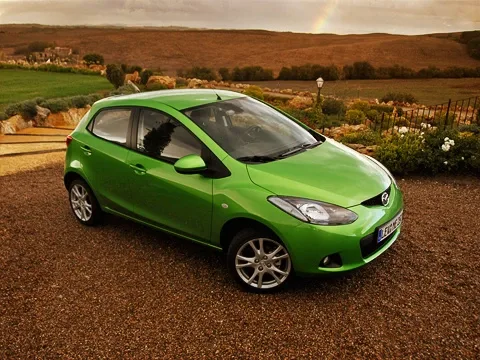
There will certainly be many willing. But Mazda took pity on competitors and is not going to conquer the Russian market. The annual sales plan — you will not believe it — is only two thousand cars. That is why we will not see simple versions with weak engines or three-door bodies. For European dealers, the success of the Mazda2 is extremely important, but in Russia this car is just an addition to the model range. Well, for girls, who will make up 90% of buyers, this is generally great news. The fewer "twos" on the streets, the more their owners stand out. And guys will not be left out either — no one forbids ordering a car with a manual gearbox.
Technical specifications
* — including side mirrors; ** — with the second row of seats folded; *** — option
| Specifications | 1.5 MT | 1.5 AT |
|---|---|---|
| Body | ||
| Number of doors/seats | 5/5 | |
| Length, mm | 3885 | |
| Width, mm | 1695 (1958 *) | |
| Height, mm | 1475 | |
| Curb weight, kg | 960 | n/a |
| Gross weight, kg | 1485 | |
| Trunk volume, l | 250 (787 **) | |
| Engine | ||
| Type | Petrol, with distributed injection | |
| Location | Front, transverse | |
| Number and arrangement of cylinders | 4, in-line | |
| Number of valves | 16 | |
| Displacement, cm3 | 1498 | |
| Max. power, hp/rpm-1 | 103/6000 | |
| Max. torque, Nm/rpm-1 | 137/4000 | |
| Transmission | ||
| Gearbox | Manual, five-speed | Automatic, four-speed |
| Drive | Front | |
| Chassis | ||
| Front suspension | Independent, McPherson | |
| Rear suspension | Semi-independent | |
| Front brakes | Disc, ventilated | |
| Rear brakes | Drum | |
| Tires | 185/55 R15 (195/45 R16 ***) | |
| Ground clearance, mm | 155 | |
| Performance characteristics | ||
| Maximum speed, km/h | 188 | 168 |
| Acceleration time from 0 to 100 km/h, s | 10.4 | 12.1 |
| Fuel consumption, l/100 km | ||
| urban cycle | 7.6 | 9.1 |
| extra-urban cycle | 4.9 | 5.5 |
| combined cycle | 5.9 | 6.8 |
| Emission standard | Euro-4 | |
| Fuel tank capacity, l | 42.8 | |
| Fuel | AI-95 | |
Mazda2 trims
| Trim | Touring | Sport |
|---|---|---|
| Heated front seats | + | + |
| Front electric windows | + | + |
| Power-folding mirrors | + | + |
| CD player with MP3 | + | + |
| Steering wheel audio controls | + | + |
| ABS | + | + |
| EBD | + | + |
| 6 airbags | + | + |
| Climate control | - | + |
| Rear electric windows | - | + |
| Leather steering wheel | - | + |
| Fog lights | - | + |
| 16-inch alloy wheels | - | + |
| Stability control | - | + |
| On-board computer | - | + |
| Price, in US dollars | 16300 | n/a |
Technology 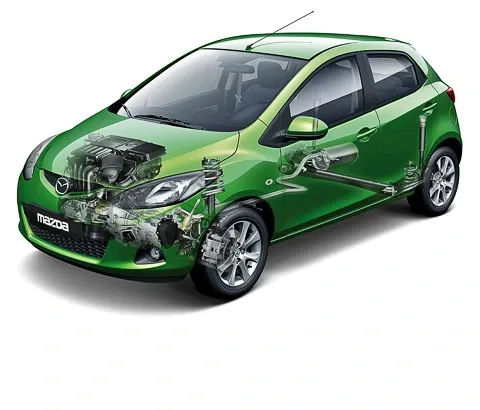
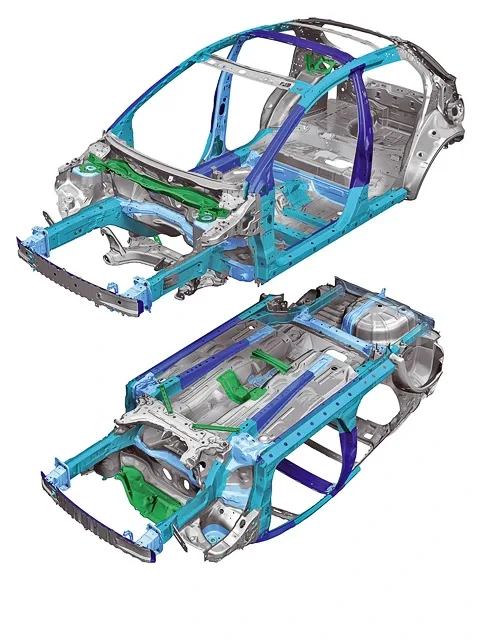
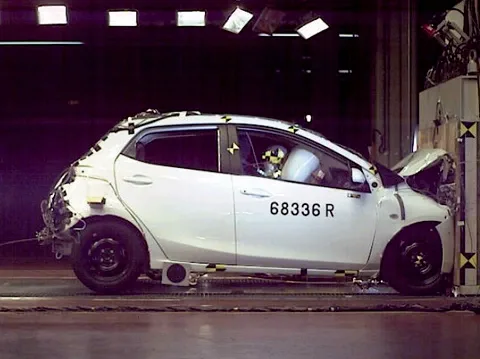
Already in the base version, the Mazda2 has six airbags, a telescopic steering column, and "collapsible" pedals. The car passed internal crash tests successfully, and the creators count on decent results in EuroNCAP tests. The previous generation received four stars in 2004, and the new one should have at least as many.
Design 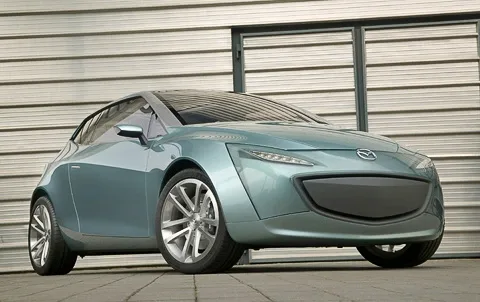
The Sassou concept car, presented in 2005 at the Frankfurt Motor Show, is the forerunner of the production "two." It was created at the European design center under the leadership of Peter Birtwhistle.
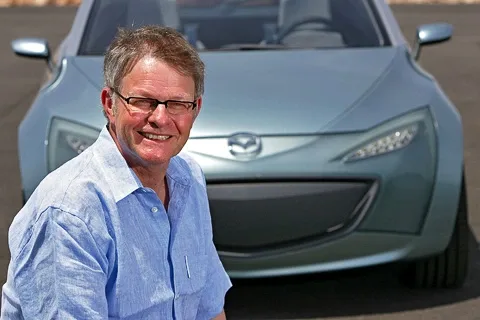
Peter Birtwhistle: "We conceived the Sassou as a city car for young people — with a compact, light, swift body and a stylish functional interior. Of course, not everything made it to the assembly line, but the key design elements — muscular front fenders and a rising beltline — remained on the production car."
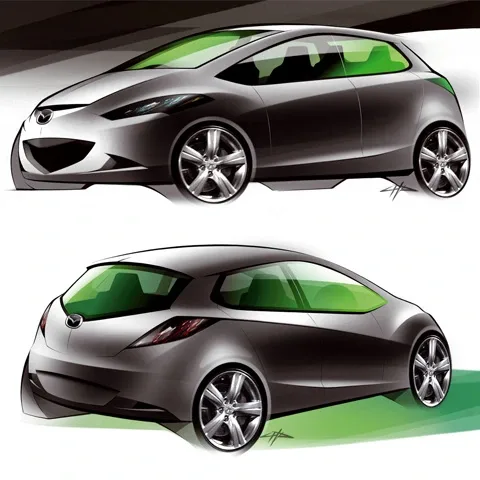
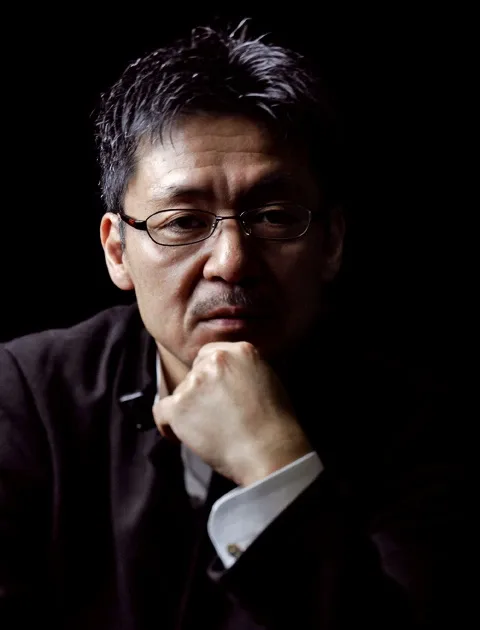
Meet Ikuo Maeda, the chief designer of the Mazda2. It was he who once worked on the design of the Mazda RX-8 coupe. I must say, his style is felt in the new model too. "In 2005, when we approved the design project of the new Mazda2, we had two options, and we could not choose between them," says Maeda. "I was in Milan when our chief called me and said: 'the choice is yours!' And I spent a whole week walking around Italy, trying to imagine both options on its streets, before I could make a final decision."
Development

Shigeo Mizuno has been working at the company since 1985, and has devoted more than two decades to creating engines. In 2002, it was he who led the Mazda2 project. According to him, the previous two generations of the model had almost the best engines in the class, but their concept differed from the current one. When the team was defining the main goals, design, refined handling and fuel efficiency were prioritized. For this, the body was decided to be made more compact. Moreover, as Mizuno notes, the designers deliberately used visual tricks to make the car seem even smaller than it is. In reality, the difference with the previous, more utilitarian Mazda2 is quite small.
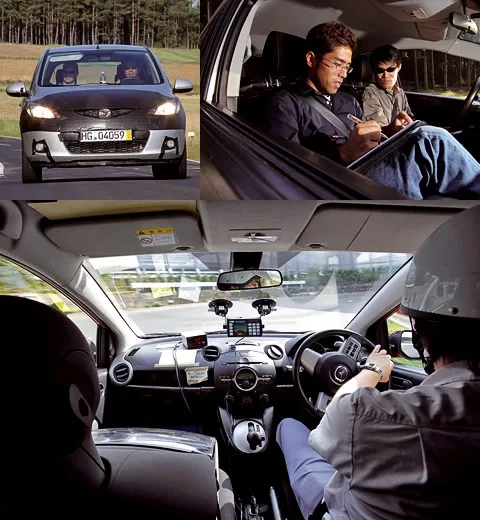
The creation and testing of the car took place in Japan, at the Hiroshima proving ground. The engineers placed special emphasis not only on driving behavior, but also on acoustic comfort — dozens of sensors were placed throughout the cabin to record noise levels. The fine-tuning of the European version was completed on German soil.
History
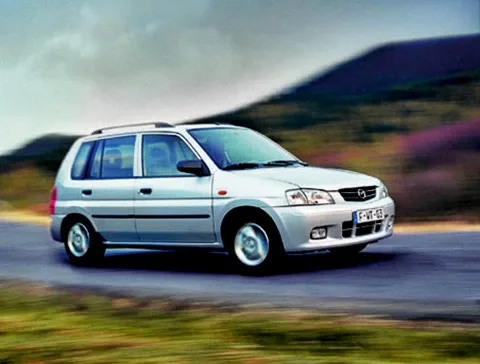
The first-generation Mazda Demio debuted in 1996. The car was offered with 1.3 and 1.5 liter engines, paired with a manual or automatic transmission. Interesting fact: in the Japanese market, this model was also sold under the Ford brand as the Festiva Mini Wagon.
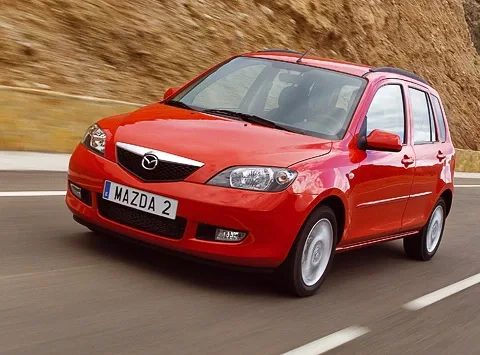
In 2002, the second generation was released, which in Europe was already called the Mazda2. In Japan, the model was a success — it entered the top seven most sought-after cars. In Europe, however, only slightly more than 150 thousand units were sold over the entire period.
Behind the scenes
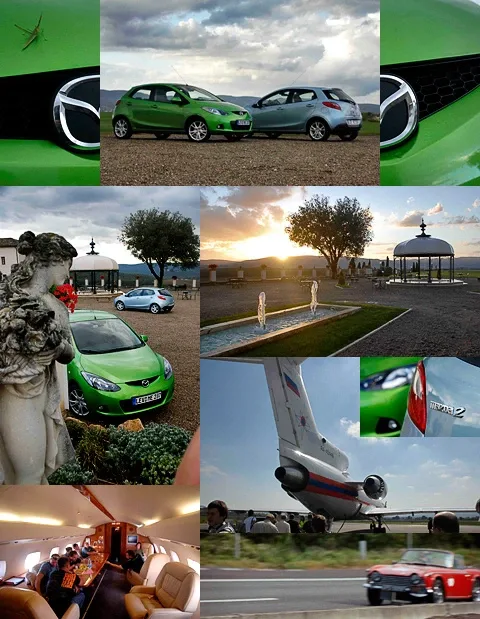
Italy is sunshine, picturesque views and, of course, the hot temper of the locals. But here's what's surprising: for all their emotionality, Italians are convinced that a real car should be black, gray or silver. At a stretch — dark blue. Even Alfa Romeos are mostly in some gray shades. Therefore, the green "two" that I got looked especially flashy against the background of local cars.
True, getting it turned out to be not so easy. At the hotel where the press was accommodated, a couple of dozen Mazda2s were displayed, and there were plenty of green ones among them. But my nimble colleagues immediately grabbed the cars of the most winning color, in my opinion. By hook or by crook, I still managed to get a green one — first with a 1.5-liter engine, and then with a 1.3-liter one.
True, getting it turned out to be not so easy. At the hotel where the press was accommodated, a couple of dozen Mazda2s were displayed, and there were plenty of green ones among them. But my nimble colleagues immediately grabbed the cars of the most winning color, in my opinion. By hook or by crook, I still managed to get a green one — first with a 1.5-liter engine, and then with a 1.3-liter one.