
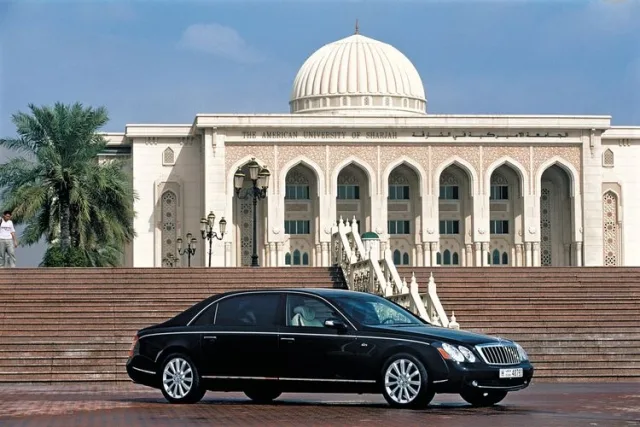
The roof window here is also equipped with an electrochromic glass insert. The disadvantage is that it is not completely transparent, which makes the tops of palm trees and skyscrapers look as if in a haze. But there is also a plus: with a button, you can switch the glass to matte mode. And then both day and night (thanks to the built-in lighting), the same milky-white light pours from the ceiling. A very original solution! True, the grid of black lacquered partitions superimposed on the ceiling window is slightly confusing. What does it remind me of... A sky in a grid? A warning for the rich? Like, live for your pleasure, but don't forget: you shouldn't swear off prison or poverty!
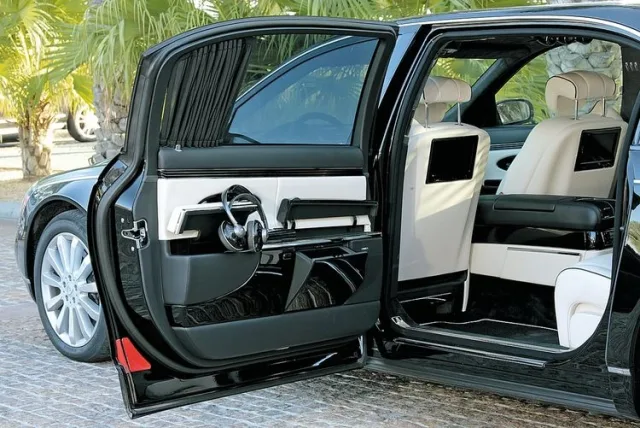
The huge door, which houses three boxes with lids, can be closed by a servo — with a button on the ceiling. But the curtain on the window does not open completely...
Meanwhile, the fantastic views of Dubai's construction sites gave way to an endless desert crossed by a gray strip of asphalt. The roads in the UAE are almost like in America: straight, wide, and rather monotonous. The speed limit is 120 km/h, and cameras on low posts are often encountered. Fines, they say, are very severe. But...
— Here you can drive without fear. — Saeed's eyes sparkle with excitement. — There are no cameras or police on this road: verified!
Behind the wheel of the Maybach, you feel like in the previous generation S-class, pumped to the extreme. Chrome, leather... The gas and brake pedals are a bit stiff, but their travel is perfectly calibrated. You start quickly and smoothly, and the good old five-speed automatic shifts the long gears imperceptibly and infrequently — no wonder, with such a torque shelf of 1000 Nm.
But the Maybach "floats" on the road! And the steering wheel has to be constantly corrected — a little, but regularly. And this is not surprising: the basis of the Maybach's "mechanics" was laid back in the 90s, and the archaic "screw — ball nut" steering system passed to this monster from the "one hundred and fortieth" S-class. And even with the refined air suspension of the Spezial version, comfort remains the main thing in this car. Therefore, with a sharp turn of the steering wheel, the Maybach noticeably rolls and goes into an arc with a noticeable oversteer. At least the steering wheel doesn't "bite" during energetic rotation, as with the first Maybachs (see AR No. 22, 2002).
In short, driving the Maybach 62 S is not a pleasure, but rather a job. But if you accelerate...
Under full throttle, the Maybach 62 S gains speed like a jet airliner on takeoff — powerfully, quickly, and absolutely imperceptibly. You are slightly pressed into the leather seat back: as a passenger, you won't even spill champagne. It would be possible, by the way, to arrange such a test with Saeed and the driver sitting in the back, but Saeed doesn't drink alcohol: for Muslims in the Emirates, drunkenness gets three months in prison. So in the refrigerator between the rear seats, instead of champagne, there are just bottles of water.
What's on the odometer? Wow... You can't feel the speed at all. After 200 km/h, the Maybach stops wandering — and seems to freeze in the middle of the desert. All you can hear is the air outside hissing furiously, tearing and collapsing behind the long, streamlined body. But the acoustic protest of the air is quite well muffled by the almost centimeter-thick window glass. And while Said is chatting with the German in the back, I meditate on the asphalt ribbon, my relaxed hands resting on the heavy steering wheel. We're flying through the sands. The speedometer shows 260, but it feels like 60 km/h.
You asked what Gran Turismo is?
It's not a Ferrari. It's not a Lamborghini. It's not even a Mercedes. It's a Maybach 62. A car big and fast enough, with a spacious trunk for "grand touring." It has everything for a journey, like a business jet. Speed to keep up. Silence and smoothness to not notice distances. Finally, there's "music" and a DVD player (Bose brand, with rather mediocre sound) to keep you entertained. And most importantly — a full-fledged reclining lounge chair!
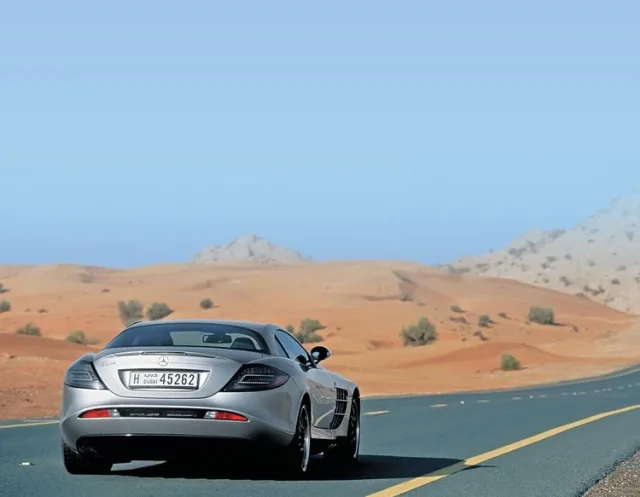
One thing is unclear: why do we, the emirs, need the "short" Maybach 57? Yes, we're used to riding in the front, next to the driver. But habits are a matter of time; soon we'll move to the back! And for driving yourself, there are completely different cars — no less expensive and far more "driver-oriented." For example, the Mercedes-Benz SLR McLaren 722 Edition.
The numbers 722 — that's 7 hours 22 minutes, the start time and also the race number of the legendary crew of Moss and Jenkinson in the Mercedes SLR race car at the victorious Mille Miglia rally in 1955. We've talked about all this more than once — and we even know how the "regular" modern SLR drives.
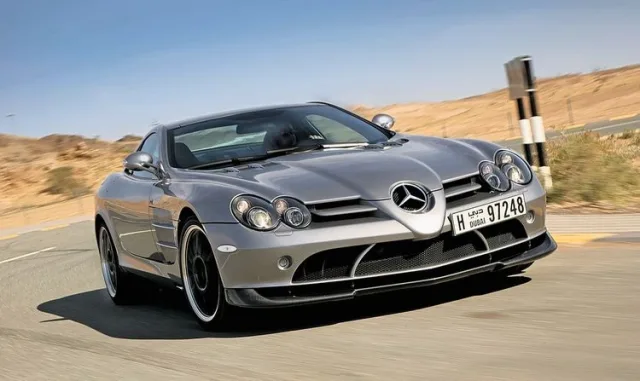
This car is quite strange. On one hand — stunning looks, carbon fiber monocoque, racing double-wishbone suspension, a highly tuned 626-horsepower supercharged V8, composite brakes, and a top speed of 330 km/h. On the other — a regular "open" differential without self-locking and a five-speed automatic. The Mercedes folks themselves feel that the SLR doesn't thunder in the world of supercars. It doesn't have the aura of its predecessor, the McLaren F1. That's probably why the SLR 722 Edition appeared — a kind of "hot" SLR.
The recipe is simple: tuning! Weight reduction of 44 kg thanks to sound insulation removal and different forged wheels, "single-tube" Koni shocks instead of Bilstein dampers. A "rechipped" engine that, without increasing boost pressure (0.9 atm), develops 24 hp more. Larger Brembo brake discs with a modernized electro-hydraulic drive. For all this, including the beautiful 722 badges, red seat belts, and "racing" rough suede interior trim — about 5% of the car's price. And that price is, no more no less, 580 thousand euros. And don't grab your head: the entire limited series of 150 722 Edition supercars has already been sold out!
And I, lucky guy, without the usual million in my pocket, casually approach the dark graphite supercar, sink into the leather-covered carbon fiber "bucket" seat, and, even if on the second try, manage to slam shut the tight "guillotine" door.
In the Maybach, I glided silently and smoothly. But the SLR 722 shakes me on every seam of Dubai's asphalt. And the deep roar of the eight-cylinder "supercharger" almost deafens me — because instead of sound-absorbing mats underfoot, the bare carbon fiber of the monocoque gleams. And where did that uncertainty in the "near-zero" steering zone go, which surprised us in the "regular" SLR three years ago (see AR No. 24, 2003)? Where's the whine of the differential? Where did the braking problems at low speeds disappear?
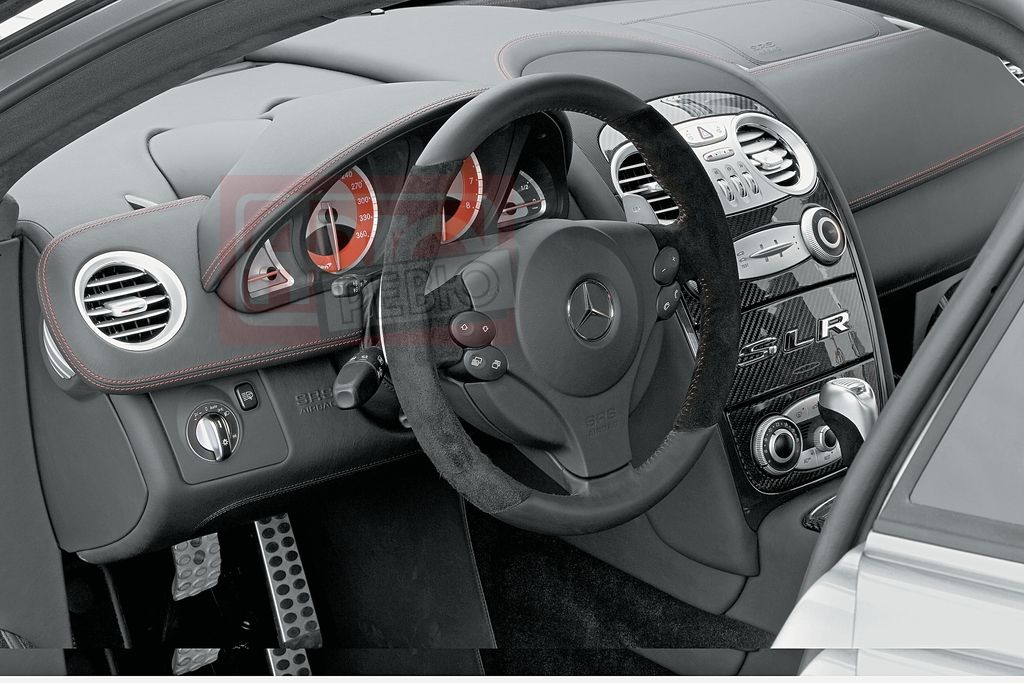 | 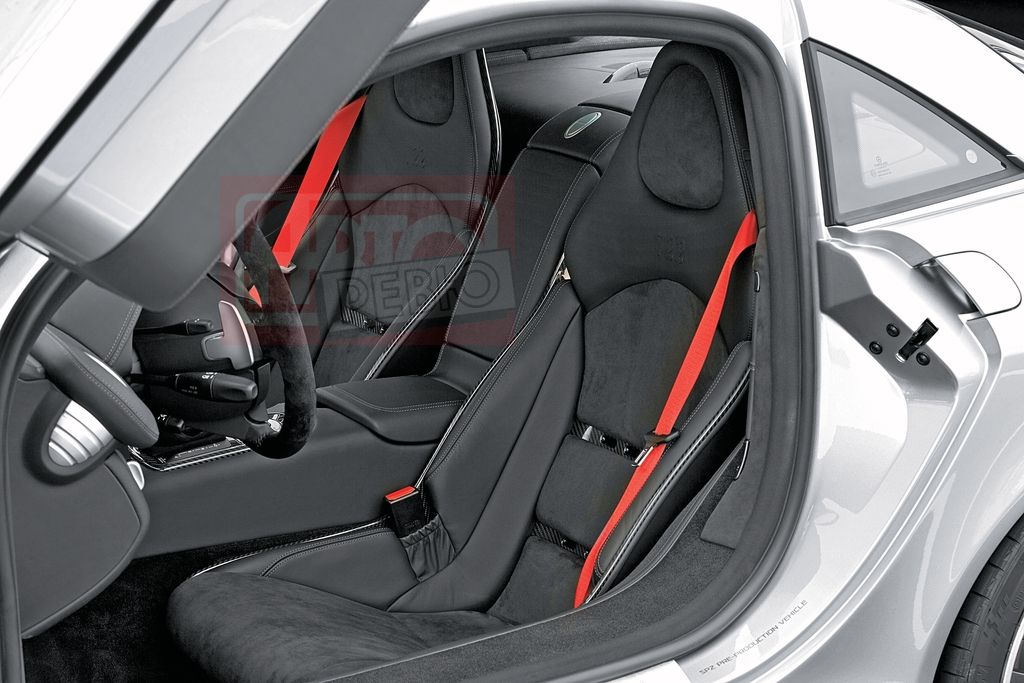 |
| The steering wheel of the SLR 722 Edition is wrapped in rough suede — "grippy" and good at absorbing treacherous sweat | The seats are based on carbon fiber racing "buckets," but with electric adjustments! |
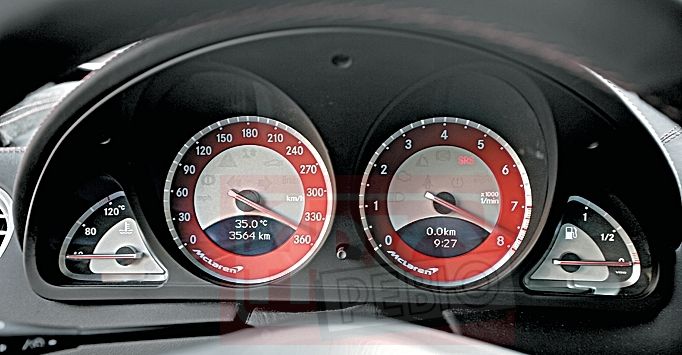 | 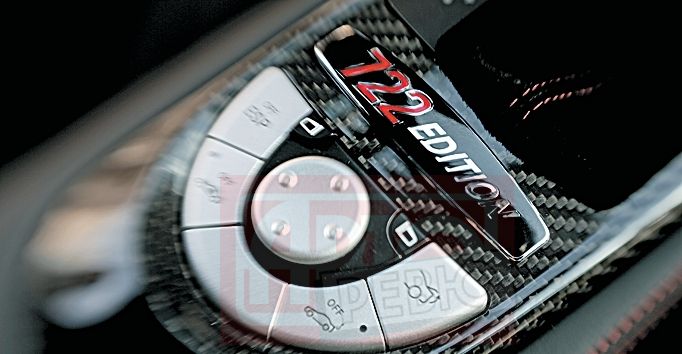 |
| To "lay down" the needles, the 650-horsepower monster needs about half a minute | Badges of the special series 722: tuning... |
And at high speeds?
Now Said isn't with me: there's no one to suggest a "safe" path. And the cameras — there they are, every couple of kilometers. I'm shaking in the cramped and noisy cockpit, wondering: why does the UAE need such a car if driving fast is prohibited?
The road leads to the neighboring Sultanate of Oman. The skyscraper frenzy of Dubai is left behind, but even here, in the hinterland, small villages with familiar one-story mud-brick houses alternate with something unusual — for example, fenced-off dunes where locals and tourists enthusiastically crawl in SUVs and race buggies and quad bikes. Oh, life is good in the UAE! And with their average annual income of 28 thousand dollars...
When we hit a section of bad road under repair, the SLR 722 gives a brutal shaking. Good thing none of the 150 cars produced have been ordered for Russia! By the way, the suspension of the "seven twenty-second" version with stiffer springs and Koni shocks was tuned by my old acquaintance, Chris de Bruyn, now the leading test engineer at Koni. He's the one who likes to "tighten" the shock absorber resistance on rebound so much that the car literally sticks to the road. But on poor surfaces or during emergency braking, this turns into a problem: during each suspension stroke, the "one-way" increased shock absorber resistance prevents the body from fully rising after the compression stroke, and the car "squats" lower and lower. Look how intensely the SLR 722 dives its nose during deceleration: the front suspension simply can't "straighten out" under load!
The Koni shocks on this car aren't ordinary ones, but from the new FSD line, with automatic valves that react to vibration frequency. The idea is that they should provide both precise handling and decent ride comfort. But, as with the VAZ "twelfth" we tested in 2006, comfort is out of the question here: the stiff rebound stroke turns the Mercedes SLR 722 into a real recorder, registering every bump.
But compared to the base Mercedes SLR, all rocking has disappeared, the steering has become heavier and more informative, and reactions are noticeably sharper. On a winding road in the low Omani mountains, the limit in corners is only my own fear. How tenaciously the SLR 722 holds the asphalt! And how fitting that the steering wheel of the "seven twenty-second" is wrapped in that rough racing suede — it perfectly absorbs sweat from the palms.
The SLR 722 goes into a slide more gently than the "regular" SLR three years ago. Back then, with stability control off, it was truly terrifying. Now it's quite tolerable.
However, turning off the stability system on this car is simply pointless. Without it, not only can you not achieve the claimed 3.6 seconds to 100 km/h — even just getting moving is extremely difficult. The rear wheels spin on the asphalt as if there's ice under them! Huge traction plus an "open" differential without locking — not a pleasant combination.
So a fast start without electronics is practically impossible. But with ESP on, everything is simple: hold the car with the brakes, add a little gas, release the left pedal — and a moment later, when the SLR squats and the huge rear wheels, almost thirty centimeters wide, find grip on the asphalt, smoothly press the accelerator. And — off we go...
The roar of the supercharged "eight" at full throttle becomes piercingly resonant. At first, the acceleration doesn't seem stunning, but... When the five-speed automatic shifts into fifth gear with a lightning-fast jolt, I look at the speedometer. And it's already 300 km/h.
And the acceleration doesn't stop! The needle keeps stubbornly creeping: 310, 320... The car gives 100% confidence — at speeds over three hundred, the SLR 722, despite the fine and frequent shaking, as if in air pockets, stands on the straight as if glued. I feel I can calmly change to the left lane, overtake a car going my way, return, and continue accelerating. After all, the claimed top speed of the 722 Edition version has increased by 3 km/h — from 334 to 337 km/h.
But better not to tempt fate. Let the road around be deserted and empty, but this is still not a test track.
Brake.
Behind, the spoiler instantly "opens" — it stands almost vertically, helping to dissipate the furious kinetic energy. Remember Einstein's formula — E=mc²? Okay, let's stick with Newtonian mechanics: E=mV²/2. Given: mass — 1724 kg, speed — 320 km/h... But the huge ceramic brakes don't care — they slow the SLR equally confidently from three hundred and from thirty kilometers per hour. And the world behind the glass regains its usual relationship of space and time.
Superb! The Mercedes SLR 722 Edition is an example of excellent factory tuning. But why so expensive? Is it really just for reprogramming control units, changing springs and shocks, that you need to pay an extra 30 thousand euros?
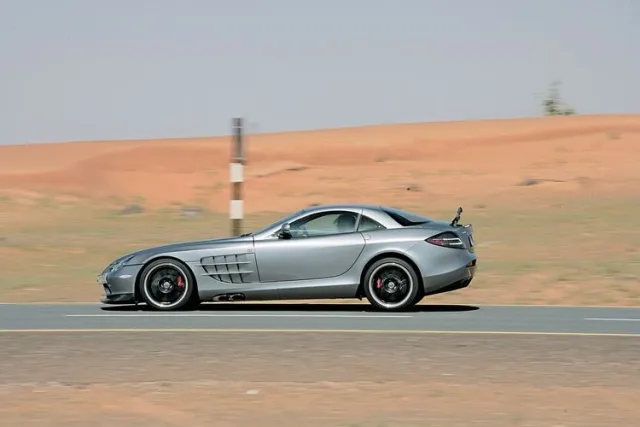
The SLR 722 Edition brakes "to the floor" from about 200 km/h: the spoiler is raised to a maximum angle of 65°, the stiff "on rebound" suspension presses the front end to the asphalt. Deceleration — over 1.3 g!
Actually, this money includes 100 hours of aerodynamic wind tunnel testing, thanks to which the 722 version got a carbon fiber 'splitter' lip under the front bumper. And most importantly — if you compare this with the 80,000 euro surcharge for the Spezial version of the Maybach 62, it doesn't seem so expensive after all...
Not expensive? With Russian prices of 580,000 euros for the Mercedes SLR and 665,000 euros for the Maybach 62 S?
Has the world gone mad?
No, everything is fine, the skyscrapers of Dubai, rising from the sands, silently confirm. It's just that there is a lot of money in the world now. It needs to be spent on something. Some, like in the Emirates, invest it in construction — billions from oil and liquefied gas sales go into fantastic skyscraper projects, giant hotels, indoor ski slopes, or artificial islands with multi-million-dollar villas. Soon, Dubai will even have a high-speed metro with automatic cars accelerating to 110 km/h. Moscow looks poor, gray, and very provincial after all this.
And others buy automotive luxury.
By the way, a 'Formula' track will soon appear in the UAE — in the emirate of Abu Dhabi. And the Mercedes SLR 722 Edition was created precisely to participate in track days from time to time.
There are no tracks in Moscow — and, apparently, there won't be any in the near future. But that didn't stop the sale of seven SLR supercars in 'standard' specification over three years. And Maybachs — many more: 45 cars, about two-thirds of which are in the long-wheelbase version 62.
Should we be happy about this or outraged? Should we sympathize with Mercedes people that global demand for Maybach is lower than expected — instead of the planned thousand cars a year, 'only' 300-400 Maybachs are sold — or should we gloat? How will this extravaganza of luxury end? With a global crisis, bursting bubbles — or, on the contrary, with a rise in living standards worldwide to the Emirates level? What is the norm — wealth or poverty?
Allah knows...
| Specifications | ||
| Parameters | Vehicle | |
| Maybach 62 | Maybach 62 S | |
| Length, mm | 6165 | 6165 |
| Width, mm | 1980 | 1980 |
| Height, mm | 1573 | 1573 |
| Wheelbase, mm | 3827 | 3827 |
| Track front/rear, mm | 1675/1695 | 1675/1695 |
| Body type | 4-door sedan | 4-door sedan |
| Trunk volume, l | 605 | 605 |
| Curb weight, kg | 2780 | 2780 |
| Gross weight, kg | 3380 | 3380 |
| Engine | gasoline, with distributed fuel injection | |
| Number and arrangement of cylinders | 12, V-shaped | 12, V-shaped |
| Displacement, cm³ | 5513 | 5513 |
| Compression ratio | 9.0:1 | 9.0:1 |
| Number of valves | 36 | 36 |
| Max power, hp/kW/rpm | 550/105/5250 | 612/450/4800 |
| Max torque, Nm/rpm | 900/2300—3000 | 1000/2000 |
| Transmission | automatic, 5-speed | |
| Gear ratios | ||
| I | 3.59 | 3.59 |
| II | 2.19 | 2.19 |
| III | 1.41 | 1.41 |
| IV | 1.00 | 1.00 |
| V | 0.83 | 0.83 |
| reverse | 3.16 | 3.16 |
| final drive | 2.82 | 2.82 |
| Drive | rear-wheel drive | |
| Front suspension | independent, air, double wishbone, with stabilizer | |
| Rear suspension | independent, air, multi-link, with stabilizer | |
| Brake system | electro-hydraulic | |
| Front brakes | disc, ventilated | |
| Rear brakes | disc, ventilated | |
| Tires | 275/50 R19 | 275/45 R20 |
| Maximum speed, km/h | 250* | 250* |
| Acceleration time 0—100 km/h, s | 5.4 | 5.2 |
| Fuel consumption (combined cycle), l/100 km | 15.9 | 16.4 |
| Fuel tank capacity, l | 110 | 110 |
| * Electronically limited | ||
| Specifications | ||
| Parameters | Vehicles | |
| Mercedes SLR McLaren | Mercedes SLR McLaren 722 Edition | |
| Length, mm | 4656 | 4656 |
| Width, mm | 1908 | 1908 |
| Height, mm | 1261 | 1251 |
| Wheelbase, mm | 2700 | 2700 |
| Track front/rear, mm | 1638/1569 | 1638/1569 |
| Engine | gasoline, supercharged with two intercoolers | |
| Location | front, longitudinal, within the wheelbase | |
| Number and arrangement of cylinders | V8 | V8 |
| Displacement, cm³ | 5439 | 5439 |
| Cylinder bore/piston stroke, mm | 97.0/92.0 | 97.0/92.0 |
| Compression ratio | 8.8:1 | 8.8:1 |
| Number of valves | 24 | 24 |
| Max power, hp/kW/rpm | 626/460/6500 | 650/478/6500 |
| Max torque, Nm/rpm | 780/3250—5000 | 820/4000 |
| Drive | rear-wheel drive | |
| Transmission | automatic, 5-speed | |
| Gear ratios | ||
| I | 3.56 | 3.56 |
| II | 2.19 | 2.19 |
| III | 1.41 | 1.41 |
| IV | 1.00 | 1.00 |
| V | 0.83 | 0.83 |
| reverse | 3.17/1.93 | 3.17/1.93 |
| final drive | 3.06 | 3.06 |
| Front suspension | independent double wishbone, coil spring, with stabilizer | |
| Rear suspension | independent double wishbone, coil spring | |
| Brakes | electro-hydraulic, with ABS | |
| Steering | rack and pinion, power assisted | |
| Steering ratio/turns lock to lock | 12.6/2.2 | 12.6/2.2 |
| Tires (wheels) | ||
| front | 245/40 ZR18 (9Jx18) | 255/35 ZR19 (9Jx19) |
| rear | 295/35 ZR18 (11.5Jx18) | 295/30 ZR19 (11.5Jx19) |
| Minimum turning circle, m | 12.2 | 12.2 |
| Curb/gross weight, kg | 1693/1933 | 1649/1940 |
| Trunk volume, l | 272 | 272 |
| Maximum speed, km/h | 334 | 337 |
| Acceleration time, s | ||
| 0—100 km/h | 3.8 | 3.6 |
| 0—200 km/h | 10.6 | 10.2 |
| 0—300 km/h | 28.8 | 28.0 |
| Fuel consumption (combined cycle), l/100 km | 14.5 | —* |
| Fuel tank capacity (reserve), l | 97.6 (12) | 97.6 (12) |
| * No data | ||