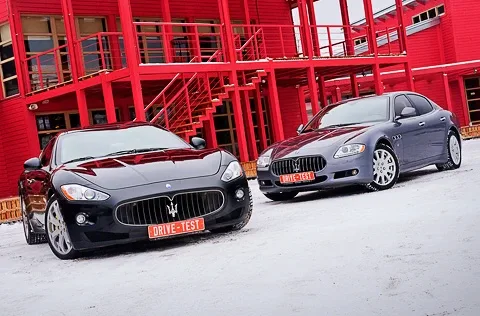
Before the first snow, we only managed to drive the base coupe. An excellent car for everyday driving! Surprised? How else could Ferrari's creators have avoided internal competition? No big deal. Scroll down and check out the brand's history: the company from Modena is alien to any canons. It was equally successful in sports hardcore and satisfying the American craving for comfort. The brainchild of the Maserati brothers, passing from hand to hand, either completely lost its identity or regained its individuality. The only constant was the Italian essence. And in this GranTurismo, Maserati is present down to the last carbon molecule in the composite driveshaft.
Just look! Where else but Italy could such a sensual and multifaceted image have emerged? Whether it's beautiful or not doesn't matter. The key is that Pininfarina's work clearly demonstrates the difference between this striking giant and the previous coupe by Giugiaro. The difference lies in the Italian word sofisticati. The new car, nearly 4.9 meters long, is more complex, more refined, and more sophisticated.
Just touch the button on the inside of the door handle, and the huge frameless "gate" swings outward with a characteristic click of the electromechanical lock. The door is heavy, but the mechanism is tuned so it closes with minimal effort. It makes a pleasant sound, even if not the most expensive.
Inside, you recognize not only the signature stiff steering wheel with profiled spokes. The light control unit, chrome door handles, and the steering column servo joystick come from the Lancia Thesis sedan. Intra-Fiat unification. Ferrari can no longer afford this. The interior architecture is German-straightforward, but it's assembled by Italians. The gap between the adjustable steering column and the dashboard is touchingly covered by a protruding leather flap, and the gaps between parts are uneven. The lemon decorative inserts don't match the body color. The backlighting of the analog gauges is a dim backdrop for the bright digital display. The large screen on the center console displays information on a "as it fits" basis...
The Maserati evokes that slightly sloppy feeling of low-volume production, as they say in such cases. But even this level of refinement is a surprise: I expected worse. In terms of material quality, it's premium. The cabin is almost entirely upholstered in leather, and all the plastic within reach is pleasant to the touch. If the coupe were here, as in Europe, competing with the BMW 6 Series, there would be no question. However, during crisis sales with a price near 160 thousand euros, the GranTurismo faces Bentley, where the tolerances for the notorious "sloppiness" are much stricter. Even the key looks expensive.
Both nominally and subjectively, the supersedan is the slowest in our trio. It seems that the claimed 5.4 seconds is quite enough for the "super-" prefix? However, even in sport mode, the throttle responses remain relatively impassive. The brakes have noticeable pedal free play. Steering reactions are softer, and the wheel itself is loaded with background effort that reduces feedback.
This artificial effort is strange: as if the tie rods were hydraulic cylinder rods. When turning the wheel, you overcome useless resistance from the drive. In theory, it should provide clearer self-centering, but in reality, it's just mush in the near-zero zone. Because of it and the higher-profile tires, there's no coupe-like build-up of reactive force at small angles. This prevents you from feeling the limit as clearly in a slippery corner. You have to resort not only to corrective steering but also to "searching slides"—provoking micro-understeer to gauge grip.
The coupe is equally controllable by steering and throttle. It instantly responds to dynamic weight transfer, allowing you to turn the wheel at minimal angles while lifting off the gas. The Quattroporte is longer and heavier by more than a hundredweight. It has pronounced understeer and responds sluggishly to throttle changes. If you simply lift off and turn as in the coupe, the Quattroporte will continue straight. Here, a more decisive command is needed. You have to steer, you have to, excuse me, "steer in."
Despite a wheelbase 125 mm longer, the sedan's directional stability is worse. It reacts more sharply to road camber and veers off course where the coupe holds. Of course, everything is relative: compared to other cars, the Quattroporte handles quite sportily. But in my opinion, the Maserati sedan is not one of those cars that "can't scare because they're predictable." Racing along a slippery road in a Quattroporte is frightening. Whereas in the GranTurismo, it's frighteningly interesting.
With a wheelbase over three meters, the sedan could not only hold a high-speed straight better but also offer more rear passenger space. The space becomes commensurate with the price tag only if you slide the front right seat forward. However, the Maserati can argue with anyone about rear seat comfort. Thanks to simple adjustments, you can find such a relaxed position that any technological flaws won't matter.
Don't talk to me about sport: I'm sure all Quattroporte owners value this car primarily for its design and the rear bench! Even though there's a harsh draft around the legs. But choosing the Quattroporte as a executive car is like giving Santa Claus a trident instead of a staff. Functionally similar, but it looks ridiculous. On the move, the Maserati is too noisy and stiff for a passenger. And you can't call it a driver's car either—it's not communicative enough.
Isn't my executive sedan a demonstration of my attitude toward quality? I admit that a Maserati breakdown isn't perceived as something out of the ordinary. These are the rules of the game, the quirks of ownership—any owner of a low-volume "Italian" will confirm this. But we were still tired of electronic glitches, warning light illumination, and alarming onboard computer reports. First, a failure of the adaptive suspension at 5,500 km, then the engine suddenly stalls in the middle of the road. The test ended with a "Check engine" suggestion, even though we only put "98" Ultimate in the tank. We never shook the feeling of working with a raw, unfinished project. And this after six years of production life!
A buyer considering the four-door Quattroporte should understand: the perfect balance you expect from a car at this price isn't here. This car doesn't fully meet any of the roles it's cast for. Last year, the Russian Maserati dealer managed to sell out the entire quota allocated for our country—about eighty cars, and roughly half were Quattroportes. But today the picture isn't so rosy, and it's not just about the economic downturn.
The Quattroporte has a serious rival—the large Porsche Panamera hatchback, and its 400-horsepower version costs about the same as the Maserati. In spirit, these cars are very similar, but in terms of technology and build quality, the Panamera is clearly ahead. You can talk endlessly about how Maserati has its own unique buyer, but it's unlikely that anyone who decides to get an executive car with a sporty character won't even glance at Porsche. I'm sure they will—and that's why I don't believe in a cloudless future for the Quattroporte.
The GranTurismo is not just a large and quite comfortable coupe on the same platform as the sedan. It's not a banal sport modification, but the next step in evolution. A logical continuation of the Maserati revival program that Ferrari launched in the early 2000s. The coupe turned out more refined, cohesive, and thoughtful. It wins in material quality, is more interesting in design details, and is more ergonomic. As a system, this car is better assembled, and the name GranTurismo fits it perfectly.
You can't call the coupe a better investment than the sedan—they have different purposes. But it's the GranTurismo that is currently the brand's calling card, and it's the future. Thanks to its responsiveness and intuitiveness, the coupe is great for everyday driving, even in our realities. Yes, the car is low, and the license plate mount on the lower edge of the front bumper makes it look like a very expensive bulldozer. But if you see someone behind the wheel of a Maserati coupe in winter, don't rush to twirl your finger at your temple: on a snowy road, this car feels no worse than a regular car with twelve centimeters of ground clearance.
The GranTurismo also has glitches: the dashboard lights up with "Incomplete vehicle data"! But if I sum up everything I learned about the car during the test, the picture is quite optimistic. I find the charismatic GranTurismo S version especially successful. Of course, the two-door Maserati will have to fight for buyers with Bentleys stuck in warehouses, which are now being sold for almost half price. But overall, the large Italian coupe can live peacefully for another four years—until the two-door Panamera appears.
Configurations of the tested cars
| Model | GranTurismo 4.2 | GranTurismo S Automatica 4.7 | Quattroporte S 4.7 |
| Front airbags | + | + | + |
| Side airbags | + | + | + |
| Inflatable "curtains" | + | + | + |
| Isofix child seat anchors | + | + | + |
| ABS | + | + | + |
| Dynamic stability control | + | + | + |
| Traction control | + | + | + |
| Bi-xenon headlights | + | + | + |
| Adaptive headlights | + | + | + |
| Fog lights | + | + | + |
| Tire pressure sensors | O | O | O |
| Rain sensor | + | + | + |
| Light sensor | + | + | + |
| Adaptive suspension | + | + | + |
| Automatic transmission | + | + | + |
| Paddle shifters for manual mode | + | + | O |
| Front parking sensors | O | O | O |
| Rear parking sensors | + | + | + |
| On-board computer | + | + | + |
| Cruise control | + | + | + |
| Dual-zone climate control | + | + | + |
| Multifunction steering wheel | + | + | + |
| Power-adjustable steering column (rake and reach) | O | O | + |
| Heated and power-adjustable rearview mirrors | + | + | + |
| Electrochromic interior mirror | + | + | + |
| Electrochromic rearview mirrors with heating and power adjustment | - | O | - |
| Power-adjustable front seats | + | + | + |
| Driver's seat memory | + | + | + |
| Heated front seats | O | O | + |
| Heated rear seats | - | - | - |
| Ventilated front seats | - | - | + |
| Driver's seat with vibration massage | - | - | + |
| Power sunshade for rear window | - | - | + |
| CD player with MP3 support | + | + | + |
| Navigation system | + | + | + |
| Built-in phone | O | - | - |
| Integrated Bluetooth hands-free system | - | + | + |
| Sunroof | - | - | O |
| Trunk lid closer | + | + | + |
| Immobilizer | + | + | + |
| Anti-theft alarm | + | + | + |
| Leather interior trim | + | + | + |
| Wood interior trim | - | - | + |
| Metallic paint | + | + | + |
| Space-saver spare wheel | - | - | O |
| Base trim price | 5,919,040 rubles (139,600 euros)* | 6,368,480 rubles
(150,200 euros) | 6,279,440 rubles (148,100 euros) |
| Tested car price | 6,762,800 rubles (159,500 euros) | 7,178,320 rubles
(169,300 euros) | 7,123,200 rubles (168,000 euros) |
* At an exchange rate of 1 euro = 42.4 rubles
Key:
+ — included in base trim;
- — not available;
o — option installed on the tested car
Engineering
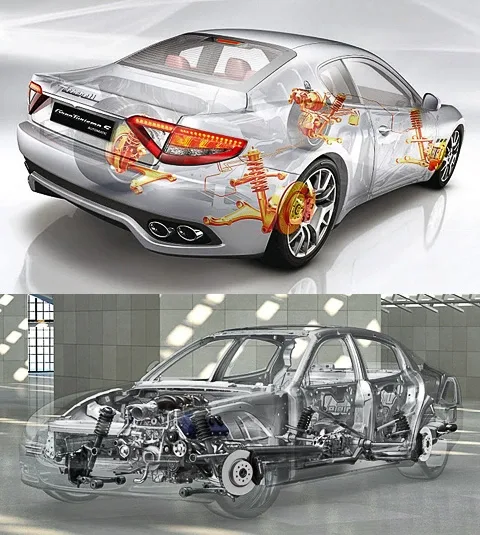
The suspension on both models — GranTurismo and Quattroporte — uses a double-wishbone layout and is structurally almost identical. The only difference is that on the coupe, all bushings and springs are noticeably stiffer. In essence, this is an evolution of the platform that traces back to the 3200 GT coupe (later renamed Maserati Coupe). The Alfa Romeo 8C supercar is also built on this same platform.

The GranTurismo's body structure is a steel space frame based on the Quattroporte sedan's design. At the rear, the suspension is mounted to a tubular subframe. Part of the front frame is cast from aluminum, and the trunk compartment is made of molded plastic.
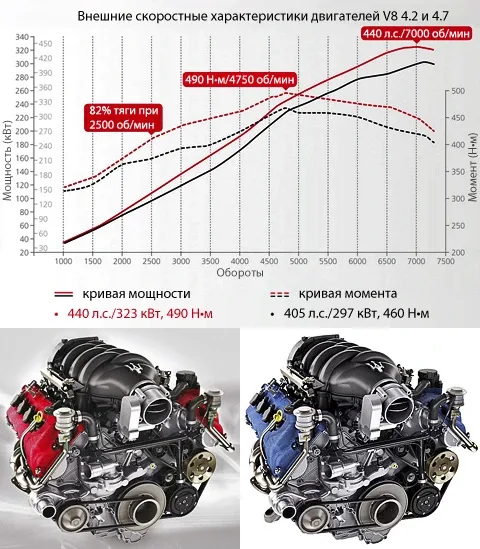
The aluminum V8 with a displacement of 4.2 liters (photo on the right) originates from Ferrari. Initially, it had a dry-sump lubrication system and rather noisy oil pumps. However, when the engine was adapted for the ZF automatic transmission, they decided to abandon the racing layout in favor of conventional lubrication. The camshaft drive is chain-driven, and variable valve timing is only on the intake side. The 4.7 version (left, with red valve cover) was achieved by increasing both the cylinder bore and piston stroke. Moving from 4.2 to 4.7 is a traditional step for Maserati. The cylinder bank angle is 90°, and the engine weighs 190 kg.
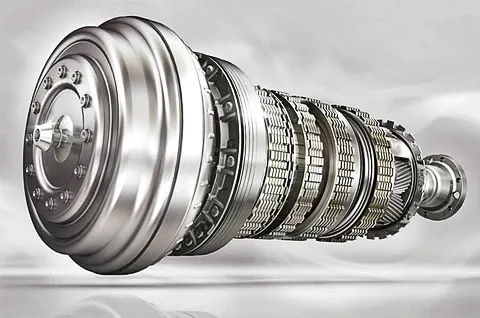
The six-speed ZF 6HP26 automatic is familiar from other brands: it's used in Audi, Bentley, BMW, Jaguar, and even Aston Martin. At Maserati, this gearbox first appeared in the Quattroporte, and the body structure had to be modified for it. Previously, the Duo Select robotic transmission was mounted at the rear and combined with the final drive.
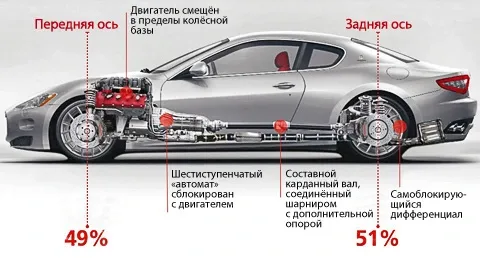
Although the transaxle layout was abandoned, the static weight distribution of the GranTurismo S coupe with the automatic is almost ideal.

When load is maximum, pneumatic valves close the "bypass channel" in the muffler, making the exhaust direct.
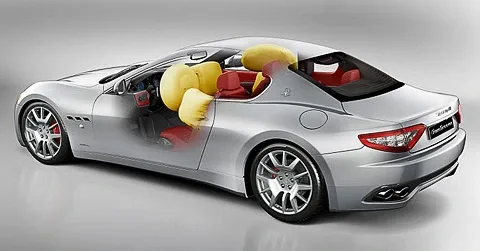
The coupe comes standard with six airbags. For rear passengers of the sedan, inflatable "curtains" are additionally provided.
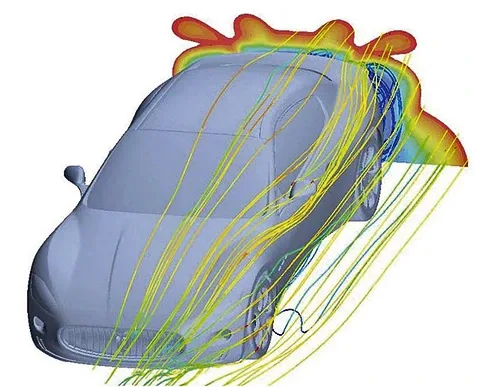
The drag coefficient of the GranTurismo is C
x = 0.33. For a car of this type, that's good. However, it's not entirely clear how lift forces behave at high speeds.
Design
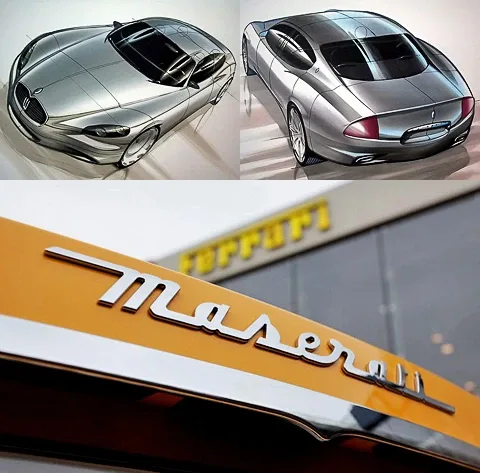
When Maserati came under Ferrari's management, work on future models was entrusted to Pininfarina instead of ItalDesign. The sketches show the first drafts of the Quattroporte sedan.
History of Gran Turismo (Robert Yesenov)
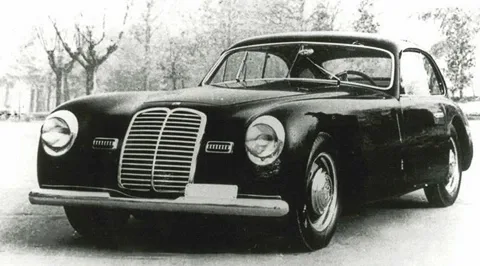
Throughout its history, Maserati has produced more than fifty GranTurismo-class coupes and their modifications, so I'll only mention a few. Let me start with the first post-war production model — the A6 coupe. This two-seater, created by Ernesto Maserati, Alberto Massimino, and Gioachino Colombo, debuted in 1947 at the Geneva Motor Show. Under the hood was a naturally aspirated inline six-cylinder engine with a displacement of 1.5 liters and 66 hp, based on the racing unit from the Maserati 6CM (157 hp with supercharger). Production ended in 1950, and by then, coachbuilders Zagato, Bertone, and Carrozzeria Allemano had already made their own versions.
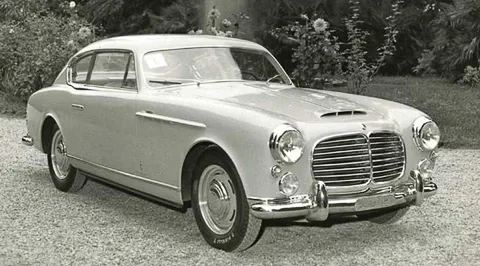
The next step in the A6's evolution was the A6G 2000 two-door. Its length was 4080 mm, and curb weight was about 1100 kg. Besides the exterior, the engine was also updated: the six-cylinder unit with a cast-iron block got three carburetors and developed up to 100 hp from two liters of displacement. With a four-speed manual, the A6G could reach 160 km/h. A total of 16 cars were built: nine four-seat versions by Pininfarina, five convertibles and one coupe by the Turin-based Frua, and one more two-door by Vignale.
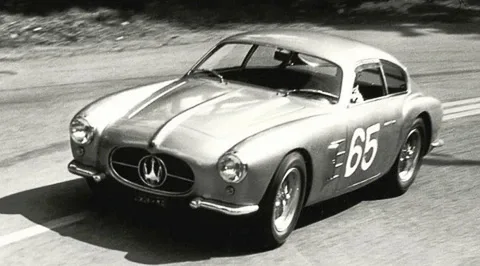
In 1954, a couple more digits were added to the A6G 2000 index — thus the designation A6G 54 2000 appeared. Under the aluminum body panels, stretching 4090 mm, hid a steel tubular frame, double-wishbone front suspension, and a torsion beam rear axle. The coupe weighed 1140 kg, but the extra weight didn't make it slower. The two-liter inline six, after refining the fuel system, produced 150–160 hp, and the top speed increased to 210 km/h. By 1957, coachbuilders Zagato, Frua, and Allemano had produced 60 such coupes and spiders.
The elegant Maserati Sebring coupe, which went into production in 1962, was initially aimed at the North American market. Even the name hints at this: designer Alfredo Vignale named his work in honor of Maserati's victory at the 12 Hours of Sebring race. The Americanization was felt in everything — in the increased dimensions (4470 mm in length), in the more spacious interior designed for two rear passengers, and under the hood. There sat six-cylinder engines with displacements of 3.5–4 liters and power outputs of 235–265 hp. For Americans, for the first time in Maserati's history, an optional three-speed Borg-Warner automatic transmission was offered. The fastest versions could reach 255 km/h. By 1969, 593 cars had been built.
The next large coupe was named after the cold wind that blows from the Mediterranean to the south of France — Mistral. But the two-door, designed by Pietro Frua and shown in Turin in 1963, looked truly warm and sensual. Four and a half meters in length, with a wheelbase of 2400 mm. The chassis was either a steel tubular frame or an aluminum body. Over seven years of production, the Mistral was fitted with inline six-cylinder engines of 3.5 (235 hp), 3.7 (245 hp), and 4.0 (265 hp), with a five-speed manual or a three-speed automatic. For comfort on long trips, air conditioning, an audio system, and disc brakes on all wheels were provided. A total of 828 coupes and roadsters were produced.
The Mexico model became the first Maserati coupe with a V8 engine — it was shown in 1966. The story behind the name is curious: the car was essentially given to the President of Mexico, Adolfo López Mateos, who bought one of the prototypes of the future two-door. What else is interesting? The coupe was built on the same platform as the first-generation Quattroporte sedan. From it came the V8 engines of 4.1 (260 hp) and 4.7 (290 hp), a shortened platform (wheelbase — 2640 mm), a steel monocoque, and a rear leaf-spring suspension. This solid car, 4760 mm long and weighing 1830 kg, boasted a full four-seat cabin and prestigious equipment: air conditioning, a stereo system, an optional automatic, and leather upholstery. Until 1972, 480 units were produced.
A wedge-shaped front end, a low-slung silhouette just 1160 mm high — the first-generation Maserati Ghibli (1967–1973) became a true automotive sculpture. Its author was the young Giorgetto Giugiaro, who was then working at the Ghia studio. Not only the appearance was sporty: under the long hood beat a fiery heart — a V8 4.7 from the Quattroporte sedan. This naturally aspirated V8 featured a 90-degree cylinder bank angle, four Weber carburetors, and a dry-sump lubrication system. Output was 315 hp and 462 N•m. The not-so-light coupe (1650 kg) measuring 4.7 meters could accelerate to 265 km/h. On offer were a five-speed ZF manual or a three-speed automatic. Equipment was fitting: air conditioning, power windows, leather upholstery, rear window defroster, and an adjustable steering column. In total, the Italians made 1170 cars, including the “hot” Ghibli SS with a more powerful V8 (4.9 liters, 335 hp), improved brakes, and a top speed of 280 km/h.
The Maserati Indy coupe is another two-door with a full four-seat cabin. The model, which replaced the Sebring in 1969, was named in honor of Maserati's victories at the Indianapolis track in 1939–1940. Length — 4740 mm, wheelbase — 2600 mm. Under the steel panels is a body with a load-bearing base. The car was positioned as a more comfortable alternative to the Ghibli, although externally they were almost indistinguishable. The V8 engines of 4.1, 4.7, and 4.9 were detuned to 250, 290, and 320 hp, respectively. However, the five-speed manual was offered with two different gear ratios. The three-speed automatic and power steering remained on the options list. Despite greater practicality, the Indy was produced in smaller numbers — 1104 cars over seven years.
In 1973, at the Geneva Motor Show, the Italians brought the replacement for the Ghibli — the two-door beauty Maserati Khamsin. The name comes from the dry, hot wind of northeastern Africa. Giugiaro's initial idea was refined at the Bertone studio — and the result was excellent! Look at the rear: the floating taillights are integrated directly into the glass panel. The steel monocoque was redesigned, although the wheelbase remained the same — 2550 mm. The rear leaf springs were replaced with a double-wishbone setup, and the worm-and-sector steering gave way to a rack-and-pinion system. True, the engine range was reduced to a single V8 4.9 (320 hp, 482 N•m), but the ZF and Borg Warner gearboxes remained. Until 1982, only 435 rear-wheel-drive coupes were made.
In 1975, De Tomaso Modena S.p.A. bought the bankrupt Maserati from Citroën. The first coupe of the new era was the Kyalami, essentially a rebadged De Tomaso Longchamp. But their engines were different: the donor was content with a Ford Cleveland V8, while the Maserati used its own engines of 4.1 (270 hp) and 4.9 (280 hp). Two types of gearboxes — also familiar from previous Maserati models. Suspensions were double-wishbone, and steering was power-assisted. True, the car, 4580 mm long, weighed 1750 kg. But the engines' capabilities were enough for a 0-100 km/h sprint in 7.6 seconds and a top speed of 240 km/h. The coupe also had a truly luxurious interior — Alcantara upholstery, Connolly leather, and thick-pile carpets. Until 1983, only 200 such masterpieces were created, 26 of them with a Borg Warner automatic.