
Lifan 520. Love Breeze
Everyone knows that selling cars from China in Russia today can bring good profits. Therefore, almost every self-respecting domestic company that deals in cars considers it a matter of honor to establish partnerships with proven manufacturers from the Celestial Empire.
Moreover, this very "partnership" implies not only organizing the sale of finished cars, but also launching workshops in Russia for semi-knocked-down assembly of Chinese cars. The idea is not new: many of our firms have already loudly announced the start of such production, but as a rule, it never went beyond press releases. Let us hope that the "Avtomir" group of companies, which announced the start of screwdriver assembly of Lifan cars at the facilities of the "Derways" plant in Karachay-Cherkessia, will do better, and the cars will actually reach the buyer.
In its homeland, Lifan is known primarily as the largest manufacturer of motorcycles and engines. They started making cars relatively recently, and their entire lineup consists of a single model — Lifan 520. On the one hand, this is alarming. But when I personally visited the Lifan factory, my doubts were dispelled. The organization of labor and production methods there are no different from what I saw at other Chinese car factories. The workshops are equipped with the latest equipment, work is in full swing on the assembly line, and every few minutes another finished car drives onto the quality control stand. True, for the sake of fairness, it is worth noting that the welding shop seemed to me insufficiently robotized — there were too many people there. Nevertheless, overall, the plant can be called a modern enterprise. And their "520th" is definitely no worse than other Chinese cars of this class. This is what we were allowed to verify during the test drive.
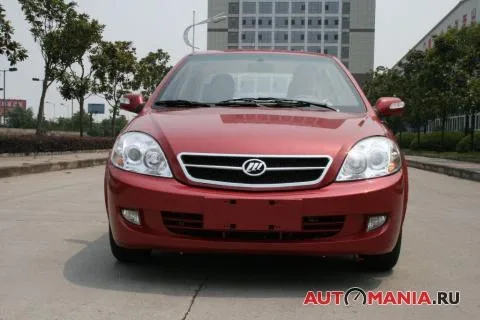
If you want and look closely, in the exterior of the Lifan 520 you can easily find features borrowed from some models of other brands. But let us be tolerant and say that the design is made in the traditional manner of the Japanese-Korean school. The car cannot be called bad, but it does not shine with originality either. The appearance of the Lifan 520 is ordinary, normal, typical, restrained, conservative, neutral… Some liveliness to the image is added by the side mirror housings with built-in turn signal repeaters and small fog lights in the lower part of the bumper. Although this is purely my opinion. For example, some of my colleagues really liked the modern streamlined body shape with an emphasis on the headlights, as if spread over the fenders. According to them, this added aggression and dynamics to the average appearance of the model. But where I definitely agreed with my colleagues is that the Lifan badge with the image of a line of "VAZ boats" will be recognized in Russia as the most stylish and "original". By the way, another thing I like about the Chinese auto industry is that it may well become the very stake that will finally finish off the agony of domestic manufacturers. The fact is that in terms of assembly quality, Chinese cars still surpass cars created back in the USSR. Poorly fitted parts are rare here — the Chinese learn quickly. So in the Lifan 520, I did not hear the characteristic "nine" squeaks and rattles while driving. Just don't puff out your cheeks in a fit of patriotism. Our engineers really design the most powerful rockets and launch systems, but we have never learned how to make civilian cars. Although there was plenty of time and money too. But we got distracted, though not much…
The trim materials are made at a quite decent level. It is pleasing that there are no pseudo-chromed or fake wood panels here, which neighboring competitors love to decorate their interiors with. Nevertheless, the interior is made in a purely Chinese style — beige bottom, light gray top. Noticing my sour expression when examining the interior, representatives of "Avtomir" hastened to assure that among the cars assembled in Cherkessk, it will be possible to choose a version with a fully dark interior. Now that's our way, otherwise light upholstery in our climate becomes a real headache. It would also be good to add window tinting to the base configuration. With it, the Lifan 520 would look more attractive, and the archaic by today's standards design would not give a reason for cynical mockery from envious "tazovod" owners.
In terms of technical equipment, this is a solid Asian middle-class car. The "staffing table" includes: electric mirror drive, power windows, a double-DIN radio with a CD changer supporting mp3, and air conditioning. I don't know whether it is worth mentioning the power steering — this device has long become commonplace even on European cars… In general, the Lifan 520 also has it.
Behind the wheel of the Lifan 520, you feel quite comfortable and even cozy. For the test, I got a version with a 1.6-liter engine producing 115 horsepower and a manual 5-speed gearbox. Engage first, press the gas — the car starts smoothly. Second, third gear. The "Chinese" picks up speed quite well, but does it with some laziness, although it did not claim to be a sports car. What annoys more is the engine noise. It is clear that not every even European car of this level can boast of silence in the cabin. But in the case of Lifan, it feels like there is no acoustic protection at all: the engine howls mercilessly, you can hear sand grains hitting the wheel arches (although, if you remember the same Chevrolet Lanos, which makes at least as much noise, these complaints no longer seem so significant).
Handling is better. The Lifan responds adequately and quickly to steering wheel turns. The reactive force is, of course, a bit weak, but it is enough to control both the car and its movement. But the suspension is a bit soft. Alas, the Chinese seem to tune the stiffness for their roads, and in our conditions such compliance is fraught with damaged bumpers and sills (it is enough to drive off a high curb or catch a wave on a freshly repaired road). Characteristically, this almost does not affect stability. Body rolls in corners are noticeable, but the Lifan traces the set trajectory without problems even at decent speeds. Having gained experience, you can even entertain your family with tricks like a "police turn" or "controlled drift", although at first, frankly, I was scared to do such things. However, I repeat, this is absolutely subjective, and many of my colleagues rated the handling and dynamics of the Lifan 520 higher than I did, giving scores fully corresponding to the car's class.
But where we agreed unanimously is that the main advantage of the new product is its price. The Russian configuration of the Lifan 520 has not yet been finally determined. It is only known that air conditioning, power steering, and a dark interior will definitely be included. According to representatives of "Avtomir", the car will be sold in the range from $10,000 to $13,000. Specifically for our market, the name Lifan 520 (which in Chinese internet slang means "I love you") will be replaced with another, more euphonious and less conflicting one. According to some data, Lifan will be renamed "Breeze", and how true this is, we will find out at the end of summer, when the first car rolls off the assembly line of the "Derways" plant.
Technical specifications
| Dimensions: | Lifan 520 |
| Length (mm) | 4370 |
| Width (mm) | 1700 |
| Height (mm) | 1473 |
| Curb weight (kg) | 1155 |
| Engine displacement (cm3) | 1560 |
| Maximum power (hp) | 115 at 6,000 rpm |
| Maximum torque (Nm) | 149 at 4,500 rpm |
| Gearbox | 5-speed manual |
| Front brakes | ventilated discs |
| Rear brakes | drums |
| Fuel tank capacity (l) | 51 |
| Maximum speed (km/h) | 176 |
| Acceleration 0–100 km/h (s) | 10.5 |
| Average fuel consumption (l) | 7 |
| Price* ($) | 10,000–13,000 |
* – the exact price has not yet been determined
Magazine "Autogid" July 27, 2007 No. 26(26)
Source – www.automania.ru