
Yuri VETROV, photos by the author and Lexus press office
Luxury, style and comfort — that's how we used to perceive the second-generation Lexus RX. However, getting acquainted with the updated RX350 on Italian roads near Siena, where the famous Mille Miglia once thundered, turned out to be unexpected. The crossover became more spirited, more composed, sharper and much more thrilling to drive… The image has changed radically!
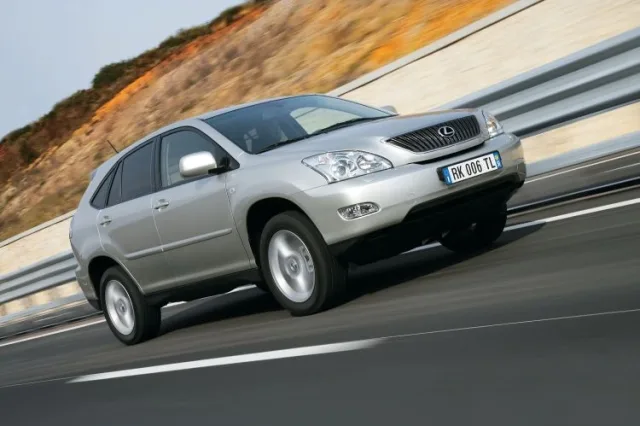
The step is, in general, predictable: its competitor in the American market — the second-generation Mercedes ML — has noticeably tightened its ride qualities. Is the Lexus RX really going to stay in its respectable role — with a "dead" steering wheel lacking feedback, noticeable body roll and not too impressive dynamics?
Not so!
| Takayuki Katsuda: "For Lexus, safety is above all" |
Let's start with the fact that the new index directly indicates an increase in power. The European RX300 with a three-liter engine (204 hp) has given way to a 3.5-liter engine producing 276 horsepower. The almost two-ton crossover accelerates with surprising ease under the pressure of 342 Nm, as if it were a feather. The new engine is not only more powerful and torquier, but also noticeably more responsive — the power peak has shifted from 5600 to 6200 rpm, and a different electronic calibration works wonders. You feel this from the very first meters. Just press the pedal — and the Lexus responds instantly, almost without pauses. At the same time, there is no jerking: there is not a hint of abruptness in the response.
A pleasant bonus: the RX350 is not only quicker than its predecessor, but also more economical — on average, a liter of gasoline less per hundred kilometers!
The second plus is the new algorithm of the five-speed automatic. Shifts are smooth and comfortable, downshifts are timely, and on mountain serpentines the gearbox doesn't fuss, without unnecessary shifting through gears. Manual mode was needed only before the riskiest overtakes. At the same time, the automatic holds the selected gear until the cutoff at 6300 rpm, and the car engine-brakes and accelerates as if there were a manual under the hood — the torque converter locks up completely.
 |  |  |
| The heart of the updated Lexus is a lively V6 with 272 hp | The red zone of the tachometer now starts at 6300 rpm | The new navigation speaks three languages, and its processor has become 65% faster |
And finally, "thirdly" — the retuned suspension. The updated Lexus no longer keeps its distance from the driver! The steering wheel, although it seems slightly light, has a clear steering feel. The reactions are exactly what you expect from a car of this class: not lightning-fast, but precise. On corner entry — slight understeer, and in the middle of a fast arc it changes to almost "neutral" grip. On the Siena serpentines, this is pure pleasure.
Another surprise — the center differential has a locking viscous coupling again, as on first-generation cars. This gives the crossover the manners of honest all-wheel-drive cars of the early 90s — like the Mitsubishi Lancer Evo or Toyota Celica GT-4. Their transmissions are identical: 50:50 torque split and a viscous coupling as a lock. But if you enter a curve on gravel and gently slide with all four wheels under power, the VSC stability system will intervene. It is still non-switchable and tuned the old way. And that's a pity: the electronics cut off slides too roughly and even harshly. It not only "strangles" the engine but also continues to brake the car when the slide has long since stopped.
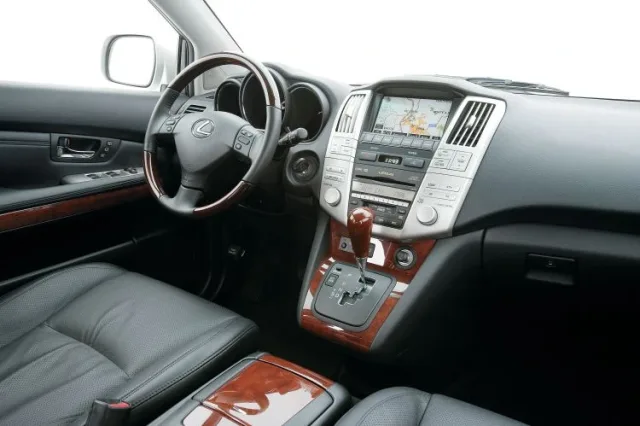
Navigation and the luxurious Mark Levinson audio system will also appear on Russian cars —
in the top R3 version
Why don't the Toyota people put "smart" VDIM stabilization on the RX, as on the eight-cylinder Lexus GS or the third-generation RAV4? The chief engineer of the RX350, Takayuki Katsuda, answered evasively. They say safety is a priority for Lexus, but the format of the project did not allow creating a fundamentally new system: this is only a facelift, not a new model.
As before, the RX is offered with two types of suspension — coil spring and air. I tried both and, frankly, did not feel much difference. Except that the spring version transmits the road profile a bit more detailed. But the RX350 as a whole has become stiffer — for closeness to the driver, part of that magnificent comfort for which the RX300 was famous had to be sacrificed. Now on a broken road, the crossover noticeably shakes, especially in the rear row. But at high speed, even on imperfect highway asphalt, the car flies like an arrow, delighting with excellent ride smoothness, excellent directional stability and silence in the cabin. Only the slaps of wide tires on patches and cracks are audible.
The refined sound insulation has indeed improved acoustic comfort. Road noise has decreased, and the new windshield with a special coating more effectively dampens high frequencies. The engine is almost inaudible up to 3000 rpm. But after 4000 rpm, its low rumble at full throttle begins to tire. Perhaps the culprit is the bypass valve in the muffler, which opens a short "straight-through" path for exhaust gases under load?
There are other updates. The processor of the new navigation has become 65% faster, and the combined Mark Levinson audio system has also been modernized. True, the Russian provider servicing Lexus navigation has not yet managed to resolve all legal issues. But the light at the end of the bureaucratic tunnel is already visible…
As for prices, in the "premium segment" Lexus is still out of competition. The base Comfort version (formerly R1) with coil springs and without adaptive headlights, electric steering column adjustment and power tailgate has risen in price by only 5% — to $59,950. And the top RX350 Premium has added 3% and costs $68,000. Neither the BMW X3 nor the Mercedes ML 350 can answer the Japanese: with similar equipment, they come out noticeably more expensive…
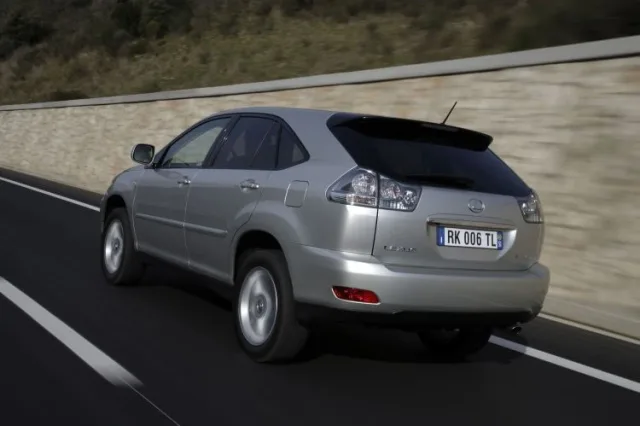
By the way, in the USA, the RX350 will replace the RX330 modification. Now globally the Lexus RX is sold only in two versions — RX350 and RX 400h. True, is it worth overpaying almost $9,300 for the almost front-wheel-drive "hybrid" 400h, if when accelerating to 100 km/h with a fully charged battery it is only 0.2 seconds faster? Unless for the sake of fighting global warming...
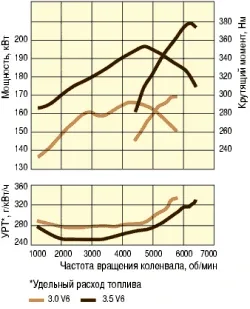 | |
| The comparison of the external speed characteristics of the RX300 and RX350 engines clearly demonstrates the difference: the new engine is more powerful, torquier and higher-revving. And at the same time more economical (see specific fuel consumption graphs) | A different electronic calibration has made it possible to noticeably speed up automatic shifts — by 0.5–0.8 s. Moreover, shift times now almost do not depend on speed |
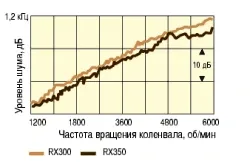 | |
| The liveliness of the throttle response can be measured in fractions of a second: the delay has decreased by an average of 0.1 s | In the mid-frequency region (1.2 kHz), the new engine is quieter than its predecessor across the entire rpm range |
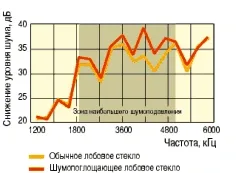 | |
| The new windshield helps reduce noise levels at medium and high frequencies |
| Lexus RX350 and Lexus RX300 (manufacturer data) | ||
| Body type | 5-door wagon | |
| Number of seats | 5 | |
| Length, mm | 4740 | |
| Width, mm | 1845 | |
| Height, mm | 1660—1715* | 1670—1725* |
| Wheelbase, mm | 2715 | |
| Track front/rear, mm | 1575/1555 | 1580/1560 |
| Ground clearance, mm | 150—205* | 160—215* |
| Trunk volume, l | 440/2130** | |
| Curb weight, kg | 1915 | |
| Gross weight, kg | 2380 | |
| Engine: location | front, transverse | |
| Type | petrol, with distributed fuel injection | |
| Number and arrangement of cylinders | 6, V-shaped | |
| Displacement, cm³ | 3456 | 2995 |
| Compression ratio | 10.8 | 10.5 |
| Number of valves | 24 | |
| Maximum power, hp/kW/rpm | 276/203/6200 | 204/150/5600 |
| Maximum torque, Nm/rpm | 342/4700 | 283/4500 |
| Gearbox | automatic, 5-speed | |
| Gear ratios: I | 4.24 | |
| II | 2.36 | |
| III | 1.52 | |
| IV | 1.05 | |
| V | 0.76 | |
| reverse | 3.38 | |
| final drive | 3.29 | 3.48 |
| Drive | permanent, all-wheel, with center differential locked by viscous coupling | permanent, all-wheel, with free center differential |
| Front suspension | independent, air/coil spring, McPherson, with stabilizer | |
| Rear suspension | independent, air/coil spring, McPherson, with stabilizer | |
| Tires | 235/55 R18 | |
| Front brakes | disc, ventilated | |
| Rear brakes | disc | |
| Maximum speed, km/h | 200*** | 200 |
| Acceleration time 0—100 km/h, s | 7.8 | 9.0 |
| Fuel consumption, l/100 km: urban cycle | 15.7 | 16.9 |
| extra-urban cycle | 8.5 | 9.4 |
| combined cycle | 11.2 | 12.2 |
| Fuel tank capacity, l | 72 | |
| Fuel | petrol AI-95 | |
| * Depending on air suspension position | ||
| ** With rear seats folded | ||
| *** Electronically limited | ||