
Yuri VETROV | Photos by the author and Toyota
Russia and the US have more in common than it might seem. A penchant for scale and luxury, an unpretentious outlook on life... Where else can you see workers in stale overalls mixing concrete just a stone's throw from an elite golf club?
What also unites us is the scale of territories. Vast expanses, wild forests and wastelands, endless roads stretching beyond the horizon...
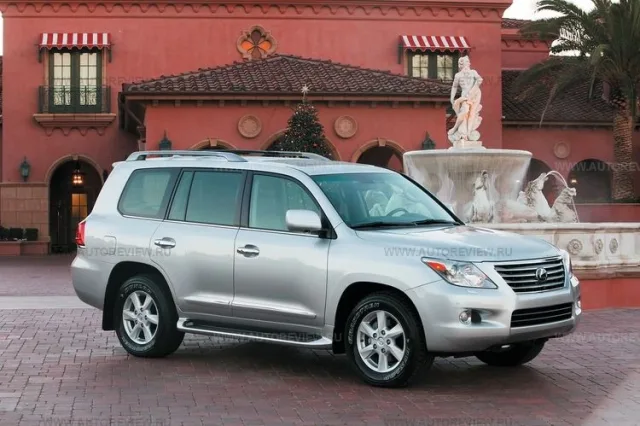
That's why both we and they need the same kind of vehicle: presentable like a posh hotel and indestructible like construction machinery. That's exactly what the Lexus LX 570 turned out to be.
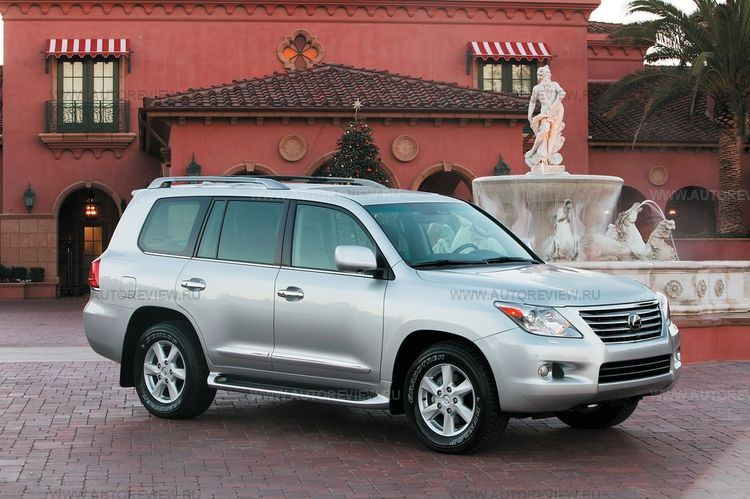
This Lexus has become one and a half times more powerful than its predecessor, but it has also gained a full 200 kilograms. Eco-activists, are you listening? No hint of a unibody — only a time-tested heavy frame. No hybrid drive — only ruthless fuel burning!
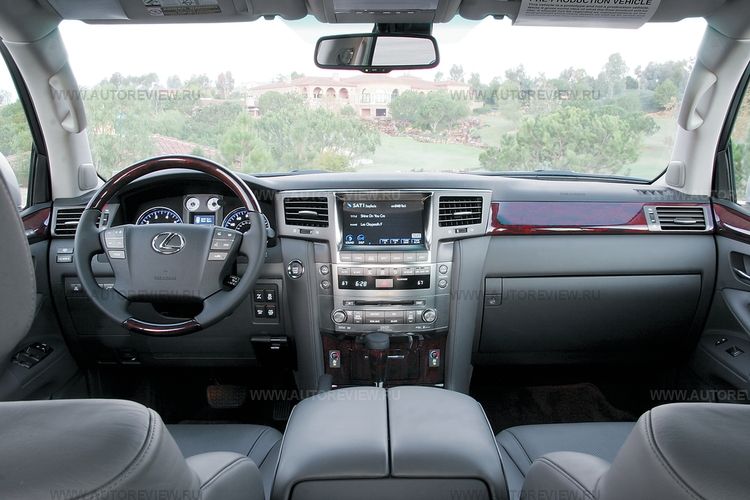
The interior is rich, but there's clearly an overabundance of chrome plastic
Previously, all SUVs with the letter L on the grille — from the very first LX 450 model of 1996 — copied the style of the GS sedan. The current one, however, clearly looks to the flagship LS. But no matter how you look at it, you can't discern the signature Japanese L-finesse philosophy here. Instead, the 'donor', the new Land Cruiser 200, is easily recognizable: the LX is only 40 mm longer than it, and the entire difference is in the bumpers.
As soon as you touch the door handle, the electronic 'sim-sim' Card Key activates. You climb onto the wide running board as if onto a captain's bridge, one more step — and you're behind the wheel, trimmed in leather and wood. The center console with matte silver resembles a cobra poised to strike; the seats are flat but with pleasant perforated leather... Only the instrument cluster disappoints: six simple dials, with the most honorable place in the center top given to... oil pressure and voltmeter gauges. 'That's what American buyers wanted,' says LX 570 chief engineer Hideyuki Watanabe with a shrug. The exquisite Japanese optitron scales in deep wells went only to the 'European relative' — the Land Cruiser 200.
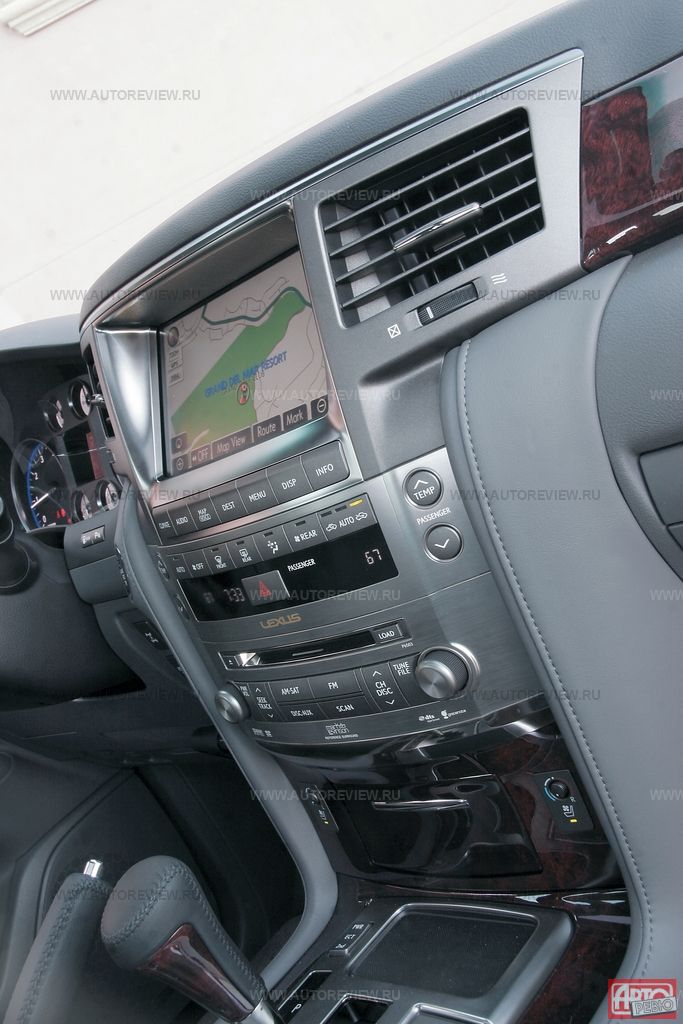 | 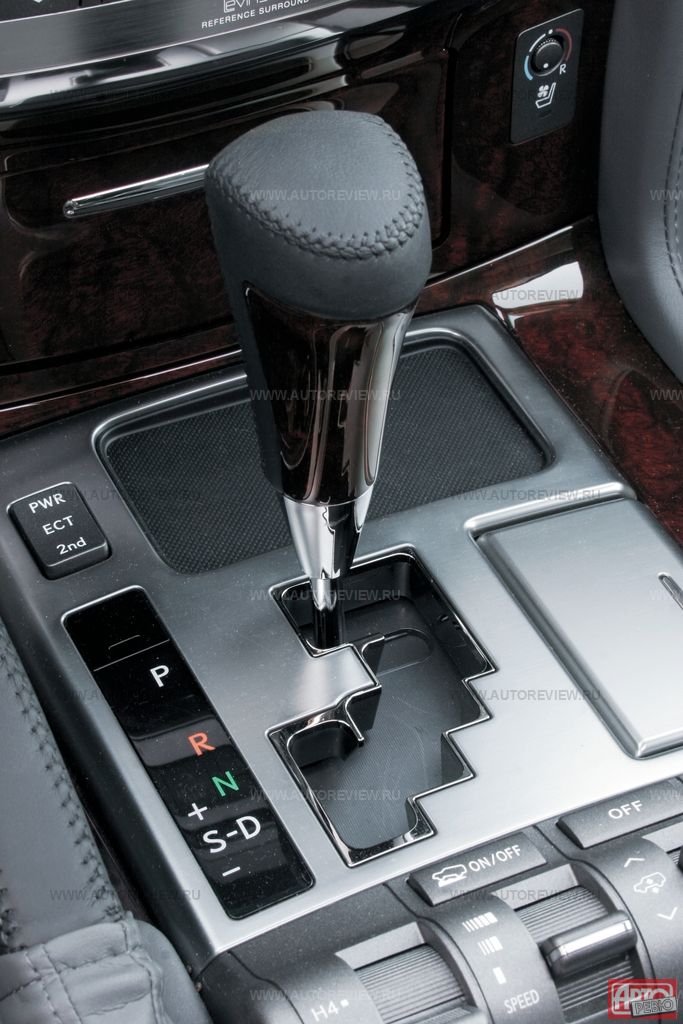 | 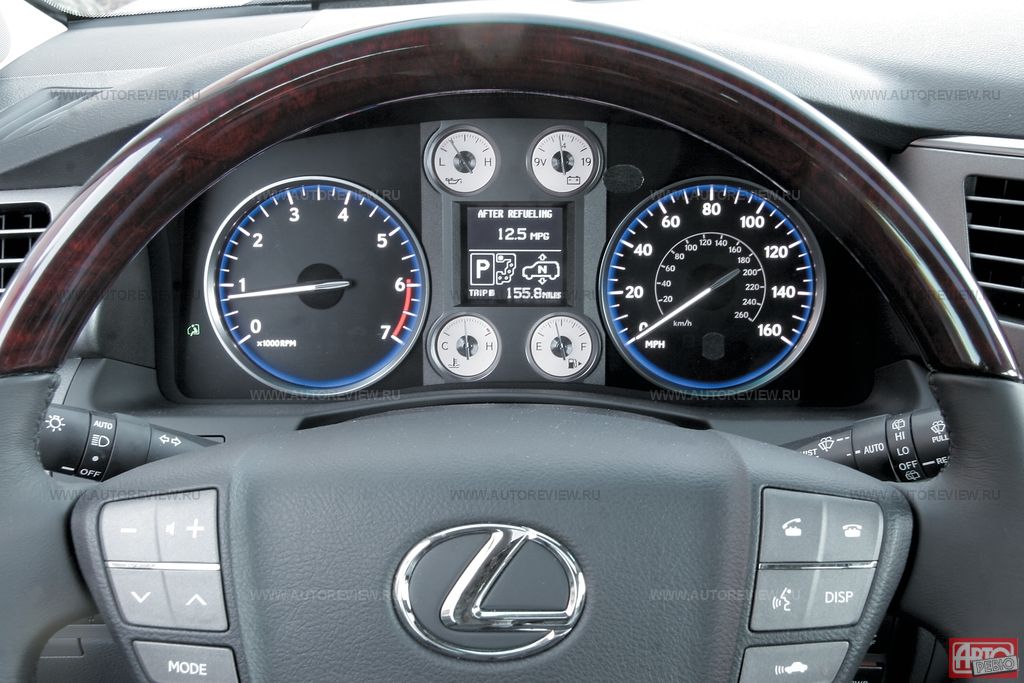 |
| The touchscreen is used for both navigation and music control | The 'automatic' works smoothly and clearly — manual mode isn't needed | Instruments are like those in American pickups |
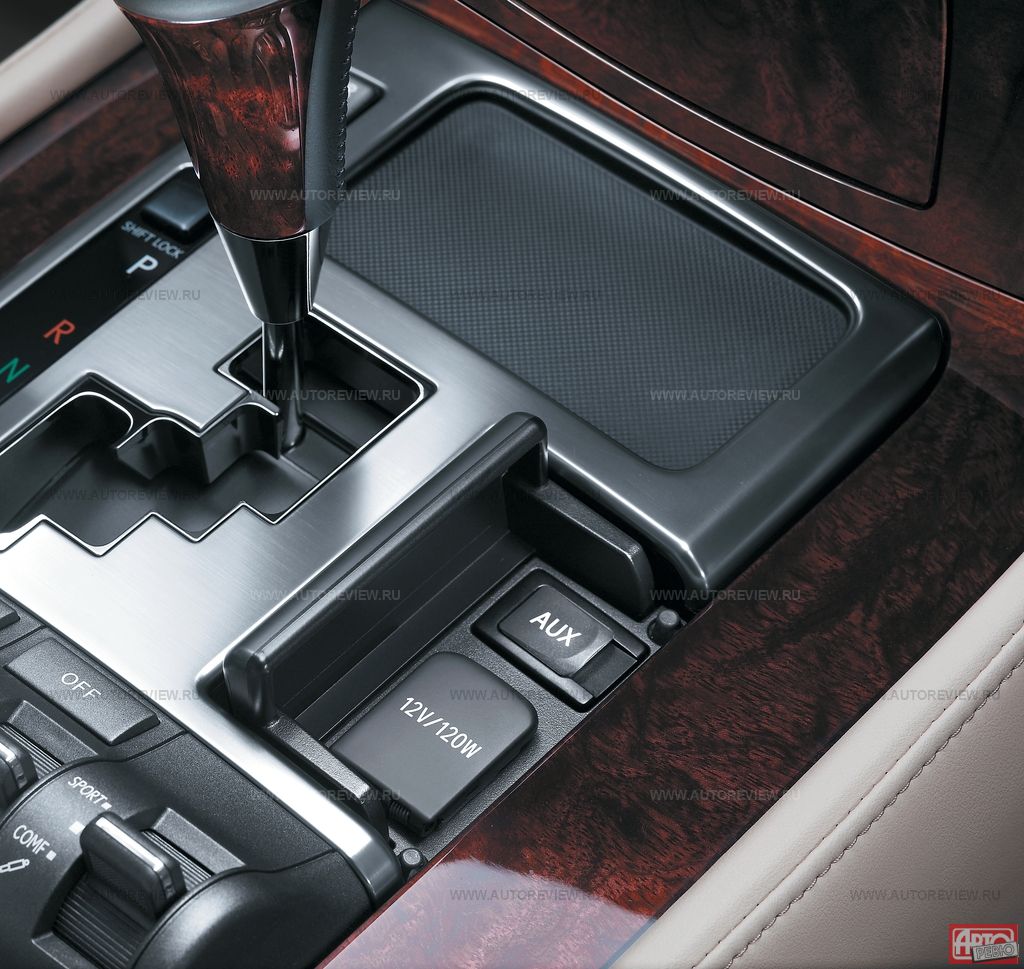 | ||
| The buttons to the left of the steering wheel can disable the cornering lights and the 'squatting' suspension. The 12-volt outlet is strictly for the American market | ||
You press the button on the key fob — and the electric drive, like a leisurely butler, lifts the upper part of the tailgate: 'Your luggage, sir.' And how pleasant it is to settle into the spacious rear sofa! Four-zone climate control lets everyone choose their own temperature, and coolness wafts even from above, as if from a fan. You insert a Tom Cochrane disc into the standard Mark Levinson 7.1 audio system — and from 19 speakers comes: 'Life is a highway. I've been driving all night long...'
Life is a highway!
The cabin is incredibly quiet, unless you provoke the engine with a kick-down. Wind noise, tire hum, suspension impacts, the clatter of pebbles against the underbody — all of that stays somewhere outside, behind the double glazing. Springs, adjustable dampers, and new rubber mounts between the body and frame handle bumps no worse than a thick featherbed, even on a broken rocky road. Only on short waves do passengers start to shake in time with the vibrations of heavy unsprung masses — although 'my' car in Russian specification has 18-inch wheels. On American versions with 20-inch wheels, this effect will likely be more noticeable.

A ford 700 mm deep is no problem for it, and an obstacle lifting the rear wheel can be up to 630 mm. A true off-roader!
How does it handle? The LX 570 retains the main virtues of its predecessor — adequacy and predictability. What do you usually expect from a heavy SUV? Excitement, zero body roll, and instant responses? Hardly. That's not here. Reactions to steering input, which is 'light' in the American manner, are unhurried but precise. At the limit — a gentle understeer. But the Lexus doesn't provoke heroics: in a sharp turn, under tire squeal, noticeable body roll begins. And the brake pedal, though understandable, causes the car to nose-dive noticeably under hard braking!
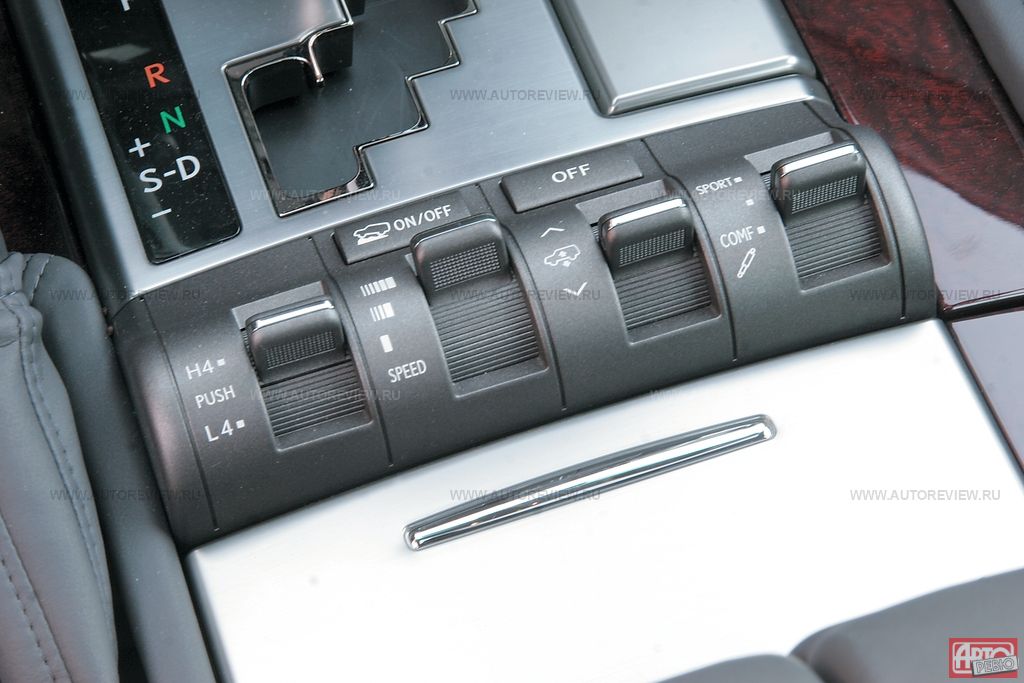 | 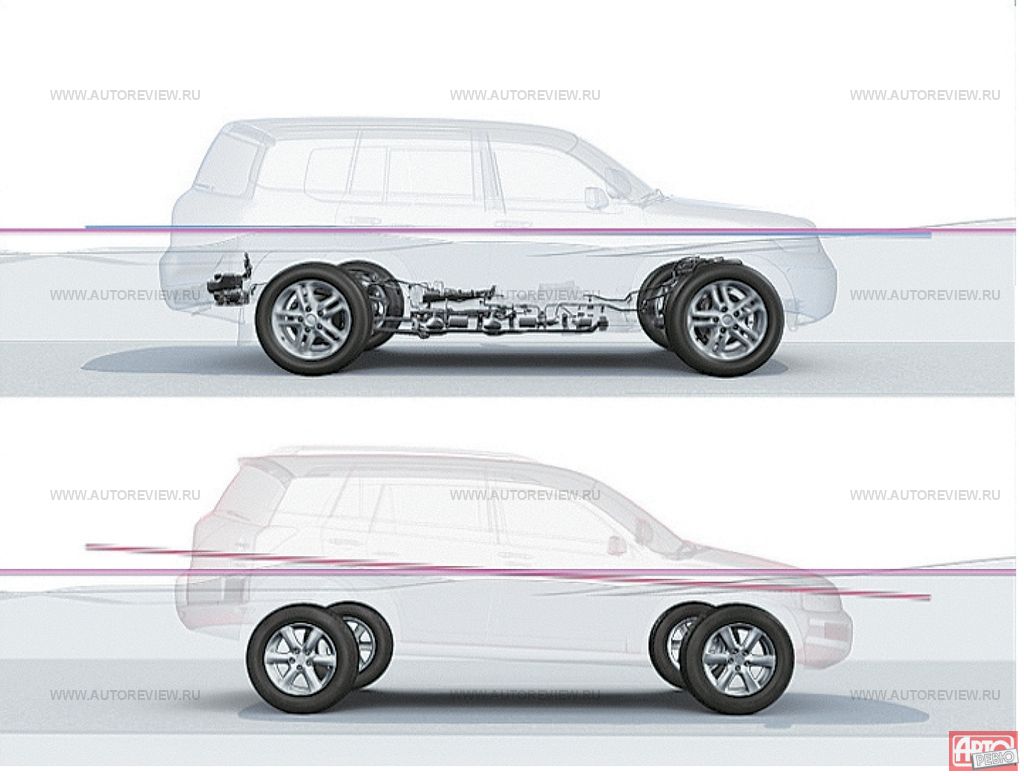 (top - Sport, bottom - Comfort) | |
| Off-road, it's worth pressing all the buttons to the right of the steering wheel: they lock the center differential, disable the stability control system, and deactivate the curtain airbags (RSCA off), which could deploy during severe body roll. The switches on the center tunnel control the transfer case, speed in Crawl mode, ride height, and damper stiffness. Switching the latter to Sport noticeably reduces body roll and nose-dive — the AVS hydropneumatics work | ||
Slight deviations from the trajectory on bumps due to the twitching of the solid rear axle, guided by the archaic Panhard rod, are also a bit annoying...
And what about the vaunted AVS hydropneumatics? Shouldn't it actively combat body roll and nose-dive? This isn't the simple 'passive' Monroe Kinetic hydraulics like on the younger GX 470 (a similar system is now also fitted to the Land Cruiser 200). Here, fluid is transferred not between hydraulic cylinders built into the stabilizers, but between the dampers! The scheme fundamentally resembles... the Hydractive II hydropneumatic suspension from Citroen. By the way, the dampers are supplied by Hitachi, while Toyota makes the other components itself.
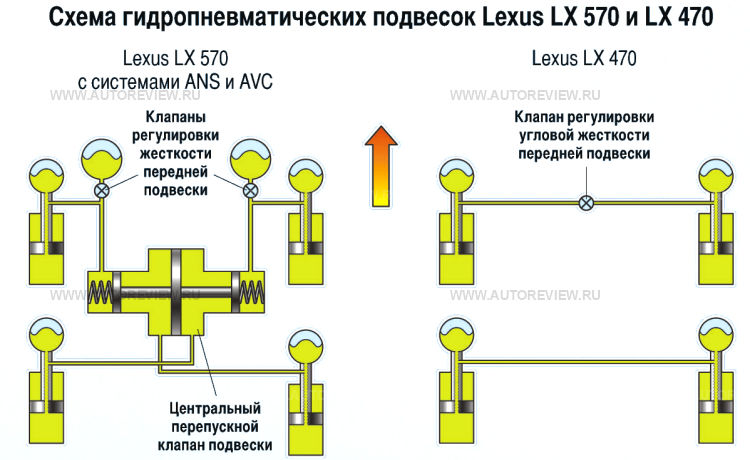
Here, hydropneumatics merely supplement the springs. In the previous LX 470, the dampers were connected in pairs and only damped body roll. Now fluid flows between all four struts through a central valve: the new suspension can combat both body roll and nose-dive. The circuits are diagonal — this increases the wheel articulation angle off-road. But angular stiffness is still adjustable only for the front suspension. Ground clearance changes by pumping or releasing fluid from both circuits
The system works. As soon as you switch the regulator on the tunnel to Sport mode, body roll and nose-dive become noticeably less — at the level of the BMW X5 and Porsche Cayenne without the optional Dynamic Drive and PDCC systems. But...
'We didn't set ourselves the task, like the Germans, of turning an SUV into a racing kart,' Hideyuki Watanabe says calmly. 'In America, no one would understand that.' Watanabe was among the 1,400 engineers who created the very first Lexus — the legendary LS400 sedan. At that time, he was specifically in charge of the suspension and knows American tastes firsthand.
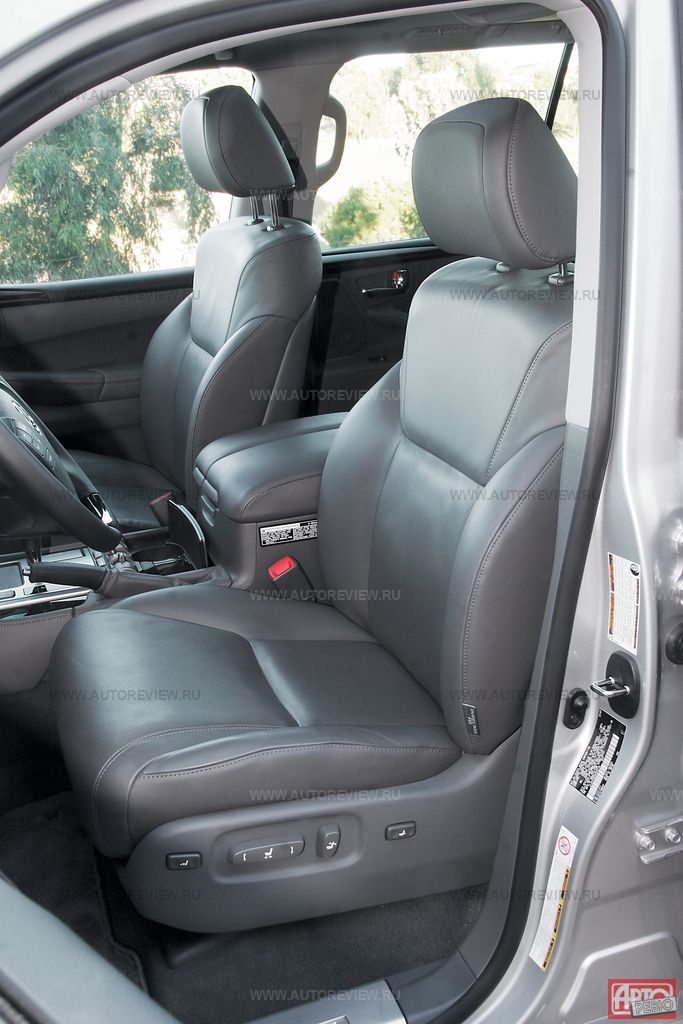 | 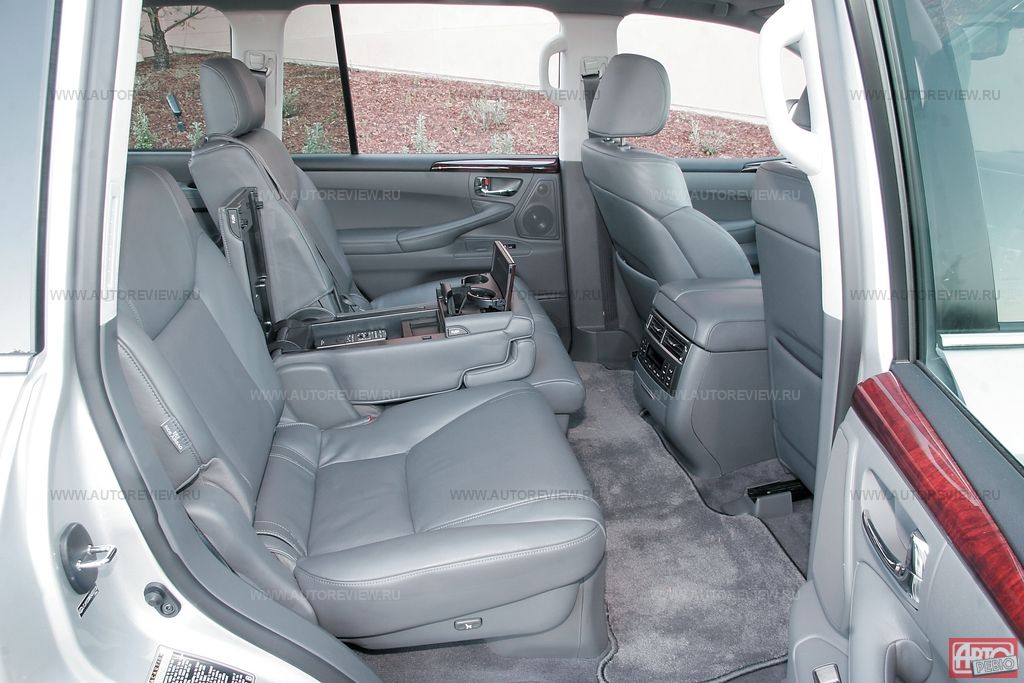 | 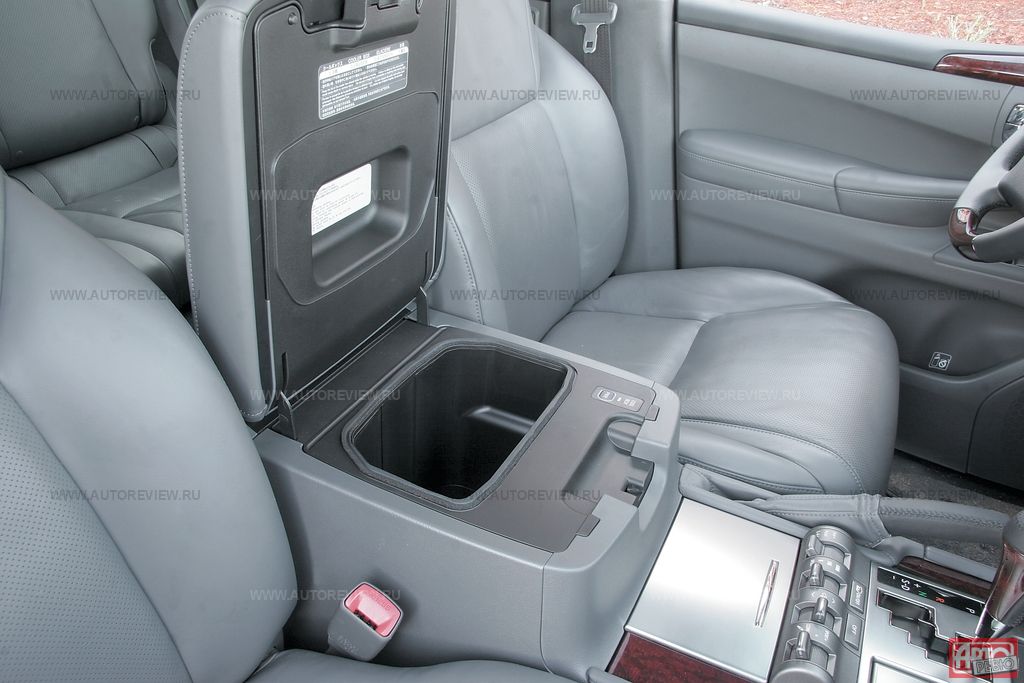 |
| Ventilated seats are a real pleasure on a long journey | The middle row now folds and unfolds at the touch of a button | The mini-bar with cooling fits only a couple of bottles |
Sitting behind the wheel of this huge SUV, I'm ready to give up the illusion of sportiness in favor of comfort without regret, so I return the Lexus damper switch to Comfort mode. By the way, even in 'comfort', the automatic height control system (AHS) works, which lowers the body by 20 mm at speeds above 90 km/h. And if you turn off the engine, the car will squat even lower — by 50 mm, like a camel that bends its legs to make it easier to climb on.
The steering with the active VGRS mechanism also doesn't provoke a racing style: in the city, the wheel makes 3.14 turns from lock to lock, and on the highway the ratio increases to four "virtual" turns. The only thing that will please enthusiasts is the Torsen center differential, which distributes torque in favor of the rear axle in a 2/3 ratio. Just like on the latest Audi quattro! Just turn off the stability control, and on hard ground the car willingly goes into a controlled drift — isn't that a Pikes Peak run?
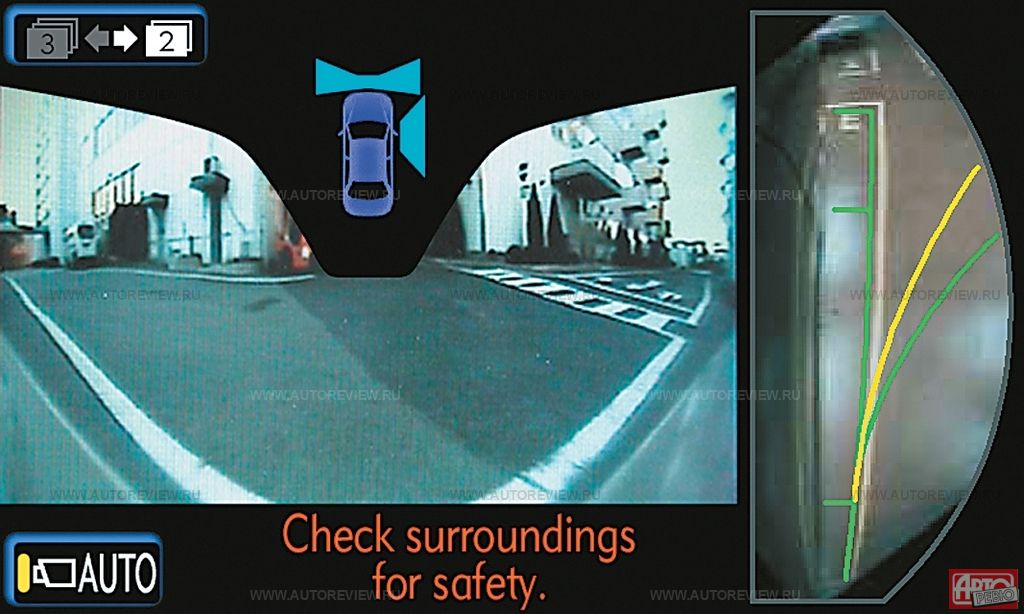 | 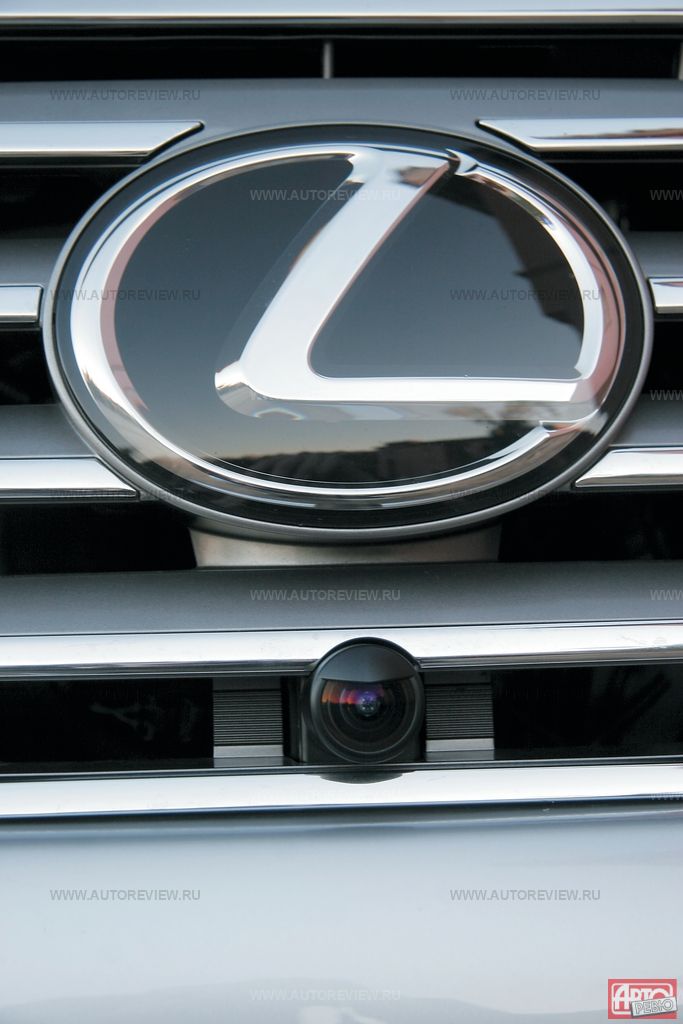 | |
| Cameras in the radiator grille and in the right mirror are a great help when maneuvering and off-road | ||
And there is every reason for that…
The new engine — an all-aluminum "V8" with a displacement of 5.7 liters, producing 367 horsepower, with four valves per cylinder and variable valve timing on all camshafts — is inferior in power to the Mercedes GL 500 engine (5.5 L, 388 hp) and the Porsche Cayenne S V8 with direct injection (4.8 L, 385 hp). But behind the wheel of the LX 570, the thought that there isn't enough traction never crosses your mind. Under a low, throaty roar, typically American in character, this unit accelerates the three-ton beast with the agility of a "hot" hatchback!
A significant role is also played by the new six-speed automatic transmission, which selects gears without delays or jerks, always on time. A manual mode is provided here, but it's unlikely to be needed — the automatic handles everything perfectly on its own, even on rough terrain.
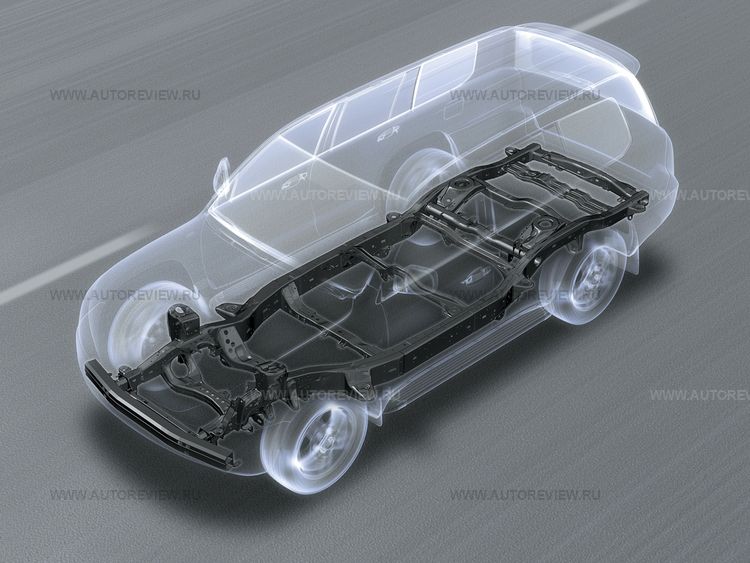
The frame has become 20% stiffer in bending and 40% in torsion, and also received programmed deformation zones for frontal and rear collisions
Off-road, the Lexus is also at its best. To overcome a serious obstacle, it's enough to remember the sequence for engaging the Crawl off-road cruise control once. No competitor offers this! So: selector to "neutral," transfer case to 4L mode — the air suspension automatically raises the body by 75 mm, lock the Torsen — and engage the "crawl mode." That's it, select Drive and go. The speed is set with a toggle switch on the center tunnel: 1, 3, or 5 km/h. Need to slow down? Press the brake pedal, and the advanced ABS, knowing in advance what surface is under the wheels, slows the car as effectively as possible. The system analyzes engine speed, gear ratio, acceleration, and wheel speed to determine the coefficient of friction. The cruise control doesn't turn off. All that's left is to turn the wheel, choosing a path between obstacles…
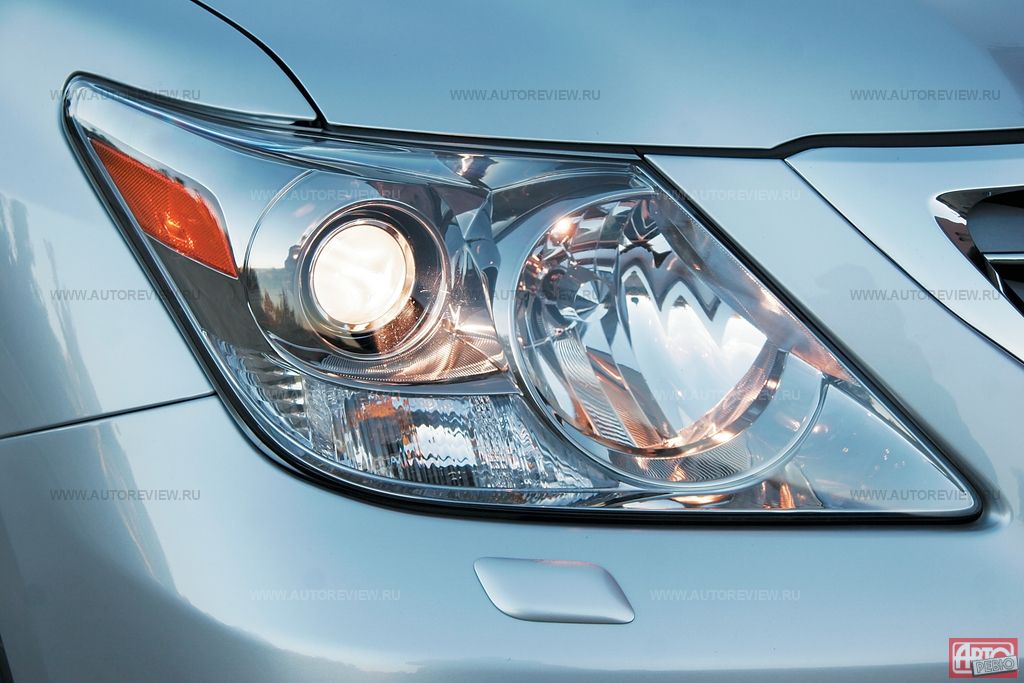 | 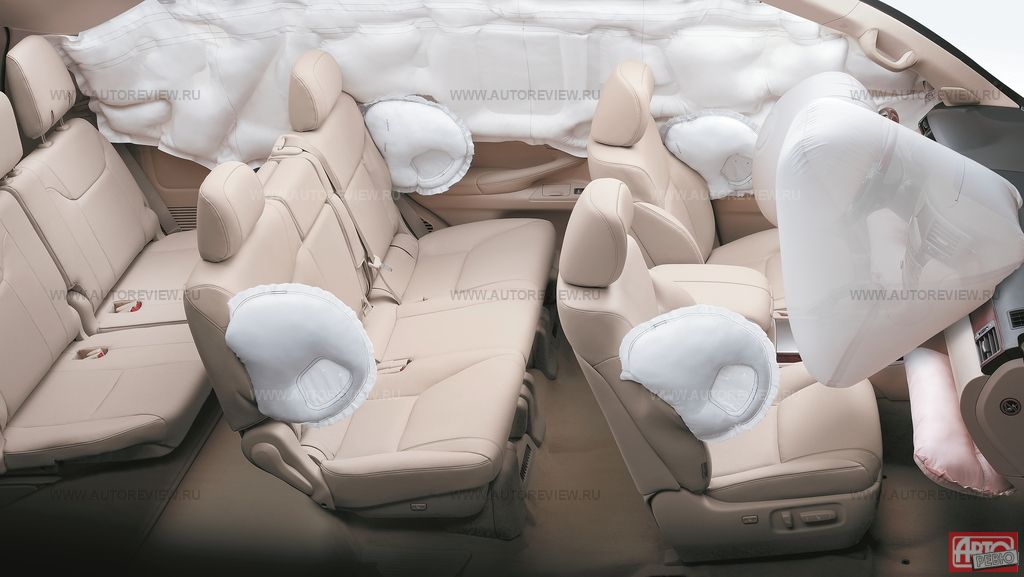 |
| The headlights are equipped with swivel sections | Ten airbags — there's simply nowhere for more |
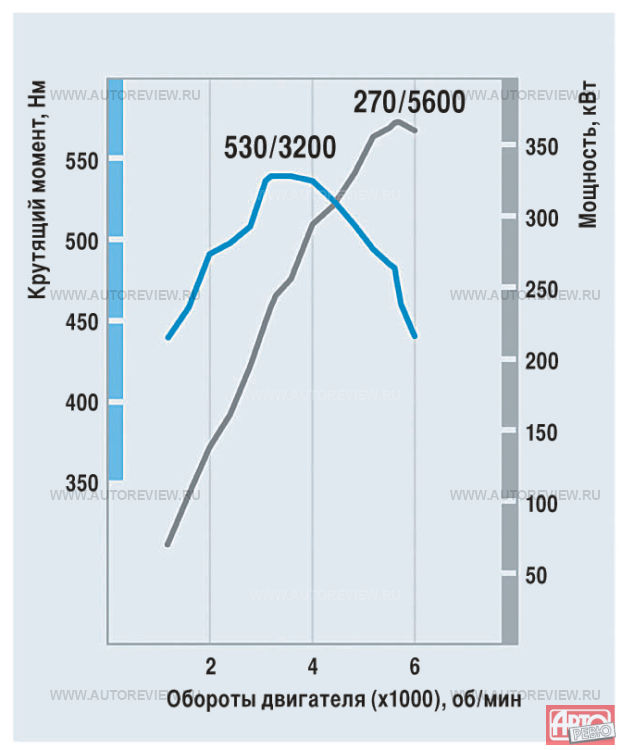 | 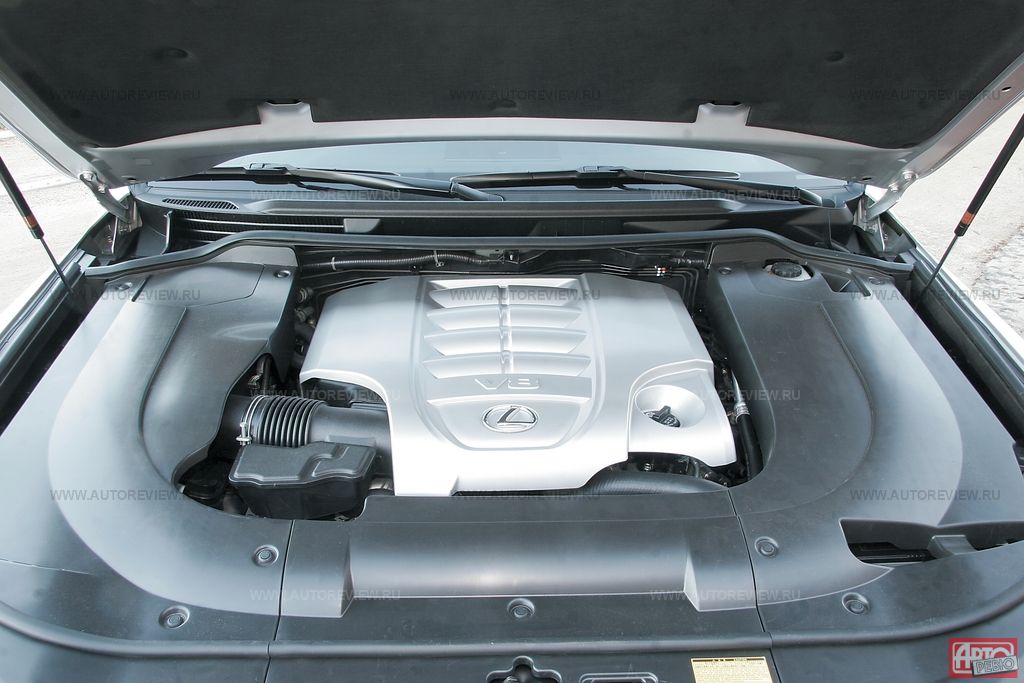 |
| The 5.7-liter engine holds 430 Nm of torque in the range from 1500 to 6000 rpm, with a peak of 530 Nm | |
In a word, even an inexperienced driver in an LX 570 can climb slopes that many modern crossovers could only dream of. And if a seasoned off-roader is behind the wheel, the Lexus works wonders of off-road capability.
For America with its ideal roads, such potential is perhaps even excessive. But for our conditions — it's just what's needed!
The main markets for the LX 570 are the USA, Russia, Saudi Arabia, and Australia. In America, 30 thousand cars are planned to be sold this year. By local standards, that's not much, but for comparison: in 2007, the previous generation LX 470 sold in the States in a run of only about nine thousand. And now the same figure is included in the sales plan for Russia! And that's quite realistic. With a barrel price above $100, few will be bothered that the Russian price tag for the LX 570 will be almost twice the American one, where the base price is $73,800. Sales are scheduled to start in February, and compared to the Land Cruiser 200, Russian buyers will have to pay at least $40,000 extra for 79 additional "horses," the clever suspension, and service electronics with the Mark Levinson audio system. But our oil tycoons are unlikely to be poorer than Arab sheikhs, right?
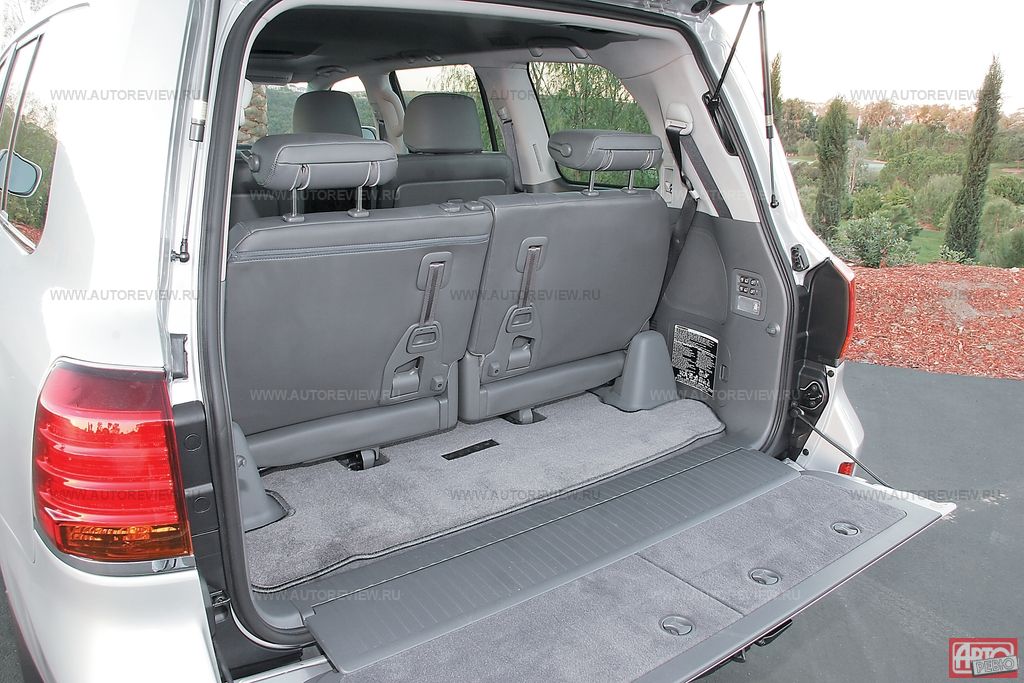 | 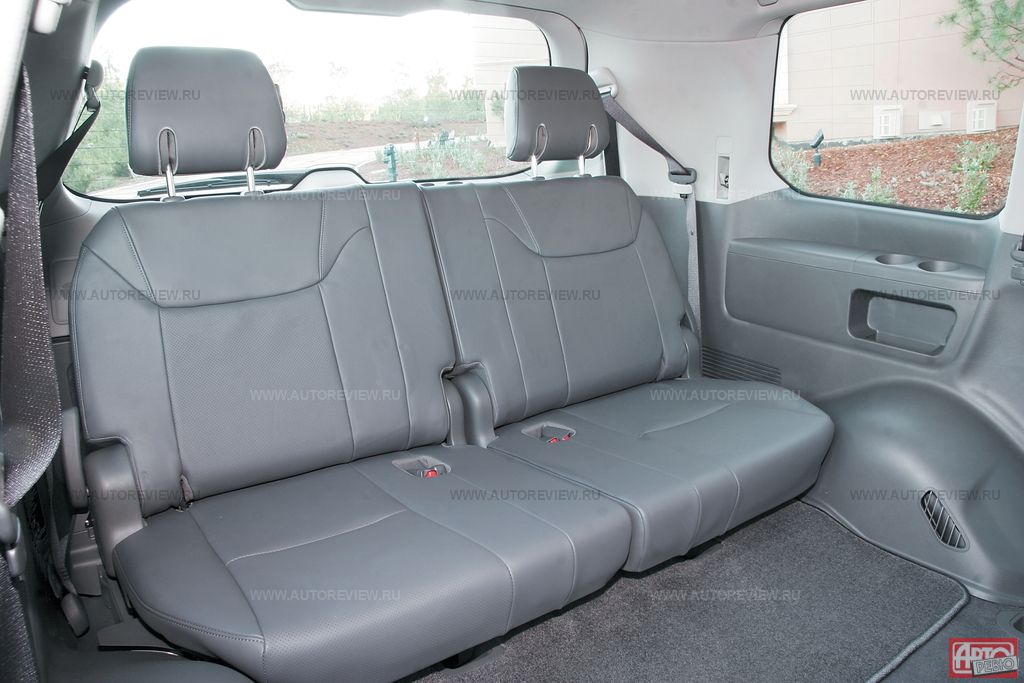 | 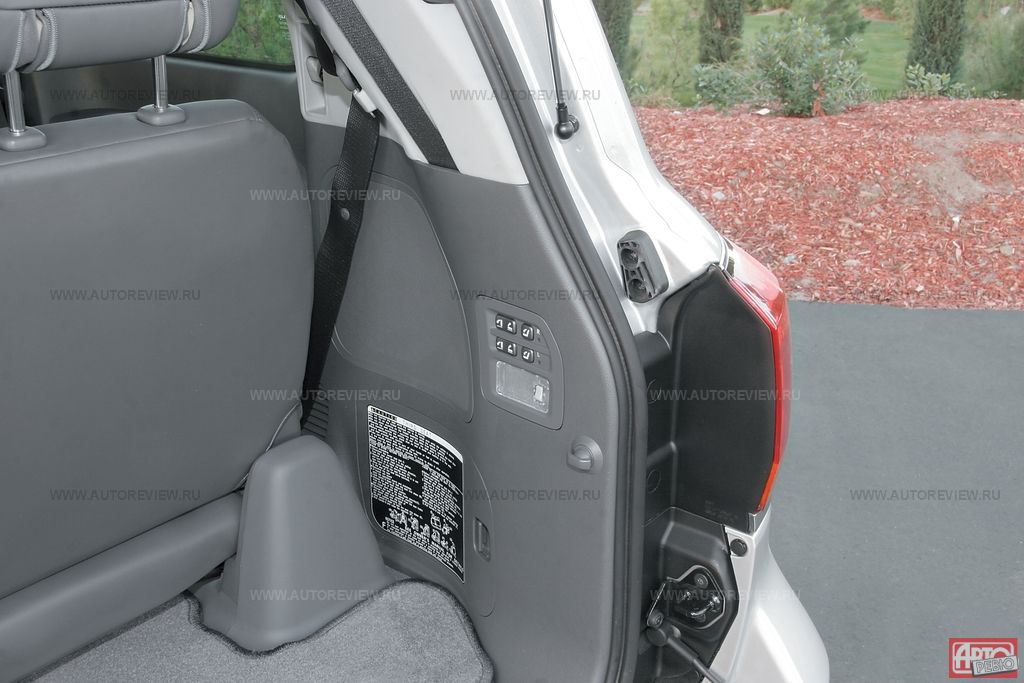 |
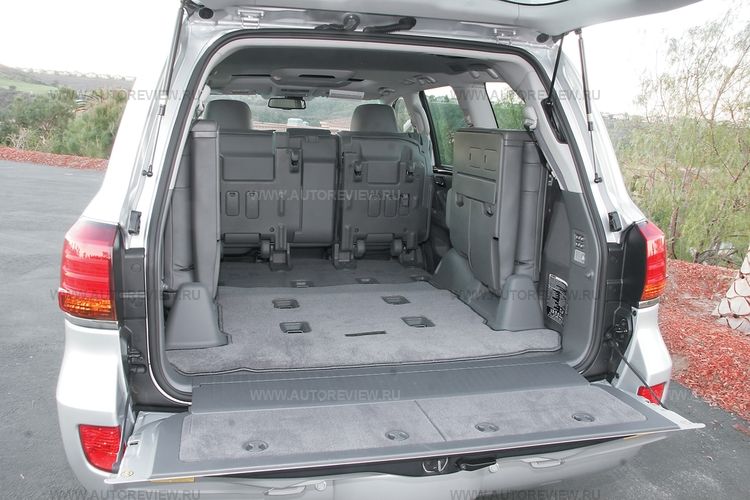
| The trunk with the seats of both rear rows folded is not as spacious as one would like, but if there's more cargo than a couple of bags from the store, the third row, where even adults fit freely, folds electrically. The buttons are on the right wall of the luggage compartment | ||
| Specifications | |
| Parameters | Vehicle |
| Lexus LX 570 | |
| Body type | 5-door wagon |
| Number of seats | 8 |
| Dimensions, mm | |
| length | 4990 |
| width | 1970 |
| height | 1920* |
| wheelbase | 2850 |
| track front/rear | 1640/1635 |
| Departure/approach angle, deg. | 29—31/20—23 |
| Ramp angle, deg. | 23—27 |
| Trunk volume, L | 259/701**/1267*** |
| Curb weight, kg | 2660 |
| Gross weight, kg | 3300 |
| Aerodynamic drag coefficient, Cx | 0.35 |
| Engine | gasoline, with multipoint fuel injection |
| Location | longitudinal |
| Number and arrangement of cylinders | 8, V-shaped |
| Displacement, cm³ | 5663 |
| Cylinder bore/piston stroke, mm | 94.0/102.0 |
| Compression ratio | 10.2:1 |
| Number of valves | 32 |
| Max power, hp/kW/rpm | 367/270/5600 |
| Max torque, Nm/rpm | 530/3200 |
| Transmission | automatic, six-speed |
| Drive | permanent, all-wheel |
| Front suspension | independent, coil spring, double wishbone |
| Rear suspension | dependent, coil spring, with Panhard rod |
| Front brakes/disc diameter, mm | disc, ventilated/340 |
| Rear brakes/disc diameter, mm | disc, ventilated/345 |
| Tires | 285/65 R18 |
| Maximum speed, km/h | 220**** |
| Acceleration time 0—100 km/h, s | 7.5 |
| Fuel tank capacity, L | 93 |
| Fuel | gasoline AI 95—98 |
| * In standard suspension position | |
| ** With third-row seats folded | |
| *** With second and third-row seats folded | |
| **** Electronically limited | |