
 Comments (11)
 Once, at the dawn of the automotive industry, almost every car was a luxury item and a bespoke product. They cost more than carriages and were therefore affordable only to a select few. Then Henry Ford came along, who showed from his own experience that a car is not a toy for the rich, but a working tool, and put all of America behind the wheel. Today, this philosophy has been replicated by everyone, from the States to China, filling the markets with budget models for a wide range of drivers. In such a situation, there is no talk of executive chic — the main thing is that the cabin is more spacious and the trunk is bigger.
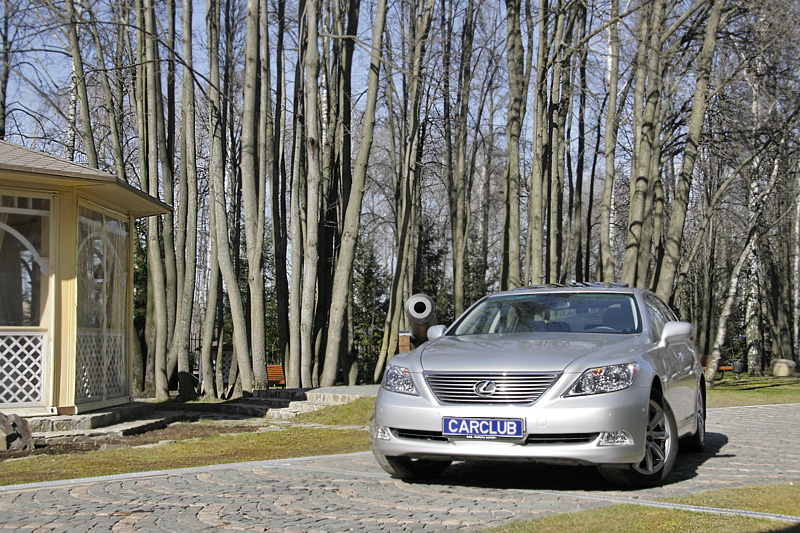
It is against this backdrop that truly luxurious cars stand out especially vividly. Owners of such cars, willy-nilly, have to be pioneers, testing out newfangled technologies that in ten or twenty years will become the standard for everyone. Therefore, we approached our acquaintance with the pinnacle of the Japanese auto industry — the flagship sedan Lexus LS 460, designed to challenge Mercedes-Benz and other grandees — with particular reverence.
The Japanese have been working on the luxury brand Lexus for nearly two decades and have achieved considerable success in this field, especially in the technical part. Take, for example, the new LS460 — it is the world's first passenger car with an 8-speed automatic transmission. Honestly, at first I was skeptical about this: eight gears is already overkill, like 8 megapixels in a cheap digital camera with a mediocre lens. A beautiful advertising trick to rub the noses of the Germans from Mercedes with their seven-speed automatic 7G-Tronic. In reality, six gears, as in BMW and Audi, are quite enough. Extra complexity in the design usually only means a higher price and lower reliability. But the Japanese somehow miraculously manage to turn this logic on its head. The Lexus LS460 with a 380-horsepower V8 and rich equipment costs from 112,700 dollars. For comparison: the Audi A8 4.2 with its 350 horses is priced at a minimum of 128,374 dollars, and the BMW 750 and Mercedes S450 are even more expensive: from 134,500 and 130,450 dollars respectively. At the same time, Lexus, as befits Toyota, is famous for its reliability. So a paradox emerges: a car stuffed with the most complex systems turns out to be both cheaper and, ideally, more reliable than its competitors. Perhaps this is the Japanese engineering miracle?
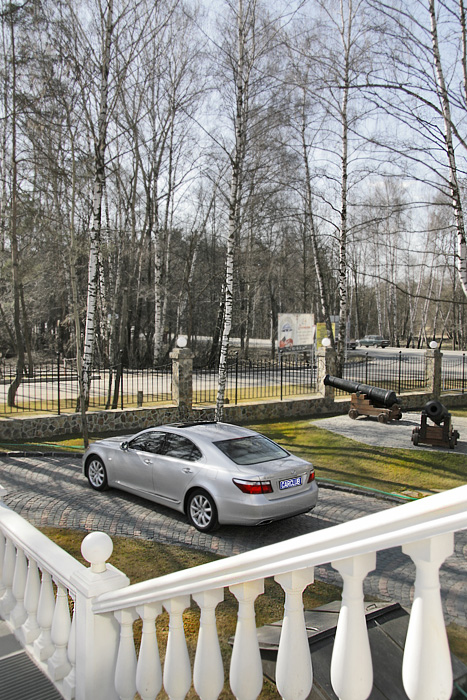
Be that as it may, in terms of design, Lexus still loses to the Europeans. The LS460 lacks expressiveness and a memorable appearance. The Japanese did an excellent job with the striking IS 250 sedan, but the flagship looks much more modest. The classic radiator grille, slanting headlights, flat sides — there is literally nothing for the eye to catch on. Except perhaps the exhaust pipes integrated into the rear bumper and the solid chrome window frames — they are made from a single piece, whereas all competitors have composite ones. There it is, that very technological superiority.
Inside, everything is much more interesting. The stylish steering wheel immediately catches the eye, followed by the massive center console with a large touchscreen. True, the abundance of buttons is slightly intimidating. Near the selector are buttons for adjusting the shock absorbers and transmission — they are needed and used often. But activating the electronic parking brake, controlling the rear window shades, adjusting the instrument panel brightness, and other secondary functions could well have been hidden in the display menu. And around the screen itself, many small gray plastic buttons are scattered on the console, which get lost against the same gray wood.
It is a pity that we got a version with a mouse-gray interior. Paired with a silver body, this Lexus turns into the dream of a gray office clerk. It would have been better to have a black interior, and ventilation, which is available both front and rear, would save you from the summer heat. The rear row deserves a separate discussion — after all, this is an executive car, albeit in the standard, non-stretched version. As expected, there is an abundance of space here, especially if you slide the front passenger seat all the way forward. The folding armrest hides climate control and audio system controls for rear passengers. A little more attention to detail — and Lexus could well have pushed the Germans aside. But as it is, the eye gets tired of these flawless but faceless buttons and knobs. It seems the designer did not rack his brains over their beauty — just an engineer with a ruler took standard buttons from other Toyota models and placed them in their spots. Why reinvent the wheel, and the cost is lower — unification, after all!
But enough lounging on the rear sofa — a car is a means of transportation, not a luxury item, so it is time to get behind the wheel. And here, in motion, the Lexus is simply magnificent. It seems as if the sedan has no mass at all, and it accelerates at the whim of the wind. At first, the steering wheel seems too light, but the reactive force accurately conveys the character of the LS460. The handling is light and effortless: the driver only needs to set the direction, and then the car does everything itself. It even knows how to slightly steer in a corner, not letting the wheels break into a skid — like an experienced racer seeking the ideal trajectory.
The eight-speed automatic works flawlessly. But it is not about the number of gears at all — it is just that the torque converter shifts so smoothly that the driver does not notice the gear changes at all. Even during hard acceleration, the shifts are imperceptible, and it is simply impossible to guess which gear is currently engaged. In a car with a four-speed transmission, the driver always knows what gear he is in, but here it is unattainable. And why bother? Press the gas — and in a second the car is already flying, and without the howl of the engine and jerks, but absolutely silently. It is like a gust of wind or a high-speed train, where dynamics are felt only by the trees flashing outside the window. If you want a sharper response, you can turn on the sport mode of the automatic or switch to manual shifting, though then you will have to yank the selector too often. Accelerating the Lexus to 200 km/h is as easy as pie, and the car seems not to even notice the load.
The sedan's suspension is also excellent. The active shock absorbers offer three modes: Comfort, Auto, and Sport. As a driver, I preferred Sport — body roll is minimal, and slight jolts from road joints only remind you that you are driving on asphalt. In Comfort mode, there is noticeable pitching, which can make passengers carsick. So the optimal for everyone will be Auto — that is what the gloomy Japanese genius was counting on. It is a pity that the suspension is not air and cannot change the ground clearance, unlike Mercedes and Audi.
Parting with the Lexus was truly sad. It is so computerized that in terms of intelligence, it seems to have come close to a human. If only it had a little more soul — and it would come alive.
But the most important thing is that I managed to unravel the secret of this engineering miracle: why Lexus does not yield to the Germans in characteristics but costs less. Everything ingenious is simple — the Japanese reduced the design staff to a minimum and slightly raised the salaries of technologists. That is the whole secret. The result is an excellent silver car. It will surely appeal to a person who adores gadgets and buttons, but at the same time counts money and is not ready to overpay for ostentatious solidity. With its main task — transporting important passengers with maximum comfort — the Lexus LS copes splendidly and, in addition, gives the driver pleasure. So everyone is happy — Happy End.
Text: Leonid Pavlov.