
On the screen, the hero steps across a wooden floor — and a cup of tea flies upward. In mid-air, he draws a sword, sweeps it in a circle around the room, and slices through the planks. The steel whistles, the hero lands on the platform, a second of silence — and the planks crash down, shaking the air.
How swift the blade is! And how impressively, precisely, and powerfully does the "home theater" audio system in the new Lexus LS 460 convey this scene...
Nineteen speakers: neodymium magnets, titanium tweeters, composite woofers for bass. A digital amplifier with 15 channels delivering 450 watts, built with discrete transistors, capacitors, and inductors rather than microchips...
Such a "home theater" in 7.1 format from the renowned American brand Mark Levinson — installed for an extra charge instead of the standard Pioneer audio — is something worth showing off to friends. Say, play a DVD with a scene from the film "Hero" — the one where the sword whistles in a circle and the planks dramatically collapse. Or put on a track from Mark Levinson's signature "test" disc featuring a jazz drummer solo. For the first time in my life, sitting in the back seat of a production car, I heard such a precise and spacious soundstage! Every drum, every cymbal sounds separately, floating in space — as if you were placed in a studio right in front of the kit.
But switch the "test" disc for an ordinary recording — jazz, classical, or simple pop from the radio — and the sound becomes lifeless. Correct, accurate, monitor-like. But dry and dead, as if through cotton wool. That's exactly why I don't favor Mark Levinson with its deliberately "transistor" character...
Such sound would suit a BMW "7 Series" with its technocratic spirit better. But the Lexus LS 460 is a completely different car. It needs a different sound.
 |  | |
| Restrained and tasteful: the interior is simple, beautiful, and pleasing to the eye. The engine starts with a button. The interactive screen and surrounding keys form the HMI — Human Machine Interface. The automatic gear lever moves along a zigzag gate; on the tunnel nearby are buttons for the suspension (including ride height adjustment), transmission, stability system, rear window sunshade, and seat "climate" | Smooth lines — in the spirit of the signature "L-finesse" concept of subtlety | Spacious and cozy in the back; in the folding armrest — a control unit for "climate" and multimedia |
The Japanese themselves call their approach human-centered engineering. In a loose retelling, it smacks of the stagnant eighties slogan: "Everything in the name of man, everything for the benefit of man." Then underground wits would add that they even knew the name of that man.
Yes, Brezhnev, who loved cars, would surely have taken a liking to the Lexus LS.
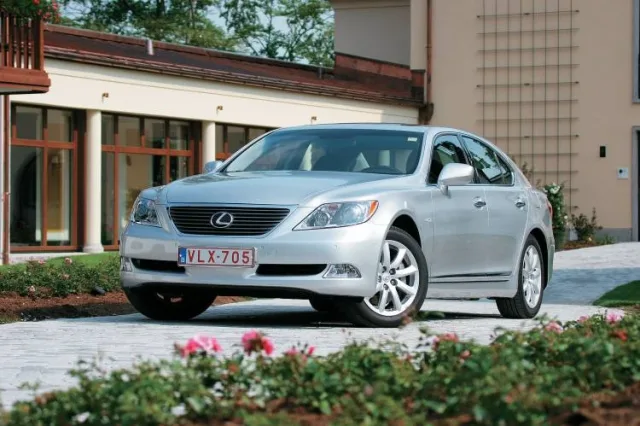
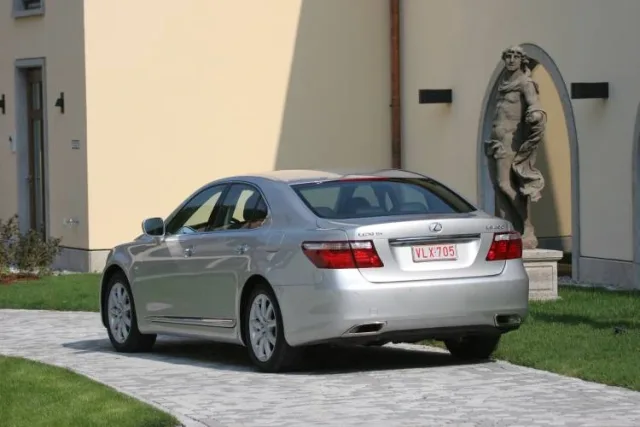
It is beautiful. It is not derivative: in the fourth generation, the Lexus LS has finally shed its imitation, its pursuit of the Mercedes S-Class. It is recognizable: it resembles both the Lexus GS and the smaller IS, especially with the signature "Japanese" curve of the rear door window line. It is organic. The only things that catch the eye are the exhaust tips in a surprisingly sporty style. And the overly massive, overly chromed radiator grille, like on current Volkswagens.
And the interior — calmness itself. Embodied conservatism. The panel is just a panel. The center console is just a console. The seats are just seats, massive and cozy. No surprises: everything is expected, beautiful, and elegant.
And the buttons here are just buttons. Moreover, there are many of them — 28. Even Mercedes has followed the fashion, adopting BMW's idea of the "computer" interface iDrive.
— Yes, iDrive on the BMW was a step forward, — admits Yoshihiko Matsuda, one of the top managers of the Lexus division. — Of course, the implementation on the BMW "7 Series" is terrible, but the idea is good. We will also make something similar, but later...
 |  |  |
| The seats are magnificent — especially if you don't expect sporty lateral support from them | All sunshades are power-operated | The long-wheelbase version has a small pull-out table in the rear |
 |  |  |
| Control unit in the rear armrest: 24 buttons and two temperature regulators for the seat climate control | Only short people can relax on the extended "ottoman" — even with the front seat fully moved forward, as in the photo | For the first time in the world, the ventilation system has not only regular vents but also ceiling ones. Moreover, for the long-wheelbase version, an additional infrared sensor is provided on the ceiling that measures the temperature of occupants and adjusts airflow if people got into the car from cold or heat |
 |  |  |
| On the rear ceiling — a fold-down 9-inch monitor | The massager remote is wired. And of the two programs, only shiatsu massage is good | In the rear box, two remotes are hidden — "massage" and audiovisual |
Matsuda-san, who resembles Jackie Chan, is one of those who went through the long path accepted at Toyota from a simple engine engineer to a big boss. Now he is responsible for the technical and model policy of the Lexus division. And he is very proud that he is still an engineer.
— The whole of Toyota is still run by us, engineers. At any moment, we can simply walk in to the president and say: "This is nonsense, this won't go into production!" So rest assured: when Lexus makes an interface like iDrive, it will be the best! But as for the LS model, it has many conservative customers who don't need any iDrive. Especially here in Japan, where many elderly wealthy people still don't want to use mobile phones...
Yes, Lexus from the very beginning became a brand for respectable people of age. And although the new IS, GS, or RX "rejuvenate" the clientele, the flagship LS is made for 55-year-olds. For conservatives. When they need to check the time, they automatically glance at the upper part of the center console — and see the green glow of the vacuum-fluorescent dial. Let it be archaic, but familiar. As in all previous big Lexuses. And, accordingly, as in the Toyota Celsior sedans — under this name, the Lexus LS was previously sold in Japan.
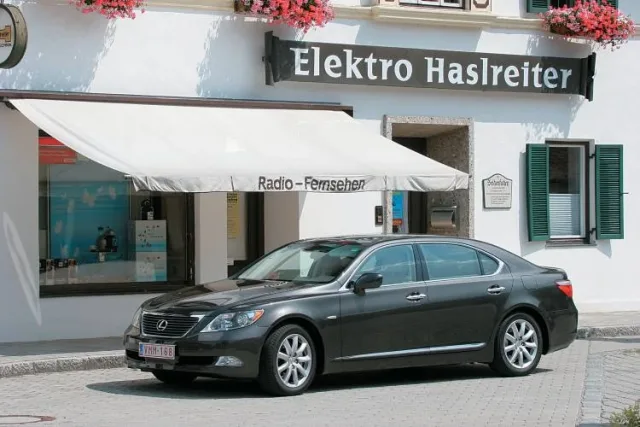
The new Lexus LS is the first car of the brand offered with two wheelbase options. In this photo — the Lexus LS 460L, which is 122 mm longer than the standard one
In the previous car, conservatism seemed forced — simply from a lack of ideas. In the new car, conservatism is no longer a parody but chic. Because Lexus is already self-sufficient, it can afford self-quotations.
Moreover, with all its interior-design conservatism, the Lexus LS is technically innovative — sometimes so much that both BMW and Mercedes can take a rest!
The display is interactive, touch-controlled. For an extra charge — a contactless access card, like in Mercedes, and an Engine Start/Stop button. But the card is unprecedentedly thin — only 3.3 mm thick! And yet, for any emergency, it still contains a "spare" metal key blade.
The seats — both front and rear — have a built-in ventilation system. Moreover, if in the previous car air of the appropriate temperature from the ventilation system was sucked through the perforated leather of the seats, in the new car each seat has its own "microclimate": the air is heated or cooled using special electric thermoelectric elements.
The climate system in the new Lexus LS is a source of special pride for engineers. In addition to the standard compressor, an additional electric compressor with a power of 1100 W is provided for rear passengers. And for left-hand drive cars, they promise to install an electric heater that will provide warmth in the cabin even before the engine warms up. But the main "trick" is not in the 13 sensors (among which there is even a tobacco smoke sensor) and not in two filters. It is located on the ceiling: right above the heads of rear passengers, two large grilles resembling speakers are displayed. Only it is not music that flows from them, but air — cold or hot. The word "dousing" is perfect for such deflectors. In 35-degree heat, sitting on the rear sofa, you feel how coolness envelops your body from two sides at once — from below, from the cushion, and from above, from the ceiling. Incredibly comfortable.
Behind the wheel, similar impressions arise, but for a different reason. Driving a five-meter car turned out to be surprisingly easy — perhaps because all instruments and controls are intuitively understandable. The turning circle is only 10.8 meters. The steering settings seem perfectly balanced: neither excessive sharpness nor sluggishness. Moreover, the sensitivity of the steering wheel changes depending on the situation: the VGRS gearbox built into the base of the steering column allows only 2.5 turns from lock to lock when parking, and with an increase in speed, the gear ratio smoothly increases to 3.6 turns.
The electromechanical power steering pleases with precision — on winding sections, your hands feel a pleasant informative load. The suspension, despite its complexity, deserves special praise. Aluminum arms in terms of engineering perfection can quite compete with the creations of Bavarian colleagues. Instead of traditional springs — pneumatic elements, and shock absorbers with adjustable valves are controlled by a computer individually for each wheel. The result is impressive: during emergency braking, the two-ton sedan almost does not dive, and in corners, rolls are minimal. The smoothness of the ride, at least on the pre-production examples we tested in Austria, also did not cause any complaints.
The brake system is a separate topic for discussion. If Mercedes engineers, when creating the new S-class, abandoned complex electro-hydraulic brakes in favor of a classic scheme with a vacuum booster, then Lexus went in the opposite direction. The new LS is the only one in its class to use the ECB system with an electrical connection between the pedal and hydraulics. At the same time, all key systems — brakes, steering, and stabilization — are combined into a single VDIM complex, which can do much more than just protect against skidding.
The power unit is also not simple. The new 4.6-liter V8 is created on the same principle as the engine on the hybrid GS 450h — with combined injection, combining conventional and direct injectors. The Japanese do not hide their pride, comparing their engine with the Bavarian unit on the BMW 750i. And this comparison is in their favor: 380 hp and 493 Nm from 4.6 liters versus 376 hp and 490 Nm for BMW with 4.8 liters. Mercedes with a similar volume of 4.6 liters is generally content with 340 hp and 430 Nm.
At idle, the engine is silent, and with an increase in speed, it sounds pleasant and muffled. The thrust is smooth and always ready to work. A significant role here is played by the new eight-speed automatic transmission — a world premiere for this class. The Japanese claim shifts in 100 milliseconds, which, according to them, is faster than ZF transmissions on BMW. It is hard to believe in superiority over the latest gearboxes, but the work of all eight gears is truly impressive: the change occurs rapidly and absolutely imperceptibly, without any jerks.
The gearbox also brings savings: the range of gear ratios is 10% wider than that of the six-speed "automatic" BMW 750i or the seven-speed Mercedes S 500. The average consumption of 14.8 l/100 km after a trip through the Austrian Alps is a worthy result for a two-ton car with a gasoline engine.
Having driven about three hundred kilometers in a pre-production car, I caught myself thinking that I was beginning to feel almost sympathy for it. Yes, there is no outstanding dynamics or thrilling handling. The interior does not shine with bright details. But the Lexus honestly fulfills its task: it transports me with comfort and luxury. Moreover, this luxury is unobtrusive — such that you do not notice it, just as you do not feel a just-worn expensive suit on yourself.
The door closers in this car work so delicately that you simply do not notice them: compact electric motors with planetary gearboxes perform their task in just a third of a second. When the servo drive closes the trunk lid, at the last 15 millimeters of travel it automatically slows it down — so that the final contact occurs without the slightest impact or sound.
This is the level of the highest class. It is exactly how, quietly and impeccably, the staff of the most expensive hotels and restaurants in the world work.
In addition, the new LS can park in reverse. Radar sensors detect a suitable free space between cars, and the driver only needs to point a finger at the desired point on the screen, where the image from the rear-view camera is broadcast, engage reverse and remove hands and feet — the steering wheel rotates by itself! Of course, this is not a revolution — in Japan, Toyota has been offering the Intelligent Parking Assist system for an additional fee to all buyers of the hybrid Prius since 2003. However, the Lexus LS will become the first car in Europe and America that can park without driver participation.
 |  |  |
| The new engine (factory index 1UR-FSE) is a "V8" with a cylinder bank angle of 90 degrees. The key feature is the simultaneous use of distributed and direct fuel injection (D-4S system): this provides more precise fuel metering and a power increase of 7.5% across the entire speed range. World premiere — electric drives of phase shifters on all four camshafts, which, unlike conventional hydraulic ones, operate at speeds below 1000 rpm and on a cold engine. But the most curious novelty is the eight-speed automatic transmission. It is 10% heavier than the previous six-speed "automatic" (95 kg), but the range of gear ratios is expanded by the same 10%. An improved valve system made it possible to speed up shifts by 40% compared to the old gearbox | External speed characteristics of the 1UR-FSE engine (Lexus LS 460) | Factory measurements show that in terms of aerodynamic noise level in the cabin at a speed of 100 km/h, only the Mercedes S-class can compete with the Lexus |
In addition, the Lexus LS can see in the dark, independently monitors road markings…
The picture is simply idyllic. Are there any drawbacks? Does the Lexus LS really have none at all?
The same question was asked to me by Yoshihiko Matsuda.
— What did you not like? Speak directly. It is very important for us to know the opinion of journalists…
It is not worth talking to a big boss about minor ergonomic flaws (for example, the steering wheel heating button can only be found by looking behind the steering wheel). Only about the main thing.
Firstly, I expected a more spacious cabin. The front passenger cannot move the seat back enough to fully stretch their legs — the rails are a bit short. In the back, it is spacious, but now cars two classes lower can boast a comparable amount of space.
— Hmm… — Matsuda-san thought. — And the long-wheelbase version? After all, you tested not only the standard LS 460, but also the extended LS 460L, right?
Yes, for the first time in the 17-year history of the Lexus brand, the flagship LS will also be offered in a version extended by 122 mm. In the "long" car, the rear sofa is replaced by two separate seats, and the right one is equipped with the Ottoman seat function. This means that with the help of servos, you can adjust not only the backrest tilt and cushion length, but also raise the leg support.
But here is the problem: if someone is sitting in the front passenger seat, then the "footrest" when unfolding rests against the back of the front seat. I managed to use the "ottoman" only by moving the front seat all the way forward with special buttons on the armrest. I leaned back — and mentally transported myself to evening Tokyo. My Lexus LS 460L silently glides from traffic light to traffic light, neon signs of Ginza or Shinjuku are reflected in the windows. I should massage my back after a game of golf — it is enough to take the massage control panel out of the box, and the pneumatic chambers built into the "ottoman" will begin a shiatsu session, kneading tired back muscles.
It has been a long time since I ate fugu fish…
 |  |  |
| Idle: direct injection on intake stroke | Under load: parallel injection on intake stroke | Cold start: first port injection on intake stroke, then direct injection on compression stroke |
| The "port" injector delivers gasoline into the intake manifold at a pressure of up to 4 atm, while the "direct" injector delivers it into the combustion chamber at a pressure of 130 atm. At idle, only direct injection is used; at medium and high loads, both injectors operate in parallel (on the intake stroke). The exception is cold start, when direct injection additionally enriches the mixture at the end of the compression stroke | ||
However, I couldn't imagine myself as a wealthy Japanese person: the "ottoman" cushion turned out to be too short for me! And although the front seat slid forward, humbly crouching, my feet still reached it. Not because my legs are that long, but because... Well, on production cars, the front seat rails will be lengthened, and the seat will slide forward another 45 mm.
But be that as it may, the Japanese clearly chose the geometry of the "ottoman" for the long-wheelbase car to suit themselves. And why is the massager installed only in the right rear seat of the L version? Why doesn't the Lexus LS have massaging front seats like the S-Class and BMW 7 Series?
— Oh, that's prohibited by Japanese laws, — they began to explain to me in a flurry. — The Ministry of Land, Infrastructure, Transport and Tourism believes that massage distracts the driver from driving...
How about that? They, in Japan, care about safety, while we, you know, have to suffer without massage?
I also complained about the lack of thrust in the long-wheelbase car: if the regular Lexus LS 460 is brisk and cheerful, the heavier LS 460L accelerates somewhat sluggishly, without spark.
— Yes, I agree with you here, — Matsuda-san didn't argue. — But don't forget about the Lexus LS 600h, which we will introduce next year. There will be enough thrust for the long-wheelbase LS 600hL as well, I assure you...
The letter h in the LS 600h index means a hybrid powertrain — two electric motors will work in tandem with the V8 engine, as in the Lexus GS 450h, and together they will provide about 430 hp. Moreover, if the Lexus LS 460 is rear-wheel drive, the LS 600h will be equipped only with all-wheel drive. And not a "surrogate" one, but a real one — permanent all-wheel drive!
And here the Japanese have outdone Europe, not to mention America. The GM—DaimlerChrysler—BMW consortium is only testing a hybrid transmission (made, by the way, according to Toyota's canons), while Lexus is already ready to bring to market the world's first petrol-electric luxury sedan. And also all-wheel drive.
| One-piece door moldings are the pride of the Japanese: they are cast in a vacuum and finished by hand |
And why is that? Is it because Toyota and Lexus live under the rule of engineers — such as Yoshihiko Matsuda? Is it because they still make their cars with sincere love and enthusiasm?
— Did you notice the chrome moldings on the side windows? — Matsuda-san asked me. — On all other cars, the window moldings are composite, but ours are solid: we cast and mill them as a single piece for the first time. Didn't you notice? Nobody notices...
And he sighed sadly.
Only in Japan can such attention be paid to such, from a European point of view, trifles. Because for the Japanese, inner beauty means a lot. And if they approach window moldings with such reverence...
The Lexus LS is beautiful in a Japanese way. Despite the fact that the Lexus brand was created for America, despite European ambitions... It is a Japanese car, from the moldings cast as a single piece to the electronic brain of the bones. The embodiment of the J-factor, the culmination of chief designer Wahei Hirai's idea of a crystallized and consciously applied "Japanese component." Even the mistakes here are typically Japanese — like the too-short "ottoman" or the lack of a massager on the front seats.
And if you trace the evolution of Lexus cars, these mistakes are becoming fewer and fewer...
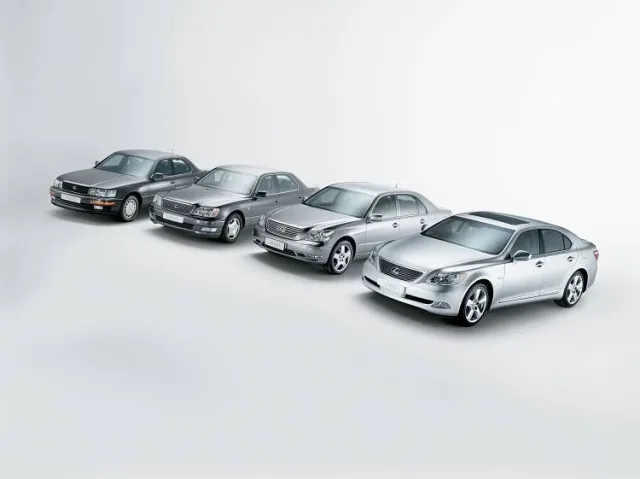
| First generation: Lexus LS 400 (1989—1994). Since 1993, it was produced with more efficient brakes, larger diameter wheels, and a standard front passenger airbag | Second generation: Lexus LS 400 (1994—2000). Essentially a deep restyling. In 1997, the exterior was refreshed, and the engine gained variable valve timing VVTi | Third generation: |
The Lexus brand has a very short history — only 23 years. The beginning was laid in August 1983, when the head of Toyota Motor, Eiji Toyoda, announced the daring F1 project (from the word "flagship") at a board of directors meeting. To create a flagship sedan for the American market, 60 designers were involved, including from the Californian studio Calty, as well as 1400 engineers divided into 24 groups, 2300 technicians, and another 220 support staff. To study competitors, a BMW 7 Series and the then Mercedes S-Class W126 were bought and disassembled down to the last screw, and marketing surveys were conducted in New York, San Francisco, and Miami.
The first production Lexus LS 400 (Luxury Sedan with a four-liter engine) appeared in 1989 — with a four-speed automatic and a refined Toyota V8 engine producing 260 hp. The public received the new product without enthusiasm: the derivative design gave rise to much ridicule. In one American TV series, a car thief even apologized to his accomplice: "Sorry, it was dark, I mistook it for a Mercedes."
But in terms of noise insulation, ride smoothness, and equipment, the Lexus was on par with its analogues. And most importantly, with excellent Japanese build quality, the LS 400 cost less than $40,000 — $10,000–20,000 cheaper than a Mercedes or BMW. In addition, the Japanese seriously invested in sales culture, which even dealers of prestigious European brands could not boast of. The two years remaining before the appearance of the much more technically advanced Mercedes S-Class W140 were enough for the new luxury brand to win the trust of wealthy Americans. Since 1992, Lexus has been the leader of the North American market among foreign luxury brands. In 2005, global sales reached 386 thousand cars, of which the Lexus LS accounted for almost 33 thousand — that's 8.5%. But in Europe, the flagship did not take root: only 1,091 units of the LS 430 were sold, including 319 cars in Russia. The change of generations should approximately double sales. Overall, for 2006, the brand forecasts sales of almost half a million cars.
In Russia, the Lexus LS 460 will appear in December and will cost more than its predecessor, for the first time crossing the $100,000 mark.