
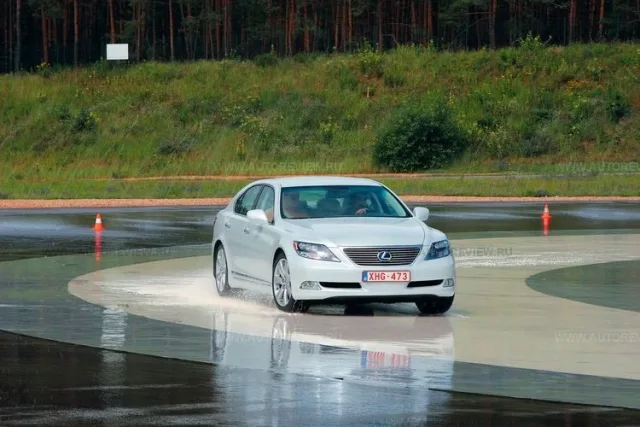
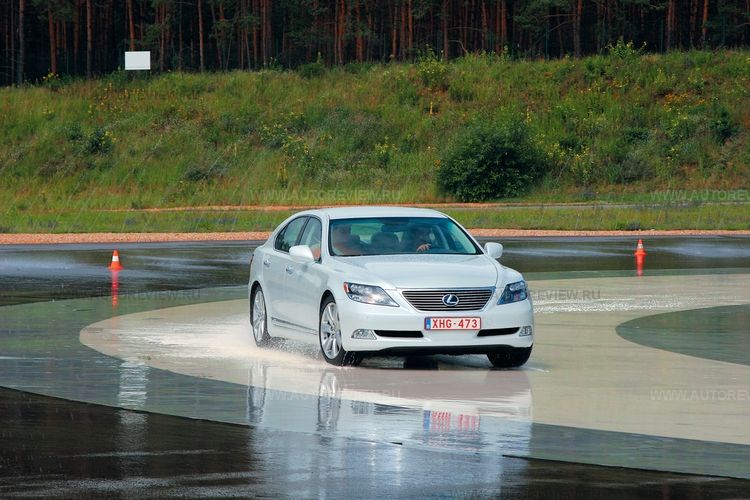
Now even Lexus has become the hero of jokes. We're talking about the "six hundredth" LS 600hL — a version with a long wheelbase, hybrid powertrain, and all-wheel drive. True, the "six hundred" here is only in the name — under that index, Mercedes hides a real V12, while Lexus has a five-liter V8 with 394 horsepower under the hood. But it's joined by an AC electric motor integrated into the proprietary Toyota Hybrid Synergy Drive transmission. True, it only helps until the battery runs out…
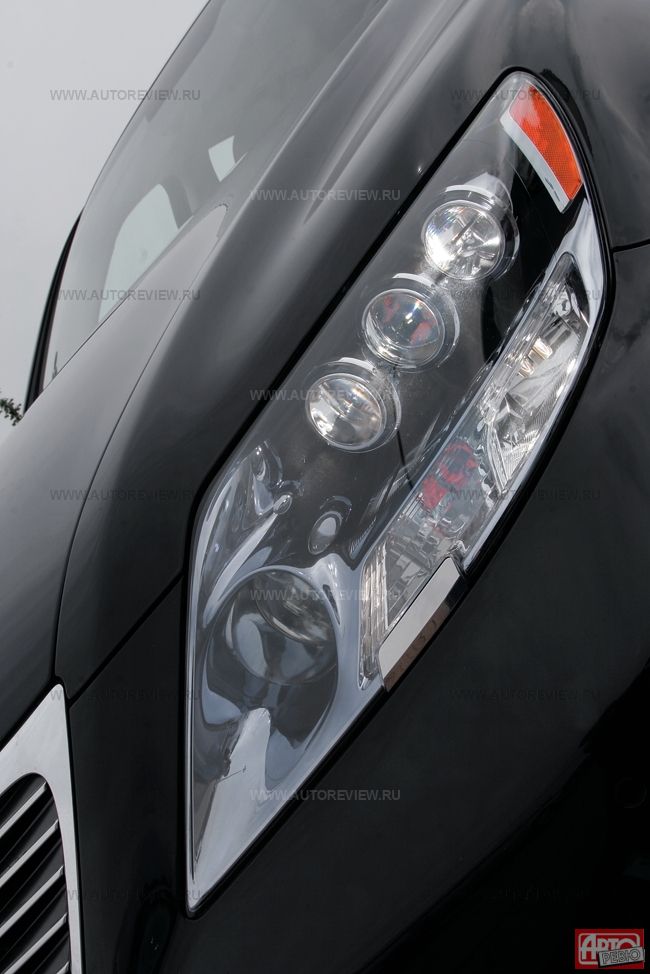 |
| LEDs paired with powerful lenses illuminate the road no worse than "xenon" |
Toyota engineers' fears that hybrids wouldn't catch on in the Russian market have been dispelled — the Lexus RX 400h and GS 450h together account for about a quarter of all sales of these models! Are our compatriots really so concerned about the environment that they're willing to overpay for energy recuperation? Or do they feel sorry for the few liters of gasoline that a hybrid Lexus saves on every hundred kilometers?
Most likely, it's something else. It's just that a hybrid today is stylish. Look at how well thought out everything is: the electric motor sits on the same axis as the planetary gearbox, next to a massive generator. When braking, kinetic energy doesn't turn into heat but is converted into electricity and stored in nickel-metal hydride batteries. And during acceleration, this reserve adds torque to the wheels.
Beautiful!
By the way, the LS is not only technically advanced but also, in my opinion, the most attractive Lexus externally. Inside, it's a complete triumph of the signature L-finesse aesthetic.
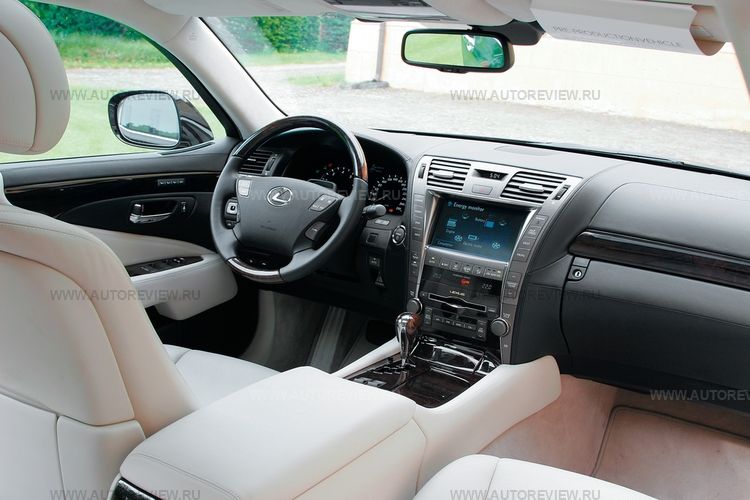
The interior features a harmonious blend of luxury and practicality
However, we've already written about all this in the test of the gasoline LS 460 (see AR No. 15, 2006). How does the "electric" LS 600hL differ from it? Externally — only by badges and new LED headlights. Three lenses in each headlight provide bright "daytime" light. The light is adaptive — when turning, the headlights follow the steering wheel and swivel up to 15 degrees. Inside, there are also few differences. They didn't integrate a wattmeter into the instrument panel as on the GS 450h, but left the familiar tachometer. However, on the left, instead of the temperature gauge, a simple indicator appeared showing what the powertrain is doing: charging the battery (charge) or delivering energy (power). However, the most visual way to monitor power flows is on the nine-inch color display. There you can enable a "cartoon" showing how energy flows from the batteries to the electric motor and wheels — or back.
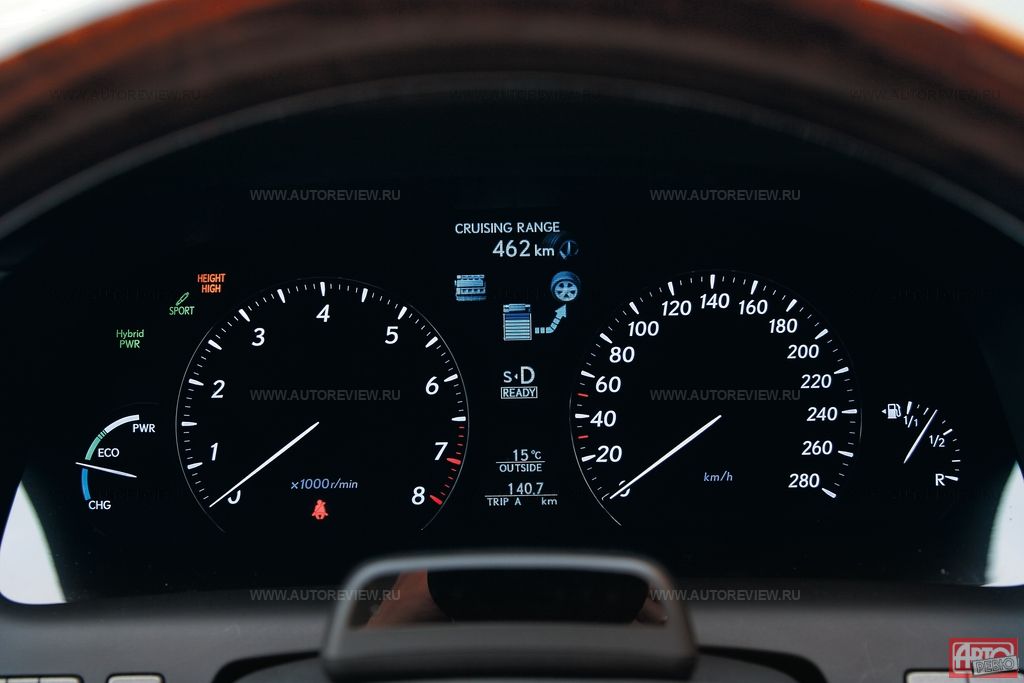 | 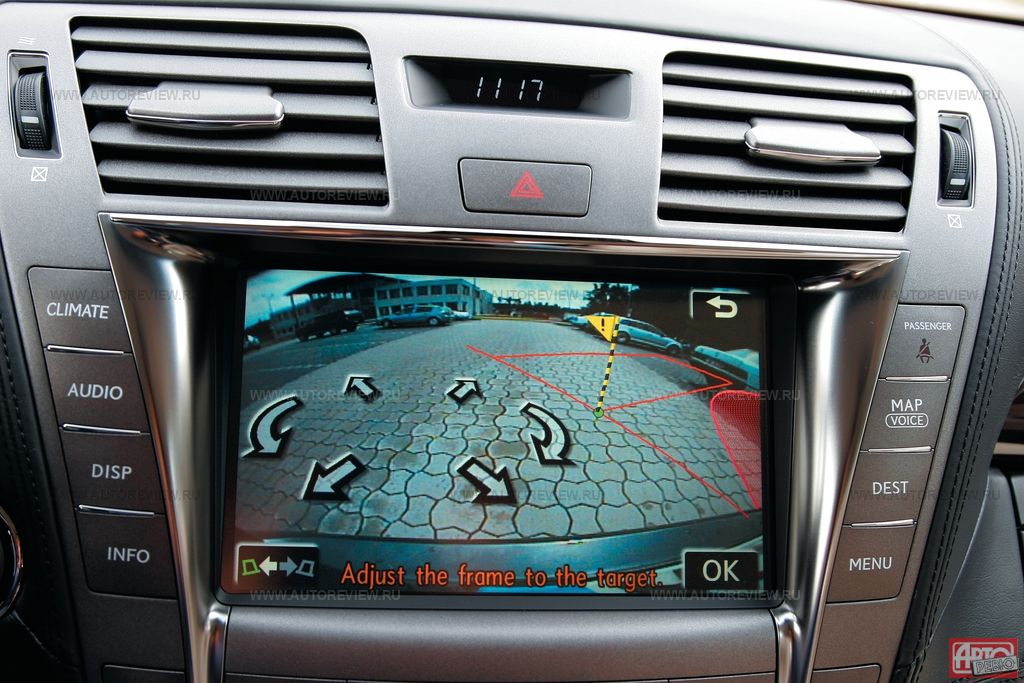 | 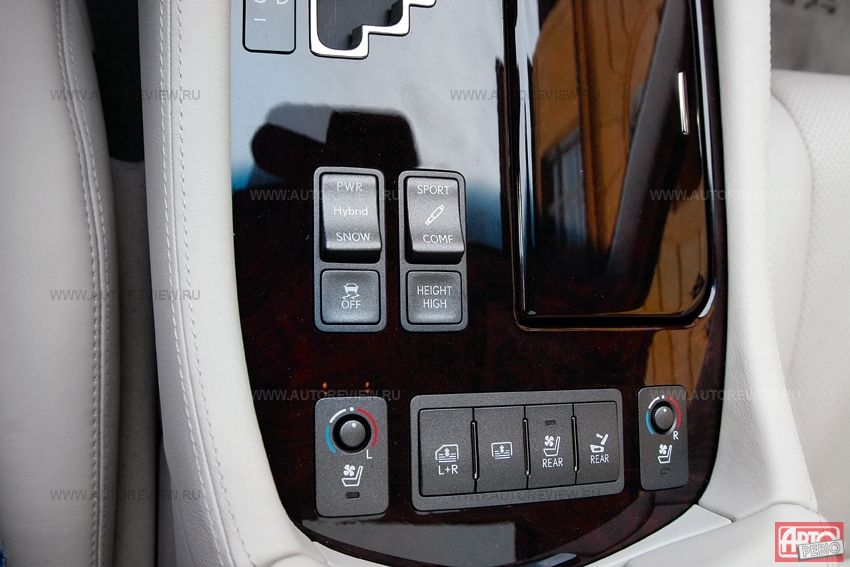 |
| On the optitronic instrument cluster — a simplified diagram of the hybrid drive operation | The intelligent system allows parking "hands-free" — you just need to align the red rectangle on the screen where the car will go, and press the gas or brake as commanded by the electronics. "Electronic" parking is possible both in line and "shoulder to shoulder" | On the center tunnel are transmission and suspension control buttons, as well as knobs for seat heating and ventilation |
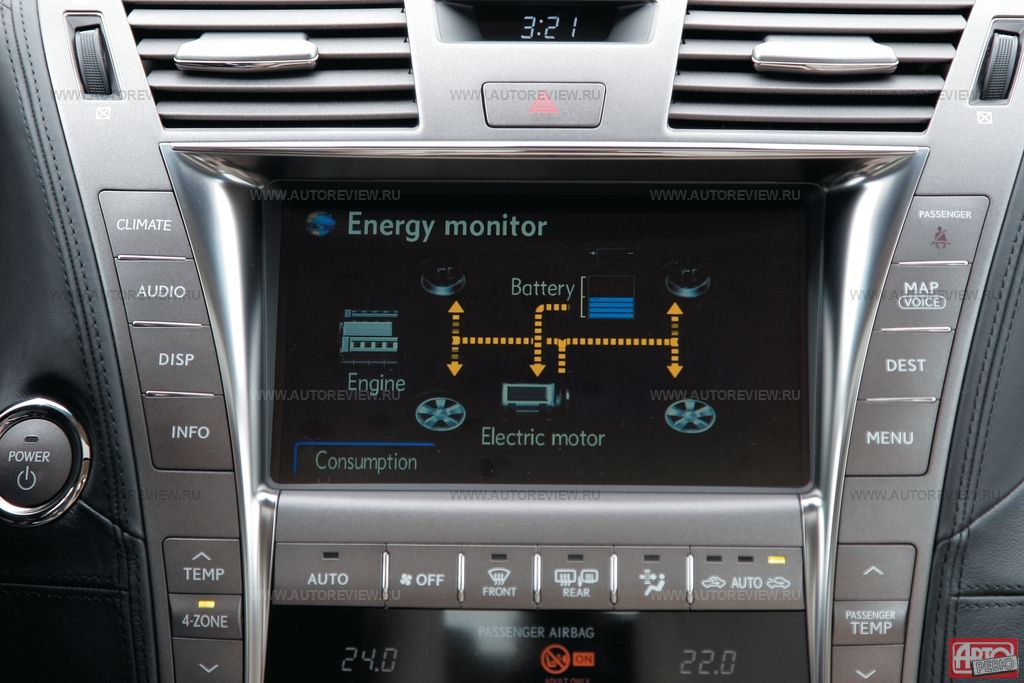 | 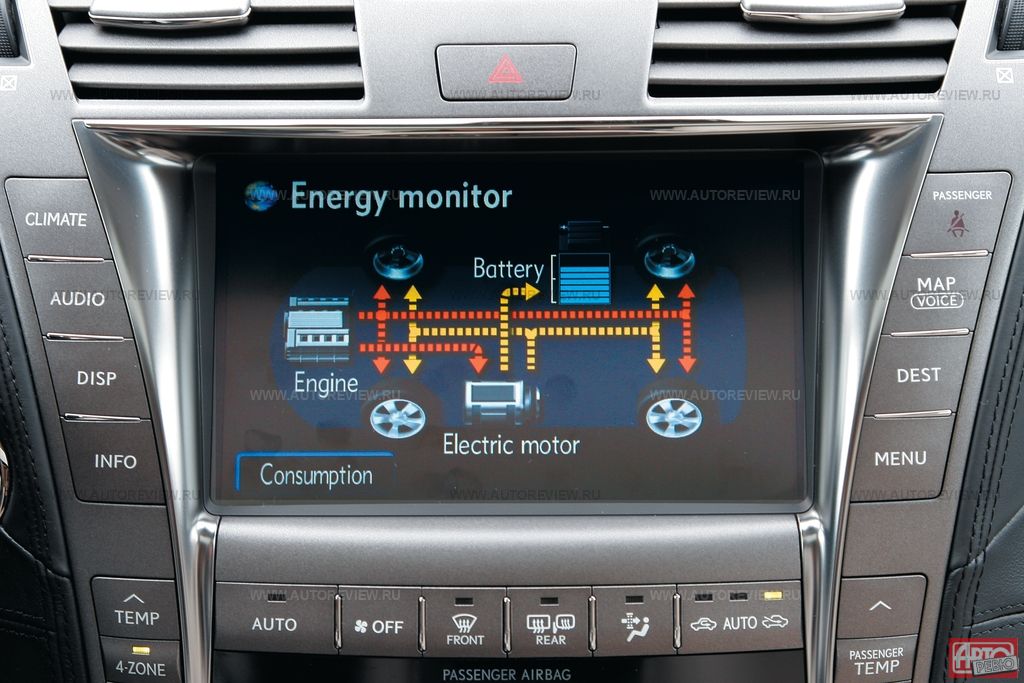 | 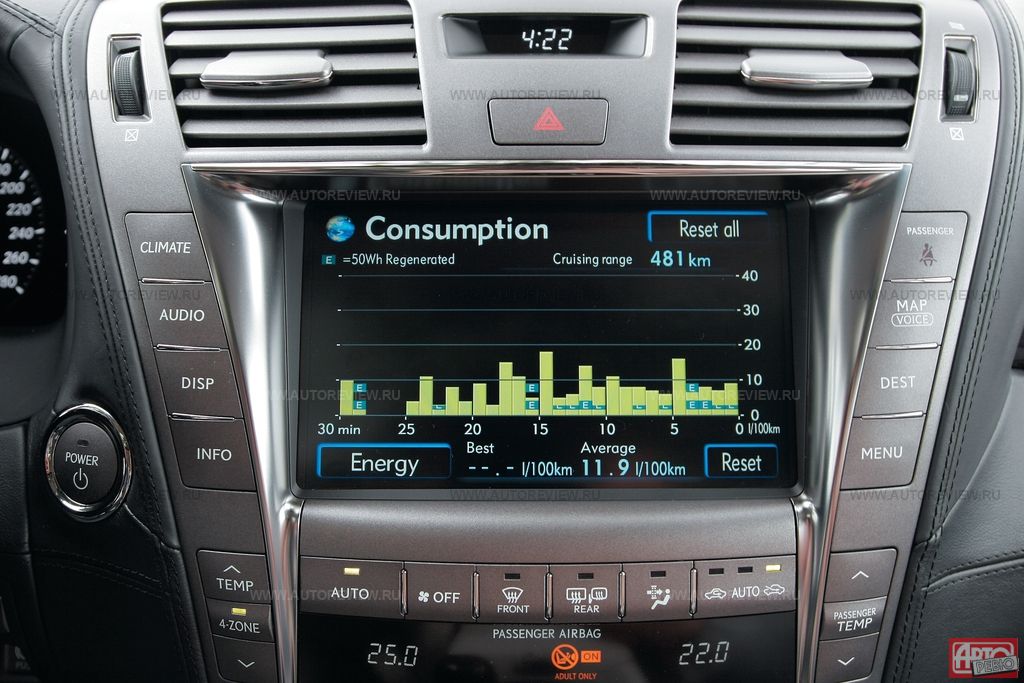 |
| Now the gasoline engine is not running — the car moves on electric power. On a fully charged battery, the Lexus LS 600hL can travel about two kilometers at a speed of 30 km/h | Now the gasoline engine not only drives the wheels but also charges the battery | During braking, energy recuperation occurs: the full square is 50 W into the battery "basket" |
The selector for the electromechanical transmission is the same as the regular "automatic" on the gasoline Lexus. There's even a Sport mode with manual shifting. Gears? In fact, the hybrid transmission has only two steps, and the transition from first to second occurs automatically at 90 km/h. But in Sport mode, the electronics simulate the operation of an eight-speed "automatic," fixing virtual gears.
However, the same transmission is also on the GS 450h (see AR No. 11, 2006). But the LS 600hL additionally received a transfer case — it's all-wheel drive! Moreover, the drive is permanent, with a Torsen high-friction center differential, which under normal conditions splits torque between the axles in a 40:60 ratio. Just like on modern Audis!
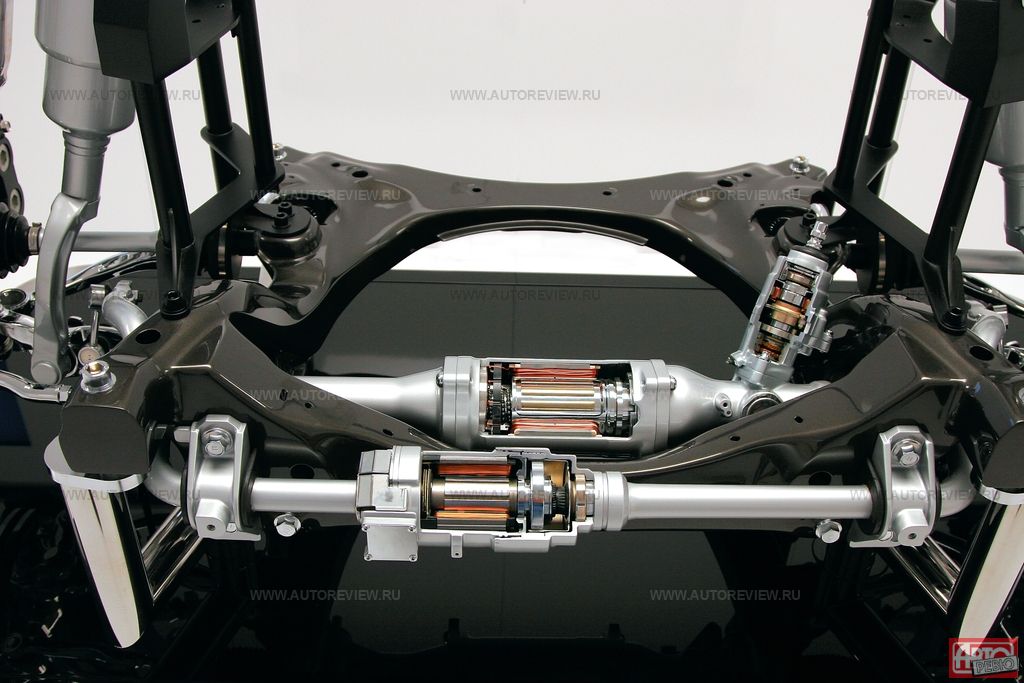 | 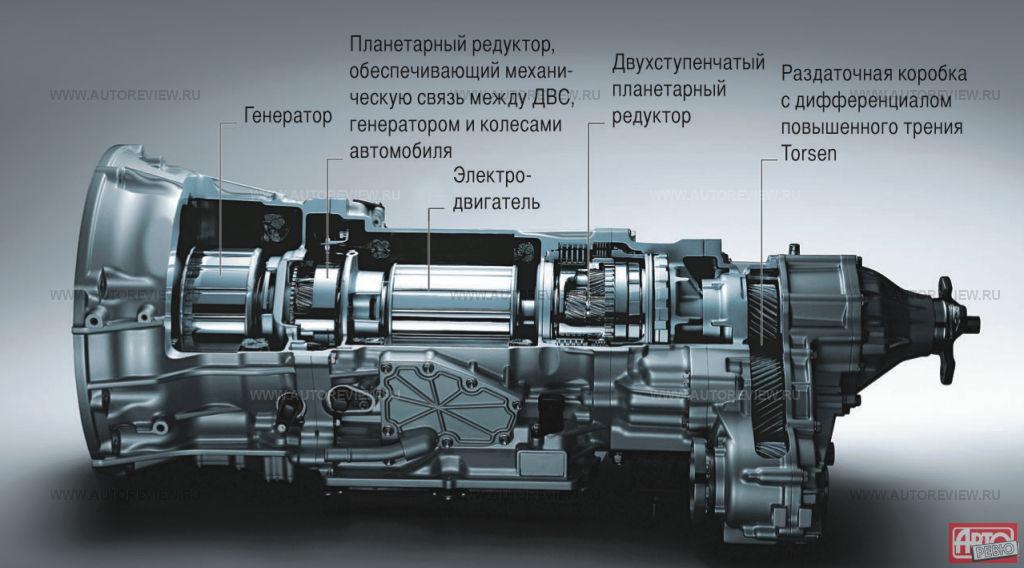 |
| The stiffness of the stabilizer bars is changed using electric actuators (front). The power steering (rear) is also fully electric | The structure of the electromechanical transmission of the Lexus LS 600hL |
Interesting, why didn't the Japanese follow BMW's path and use an electronically controlled clutch like in the xDrive system? Why transfer torque to the front wheels on asphalt, increasing transmission losses? Toyota answers that Torsen is more compact and simpler than any clutch. But there's another reason: during deceleration, permanent all-wheel drive allows the generator to load braking torque not only on the rear wheels but also on the front.
The drive on the Lexus is traditional, but there's an abundance of innovative electronics! Electric power steering, active stabilizer bars with electronic adjustment... By changing the voltage on the windings, the computer controls the stiffness of the stabilizers. Moreover, all active safety systems — including adaptive dampers and active steering — are combined into a single complex.
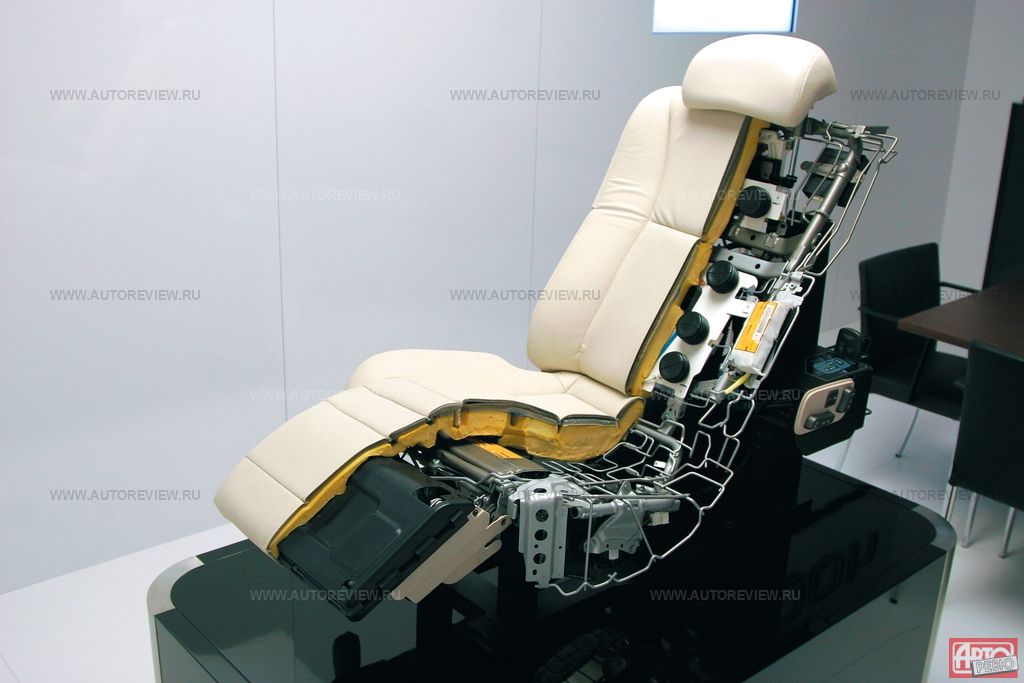 | 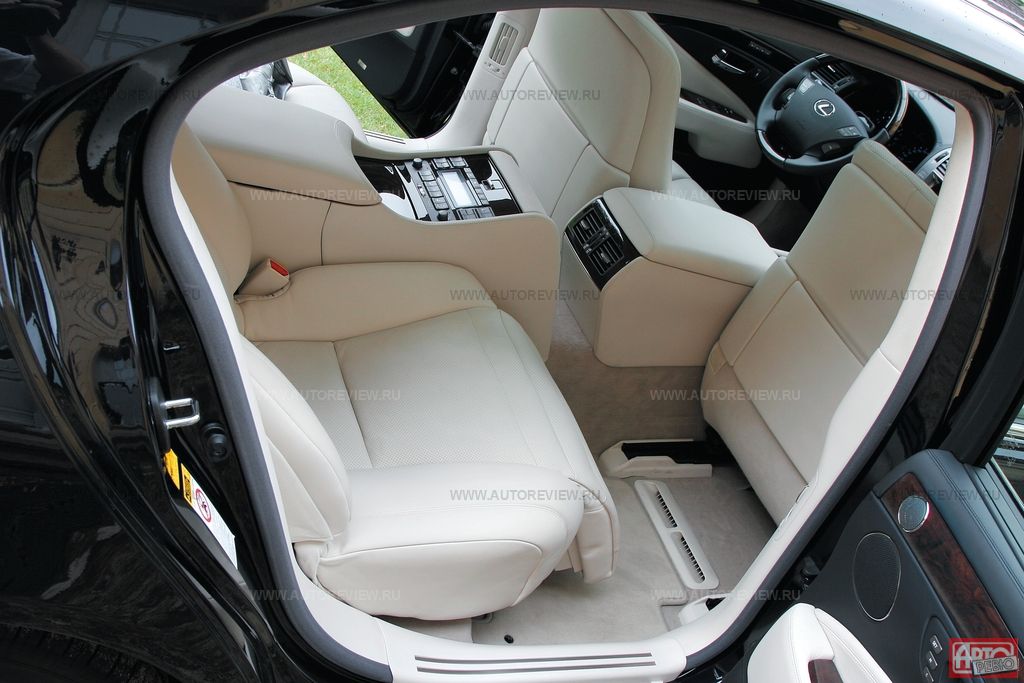 |
| The massage seat features eight pneumatic "fists" | The ottoman seat can only be used after moving the right front seat all the way forward |
Electric motors even control the intake valve timing — indicated by the letter E in the name of the VVT-iE system that equips the gasoline V8. The Japanese claim that while hydraulics only start "turning" the phases at 1000 rpm and oil temperatures above 30°C, the electric drive works on a cold engine and at low revs, reducing emissions of nitrogen oxides and hydrocarbons.
All this is wonderful, but even the Japanese haven't yet learned to make electric motors from composites. After all, any electric motor is steel cores and meters of copper wire... And the batteries weigh a fair amount. As a result, the hybrid LS 600hL with comparable equipment is 300 kg heavier than the purely gasoline LS 460.
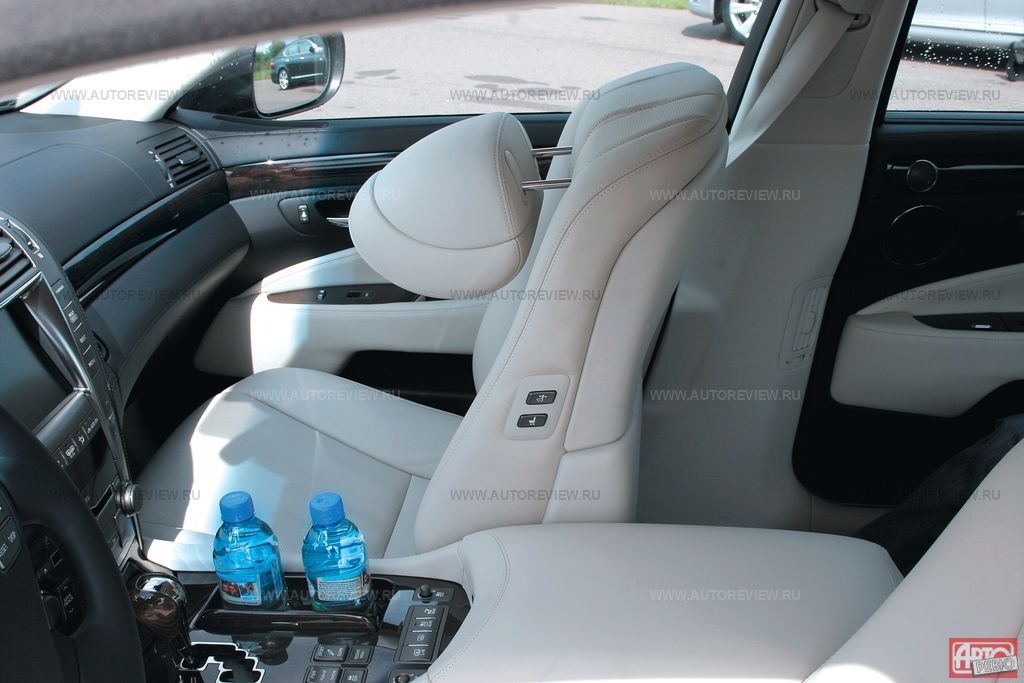 | 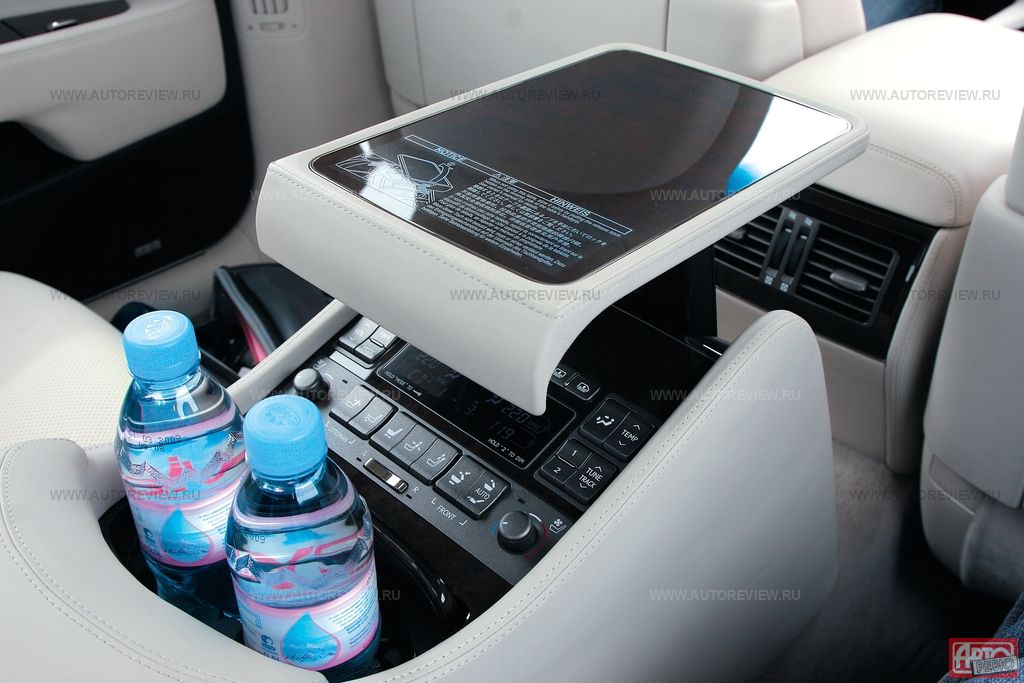 | |
| In the absence of a front passenger, their seat folds up with the press of a button | In the four-seat configuration, a console with a pull-out table and a host of buttons is installed in the rear | DVD changer — standard equipment |
So what's the benefit of the "hybrid"?
Japanese engineers insist that a V12 isn't necessary for the LS — they say the combination of an electric motor and a 394-horsepower five-liter V8 provides the same dynamics. However, the official data says otherwise: the Lexus LS 600hL reaches 100 km/h in 6.3 seconds. That's not impressive, since the regular LS 460 does the same in 5.7 seconds. So the "six hundredth" lags by 0.6 seconds. And that's provided the batteries are fully charged. And once the batteries discharge, the nearly two-and-a-half-ton body has to be hauled by the gasoline engine alone.
The only consolation is modest appetite: just 9.3 liters per hundred in the combined cycle. So, if you don't provoke the gas pedal, the hybrid Lexus allows you to contribute to saving the planet from the greenhouse effect…
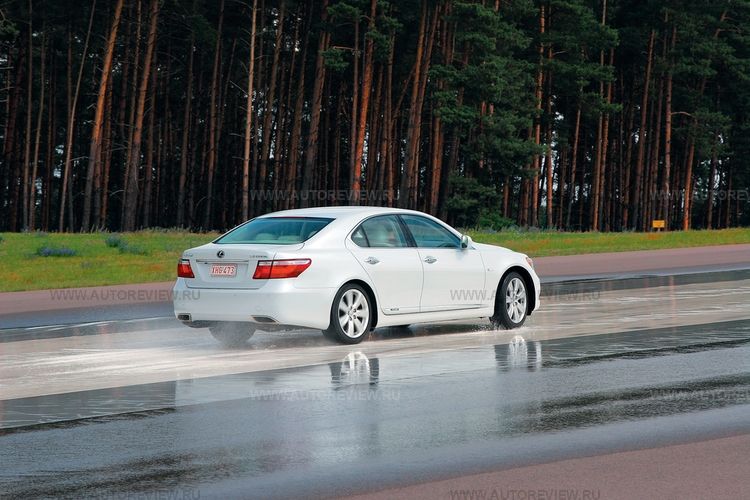
However, the car itself does not encourage aggressive driving. It is clearly tuned not for the driver, but for the passenger in the back seat. And the one behind the wheel can only glide along the highway, enjoying the smooth acceleration. But even aces may have problems with smooth deceleration: you hold the pedal still, but the deceleration still "floats." The secret is simple: part of the braking work is done by standard mechanisms, and part is taken over by the generator in the transmission, which creates braking torque on the wheels. And judging by the sensations, it does this not too evenly.
Handling, stuffed with electronic assistants, also does not shine with transparency. In normal mode everything is fine, but as soon as you speed up to 200 km/h or enter a corner more sharply, the feeling of full contact with the car disappears.
So — down with racing!

In a Lexus, you get pleasure from something completely different. From the feeling of all-encompassing comfort. The suspension is soft, but at the same time it does not allow the body to sway. Sound insulation is exemplary, aerodynamics are excellent (Cx=0.27). According to the manufacturer, at a speed of 50 km/h there is only 53 dB of noise in the cabin, and at a hundred — 60 dB. For comparison: the Russian GOST allows up to 78 dB.
And what about the Mark Levinson Surround System audio system with a 450-watt amplifier for 15 channels and 19 speakers! It's just fantastic.
Let's not forget about climate control, electric curtains, a reclining seat with heating, ventilation and massage...
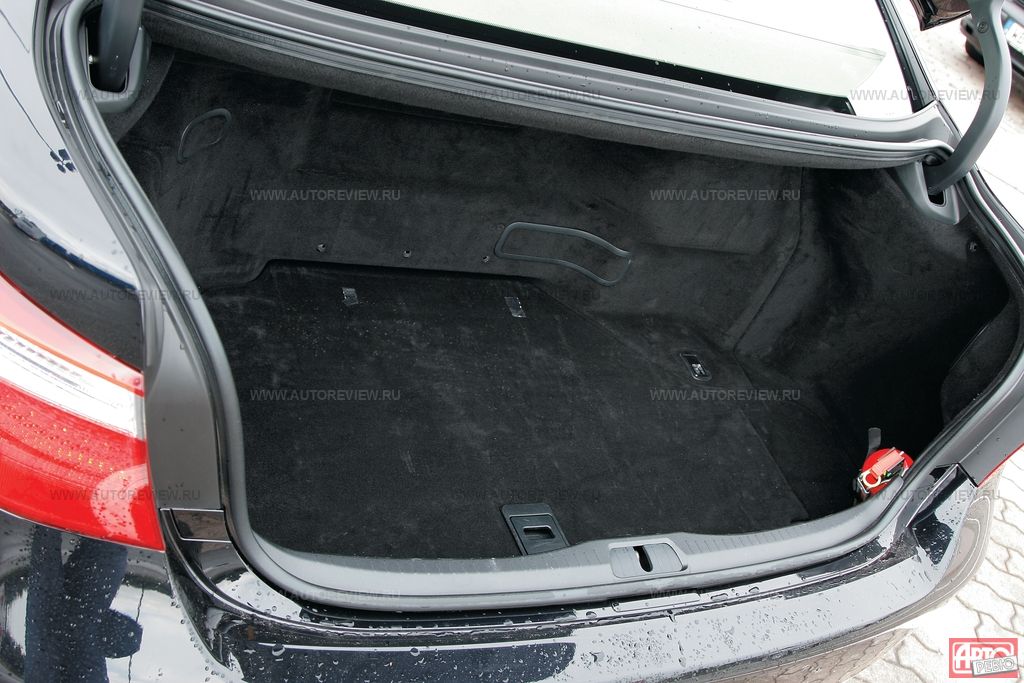 | 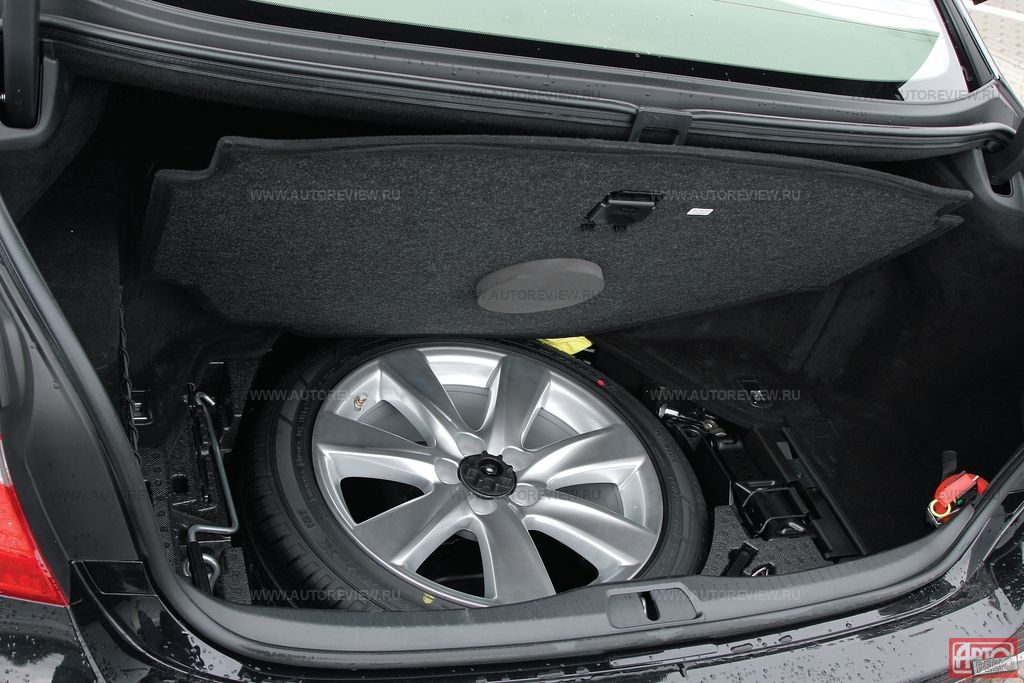 | 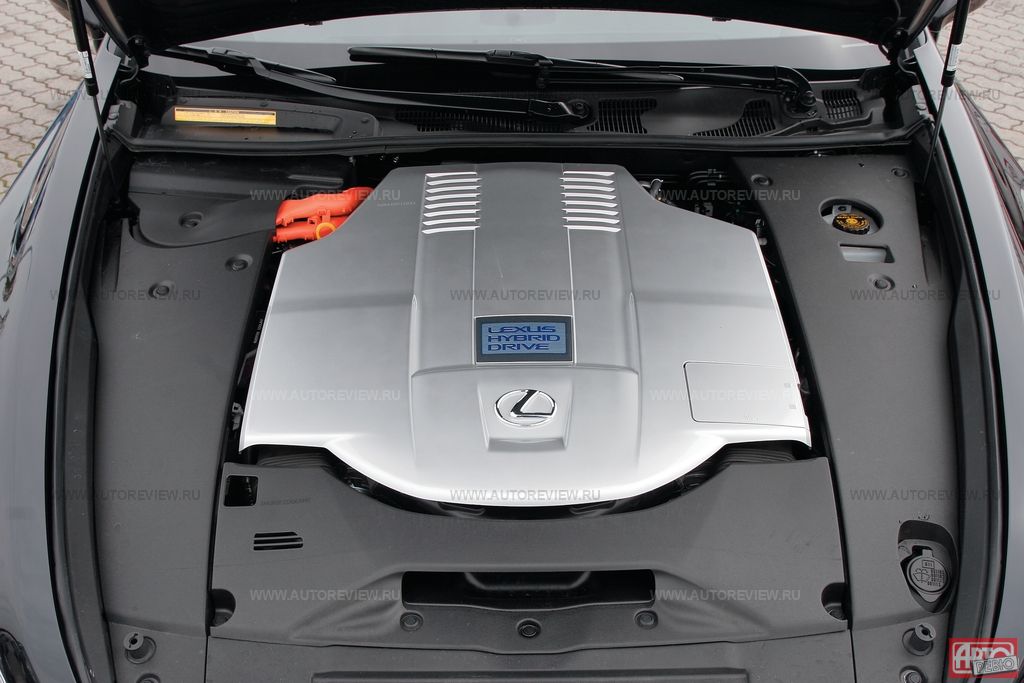 |
| The battery pack, located between the rear seats and the trunk, reduced the latter's volume from 510 to 330 liters | In the small trunk there was room for a full-size spare tire | That's definitely a "slab" engine |
Only the price is steep: the Lexus LS 600hL costs 4,750,500 rubles — that's about 191,500 dollars. You can save only 230 thousand rubles (9,274 dollars) by giving up the ottoman seat, massage and pull-out table. And the most expensive LS 460L will cost "only" a little over four million — 632 thousand cheaper. The difference is 25 thousand dollars! Moreover, the surcharge is for the fact that the car is heavier, accelerates slower and only consumes less fuel. Well, and for all-wheel drive too.
By the way, the short-wheelbase version of the LS 600h will not be officially available in Russia, although in America such a car is sold for 104,000 dollars.
So who is the Lexus LS 600hL aimed at? First of all, at Toyota itself — the company has again written itself into history by being the first to launch a hybrid sedan of the executive class into production. And history will judge how significant this "six hundredth" Lexus will be. And whether it will become the hero of jokes, as once the "six hundredth" Mercedes.
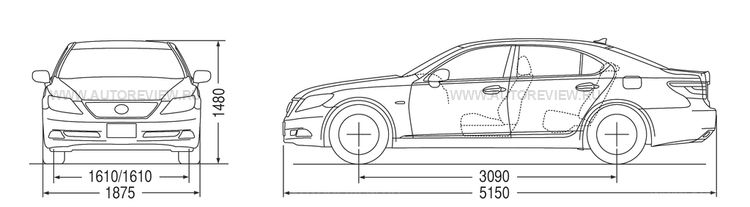
Overall dimensions of Lexus LS 600hL
| Specifications | |
| Vehicle | Lexus LS 600hL |
| Body type | 4-door sedan |
| Number of seats | 5 |
| Trunk volume, l | 330 |
| Curb weight, kg | 2320—2375 |
| Gross weight, kg | 2750 |
| Drag coefficient, Cx | 0.27 |
| Main engine | gasoline, with dual fuel injection system |
| Location | front, longitudinal |
| Number and arrangement of cylinders | 8, V-shaped |
| Displacement, cm³ | 4969 |
| Compression ratio | 11.8:1 |
| Number of valves | 32 |
| Maximum power, hp/kW/rpm | 394/290/6400 |
| Maximum torque, Nm/rpm | 520/4000 |
| Electric motor | synchronous, AC |
| Voltage, V | 650 |
| Maximum power, hp/kW | 224/165 |
| Maximum torque, Nm | 300 |
| Total power of hybrid powertrain, hp/kW | 445/327 |
| Generator | synchronous, AC |
| Voltage, V | 650 |
| Battery | nickel-metal hydride |
| Voltage, V | 288 |
| Transmission | two-stage motor-reducer |
| Drive | permanent, all-wheel, with Torsen center differential with increased friction |
| Front suspension | independent, air, multi-link |
| Rear suspension | independent, air, multi-link |
| Front brakes | disc, ventilated |
| Rear brakes | disc, ventilated |
| Tires | 245/45 R19 |
| Maximum speed, km/h | 250* |
| Acceleration 0 — 100 km/h, s | 6.3 |
| Fuel consumption, l/100 km | |
| urban cycle | 11.3 |
| extra-urban cycle | 8.0 |
| combined cycle | 9.3 |
| Fuel tank capacity, l | 84 |
| Fuel | gasoline AI-95 |
| * Electronically limited | |