
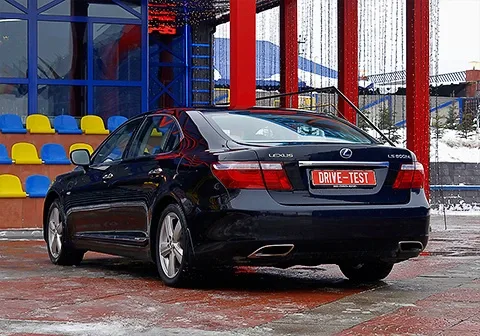
From the rear, only the badges identify the hybrid.
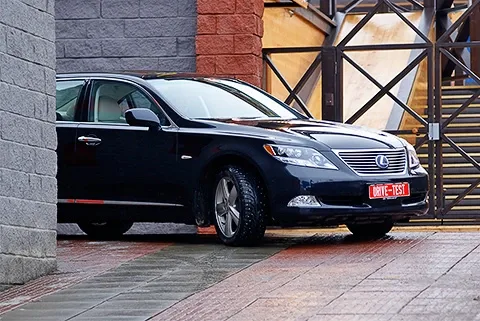
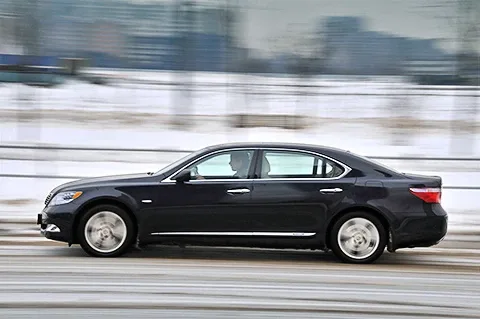
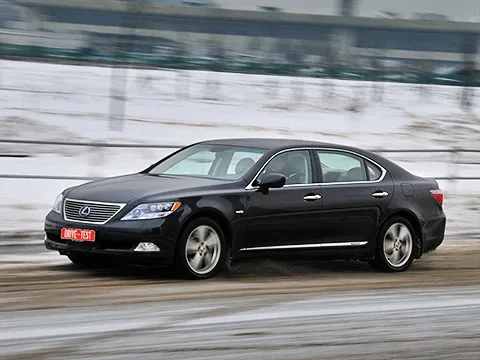
In a straight line, the "six-hundred" flies imperturbably. Large mass, long wheelbase… Even if there's a mix under the wheels, VDIM will do everything timely and imperceptibly for the driver: the integrated vehicle dynamics management system itself doses the traction, steers at small angles with the "active" steering, and distributes the braking balance.
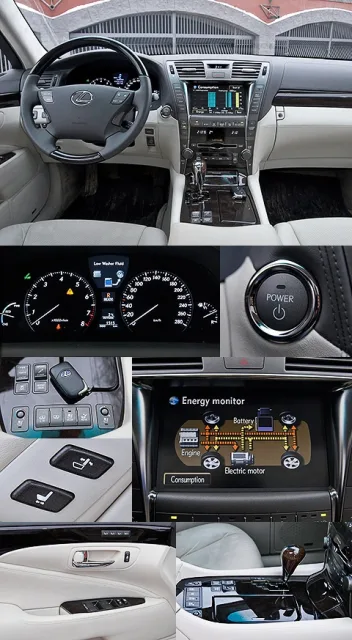
Despite the abundance of buttons and service functions, it's not hard to figure out the sedan's capabilities. The touchscreen display helps a lot. I tested the navigation system. Good graphics, object names are pronounced in Russian (but instructions—not). The system has problems with route planning, and it doesn't know all the new signs and markings. So I didn't use it.
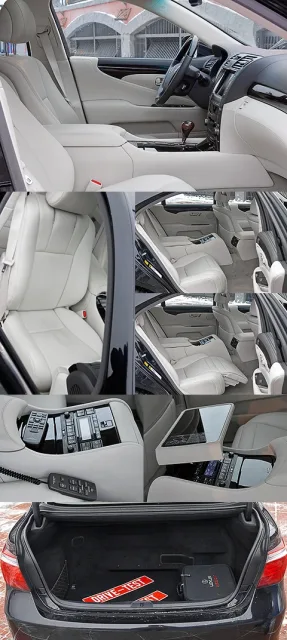
In the back—it's a kingdom. The leather is soft, above your head—white Alcantara. The wood looks magnificent. The lacquer is very pleasant to the touch. The trim materials are at the level of European competitors, and the quality too. In the ceiling—a monitor, in the armrest—a refrigerator and a table. Heated and ventilated seats and a good massage (only on the right) are in place. The only thing missing is a TV tuner.
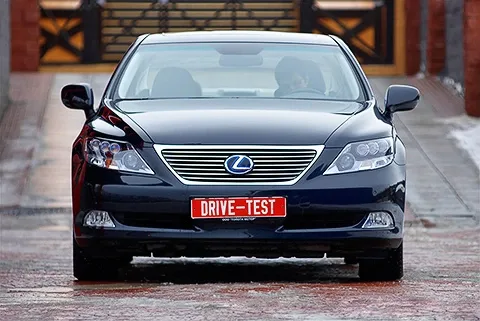
Strange thing, in the "eyes" only rows of three diodes appeared. But how much more solid and arrogant the look became!
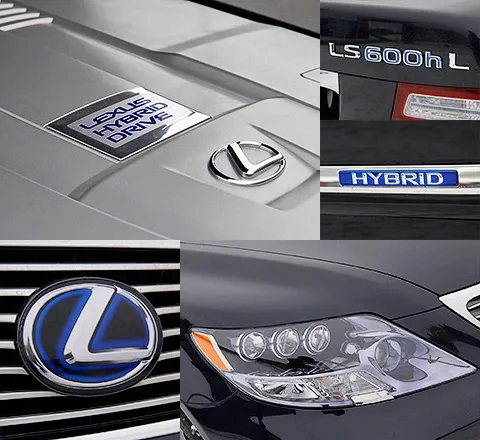
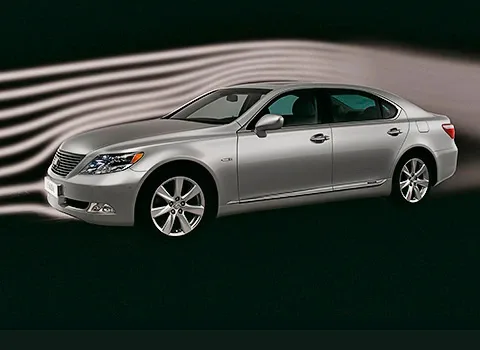
A hybrid is associated with electricity, and electricity is associated (among the Japanese) with blue. Even the headlights have a blue tint. By the way, the low-beam LED light is no worse than xenon. And such headlights are more durable and consume less energy. The high beam here is ordinary, on halogen lamps.

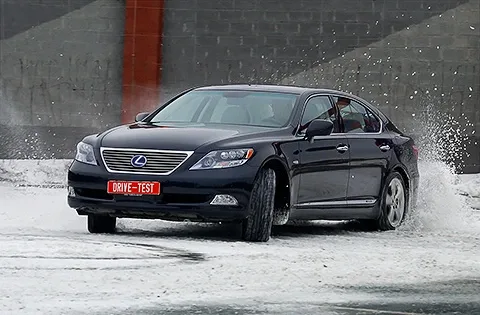
However, you shouldn't particularly count on the handling of a long-wheelbase limousine—behind the wheel of such a car will be a chauffeur, and he's in no hurry. And yet… The handling of the noticeably heavier car has worsened. Although overall it holds almost like the gasoline version. Body rolls are almost absent thanks to active stabilizers, air springs, and variable-damping shock absorbers. The steering with variable ratio still provides excellent feedback and sharpness at any speed. But the extra mass makes itself known. The gasoline LS felt more "transparent." On the other hand, from the perspective of a passenger in the second row, the extra three hundred kilograms are a plus. They make the ride smoother. Although, honestly, the non-hybrid LS had no problems with ride smoothness anyway…
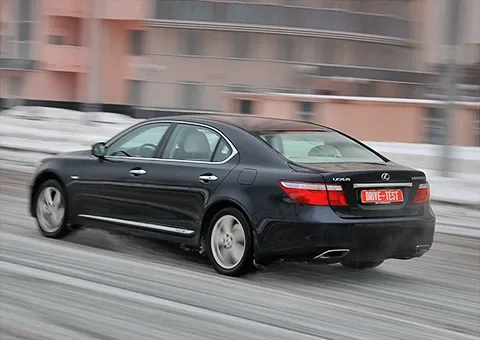
Just as an LX 570 owner is unlikely to ever use all seven seats of their SUV, so too is a Lexus LS 600h owner unlikely to sit behind the wheel. In Russia, short-wheelbase versions are not sold, and driving the long-wheelbase one means admitting you are a "chauffeur." Therefore, the owner will settle into the "royal" seat and ponder that the hybrid accelerates more smoothly, the car is generally quieter and more comfortable, "drinks" less, and also — care for the environment!
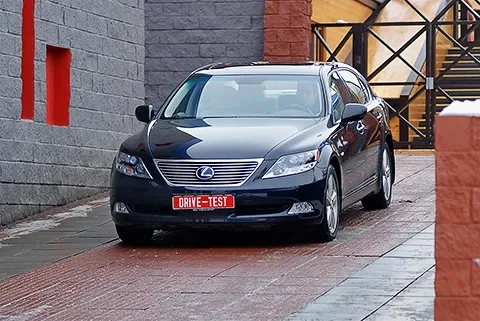
Saving oil with a few thousand LS models? Greenpeace activists, of course, will not consider the LS 600h owner enemy number one, but they won't erect a monument to Lexus either. Mass-market models, which make up the bulk of the vehicle fleet, are still sold, making noise and smoking up the sky. And gasoline is not saved by those who really need it. Now gasoline is saved for the sake of image.
Technical specifications
| Specifications | Lexus LS 600h L |
|---|---|
| Body | |
| Number of doors/seats | 4/4 |
| Length, mm | 5150 |
| Width, mm | 1875 |
| Height, mm | 1480 |
| Curb weight, kg | 2320 |
| Gross weight, kg | 2750 |
| Trunk volume, l | 330 |
| Engine | |
| Type | Petrol, with port and direct injection |
| Location | Front, longitudinal |
| Number and arrangement of cylinders | 8, V-shaped |
| Number of valves | 32 |
| Displacement, cm3 | 4969 |
| Max power, hp/rpm-1 | 394/6400 |
| Max torque, Nm/rpm-1 | 520/4000 |
| Electric motor | |
| Type | Electric, AC |
| Max power, hp/rpm-1 | 224 |
| Max torque, Nm/rpm-1 | 300 |
| Total hybrid drive power, hp | 445 |
| Transmission | |
| Gearbox | Two-speed reduction gear |
| Drive | Permanent all-wheel drive |
| Chassis | |
| Front suspension | Independent, double wishbone |
| Rear suspension | Independent, multi-link |
| Front brakes | Disc, ventilated |
| Rear brakes | Disc, ventilated |
| Performance characteristics | |
| Maximum speed, km/h | 250 |
| Acceleration time from 0 to 100 km/h, s | 6.3 |
| Fuel consumption, l/100 km | |
| Urban cycle | 11.3 |
| Extra-urban cycle | 8 |
| Combined cycle | 9.3 |
| Emission standard | Euro-4 |
| Fuel tank capacity, l | 84 |
| Fuel | AI-95 |
Equipment of the tested car
Standard equipment
Cost of the car in the base Premium trim — 4,516,500 RUB ($182,850)
- Central locking with remote door opening Smart-key
- Electronic contactless access card Card Key
- Door closers, trunk, electric trunk lid
- Illumination system when entering the cabin
- Leather interior, dashboard covered in leather
- Leather multifunction steering wheel with wood trim and heating
- Cooled compartment behind the rear armrest
- Front seats with lumbar support and electric drive
- Driver's seat memory (3 options)
- Ventilation for front and rear seats
- Electrically adjustable headrests for all seats
- Rear seats with electric drive
- Rear armrest with controls without a hatch to the trunk
- Cruise control
- Heated windshield in the wiper area
- Rain, parking (front and rear), and light sensors
- Multifunctional color display (TFT)
- Touchscreen display on the center console (EMV)
- Bluetooth
- Mark Levinson audio system (19 speakers, DVD changer, MP3 and WMA)
- Rearview camera with guidelines
- Roof-mounted 9-inch monitor for rear passengers with remote control
- 4-zone climate control
- Power sunshades
- Headliner and other interior elements trimmed in Alcantara
- Immobilizer, alarm
- Front, knee airbags for driver and front passenger, side airbags for all seats, curtain airbags
- Child seat anchors (ISOFIX)
- Air suspension
- Adaptive variable suspension (AVS)
- Height control (AHC)
- Electronically controlled braking system (ECB)
- ABS, Brake Assist
- Electromechanical parking brake (EPB) with Brake Hold function
- Traction control system (TRC)
- Vehicle stability control (VSC)
- Vehicle dynamics integrated management (VDIM)
- Electric power steering (EPS)
- Variable gear ratio steering (VGRS)
- Power sunroof
- Tires 245/45 R19 on alloy wheels
- LED low-beam headlights
- Headlight washers
- Adaptive front lighting system (i-AFS)
- Rear Ottoman seat with adjustable leg support, reclining backrest up to 45°, and massage function
- Center console between rear seats with leather and wood trim, with controls and folding table
- Front passenger seat without lumbar support with folding headrest
Cost of the car in the base Premium trim — 4,516,500 RUB ($182,850)
Technology
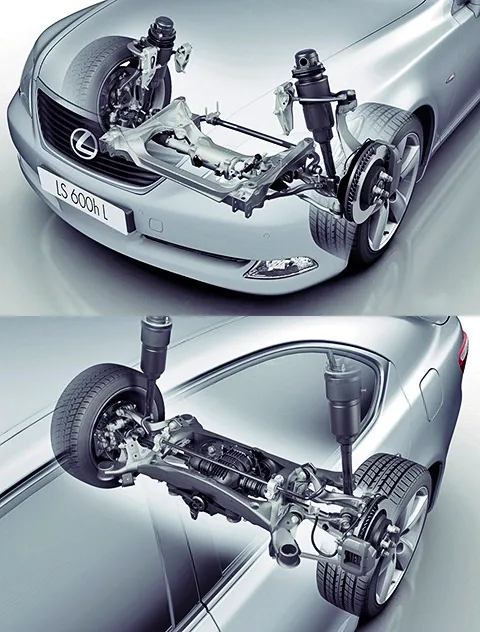
The shock absorbers are equipped with electronic control, allowing switching between three damping modes: Sport, Comfort, and Auto. In Sport mode, the difference in strut stiffness on one axle in corners can reach 20%. Air springs monitor the body position and adjust the ground clearance. Active stabilizers, together with the shock absorbers, dampen body roll. Their adjustment is performed by an electric drive mechanism located in the center of each "stabilizer." The electric power steering smoothly and imperceptibly changes the gear ratio — the steering wheel can make either 2.5 or 3.6 turns from lock to lock. If trajectory correction is needed, the VDIM system steers the wheels at small angles.
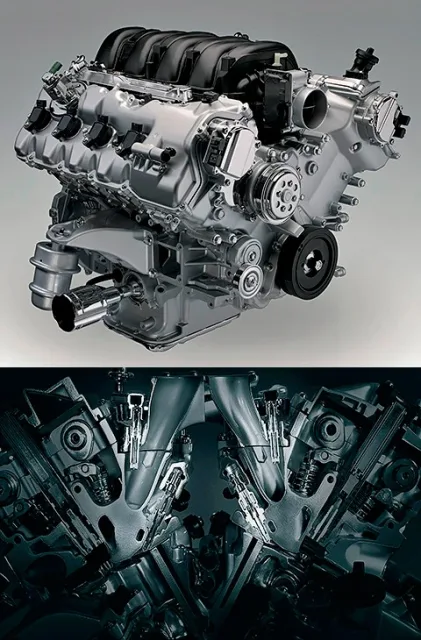
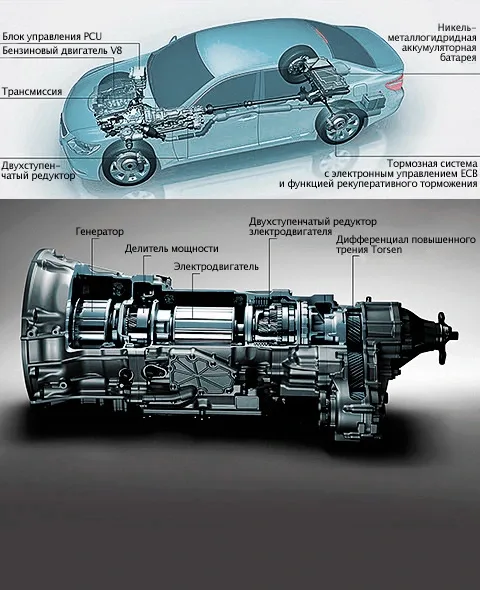
The five-liter V8 was created based on the 4.6-liter engine by increasing the piston stroke from 83 to 89.5 mm. The cylinder block is cast from aluminum alloy, and the camshafts are hollow. For maximum efficiency, the engine has both port and direct fuel injection. Each cylinder has two injectors: one in the combustion chamber, the second in the intake port. The D-4S system works as follows: at idle, direct injection is used. At low and medium speeds, both injectors operate. At maximum load, only direct injection is used. This ensures more complete fuel combustion and additional cooling of the cylinders. The engine is also equipped with a Dual VVT-iE variable valve timing system with electric drive. Assisting the internal combustion engine is a state-of-the-art electric motor. It is brushless, with permanent magnets, and water/oil cooling. The operating voltage is 650 V, power is 224 hp, and torque is 300 newton-meters.
History
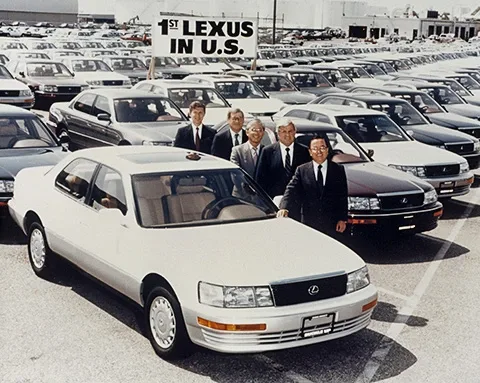
The first Lexus under the LS index (luxury sedan) was born in 1990. It was a rear-wheel-drive sedan with a 4-liter V8 producing 264 horsepower and a four-speed automatic transmission. The car accelerated to 100 km/h in 7.5 seconds, and the top speed reached 250 km/h. Of course, the design hinted at references to Mercedes-Benz, but the start was made.
In 1995, the second generation came out. However, the Japanese cheated a little here: they passed off a thoroughly modernized previous model as the new one. So technically, the LS 400 remained true to its predecessor.
But the truly new LS 430 — the third generation — debuted in 2000. The engine became larger: the displacement grew to 4.3 liters, and the output reached 281 horsepower. It was paired with a 5-speed automatic. With such equipment, the sedan reached the first hundred in 6.7 seconds and still hit the electronic limiter at the same 250 km/h.
The fourth generation LS was presented in 2006 — immediately in standard and long-wheelbase versions. And a year later, the hybrid version Lexus LS 600h went on sale in the States.