
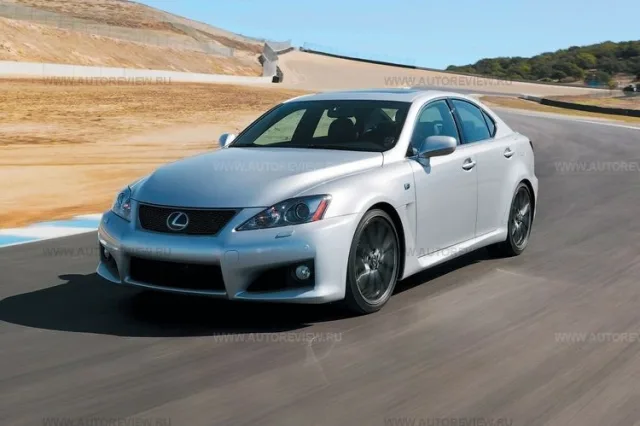
Oleg RASTEGAEV, author's photo
Sporty Lexus? So far this sounds unusual. Yes, Lexus can be comfortable, quiet, powerful, expensive, and reliable. It can, after all, be hybrid. Now it turns out it can also be sporty. Well, we'll have to get used to it: contrary to the opinion of regulars, Lexus has gained access to another prestigious club. A five-liter V8 with 423 hp, an eight-speed automatic, rear-wheel drive... According to the specs, the Lexus IS F accelerates to 100 km/h in 4.8 seconds — like the BMW M3 and Audi RS4! And these are its direct competitors, no matter what German firms say that it's still premature to perceive Lexus as a rival in the premium segment. No, it's not premature: Lexus has already outgrown its short pants — and has the right to choose who to compete with.
The letter "F" in the model name stands for Fuji, more precisely — Higashi Fuji, which is the name of the technical center where the Lexus IS F was created.
The center itself is located at the foot of the volcano of the same name, also starting with "F". By the way, Mount Fuji last erupted three hundred years ago. And now...
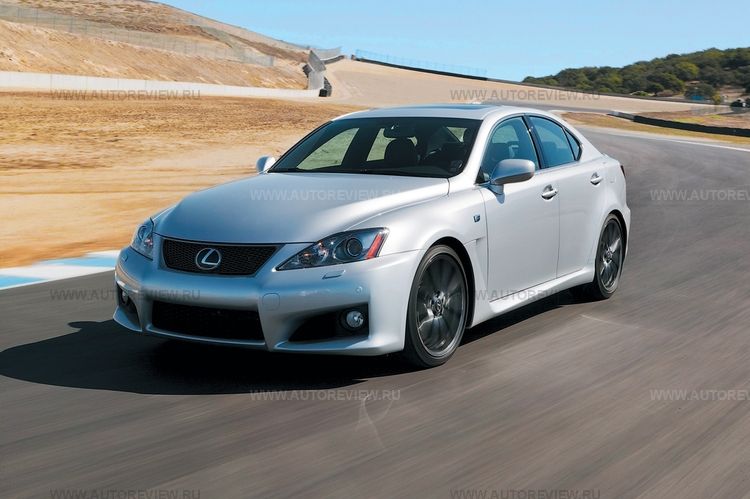
Engineers Yukihiko Yaguchi and Mamoru Sakamoto began working on the "charged" version of the Lexus IS sedan back when the previous generation model was in production (1998—2005), but the final decision to build a sporty modification based on the second-generation IS was made in 2004. It took three years to implement the project: the Japanese needed not just a high-speed car, but one endowed with traits characteristic of the Lexus brand. And since the process of final "self-identification" of the brand seems not yet complete, they decided to rely on values close and understandable to many motorists: let the characteristic feature be comfort unusual for cars of this type. And they succeeded.
The seat firmly embraces the body, but the cushion is softer than in German cars, and the side support bolsters do not clamp the driver in a vice. A good seat. And fully electrified — there's even memory for three positions, which you won't find on every such car, because usually the same person is behind the wheel. Another "excess" is the electric power steering column adjustment, which raises the steering wheel for easier entry. But sporty attributes are also present: aluminum pedal covers, the steering wheel is clearly profiled for a proper grip, and on the left and right are paddle shifters.
Sporty mood is often set by the "driver-oriented" central console, but in the Lexus the console is "neutral." On it — a large touchscreen display, a DVD-changer slot, buttons for dual-zone climate control, and a far from Spartan audio system Mark Levinson 5.1 Surround Sound with 14 speakers. Priority — comfort...
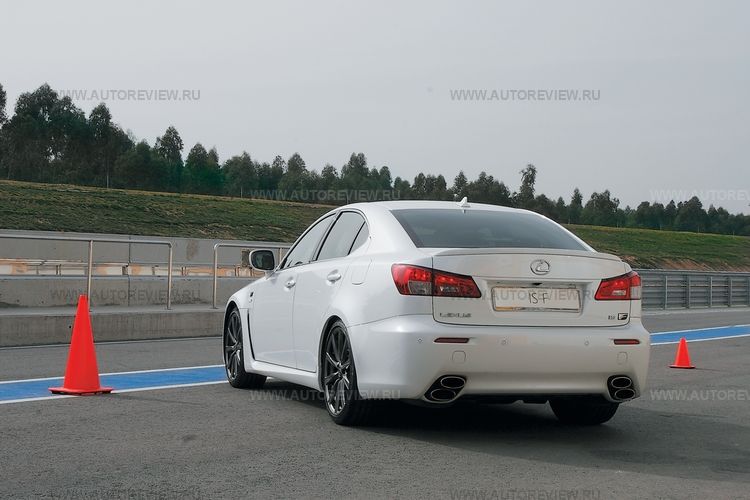
Not too much "sport" in the exterior either. The main differences from the base model are the front bumper with wide air intake openings, narrow gills in the front fenders, and dual exhaust tips. But if on other cars such tips are usually arranged "horizontally," here they are one above the other. A small detail, but intriguing. And finally, black BBS wheels — forged, 19-inch. They, by the way, are four kilograms lighter than the cast 18-inch wheels fitted to "civilian" Lexus IS sedans.
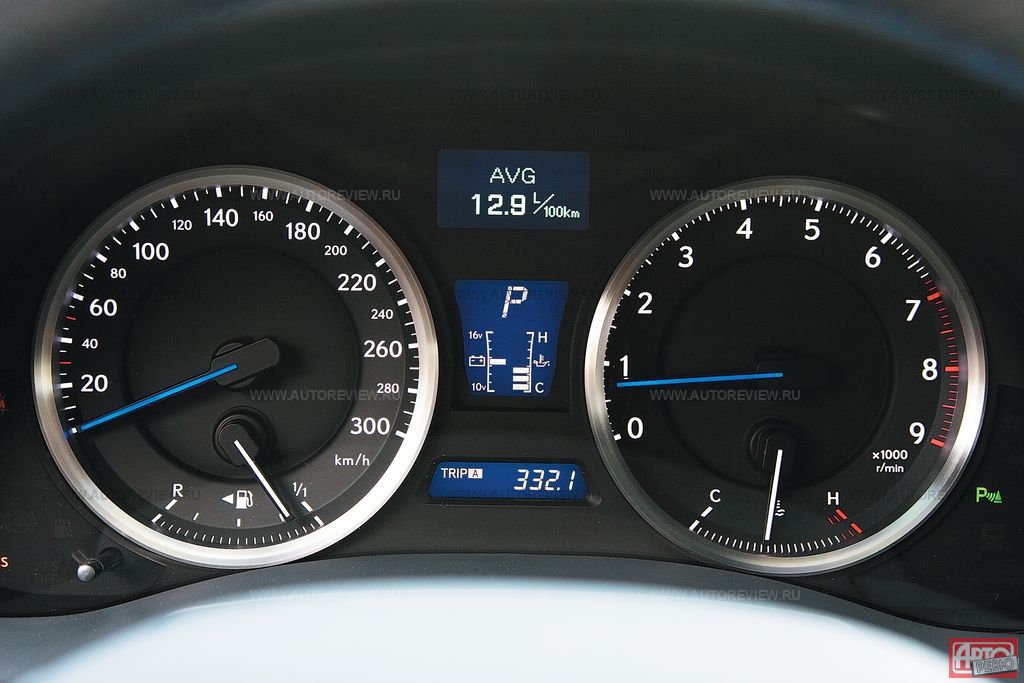 | |
| After the test run, average fuel consumption was 12.9 l/100 km — the Lexus IS F claims the title of the most economical car among "charged" classmates | The parking brake pedal will surprise only those who don't know that out of the 6000 cars planned for the annual production program, about half will go to America |
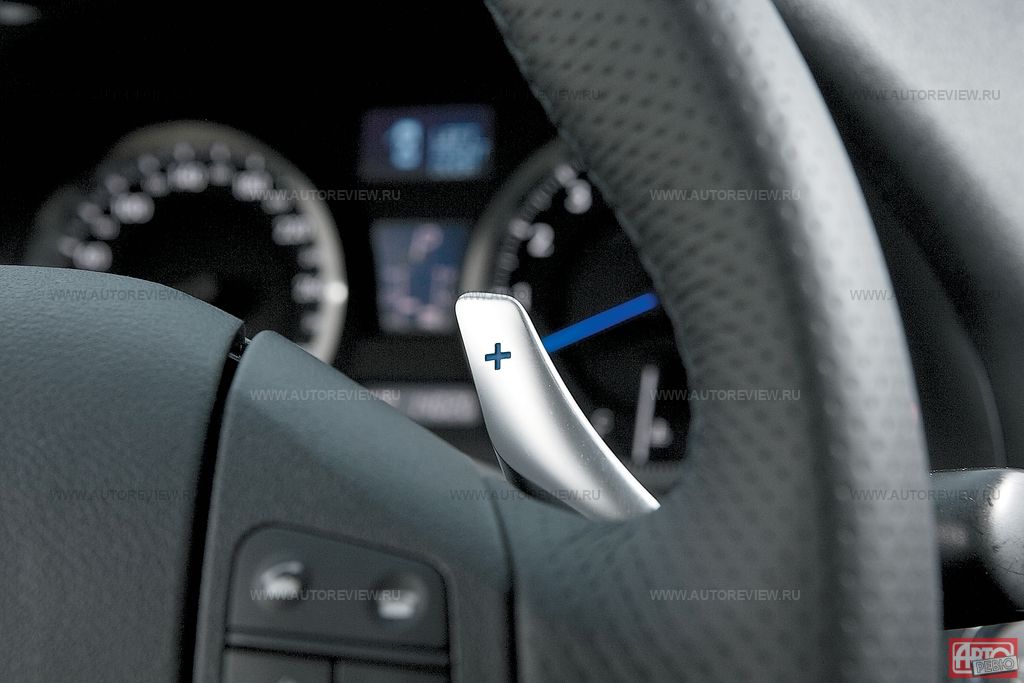 | |
| Holding the left button for five seconds completely disables the VSC stability control system. The key on the right changes the "automatic" operation algorithm | On the track, it's better to shift manually — using the paddle shifters under the steering wheel |
The five-liter engine is borrowed from the large hybrid sedan Lexus LS 600 h (see AR No. 21, 2007). But only the engine is borrowed, without the electromechanical transmission! This doesn't prevent it from being the most modern internal combustion engine in the Lexus lineup: with dual fuel injection (fuel is supplied both to the intake manifold and directly into the cylinders) and electric phase shifters. But even this engine was thoroughly reworked — the shape of the combustion chambers was changed, hollow camshafts were installed, and the lubrication system was modernized. The Japanese abandoned the "dry" sump — too serious and expensive modifications would have been required, but to prevent oil starvation in corners, they installed an additional pump that pumps excess oil from the cylinder heads. Engineers assure that this system eliminates the risk of oil starvation at lateral loads up to 1 g. By the way, the engine was refined by Yamaha specialists, and this is not the first experience of such cooperation: back in the sixties, Yamaha refined engines for the Toyota 2000GT coupe, and later for the Toyota Celica coupe.
As a result, the power of the five-liter engine was raised from 394 hp to the ideologically correct 423 hp. That is, the Lexus IS F becomes more powerful than the 420-hp BMW M3 and Audi RS4! Ahead is only the Mercedes C 63 AMG with its very large 6.3-liter engine and 457 hp.
I liked the Lexus engine. It not only endows the car with enviable temperament but also reminds of sporty engines of past years — with their wonderful pick-up at high revs. The variable valve timing system and variable geometry intake tract are tuned so that after 3500 rpm the engine gets a "second wind," and the exhaust system helps to hear this breath — it doesn't annoy with rumbling at low revs, but from 3500 rpm it reaches the expected volume.
Can you even feel the pick-up through the "automatic" quagmire? You can. For the Lexus IS F, the Japanese company Aisin supplies an eight-speed automatic with torque converter lockup on all gears except first. During acceleration, shifts are barely noticeable, and the creators assure that shift time is reduced to 0.1 seconds!
| The five-liter V8 2UR-GSE engine with dual fuel injection was "taken" from the hybrid flagship LS 600 h and refined with sporty specifics: the shapes of the combustion chambers and intake manifold were changed, titanium intake valves with increased lift were installed, hollow camshafts, some parts were replaced with aluminum ones, and an additional oil pump was built in to combat oil starvation in extreme corners. As a result, the engine turned out not only powerful (423 hp) but also economical (average consumption — 11.4 l/100 km) |
— Did you consider a transmission variant like the Volkswagen DSG gearbox?
— We tested cars with such gearboxes — we drove the BMW M3, Audi TT 3.2 DSG, — answers Sakamoto-san. — In our opinion, none of them can provide smooth, even movement at low speeds.
And the Lexus IS F can. In the city, it doesn't strain at all — it starts smoothly, crawls in traffic jams without jerks. If you need to accelerate, the "automatic" will drop one or two gears — and the Lexus will dart like a stone from a slingshot.
Still, during active driving, Drive mode fails. I brake before a corner, and the gearbox continues to "hang" in sixth gear. On exit — throttle, but the Lexus loses precious fractions of a second engaging the appropriate gear. And Sport mode doesn't fix the situation — the "automatic" algorithm doesn't provide engine braking with downshifts before corners, as "advanced" gearboxes of European cars do. And when I tried to complete a lap on the Spanish Monteblanco circuit in "Drive," the driving turned out very bland.
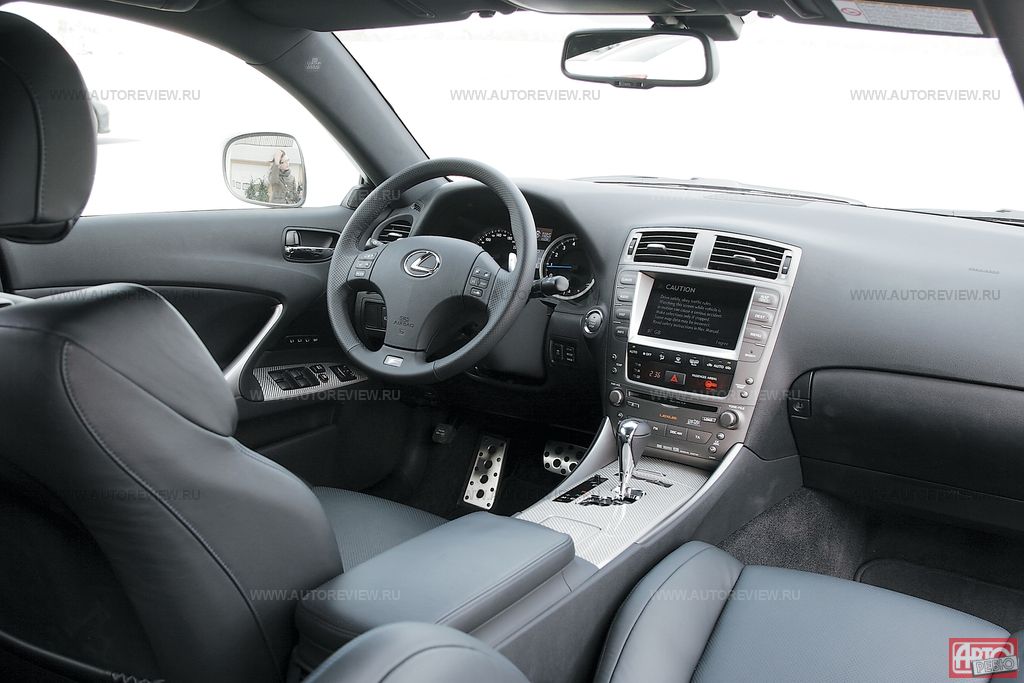 |  |
| The sporty character of the car is reminded by numerous "F" badges and aluminum trim | The eight-speed "automatic" is borrowed from the Lexus LS 460 sedan — the gear ratios are the same, but the sporty control program is completely changed |
No, you can't do without manual mode. Selector — to the left, and fingers — on the paddle shifters! Before a corner, pull the left paddle — and the Lexus, briefly growling with the engine, shifts down a gear, effectively braking with the engine. Everything is fast and harsh — no trace of smooth city driving remains. Here you feel that the torque converter lockup has engaged. The direct power flow allows precise throttle control and car management in slides. The main thing is to pull the paddles in time: if you hesitate a bit during acceleration — and the engine "hangs" on the limiter (6800 rpm). An honest mode.
Before the track, there were concerns about the brakes: even though they are Brembo, the discs are ordinary steel — ceramic, they say, is too expensive. But after three laps on the track with hard braking from 200 km/h, light smoke from the front wheels was noticed only on one car out of four. And I didn't feel any decrease in braking efficiency.
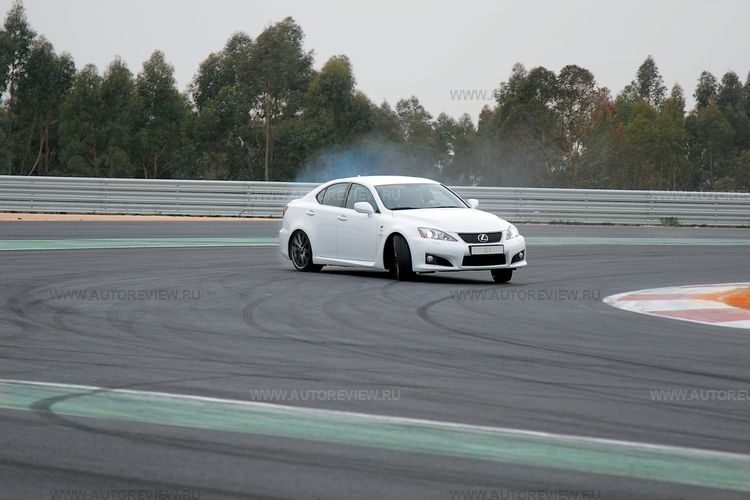
When you turn off the stability control, the Lexus IS F obediently goes into a drift, but without a limited-slip differential, the unloaded wheel spins and smokes
Although the cabin has a button to disable the stability control system, the instructor sitting next to me strongly asked not to touch it. According to him, in Sport mode the electronics switch to a racing setting and allow you to attack the track with slight drifts, and the lap is even faster than without VSC. I checked: if you drive correctly, along the optimal trajectory, the stability control does not interfere at all. But what happens if you still press the coveted button? A couple of laps without electronic shackles — and I understand why the instructor was so categorical. No, I didn't make any fatal mistakes: the Lexus responds perfectly to the steering wheel in slides that occur smoothly and predictably. Thanks for that go to the well-tuned electric power steering. Still, glancing in the mirrors on corner exits, I noticed thick clouds of white smoke a couple of times — the "inner" wheel, left without electronic backup, was spinning desperately! I had to ease off the throttle and lose precious seconds.
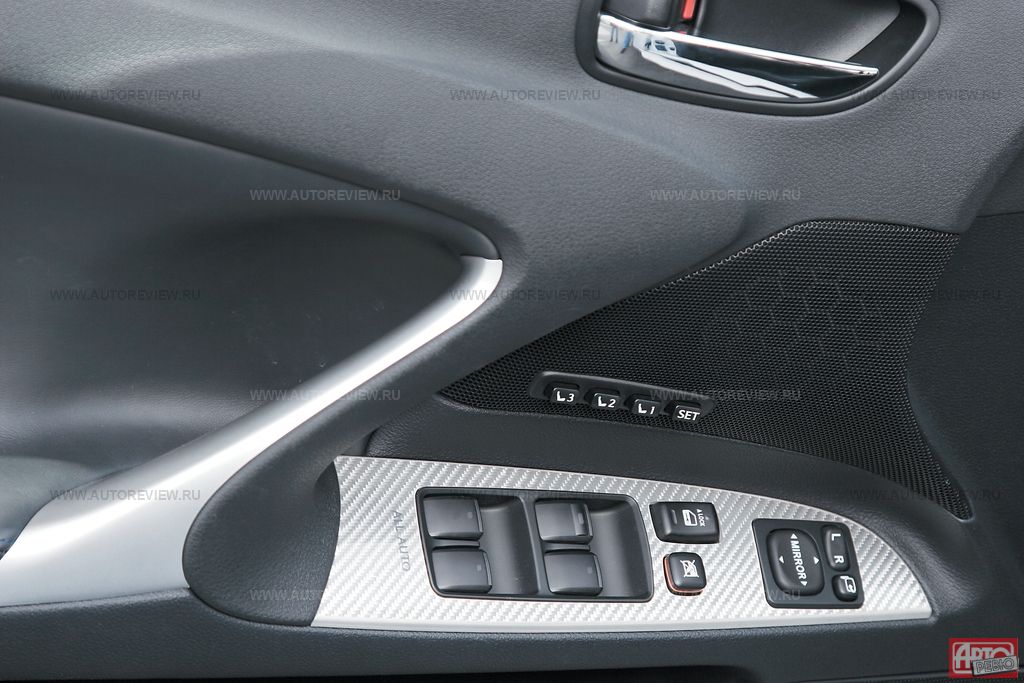 | |
| Electric seat and mirror drives have "memory" for three positions | The gills on the front fenders are not decoration for beauty. Hot air from the engine compartment exits through them |
— When you drive without stability control, you really miss a limited-slip differential, — I say to the Spanish instructor. He doesn't argue, but silently writes down the comment in a notebook.
— What else didn't you like?
— The automatic gearbox could use a full-fledged sport mode with active engine braking — shifting with paddles on the track is fun, but in regular city traffic it's distracting and requires getting used to. It's unlikely every IS F buyer will use it. That's probably all.
I look around: the other "instructors" have also taken out notebooks and are questioning colleagues. A typically Japanese approach.
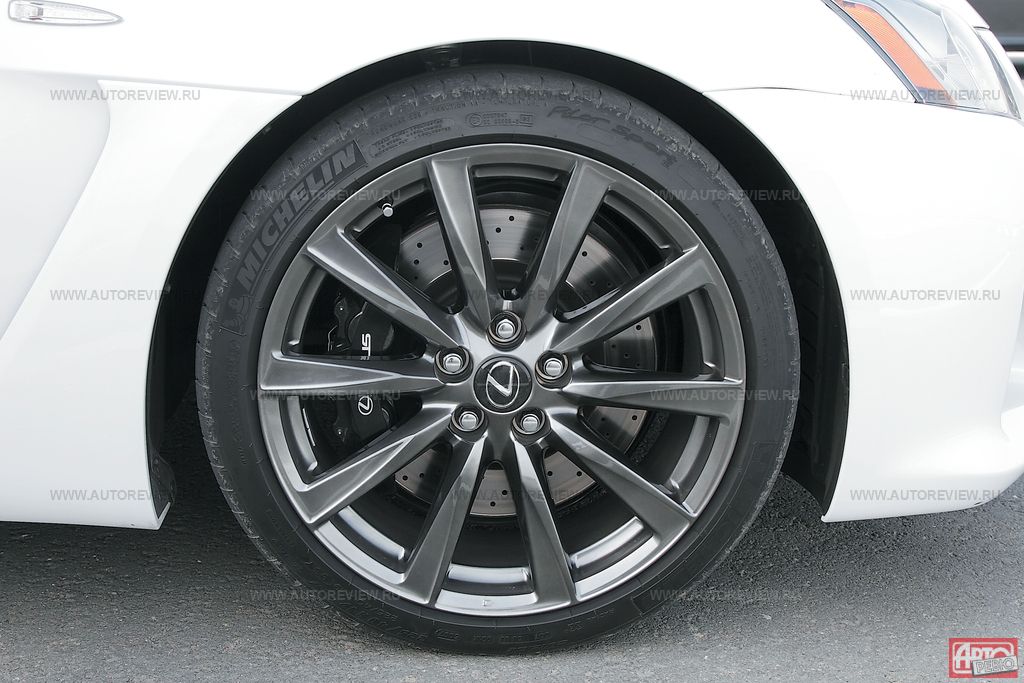 | 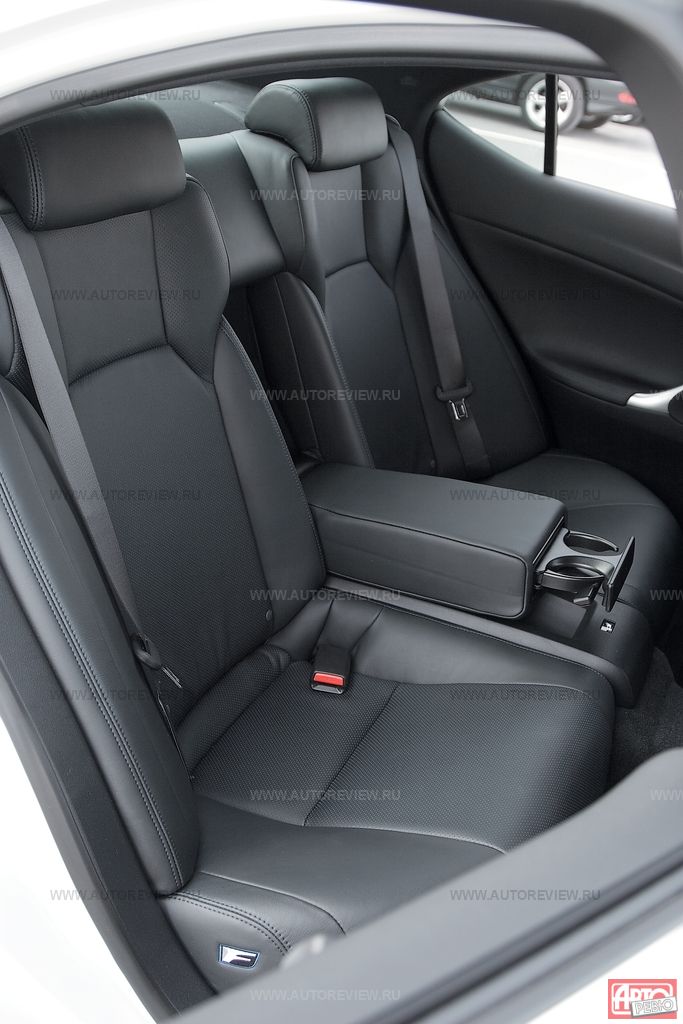 | 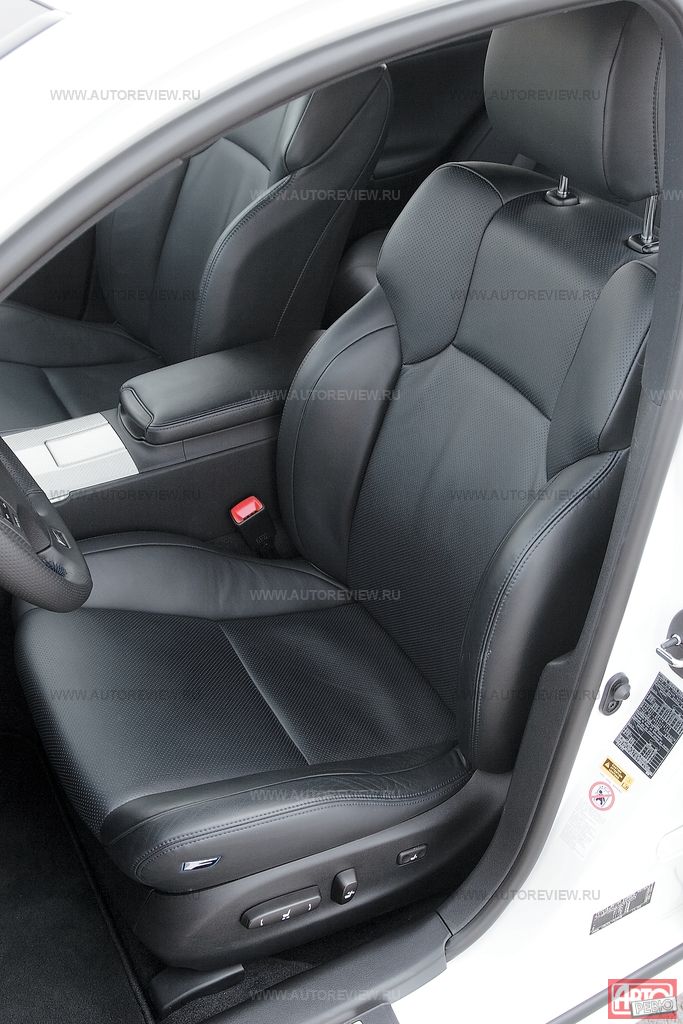 |
| Forged 19-inch wheels for the IS F are made by BBS — they are 4 kg lighter than the cast 18-inch wheels from the "civilian" Lexus IS. Tires — Michelin or Bridgestone | The rear row has pronounced recesses for two passengers | The seats with a full set of electric adjustments are soft, but at the same time hold the body perfectly |
But even if no improvements follow after all these surveys of journalists, the Lexus IS F will still find its place among sports cars. It's unlikely to beat the BMW M3 on a race lap, but for daily use, the Japanese, as usual, managed to find a balance between "sport" and comfort. It seems that even on 19-inch wheels, you'll be able to drive on our roads rather than bounce over potholes. I hope that in the summer, when the IS F reaches Russia, these expectations will be justified. Then we'll also try to compare it with competitors, the most popular of which is becoming the new BMW M3: in two months of sales in Russia, 11 cars have been sold (for comparison, 25 people bought the Audi RS4 over the entire last year). Prices for the Lexus IS F have not yet been announced, but officials unofficially hint that the benchmark will be the BMW M3 — 2 million 628 thousand rubles, or $106,000. But I believe the Lexus IS F will be slightly cheaper: it's still a newcomer to this club.
| Specifications | |
| Parameters | Vehicle |
| Lexus IS F | |
| Body type | four-door sedan |
| Number of seats | 4 |
| Dimensions, mm | |
| length | 4660 |
| width | 1815 |
| height | 1415 |
| wheelbase | 2730 |
| track front/rear | 1560/1515 |
| Trunk volume, l | 378 |
| Curb weight, kg | 1700 |
| Gross weight, kg | 2110 |
| Drag coefficient Cd | 0.27 |
| Engine | petrol with dual fuel injection |
| Location | front, longitudinal |
| Number and arrangement of cylinders | 8, V-shaped |
| Displacement, cm³ | 4969 |
| Cylinder bore/piston stroke, mm | 94.0/89.5 |
| Compression ratio | 11.8 |
| Number of valves | 32 |
| Max power, hp/kW/rpm | 423/311/6600 |
| Max torque, Nm/rpm | 505/5200 |
| Gearbox | automatic, 8-speed |
| Gear ratios | |
| I | 4.60 |
| II | 2.72 |
| III | 1.86 |
| IV | 1.46 |
| V | 1.23 |
| VI | 1.00 |
| VII | 0.82 |
| VIII | 0.69 |
| final drive | 2.94 |
| Drive | rear-wheel drive |
| Front suspension | independent, coil spring, double wishbone |
| Rear suspension | independent, coil spring, multi-link |
| Front brakes | disc, ventilated |
| Rear brakes | disc, ventilated |
| Tires front/rear | 225/40 R19/255/55 R19 |
| Maximum speed, km/h | 270* |
| Acceleration time 0-100 km/h, s | 4.8 |
| Fuel consumption, l/100 km | |
| urban cycle | 16.8 |
| extra-urban cycle | 8.3 |
| combined cycle | 11.4 |
| Fuel | petrol AI-95 |
| * Electronically limited | |