
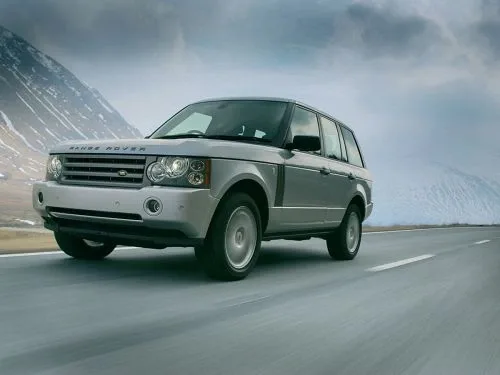
Range Rover TDV8. Price: $116,400. On sale: since December 2006.
Place a 2006 and 2007 Range Rover side by side — you won't tell them apart. Classics are, above all, about consistency.
2007 Range Rover
© Photo: Land Rover
In modern Land Rovers, sound insulation is perfected. The cabin is so quiet that at first you can't tell which engine is under the hood — petrol or diesel. The question is, of course, rhetorical — diesel. Europeans have long appreciated the benefits of diesel fuel. When almost every second car on the roads runs on heavy fuel, the proprietary filler neck with a flap that prevents a petrol nozzle from fitting becomes a very useful thing.
Such a filler neck is installed on my Range Rover as well, under the hood of which hides a new product — the TDV8 unit with 272 hp at 4000 rpm and a peak torque of 640 Nm, available in the 2000–2500 rpm range. The old diesel produced only 390 newton-meters. Just comparing these figures says more than any test drive. True, the previous engine was a V6 with a single turbo, while here there are two. But engineers swear that since 2002, when the Range Rover first got a diesel, technology has advanced so far that the "eight" has become almost more economical than the "six"!
2007 Range Rover
© Photo: Land Rover
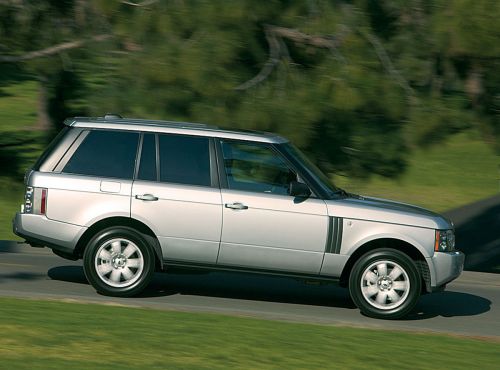
With each of its 32 valves, each cylinder, each bit of the onboard computer, this off-roader yearns to break free from city traffic jams onto the open expanse of the highway. It can't wait to show off its dynamics. You press the pedal to the floor — and after a barely noticeable pause for thought, the car surges forward. In numbers, this looks like: 9.2 seconds to 100 km/h. An excellent figure.
The new powertrain is the company's final break with the past. The previous turbodiesel was supplied by BMW, and the 5-speed automatic by General Motors. Ford's management was sickened by the thought that they were continuing to feed the Bavarians, who had already made a good profit from selling them Land Rover! And using a whole unit from direct American competitors was utterly unacceptable. Ironically, the current 6-speed gearbox from the German firm ZF is installed in almost the same form on the BMW X5.
2007 Range Rover
© Photo: Land Rover
"Nine and two" for a turbodiesel giant weighing over 2.5 tons is indeed good, because the most powerful version, the petrol V8 Supercharged, hits 100 km/h in 7.5 seconds. The thing is, you need to handle these capabilities as carefully as a test tube of nitroglycerin. Company representatives particularly praise the improved acceleration dynamics in the 80–110 km/h range — this opens new horizons for overtaking. However, the soft long-travel suspension, high center of gravity, and weak steering feedback don't give a sense of unity with the car. The "Range" responds to steering inputs with laziness, sinking into body rolls that, although reduced by 15% (according to claims), don't add calmness. It feels like driving a motorboat. Due to the low information content of the steering mechanism, driving faster than 160 km/h causes inner tension (the top speed is 200 km/h), which is absent in the Audi Q7, which seems to stick to the asphalt. In short, like a true aristocrat, the Range Rover resists a sharp, aggressive driving style.
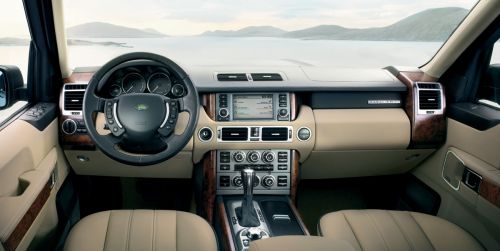
Such a driving manner also clashes with the atmosphere of grandeur and serenity that reigns in the interior. The driver's seat is elevated above the horizons of leather trim, framed by ledges of noble wood. Large buttons and toggles are arranged across the wide center console with the logic of Roman phalanxes. The color scheme would fit perfectly in some British living room.
2007 Range Rover
© Photo: Land Rover
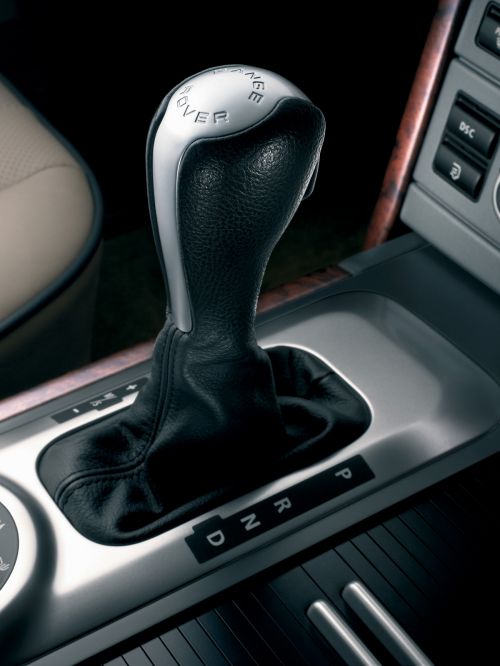
The interior underwent many changes by 2007. The ignition lock moved from the center console to the front panel, the mechanical handbrake gave way to a button for the electromechanical one, the instrument graphics became more restrained, a wide box appeared to the right of the gear selector, and the lever itself moved closer to the driver. The main thing is that behind it now stands a toggle for controlling the Terrain Response transmission modes. In such surroundings, you involuntarily accept the rules of the game and drive sedately, performing any manipulations in a measured, reserved manner.
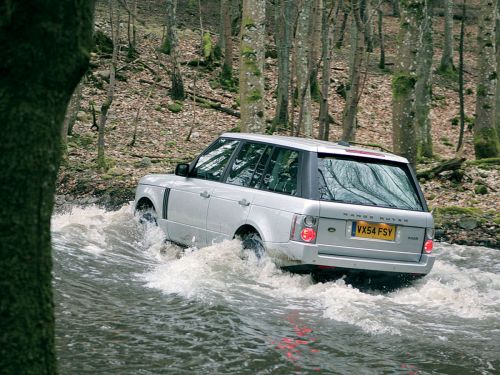
It's impossible to please everyone at once and create a car for all occasions. Polyvalence in the automotive world is unattainable, at least at the current technical level. The rolling and wandering off the trajectory on high-speed roads translate into reliable off-road driving. On the same highway tires, the Range Rover turns onto a dirt road and rushes along it, perfectly absorbing bumps with the soft air suspension and showing not the slightest tendency to yaw.
The dirt road ends in a real goat trail. This is what the British call terrain. A rocky, rutted slope that's hard to even call a road — an excellent testing ground for a "UAZ". But it's hard to imagine that a luxury car could drive here. I press the low-range button and use the second button to increase ground clearance to 265 mm. Now I switch the Terrain Response toggle to the "mud and ruts" position. The corresponding pictogram lights up. There are five in total — according to the number of algorithms programmed into the chassis control computer. There's a general mode, "grass — gravel — snow", "mud and ruts", "sand", and "rock crawl". Just as Land Rover is considered the leader among SUVs, Terrain Response can be called the generalized human experience in overcoming various surfaces. The system has already been tested on the Discovery III.
I note that the 2007 Range Rover introduced an electronic rear differential lock — previous cars only had a center differential lock.
2007 Range Rover
© Photo: Land Rover
With the advent of the electronic "handbrake", the proven Hill Descent Control system gained an unexpected ally. Using the brakes when descending a steep slope is not recommended — there's a high risk of the car turning sideways or even rolling over. Professionals, of course, do use them — extremely carefully, in measured doses, and mainly at the very bottom, to slightly slow the off-roader and prevent it from hitting its bumper on a terrain fold. But if the Range Rover starts rolling, you pull the parking brake button, and the onboard computer commands the pads to briefly press against the brake discs without allowing the wheels to lock.
Yes, the Audi Q7 can't do that. But why do I keep mentioning that wonderful car? Although the British are quick to claim that the Range Rover has no rivals at all, they were the first to bring up the Audi Q7. The similarly priced German car is like a bone in their throat, because in contrast to pedigree, it offers a set of consumer qualities devoid of any emotion. The proud British, of course, avoid detailed comparisons. But every time the words "Audi Q7" slip from a British engineer's lips, you understand that he would very much like to build exactly such a car.
There's a saying: "If a Range Rover goes somewhere, it goes to the service center." Yet for some reason, people keep buying this car, and its current, third generation since 1970, has become the most successful: over 115,000 units sold in four years. The conclusion suggests itself that the "Range" has virtues that competitors lack. However, company representatives claim that the Range Rover simply has no rivals.
Driving
The most powerful and fastest of the turbodiesel Range Rovers.
Interior
The additional Autobiography and Autobiography Bespoke trim lines offer 1.65 million combinations of body and interior colors. Enough to never repeat yourself over 55 years of continuous production.
Comfort
Power-operated side steps make getting into the cabin easier.
Safety
The lids of the new glove boxes serve as knee protection pads.
Price
With a capital P.
Specifications of Range Rover TDV8
Dimensions – 4972x1956x1902 mm
Engine – diesel, V8, twin-turbo, 3630 cm3, 272 hp/6000 rpm
Transmission – automatic, 6-speed
Dynamics – max 200 km/h; 9.2 s to 100 km/h
Competitors – Audi Q7 3.0 TDI, BMW X5 3.0d, MB ML320CDI.
Advantages and disadvantages
+ Huge suspension travel, Terrain Response system, excellent mid-range torque.
– Rolling during highway driving, low build quality, expensive maintenance.
Our opinion
This car doesn't fit the SUV label at all. A tracksuit with stripes and sneakers — an image that completely clashes with its strict lines and luxurious interior. Even the thought of transporting bags of cement seems blasphemous! Before us is rather an heir to British traditions — a Shooting Brake, a sort of hunting estate wagon. It looks equally organic on a country road and at the front entrance.