
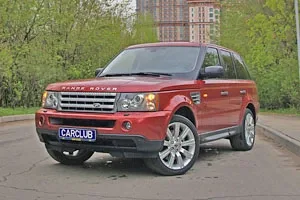
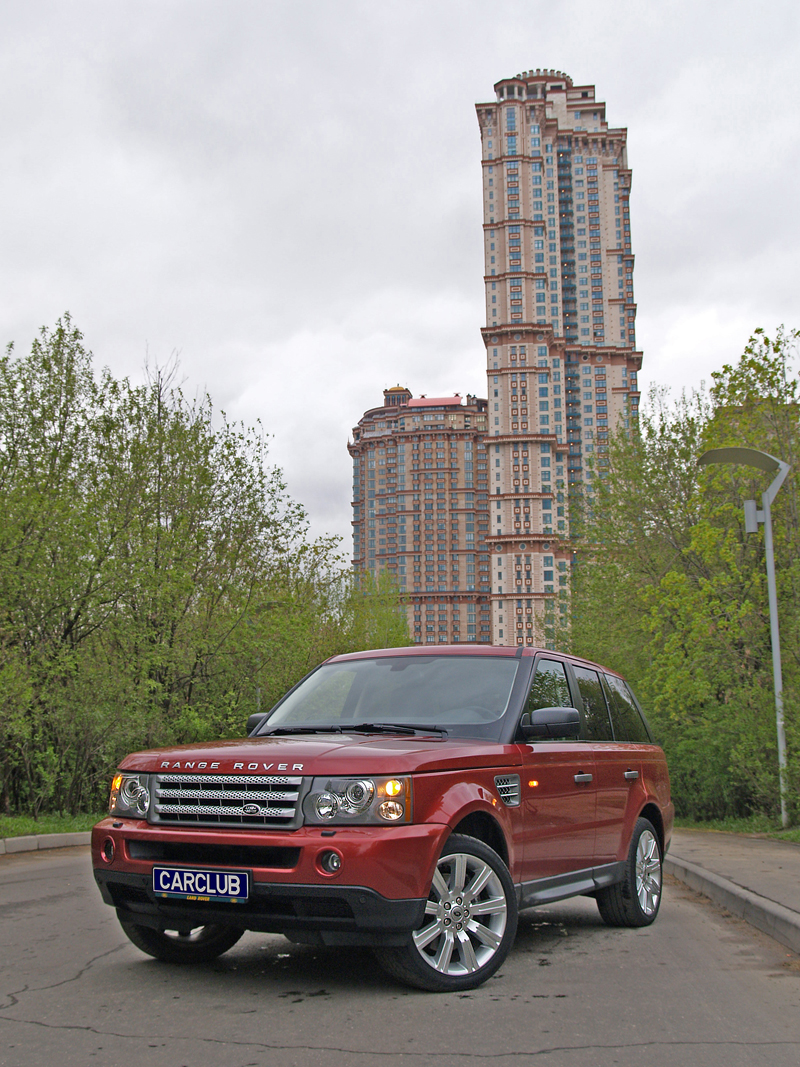
 From the standpoint of dry figures, the Range Rover Sport Supercharged confidently ranks among the most powerful sports SUVs, even ahead of the fresh BMW X5 and yielding only to the Porsche Cayenne Turbo and Volkswagen Touareg W12.Comments
 How should we understand the name Range Rover Sport? With the regular Range Rover, everything is clear — conservative Brits have nicknamed it "a farmer in a tailcoat." But what exactly did the engineers mean by the word Sport? Chess, dominoes, weightlifting, or marathon running? In the automotive world, "sport" can also be different: it can be circuit racing with supercars like Ferrari, rallying with all-wheel-drive "evolutions," or trophy raids where you cover a couple of kilometers a day and wade through water up to the windows. To figure this out, we took the Range Rover Sport Supercharged with the most powerful supercharged engine producing 390 hp for a test — real sport! It remains to be understood which kind exactly.
When you look at the specifications, the RRSS looks very respectable among sports SUVs. Only the insanely fast Porsche Cayenne Turbo and its sibling Volkswagen Touareg W12 are more powerful. Even the newest BMW X5 is left behind in this indicator. But figures are figures, and what matters much more is how these "horses" work in harness and how comfortable it is for the driver to manage this herd when you get behind the wheel rather than flip through a catalog.
Since we got the car for the weekend, the first test was a dead traffic jam on the Moscow Ring Road. For such a mode, three horses would have been enough; the rest could have been let out to graze until better times. But no such luck: the thoroughbred British steeds stubbornly stand in the stall and demand expensive fuel. We will keep silent about the readings of the onboard computer in traffic — they would only please oil magnates, whose pockets we substantially filled over the three days of the test. With the calmest driving, the Range Rover Sport consumes about 20 liters per hundred kilometers — like a larger, albeit less powerful, Hummer. We could have put up with such an appetite, but the small fuel tank is really annoying: in the city, it lasts for 300–350 km. With active driving, you will have to stop at a gas station every other day.
But enough about the little things, let's look inside the cabin. The list of options is impressive: rear passengers have access to monitors in the headrests with TV and DVD support, and different images can be displayed on the two screens. This entire car cinema is controlled via a touchscreen display on the central console. However, the plastic turned out to be rather cheap-looking. Perhaps the developers wanted to emphasize utility, but at a price of over $100,000, such a move looks strange. The power window control block placed near the rearview mirror also seemed an unsuccessful solution — you have to reach for it.
On the road, the Sport pleasantly surprised. It's not about acceleration — there was no doubt about that. The 390-horsepower engine confidently accelerates the SUV from any speed and over any distance. The sport mode of the "automatic" was especially pleasing. The gearbox does not overuse engine braking and uses all six gears, but the throttle response becomes sharper: instead of shifting down one or two gears, the "automatic" can jump from sixth to second and literally shoot off, pausing only for a second.
But the main impression was made by the handling. When the air suspension is lowered to the lowest position — Dynamic mode — body roll is minimal. Despite the high seating position, the driver feels the car well, and the steering wheel pleases with pleasant reactive force.
Off-road, the Sport also did not let us down. The air suspension raised to the maximum position gives a ground clearance of 227 mm, but it does not become stiff as in many competitors, retaining elasticity. Because of this, on a dirt road it is difficult to understand what position the suspension is in, and achieving diagonal wheel hanging is almost impossible. And if it does happen, the electronics clearly distribute torque, transferring it from spinning wheels to those with reliable traction. It works smoothly, without jerks — I have never encountered such a perfect transmission. There is also a low-range gear that makes the engine's traction truly endless.
In short, the Range Rover Sport is an excellent all-rounder. On the highway, it will give many a head start, and off-road it feels like a king, as befits a member of the Land Rover family. As for the simple plastic in the cabin or the gluttony — that is a reasonable price for combining a horse and a trembling doe in one car. Moreover, the latter problem can be solved by choosing the version with the new 271-horsepower V8 turbodiesel. The dynamics will not suffer much, but you will have to refuel half as often.
Text: Leonid Pavlov. Photo: Dmitry Malygin.