
Land Rover Freelander2. Beyond the Ordinary
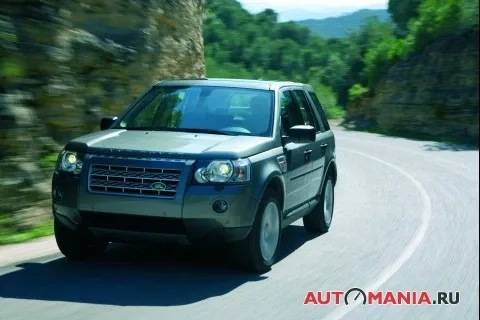
When the Land Rover Freelander first appeared in 1997, it held the title of Europe's most sought-after compact SUV for five straight years. For the Old World, where preferences traditionally lean toward utilitarian cars, this is a real paradox. How successful its successor will be is hard to say in advance, but one thing is certain: the British have produced at least a solid, and at most a very promising, vehicle.
However, on the road to success, this car faces two serious obstacles. The first is the need to surpass its own predecessor. Being second is never easy, and history knows many such examples. Moreover, the Freelander2 will have a particularly hard time, as it inherits a truly outstanding off-roader. The shadow of its ancestor will haunt it in both victories and failures. The second problem is the market. Recently, Europeans, as well as our compatriots, have been actively buying crossovers like the Toyota RAV4, Suzuki Grand Vitara, or Nissan Qashqai. These cars may be designed for asphalt, but they are modern and noticeably cheaper. So the second-generation Land Rover Freelander cannot expect an easy life, no matter how wonderful and unique it turns out to be.
Although the marketing team of the British company unanimously insists that this is an absolutely new model, brand fans (and many outside observers) will easily recognize familiar features in the appearance of the second Freelander. I'll say more—the genes of its predecessor are so clearly traced that sometimes the new model can be confused with the old one. For another car, this would be a drawback, but the Freelander2 is initially aiming for its own niche in the class. At the same time, one cannot deny that the British completely redesigned the body design with the generational change. Literally everything, down to the smallest details, was rethought. Obviously, body panels and optics were replaced first. Furthermore, unlike its predecessor, its lines now feature many traits that relate it to more prestigious siblings—for example, solidity. And a substantial appearance has always been a significant advantage for such a car.
The SUV has also grown in all dimensions (50 mm in length, 109 mm in width, and 32 mm in height). This has not been too noticeable in appearance, but all the "extra" liters gained are used to maximum benefit. The British themselves cite spaciousness and functionality as the main trump cards, and they seem not to be deceiving. In particular, there is noticeably more room in the shoulders and above the heads of passengers. The second row can accommodate three (though two will be more comfortable), and there will be no problems with legroom. As for the cargo area, it nominally holds 755 liters, and after transformation—1670 liters (almost a third more than before). As for ergonomics, nothing has changed: it did not suffer from serious flaws in the first generation either, so it would be strange to expect them in the successor. Decent adjustment ranges, well-thought-out placement of instruments on the cockpit, excellent visibility, and the aforementioned cargo-passenger qualities. The interior styling, however, does not impress with anything supernatural: the interior is modern but not extravagant. Its architecture, as before, is dominated by the principle: "Everything ingenious is simple." It is unlikely that the interior of the new model will become a benchmark, but it cannot be called dull either.
Under the hood of the base version is a new 160-horsepower 2.2-liter turbodiesel, delivering maximum 400 Nm of torque already at 2000 rpm. It is paired with a 6-speed manual or a 6-speed automatic. Even from these figures, an experienced person will appreciate its potential. In practice, everything looks even more convincing. The engine pulls from almost zero, making the wheels break free from captivity on any surface. Of course, an important role here is played by the proprietary "intelligent" (i.e., almost permanent) all-wheel drive system, implemented through an electronically controlled Haldex coupling, whose response time is reduced to 150 milliseconds. In other words, connecting the second axle takes about a quarter of a turn of the slipping wheel. However, the main "feature" of the new model is not this, but the proprietary Terrain Response system, which migrated here from the Discovery 3, and which is equipped on all new Freelander models except those in base trim. With four preset modes (asphalt, snow, ruts, or sand), it adjusts the engine, gearbox, coupling, and chassis to the given conditions. It is clear that this electronics will not replace rigid differential locks, as on serious off-roaders, but it can simulate their operation with high efficiency.
It is also worth mentioning the mandatory assistance systems for descent, ascent, and roll stability control. Usually, they are given a supporting role, but here it is worth departing from traditional neglect. For example, the descent assistance system, using the standard ABS, reliably holds the car at a set speed, and the only thing to fear is inevitable overheating during prolonged use. And how is it on asphalt?—the inquisitive reader will ask.—Excellent! Of course, it cannot be compared to a sports sedan, but among rivals of similar dimensions, it will give many a head start. The diesel, naturally, will not fully satisfy the demands of an active driver, but its inline six-cylinder gasoline sibling with a 3.2-liter displacement is quite capable of impressing, even despite the fact that the 233 hp it is rated at do not seem so. Maximum 317 Nm of torque is available already at 3200 rpm, so such a car accelerates to 100 km/h in just under 9 seconds, and the top speed is 200 km/h. And this is with a curb weight of 1770 kilograms. Moreover, despite all its "off-road" nature, the Freelander2 behaves quite car-like on asphalt; the only thing is that body rolls are still more noticeable compared to family sedans, and it does not steer as effectively. Otherwise, the average driver will be disappointed only by the noticeable fuel consumption, but here, as they say, to each their own.
In general, comments are unnecessary. It remains to mention that the minimum price of a new Land Rover Freelander from official dealers will be $37,500 for the diesel version and $52,000 for the gasoline one. In the latter case, however, the standard equipment list includes options such as the "intelligent" permanent all-wheel drive system, the Terrain Response system for adapting to road conditions, as well as roll stability control and hill descent control systems.
Technical Specifications
| Dimensions | Land Rover Freelander2 |
| Length (mm) | 4500 |
| Width (mm) | 2180 |
| Height (mm) | 1820 |
| Wheelbase (mm) | 2660 |
| Ground clearance (mm) | 220 |
| Weight (kg) | 1770 |
| Trunk volume (l) | 755/1670 |
| Engine displacement (cm3) | 3192 |
| Max power (hp) | 233 at 6300 rpm |
| Max torque (Nm) | 317 at 3200 rpm |
| Max speed (km/h) | 200 |
| Acceleration 0-100 km/h (s) | 8.9 |
| Average fuel consumption (l/100 km) | 11.2 |
| Price ($) | 37,500–55,900 |
Source – AUTOMANIA.RU