
— Give it a good thrash: it looks like it's good off-road, — our expert Oleg Rastegaev instructed me. Oleg himself had already met the new Land Rover Freelander back in the summer. True, he wasn't allowed behind the wheel then — he was only given a look at the demonstration runs by factory drivers (see AR No. 13—14, 2006).
But now I have all the trump cards in my hand: the Freelander itself (in two versions — with a diesel and a petrol engine) and a variety of Moroccan roads — asphalt, gravel, sand... I can try out all the settings of the Terrain Response off-road system, which the new Freelander was equipped with following the example of the Discovery. The only thing I couldn't do was drive on snow — this is Africa, and the snows of Kilimanjaro are far away. And they say they've already melted.
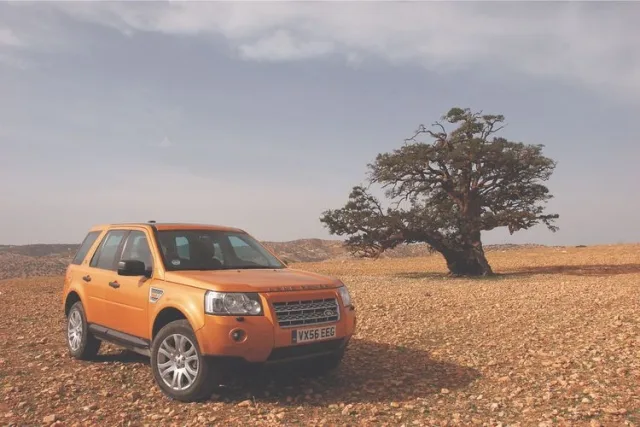
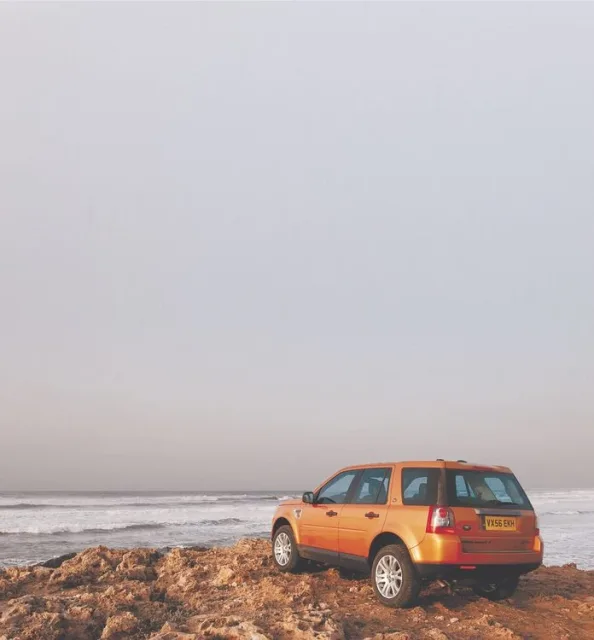
The main transport in Morocco is donkeys. They serve as both trucks and personal cars, and refueling is simple — a bag of feed is hung right on the muzzle. Same with horses. Among cars, taxis are the most common — "one twenty-three" Mercedes and Peugeot 504 station wagons. All are painted blue, all have white roofs, and all are overcrowded with passengers beyond any measure. Against such a background, even modest Dacia Logans look luxurious. And here I am in a bright orange Freelander...
But I would have been noticed even in spoiled Moscow! The little Land Rover looks great — masculine, purposeful, and in details it references the Range Rover Sport: side glazing, rear lights, honeycomb grilles on the front fenders. There was even a rumor about a possible rebranding: they say the Freelander would be called Range Rover, not Land Rover. But in Morocco this was denied: they say these are too different cars.
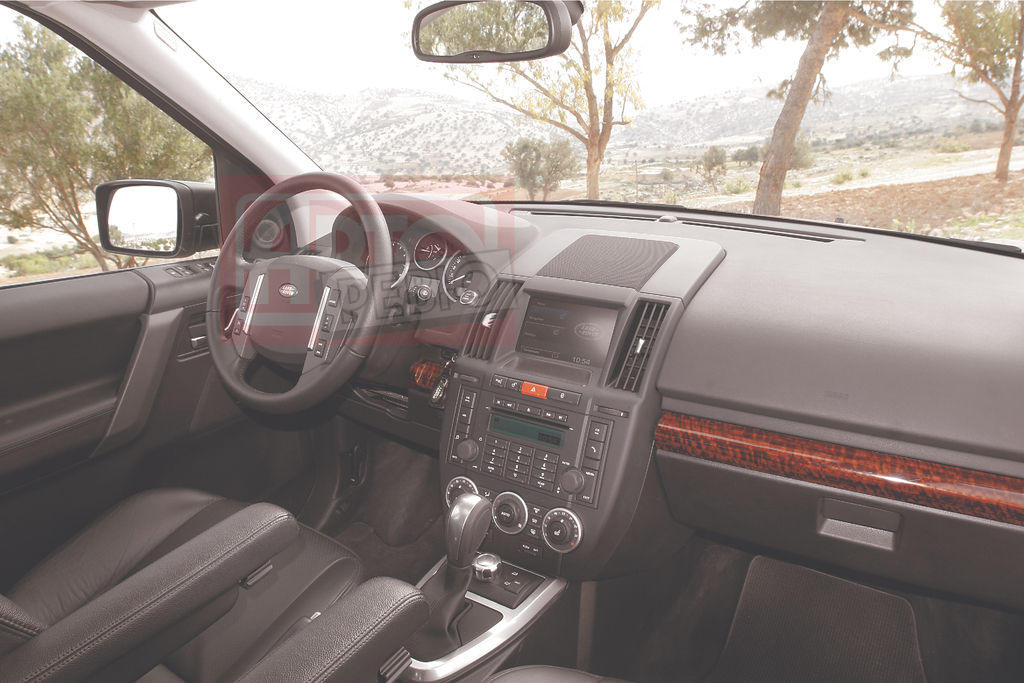 | 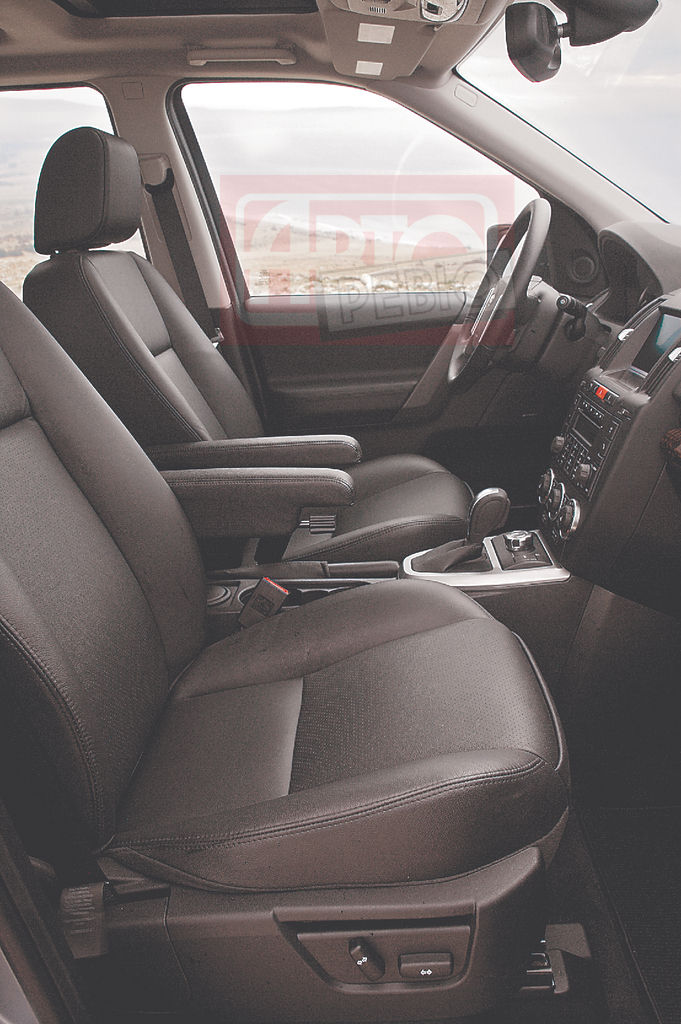 | 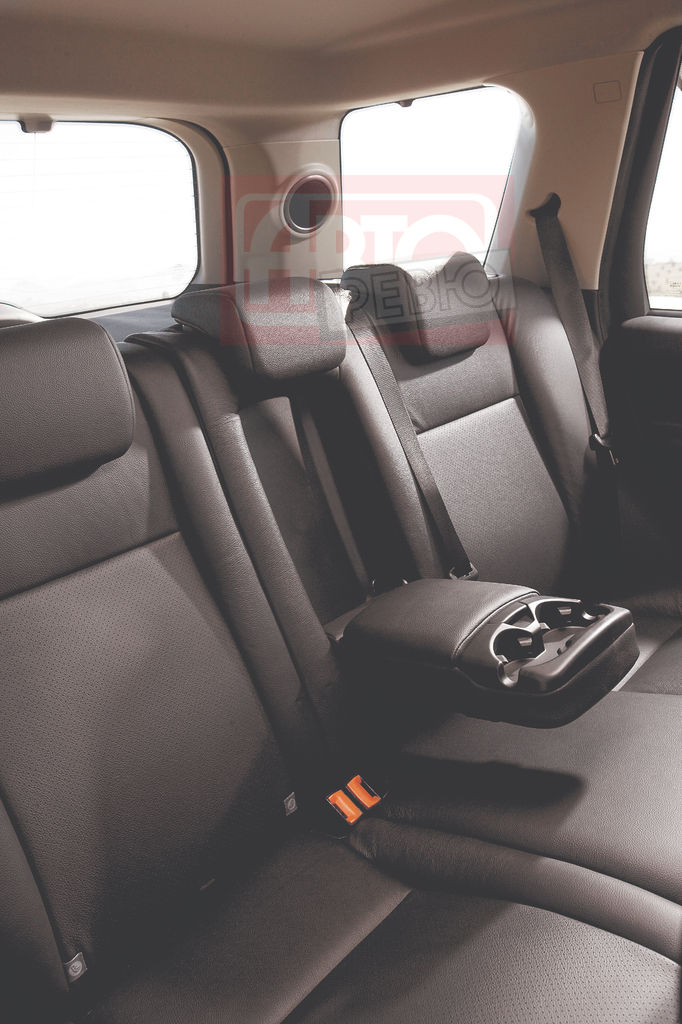 |
| The interior overall looks solid, but in details (painted instrument bezels, plastic "wood") — not very | The seats are comfortable, adjustment ranges are wide, and the steering wheel now adjusts both for height and reach | It's more spacious in the back — more legroom and headroom |
To be convinced of this, it's enough to look inside: they are really different! The instrument bezels are not chrome-plated but covered with "silver paint," the wood is not wood at all but plastic... No, this is not a Range Rover.
The engine starts with a button. Press it — and in response, a cozy purr from the newest 160-horsepower 2.2 TD4 turbodiesel, developed jointly by Ford and Peugeot. For now, all diesel Freelanders come only with a six-speed manual, while the Aisin Warner automatic will appear in the spring. The same automatic is also fitted to petrol cars. They will no longer have manual gearboxes at all.
| Despite the fact that the spare wheel has been moved from the fifth door to under the boot floor, its volume has increased to 755 liters — or up to 1670 liters with the rear seats folded |
And the diesel... Surprisingly, even on the desert highway, I never got to sixth gear — there's not enough torque. On the sandy track, it even stalled. Of course, if I had done everything as the instructor ordered, nothing would have happened: before the climb — gas, at the top — release, on the descent — engine braking... But I hesitated, the engine lost revs and stalled. Moreover, it stalled somehow immediately, without warning — like light bulbs burning out. The diesel's "torque" range is too narrow, and I was also hindered by the stiff, uninformative gas pedal.
Blaming the mirror?
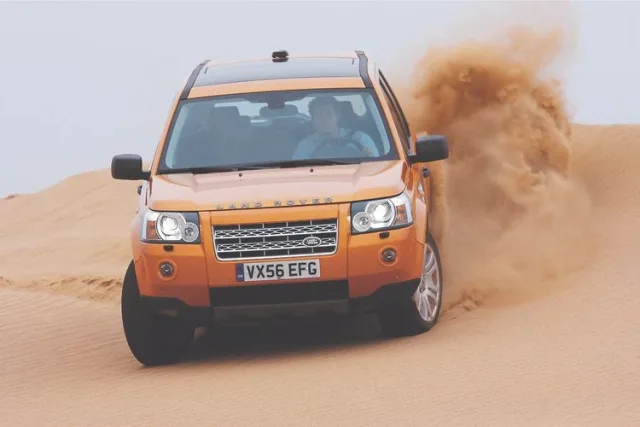
I naturally switched the Terrain Response system to Sand mode, which allows wheel slip. Although later I became convinced that even in the standard mode (General Driving), but with the stability system switched off, the Freelander drives on sand no worse. And it gets stuck when Terrain Response operates in the "slippery" mode (grass/gravel/snow): the electronics doesn't let the wheels spin at all, constantly braking them.
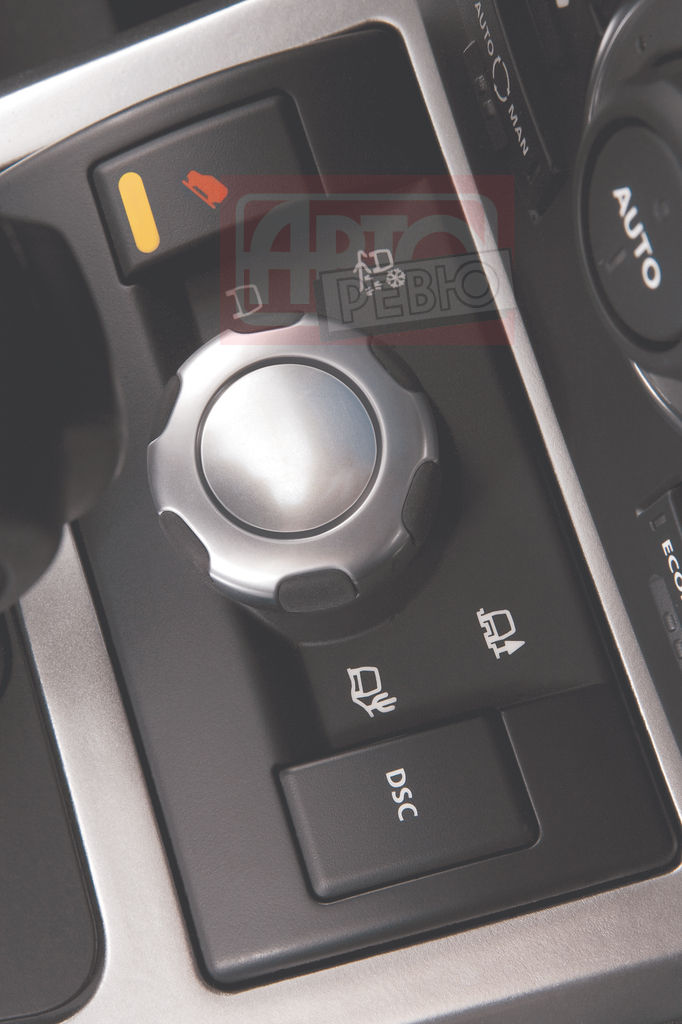 | 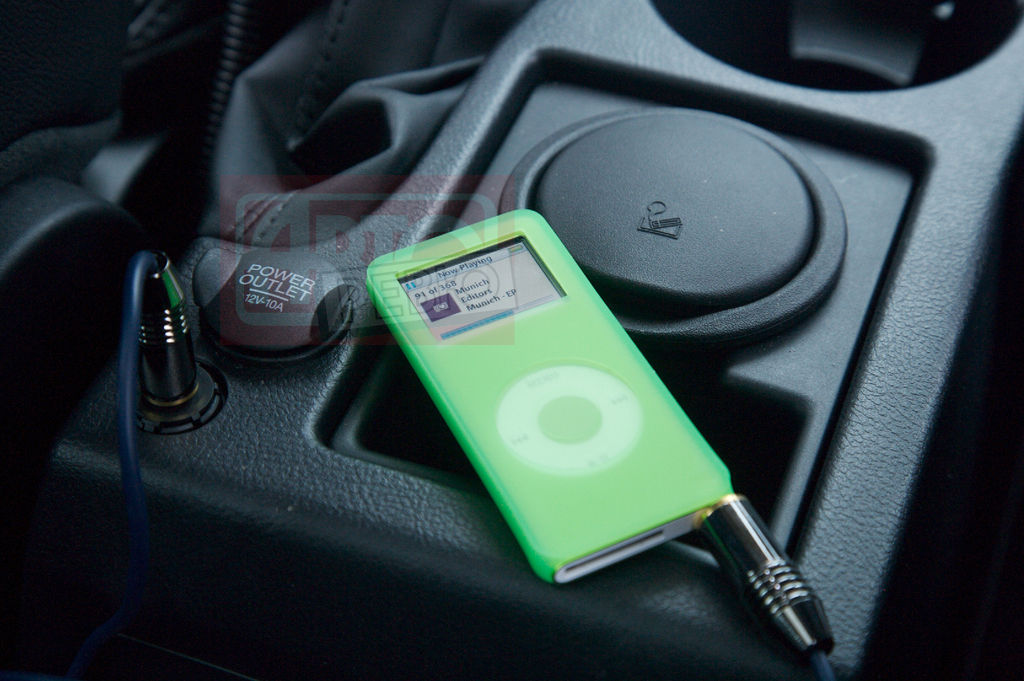 | |
| The Terrain Response system mainly controls the "strictness" of the stability system and has four modes — General Driving (asphalt), Grass/Gravel/Snow, Mud and Ruts, and Sand | The Terrain Response system modes are displayed on the instrument panel screen | The audio system has a line-in input |
In normal conditions, the Freelander is almost front-wheel drive: the electronically controlled Haldex coupling (which replaced the viscous coupling) sends no more than five percent of the torque to the rear wheels. But when the front wheels slip, the clutch pack is compressed up to full locking. This also happens when starting off.
The suspension seemed short-travel — on sandy sections it kept "bottoming out" on rebound, but on gravel it pleased with both energy intensity and ride smoothness: speed around a hundred, dust in a column, and the Freelander just slaps its tires and throws stones.
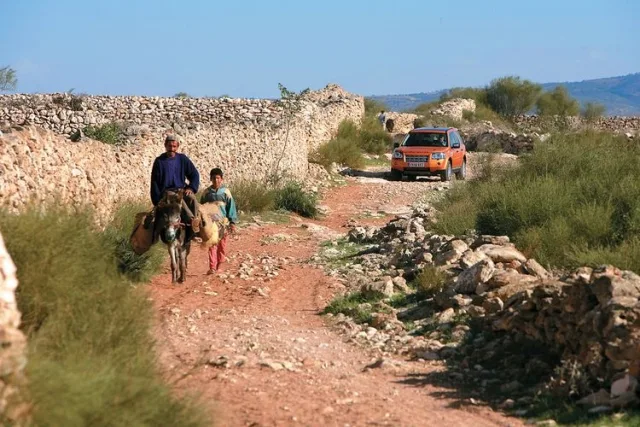
I come out of another turn — and can't believe my eyes: a miracle of miracles! From a spreading tree, like ripe fruit, ... sheep fell down! It turns out that in conditions of a severe shortage of grassy vegetation, these fatsoes have acquired monkey skills. I maneuver between the sheep and quickly make off — the shepherd was furious! Although I didn't hit a single sheep.
Handling? In this sense, the Freelander is perhaps closer to full-size SUVs than to "passenger" crossovers. On the one hand, the reactions are quite sharp (2.6 turns of the steering wheel from lock to lock), but the car starts to lean noticeably earlier than it turns. And the steering wheel is a bit empty. As a result, you enter corners "by feel."
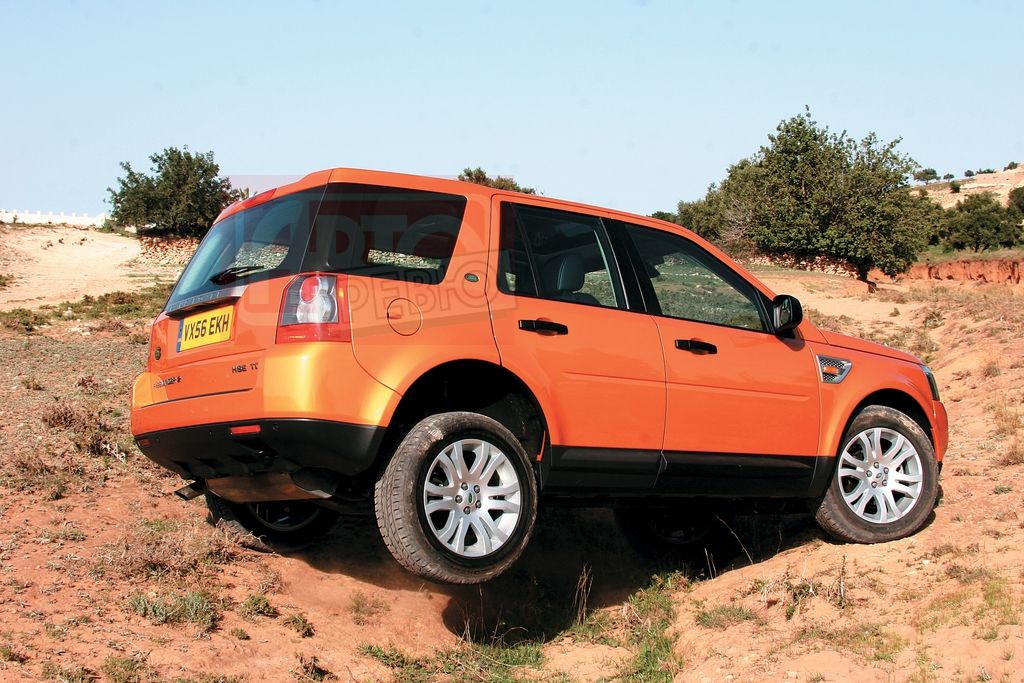 | 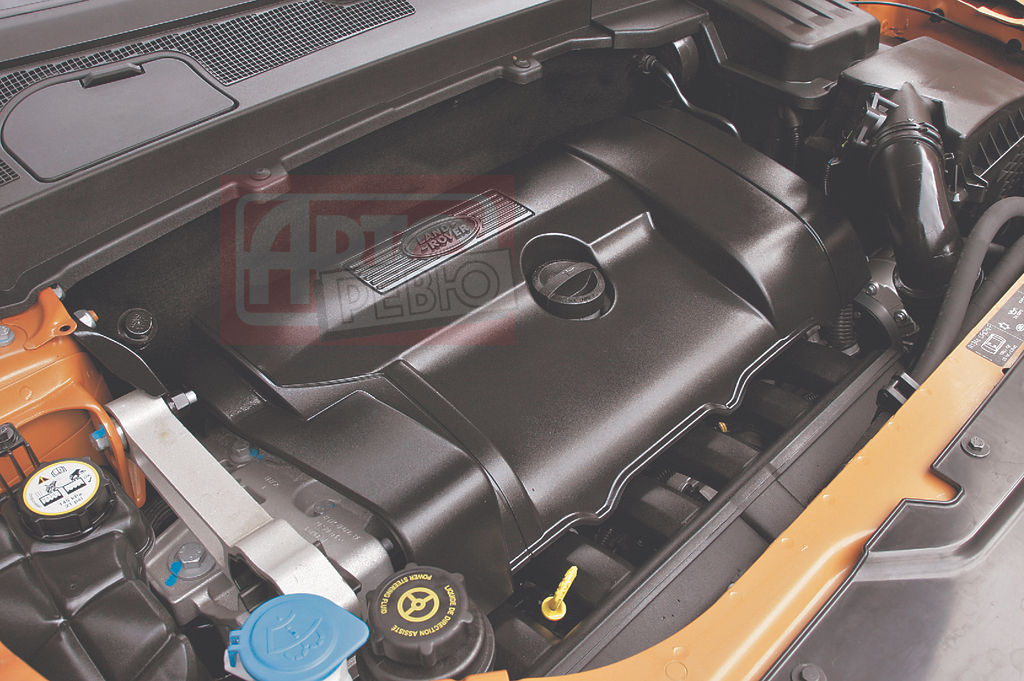 | 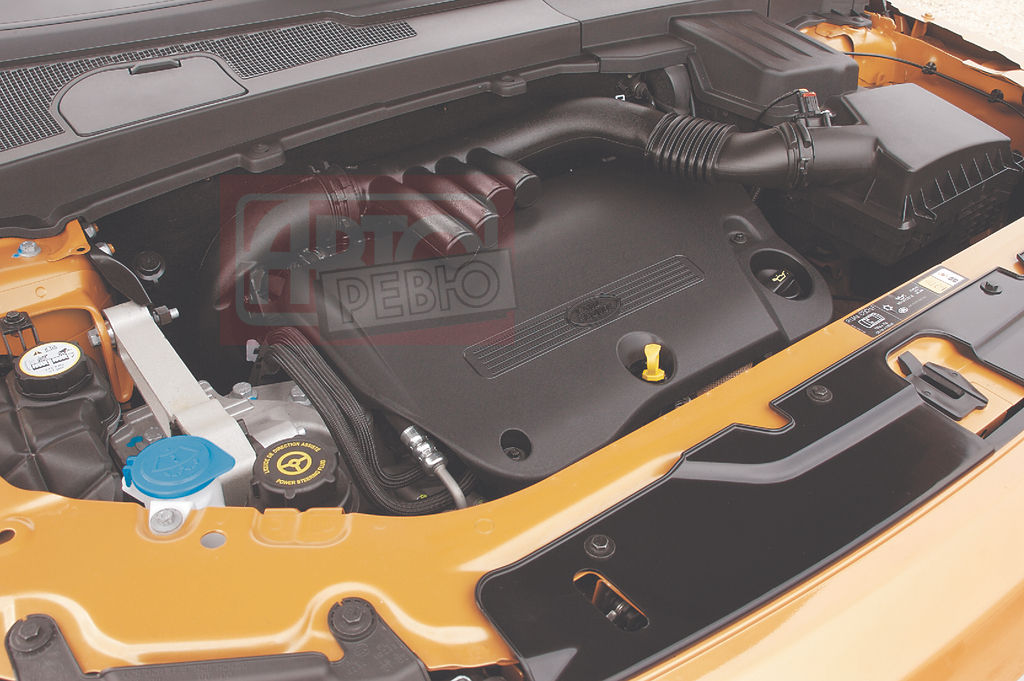 |
| The suspension, though short-travel, has enviable energy intensity | The Volvo inline "six" (3.2 L, 233 hp) is mounted transversely | The turbodiesel, jointly developed by Ford and PSA, alarmed with its narrow operating range |
The Freelander's creators listened to me and blamed everything on the "pre-production" nature of the cars:
— Look, even the bumpers on the orange cars differ in color from the body: they were painted "on the knee." We know about the low informativeness of the steering, but production cars will have different front wheel alignment angles, and the feedback will be better.
Maybe they're also blaming the mirror? They also promised to strengthen the sound insulation of the rear part (in my opinion, everything is fine as is), eradicate interior "crickets," and stop glitches in the electrics. That's commendable, otherwise on our car the headliner creaked and the fuel gauge "glitched": on the first climb uphill, half a tank of diesel went away! Risking stalling again, but this time due to lack of fuel, we take another height. Risk is a noble cause: the tank filled up with diesel again.
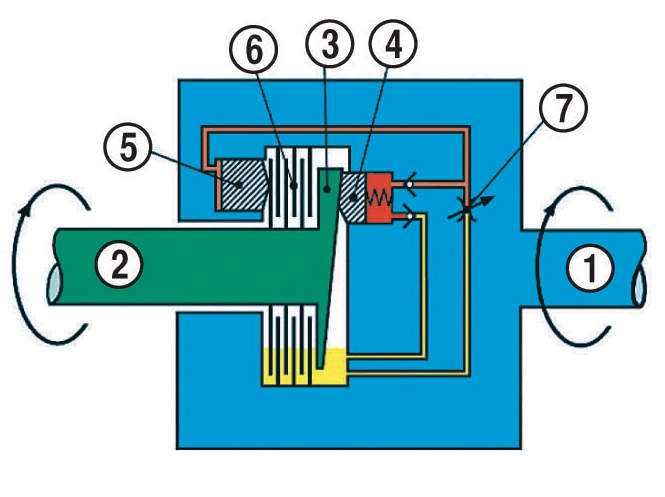 | |
| The main change in the transmission: the electronically controlled Haldex coupling in the rear wheel drive replaced the viscous coupling. There is no low-range gear or wheel locks | Haldex coupling. The clutch pack is compressed from the slightest mismatch in speeds of the drive (1) and driven (2) shafts. The rotation of the cam washers (3) leads to reciprocating motion of the pistons (4), which pump oil into the actuating cylinder with a piston (5) — and compress the clutch pack (6). The amount of torque delivered to the rear wheels is flexibly regulated by an electromagnetic valve (7), which, on command from the computer, releases pressure |
The petrol Freelander with the Volvo inline "six" (3.2 L, 233 hp) made a more pleasant impression — both on sand and on asphalt. And even though the torque here is less (317 Nm vs. 400 Nm for the diesel), the petrol car is easier to manage: the engine's operating range is wider.
The six-speed automatic gearbox in "drive" mode responds with a noticeable pause, but if you switch to manual shifting, the dynamics become completely different — you can drive quite briskly. True, you have to constantly slow down before villages: donkeys and horses roam the roads, and motorcyclists are frequently encountered. At the same time, there are no signs indicating that a populated area is ahead. The houses here look unusual: at first you think they are ruins of a medieval fortress, but upon closer inspection, you realize they are dwellings. The roof is made of tarpaulin, and the door is an ordinary blanket. Poverty is all around. However, the locals are incredibly friendly! You share your dry rations with them — and you feel the unbreakable friendship between Russia and Morocco strengthening. People literally ask to be in the frame…
The new Freelander has grown noticeably: length increased by 5 cm, height by 3 cm, and width by as much as 11 cm. Like the Toyota RAV4, it has said goodbye to the three-door version, which previously looked quite frivolous. True, the Freelander's developers consider their rivals not the RAV4 at all, but cars of a completely different level: BMW X3, Lexus RX 350, Nissan Murano. The prices are corresponding — from $37,500 for the base diesel version with a manual gearbox to $55,900 for the top petrol version with an automatic. But if you remember that the Freelander is perhaps the most capable off-road of all crossovers, and the Land Rover name still commands respect, then why not? The car is beautiful, with a noble appearance. The main thing is that the engineers keep their word and rid it of its former "childhood diseases." As soon as that happens, you can expect the car in Russia. According to rumors, they should just make it by February.
| Specifications | ||
| Vehicle | Land Rover Freelander | |
| Modification | i6 | TD4 |
| Body type | 5-door wagon | 5-door wagon |
| Number of seats | 5 | 5 |
| Trunk volume, l | 755/1670* | 755/1670* |
| Curb weight, kg | 1770 | 1770 |
| Gross weight, kg | 2505 | 2505 |
| Engine | petrol | diesel, turbocharged |
| Location | front, transverse | front, transverse |
| Number and arrangement of cylinders | 6, in-line | 4, in-line |
| Displacement, cm³ | 3192 | 2179 |
| Cylinder bore/piston stroke, mm | 84/96 | 85/96 |
| Compression ratio | 10.8:1 | 16.5:1 |
| Number of valves | 24 | 16 |
| Maximum power, hp/kW/rpm | 233/171/6300 | 160/118/4000 |
| Maximum torque, Nm/rpm | 317/3200 | 400/2000 |
| Gearbox | automatic, 6-speed | manual, 6-speed (automatic, 6-speed) |
| Gear ratios | ||
| I | 4.15 | 3.75 (4.15)** |
| II | 2.37 | 1.91 (2.37) |
| III | 1.56 | 1.18 (1.56) |
| IV | 1.16 | 0.84 (1.16) |
| V | 0.86 | 0.65 (0.86) |
| VI | 0.69 | 0.54 (0.69) |
| reverse | 3.39 | 3.44 (3.39) |
| final drive | 3.75 | 4.53 (3.33) |
| Drive | all-wheel, with Haldex coupling in the rear wheel drive | |
| Front suspension | independent, coil spring, McPherson | |
| Rear suspension | independent, coil spring, McPherson | |
| Front brakes | disc, ventilated | |
| Rear brakes | disc, ventilated | |
| Tires | 215/75 R16 | 215/75 R16 |
| Aerodynamic drag coefficient, Cx | 0.39 | 0.39 |
| Maximum speed, km/h | 200 | 181 |
| Acceleration time 0-100 km/h, s | 8.9 | 11.7 |
| Fuel consumption, l/100 km | ||
| urban cycle | 15.8 | 9.2 |
| extra-urban cycle | 8.6 | 6.2 |
| combined cycle | 11.2 | 7.5 |
| Fuel tank capacity, l | 70 | 68 |
| Fuel petrol | AI-95 | diesel fuel |
| * With rear seats folded | ||
| ** Data in parentheses — for versions with automatic transmission | ||