
Land Rover Discovery 3
Before us is a British third-generation SUV that clearly needs no introduction. However, getting acquainted with it is always an event, especially when it comes to a real off-road test.
Technical specifications:
- Turbo diesel with Common Rail injection system, displacement 2,720 cm³.
- Power — 190 horsepower at 4000 rpm, maximum torque — 440 Nm already at 1900 rpm.
- Acceleration to 100 km/h takes 11.5 seconds, top speed — 180 km/h.
- Transmission — 6-speed automatic Command Shift with manual shifting capability.
- Drive — permanent all-wheel drive, supplemented by an electric central differential lock and a two-speed transfer case.
- Fuel consumption: in the city — 11.5 l/100 km, on the highway — 8.2 l, in combined cycle — 9.4 l.
- Dimensions: length — 4835 mm, width — 2009 mm, height — 1837 mm. Gross weight — 3230 kg.
Agasin Ovakovich Karagulyan, director of Kamaz - Leader, personal car Honda CR-V.
I was familiar with this car only from TV shows on the Discovery channel, so the opportunity to test it in person was a real event for me. Especially since it was about a completely new, third generation of the model.
The first thing that catches the eye is the exterior. If the previous generation was distinguished by smooth contours, here the cult of the right angle reigns. The appearance has everything you could wish for: balanced proportions, strict restraint, respect for the brand style, a slight ruggedness, and impeccable geometry of lines.
The dimensions of the car are frankly impressive. Having gotten used to my compact Honda CR-V, I felt a bit unsure in city traffic behind the wheel of such a giant. At first, I even mistook it for an ordinary city crossover. But as soon as we drove out onto a plowed field, everything fell into place.
In essence, the Discovery is a hundred percent off-road vehicle, fully matching its image. On one hand, it is a modern all-wheel-drive vehicle with independent suspensions and electronically controlled differentials. On the other hand, there is an honest transfer case and the ability to adjust ground clearance. Its off-road capability is beyond all praise. The electronics help a lot: when turning the steering wheel, the system automatically brakes the car. Even a novice can handle the Discovery 3. The only thing was that it was a bit of a pity to drive such a beautiful car through the mud. I didn't want to get it dirty.
The diesel engine, despite its efficiency, pleases with decent output. On the first two gears, the car feels surprisingly lively for a diesel. True, with increasing speed, the dynamics fade — both the considerable mass and not the most outstanding aerodynamics take their toll. However, for the Discovery 3, speed indicators are not the main thing. Its element is off-road.
The air suspension deserves special respect: it is simultaneously comfortable, resilient, and energy-intensive. It indiscriminately swallows almost all road imperfections. However, in the back row, where there is plenty of space, bumps are felt more noticeably. This is understandable: the wheelbase is long, and the second row of seats is raised relative to the first.
The only thing that caused discomfort while driving was the armrest, which interfered with manual gear shifting.
Overall, the car left exclusively positive impressions. It will be an excellent choice for business people who often go on business trips. Beautiful, comfortable, economical, and truly off-road capable — that's how I remember the Land Rover Discovery 3.
Alfred, driving experience 11 years.
The car met us at the entrance to the showroom, ready for testing. But the manager, knowing about the upcoming photo shoot, suggested driving it to the car wash. "Why?" — I thought. This car seems designed to be dirty. The spirit of adventure that the manufacturer so actively advertises does not go well with a clean body. Mud, sand, gravel, and off-road — that is the native element of the Land Rover Discovery III.
The car's appearance resembles strict monumental architecture, as if an architect of the Brezhnev era had worked on it. No other car can boast such epochal solidity. And this is not a reproach — on the contrary, there is nothing superfluous in the design, and it exudes a special masculinity. Inside, everything is saturated with details, which makes the interior very attractive. The only thing that confuses is the abundance of buttons on the front panel. In this scattering of keys, even the door lock button got lost, which later caused us a lot of trouble!
Any test begins on asphalt. And you know what surprises the most? The diesel here does not rattle at all, as one might expect, but pulls almost like a gasoline engine. On a flat road, the car does not feel big and heavy at all. Excellent visibility allows you to quickly get used to the dimensions, and the torquey and very elastic engine creates the feeling that you are driving an ordinary passenger car, not a huge machine. This engine is a real surprise that made me reconsider my attitude towards diesels for the better. On asphalt, the Discovery is soft and comfortable. It swallows small cracks and potholes with its 18-inch wheels, protecting the peace of passengers. And it is precisely peace! In the back seat, you can easily doze off: no wheel noise, no shaking, no tossing on waves — like in a train compartment. The Disco holds a straight line superbly — both at 90 and 140 km/h. Turns are not scary for it either. If you don't pay attention to the rolls, it will take corners without a hitch. Otherwise, the DSC system comes into play, which instantly straightens the trajectory and, no matter how hard you try, will not let you lay this tall car down. The brakes work excellently. Clear and grippy responses to the pedal inspire confidence, and this is extremely important when driving such a heavy car.
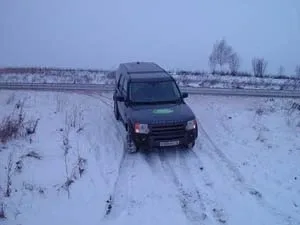
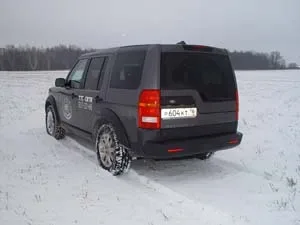
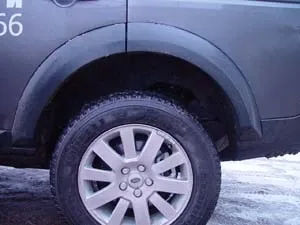
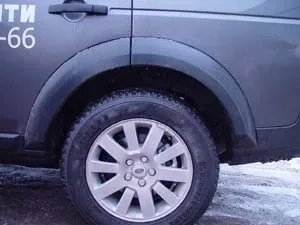
But the real story begins when we leave the highway. Only the summer tires, which the wheels were shod with, were a bit confusing. However, I remembered the test drive that TTS conducted on the beach near Podluzhnaya Street, and realized — the capabilities of this car are known to me, so summer tires did not worry me.
Off-road, the car felt like a fish in water. Indicative was the episode when it unexpectedly could not overcome small icy bumps from plowing. It turned out that we had accidentally activated the hill descent control function, which itself controls the speed and engine rpm. The system does not allow driving faster than 5 km/h, and you don't need to press the pedals — you just set the direction with the steering wheel. That's why it did not let the engine rev up to overcome the obstacle. As soon as I turned off this function, the car playfully, without extra effort, overcame the section amid the enthusiastic exclamations of the other test participants. The catalyst for interest was the innovative Terrain Response system, which in certain modes controls all the car's mechanisms. The control unit combines the engine, gearbox, air suspension, transfer case, differentials, and traction control system into a single chain. Five basic driving modes are reflected on the pictograms of the rotary Terrain Response switch. Land Rover engineers analyzed dozens of possible surfaces and situations that a new Discovery owner might encounter and adapted them to the specifics of a particular car. The result is impressive: the operating modes allow you to make the best use of the off-road potential of the Disco III. Having tried the other Terrain Response modes, we unanimously concluded that this Land Rover innovation allows you to truly enjoy off-road driving. The tension and the usual expectation disappear that you just need to get distracted for a second to switch the radio station — and you're already stuck. And if you still manage to get the car stuck, the height-adjustable air suspension will come to the rescue. By raising the car, the chances of getting out increase significantly, and in case of wheelspin, the automatic system can briefly raise it even higher.
To sum up, I'll say: 1.5–2 hours is quite a short time to truly understand the character of this car. You need to spend more time with it.

Vadim, driving experience 9 years.
I was really hooked by the TV ad for the Discovery 3: nothing superfluous or flashy, just a car that exudes reliability. And when I learned about the diesel — the question was settled, let's go for a test drive! And here, in front of the TTS dealership, stands a clean car posing for photos. The first thing that truly surprised me was how quietly the turbodiesel works: it makes no more noise than a Toyota 1.8 with a chain drive. Inside, it's a feast for the eyes: spacious, strict lines, neat finishing. This time I rode in the front passenger seat. There are plenty of electric adjustments, a wide armrest on the door, and another folding one on the right; the seat softly envelops you while providing clear lateral support. On such a car, a long journey is a pleasure! The suspension is quite soft, adding comfort, but without excessive body roll or pitching. Passengers have access to dual-zone climate control and heated seats — both front and rear. After driving on regular roads, we found an exit from the highway and turned into a field. The Discovery 3 handles ordinary descents and ascents as if they were asphalt. We decided to drive onto a plowed field with frozen clods of earth — and got stuck. Honestly, we were taken aback. Yes, it's summer tires, but this is a Discovery 3! Before continuing, we decided to figure things out and look for the right transmission or suspension setting. It turned out to be simple: the hill descent control button had been accidentally pressed. We turned it off — and the Discovery easily moved forward. True, half an hour later, I got stuck in the plowed field the same way. I tried to rock the car back and forth, but it wouldn't budge. It seemed I did everything right: raised the ground clearance, engaged low range. And again, that same button was to blame! As soon as I disabled the function, the car drove through the deep plowed field like on a regular rough road.
Only after the test did I read the manual (too bad not earlier). The proprietary Terrain Response system offers 5 settings for different surface types and comprehensively manages the engine, transmission, differential, stability control, traction control, hill descent control, and air suspension. Here are the five modes: standard; grass/gravel/snow/ice; mud/ruts; sand; large rocks. If needed, you can further enhance off-road capability: forcibly disable stability control, engage low range, and raise the air suspension. Speaking of the suspension. Off-road, the ground clearance can be raised by 55 mm, and if the car gets stuck, the system automatically adds another 70 mm. At speeds above 160 km/h, the clearance automatically decreases by 20 mm, and at 130 km/h it returns to its original position. For convenient loading or unloading, the body can be lowered by 50 mm. However, unlike the Audi Q7, where only the rear lowers, here the entire body lowers.
I really liked how the stability control works: on a sharp turn, the engine is "throttled," even if the gas pedal is floored — safety is more important. In the manual, I noticed two phrases highlighted in bold: "the center of gravity of the SUV is high, be careful" and "the additional safety provided by the stability control system should not be a reason for unjustified risk." Absolutely right. Although with such a powerful and torquey turbodiesel from the bottom end, it's tempting to push it! In terms of acceleration dynamics, it's not inferior to a gasoline engine, and in some ways even better. Judge for yourself: maximum power is already at 4000 rpm, and peak torque is 440 Nm at 1900 rpm! And this is a turbodiesel with a displacement of only 2.7 liters. For comparison, the gasoline V8 4.4 has less torque — 425 Nm, and that at 4000 rpm.
A very balanced car. Off-road, it's not inferior to such monsters as the Toyota Land Cruiser and Mitsubishi Pajero 3. And on city roads, its behavior is quite comparable to the BMW X5 and Audi Q7.
Maintenance cost (labor + parts)
Maintenance at 12, 36, 60, 84 thousand km – $115 (916 UAH)
Maintenance at 24 thousand km – $226 (1,801 UAH)
Maintenance at 48, 96 thousand km – $393 (3,138 UAH)
Maintenance at 72 thousand km – $318 (2,544 UAH)