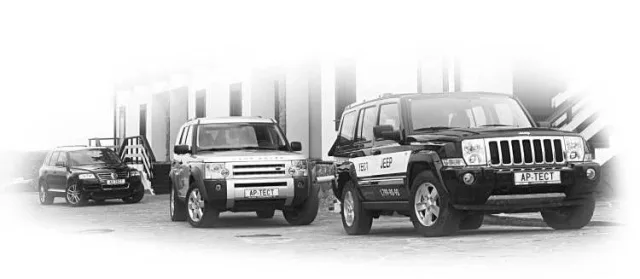
Quadra-Drive II all-wheel drive with three locking differentials, under the hood — a 5.7 Hemi V8 producing 330 horsepower and 508 Nm of torque… However, the DaimlerChrysler press office, mindful of past troubles, gives us the Jeep Commander only after we sign a document prohibiting driving it through water. It turned out that the lesson we taught last year, when our editor-in-chief “drowned” a new Mercedes ML 500 near the village of Solokh-Aul (AR No. 15, 2005), was not learned by everyone: recently, two “Commanders” have already “had a drink.” We sign, although we could have been taken at our word. But we did not promise not to compare the Commander with other SUVs. In our company are the Land Rover Discovery and Volkswagen Touareg, both with petrol V8s and automatics. Better conditions for a comparative test could not be imagined. It's just a pity that we have to forgo water procedures, especially since other dealerships have not imposed such restrictions on us.
The Commander cannot be confused with anything else. A real fortress on wheels! Angular, rough lines, chopped architecture. The resemblance to a bunker is emphasized by vertical twin headlights and fog lights hidden behind embrasures.
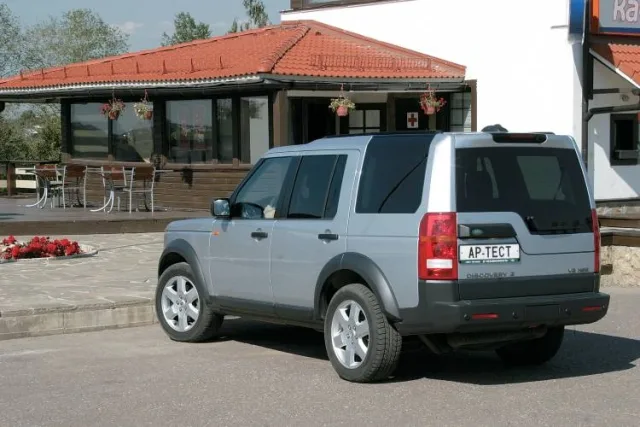
The Land Rover Discovery, although made in the same cubic style, looks much more refined and expensive. Clear lines, familiar proportions, elegant design… A truly English car! And the unpainted plastic on the bumpers and arches hints that the car is not afraid of dirty work.
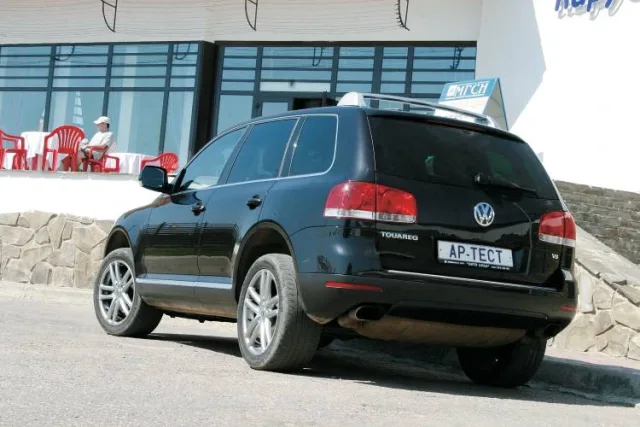
The Touareg, on the contrary, does not reveal its off-road talents at all: streamlined shapes, no “jeep” details. From a distance — an ordinary station wagon, either a Passat or a Golf. And only up close do you notice the large ground clearance and short overhangs: it's an SUV!
Getting into the Commander, a thrifty pragmatist will be shocked. What are you paying over seventy thousand dollars for? For hard plastic? For cheap wood imitation, as if from a Korean or Chinese car? For leather that looks like leatherette? No, not for that! The interior, like the exterior, is in a military style — sheer romance! Massive metal door handles, chopped panel edges… You sit down and feel almost like an American colonel (though our colonel, to save up for such a car, would need to serve faithfully for about forty years). Hex bolts shamelessly protrude in the most visible places. Even if there is nothing under them, they are still there — for example, on the automatic gearshift knob or on the wheel arch extensions.
The “commander-style” seating is comfortable. But not for everyone: the steering wheel, although sporty-looking, adjusts only for height; the pedals are adjustable but offset to the left, and the brake is significantly higher than the accelerator. The soft seat is clearly designed for heavier occupants.
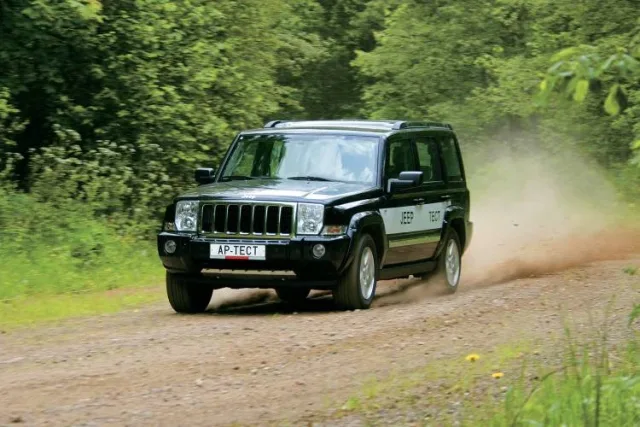
On a dirt road without stabilization, you can't speed up: the Commander throws you around in ruts, and you might just break into a skid
The round steering column switches are convenient. Rotating the left one turns on the headlights, and the ring on the right controls the rear wiper. But they overcomplicated the front wipers: to turn them on for continuous operation, you need to rotate the left stalk through five sensitivity levels of the rain sensor! The climate control knobs also require a glance — you can't adjust them by touch.
 |  |  |
| Jeep Commander: a feeling of raw power that words cannot convey | Quadra-Drive II transmission “remote”: stylish automatic selector and T-shaped transfer case mode button | Instruments: stylish and clear |
You'll also have to get used to the visibility. The view through the “tank-like” windshield is limited by thick pillars with useless handles (to grab them, you have to reach forward, forgetting about more important support points). It's better to look back in the large exterior mirrors, because the headrests and second row block almost the entire opening, and if you raise the “cargo” seats, the interior mirror shows only them and the headrests.
The Land Rover creates a more refined atmosphere. The seat distributes load evenly, and there are no complaints about the pedals. The dashboard plastic is more expensive. The clicks of the convenient climate control knobs are more informative, and the climate system itself works better. But there are ergonomic flaws: you have to reach for the window buttons, the instruments with small divisions are hard to read, and they are often obscured by the steering wheel with its absurdly thick rim. However, visibility is better than in the Commander. The pillars are thin, the mirrors are large, and the rear window is almost unobstructed by headrests.
 |  | |
| The Jeep's flat seat doesn't “hold” well even in slow corners | Passengers in the Commander's middle row don't have much room to stretch out — an armrest and cup holders. In the “gallery,” there's even less, and it's cramped | |
The Touareg's interior in Individual trim impresses with luxury, style, and quality. Real wood, real leather and aluminum, impeccable assembly. And the instruments are a sight to behold: two large dials with excellent markings and chrome bezels are not obscured by the comfortable leather steering wheel, plus a gorgeous display in the center and four small additional indicators that don't interfere. However, the steering column stalks, positioned low, are inconvenient. But the climate can be controlled without delving into buttons: set the temperature with a convenient knob, press Auto — and forget it. The best climate system in our trio. Sitting on the firm “chair” is comfortable, and the grippy leather holds you well in corners. The seating position is the most “car-like,” but visibility suffers as a result. It also suffers from the small rear window blocked by headrests, but the mirrors are the best.
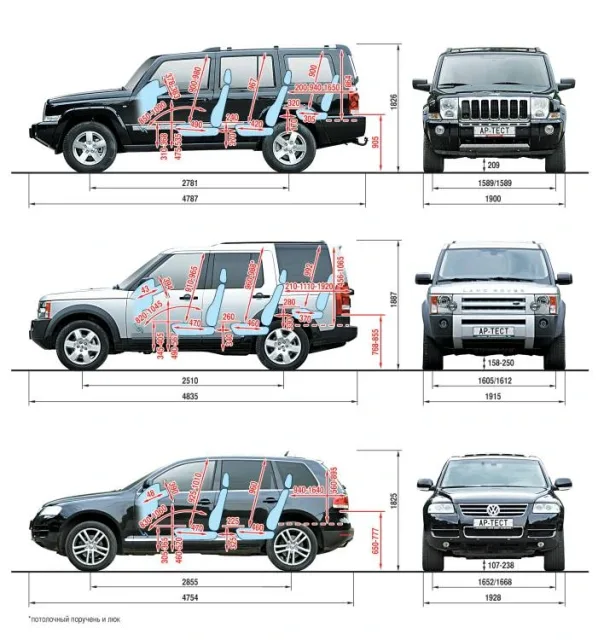
Passengers have the most space in the Discovery: the most legroom and shoulder room, and the central tunnel is almost absent. Given that the Land Rover has full seats in the trunk, this is the best car for traveling with a large company. In the others, it's tighter: the Touareg has a lower ceiling, and the Commander has less legroom. Let the Jeep get a bonus for the seats in the trunk, but they are only suitable for children. And if the children have grown up, it's better to unscrew them and leave them with the dealer: they increase the loading height, and in the working position they eat up the entire trunk.
 |  |  |
| 5.7 Hemi engine: beastly roar and powerful torque | There's room for long items |
Loading the Jeep through the separately opening glass is not only inconvenient but also dangerous — it “shoots” up so sharply that you barely have time to move your face away. Our people will put up with it, but litigious Americans could cause problems for DaimlerChrysler.
It's much easier (and safer) to use the spacious trunk of the Touareg, only the protruding bumper gets in the way. But it doesn't get in the way as much as the Discovery's tailgate. However, in the Discovery you can carry long items and securely fasten heavy loads: the solid loops in the trunk could even hold a trailer.
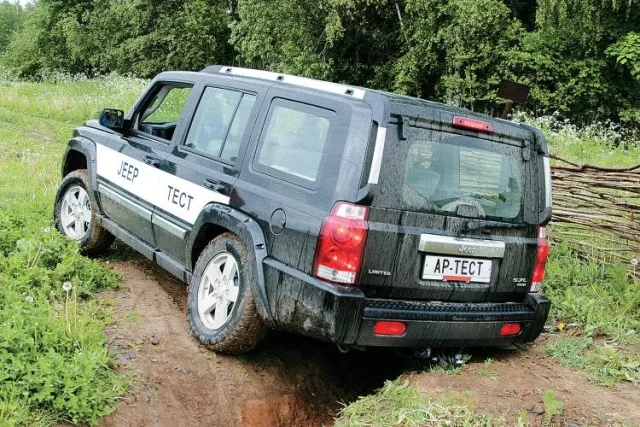
The Jeep crossed this ditch with ease. Under the wheels — slippery clay…
The Jeep Commander starts with a roar as if a fighter pilot is at the controls, and this is not an empty sound — the dynamics are truly impressive. The car accelerates to 100 km/h in less than eight seconds, and even all-wheel drive doesn't save the front wheels from spinning at launch. The powerful engine seems not to care what speed you're going or which gear the unhurried automatic has selected — it's always ready to surge. But the gearbox could behave more politely. In calm driving, illogical shifts and pauses during downshifts are annoying. Smoothness of gear changes is maintained only with moderate throttle application, but if you give free rein to all 330 “horses,” the jerks become frankly rough.
The Volkswagen Touareg loses in acceleration, although calling it sluggish would be a stretch. Its gearbox shifts smoothly and almost imperceptibly — both during acceleration and braking. Overtaking is easier in it: there are almost no delays when shifting down, and the transmission's behavior is predictable. In our trio, this is the best engine-automatic tandem.
But the three hundred English horses are harnessed poorly. Even if the Discovery surpasses the Touareg in peak capabilities, the gearbox spoils the overall impression. During measured driving, it constantly shifts from gear to gear, and during overtaking it is frankly sluggish. The only plus is the absence of jerks, which the American is guilty of.
In normal modes, the deceleration of all three heavy SUVs feels equally comfortable. But during emergency braking, differences begin. The Commander, rocking on its suspension, cannot fully use the tires' grip on the road. The Touareg stops from 100 km/h best of all — in 41.9 meters, but after a series of intense braking, its brakes overheat and lose effectiveness. The Discovery, with its commendably stable mechanisms, wins a full 5 meters over the Volkswagen during a single braking from 150 km/h. I remember how one of the Porsche engineers (and it was this company that developed the brakes for the related Touareg and Cayenne) proudly stated that finally Volkswagen got decent brakes. But the same problems in the Porsche Cayenne (see AR No. 11, 2006) suggest a design flaw, and also remind that pride is a sin.
Driving the Commander in extreme modes is an activity for people with nerves of steel or a dulled sense of self-preservation: the car jumps and yaws so much that you want to slow down forever. If you do slow down, the result won't be long in coming: body roll decreases, and the steering wheel fills with pleasant effort. But as soon as an unevenness appears in a turn, confidence disappears: jumps, breakaways, rocking. On a high-speed straight, the Jeep also doesn't please: it drives as if by itself, wanders in a wide corridor, and reacts to attempts to correct the trajectory as if it were the colonel here, and the driver at most a lieutenant.
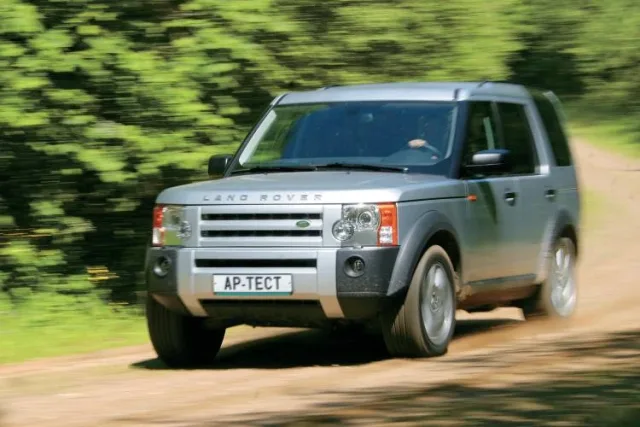
Off the asphalt, the Land Rover handles reliably and logically, and the suspension pleases with a reserve of energy intensity
 |  |
| The Discovery's interior is not as laconic as its exterior | A hoarder's dream — two glove boxes |
The Land Rover, it must be admitted, also doesn't rush into corners. But if it does enter them, it holds the trajectory precisely, despite noticeable diagonal rocking. And it pleases with informative steering effort. At the limit — an obvious understeer of the front axle, which ESP doesn't fight at all. But in the lane-change test, the stability system so zealously protects the course, suppressing the slightest breakaway of the rear wheels, that it simply starts to annoy.
On a high-speed straight, the Discovery is confident: side wind and road surface irregularities are easily corrected by short movements of the informative steering wheel.
 |  |  |
| The instruments are "dim-sighted" | The Terrain Response "dial," transmission control buttons, and air suspension are grouped into a single unit | The selector lever "rests" in Drive mode — you won't miss it! |
The Touareg against this background feels almost like a passenger car: the steering responds quickly and precisely, body roll and rocking are minimal. Even at two hundred kilometers per hour, you can safely change lanes without fear of "unwinding" the car. The Volkswagen doesn't throw itself into corners with the enthusiasm of a racing car, but it takes them clearly, at speeds that other participants never even dreamed of. The steering wheel seems almost weightless, but remains informative. At the limit, the Touareg smoothly slides with all four wheels, and ESP intervenes exactly when and to the extent that the driver doesn't panic.
 |  |  |
| The firmness of the high "chair" is optimal, but it doesn't shine with relief | The Discovery's rear seats will accommodate three passengers without problems… | …and two more can be seated in the trunk |
Maybe the Jeep Commander will take revenge for handling in the ride comfort exam? Alas. It collects all the small stuff from the road: seams, joints, cracks. Large irregularities shake the body with a full set of special effects: suspension rumble and terrible vibration of unsprung masses. Waves of asphalt cause such rocking that you want to check not the serviceability, but the very presence of shock absorbers. Speed bumps also give no rest. If at 20 km/h they respond only with a slap of tires and a sonorous thud, then, having missed them at 60 km/h, you'll get such a kick that next time you'll be more attentive. In general, serves you right.
With the gas pedal fully pressed, the multi-liter engine emits a beastly roar. Perhaps someone finds it pleasing to the ear, but over time you get tired of it. You can drive the Commander comfortably only at a speed of 80–100 km/h, when all noises are muffled and balanced. With increasing speed, even without aggressive driving, aerodynamic hum begins to dominate.
 |  |
| Transport non-dismantled furniture? Easy! | Three sunroofs in the roof — an excellent remedy for depression |
In terms of ride comfort, the Land Rover will give a head start to many more expensive SUVs: passengers are not bothered by either hard irregularities or waves of asphalt. Only potholes half a wheel deep can seriously shake the car. But even then, there will be no suspension breakdown — the energy intensity is simply amazing! Only a slight vibration from unsprung masses is annoying. Acoustic comfort is exemplary: noises from the road, engine, and wind do not irritate even at high speeds.
The Touareg yields to the Discovery both in ride comfort and noise level, but it's far from the Commander. Small irregularities are transmitted with slight jolts, especially noticeable in the sport mode of the shock absorbers, but the Volkswagen easily passes large potholes, and there is no rocking on waves at all. At 20 km/h, the Touareg noticeably shudders on a speed bump, but at 60 km/h, like the Discovery, it flies over it playfully.
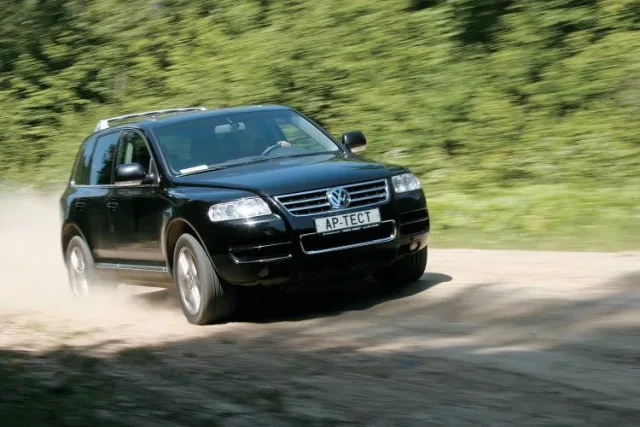
The Volkswagen won't falter even on a rally special stage — the chassis is excellently tuned
The perky roar of the Volkswagen's V-shaped "eight" will appeal only to "athletes," but comfort lovers will also suffer from noisy tires.
 |  |  |
| Such instruments wouldn't be a shame to put even on a Porsche |
Three heroes: the finale of a big comparative test
The time has come to draw a line under our grand comparison. We have already studied the behavior of these cars on asphalt, where the Volkswagen Touareg, Jeep Commander, and Land Rover Discovery showed themselves from the best side. But a real test drive would not be complete without serious off-road, for which our subjects, unlike many glamorous crossovers, are truly ready. Let's start with a light dirt road to warm up before serious trials.
On the dirt road, the Jeep Commander had the worst time. Until the speedometer needle crossed 60 km/h, the cabin is filled with shaking and vibration, which get quite tiresome. If you add gas to 80 km/h, it becomes more comfortable, but then another limiter comes into play: the car begins to rock, it's thrown from side to side in the rut, when avoiding potholes it leans and every now and then tries to go into a skid. The stability system works without stopping.
 |
 |
 |
| In the luxurious two-tone seats you sit as if glued | On the hospitable sofa it is better to sit together | The trunk is well thought out and neat |
Land Rover on a dirt road seems not to notice the surface. Whether at 40 or 120 km/h, it rides equally smoothly, and the suspension easily digests both large potholes and small ripples. On dirt, the Discovery handles just great: it follows the steering wheel clearly, easily jumps over ruts, and stably passes sections with loose surface. If you want, you can even have a small rally race, the car allows it!
 |
| This is where the optional rear differential lock is needed. The front wheel is in a ditch, the rear wheel is in the air, and the Touareg confidently crawls on loam on "bald" tires |
The Touareg also doesn't mind a breezy ride on a dirt road. It handles reliably, but the Volkswagen transmits small irregularities too thoroughly into the cabin, and that's the only thing that spoils the pleasure. But waves and potholes the Touareg swallows even better than the Discovery.
Should we head to a sand quarry? In the Commander, you don't even need to think about which gear to engage or which differential to lock. Everything is ingeniously simple: put the selector in neutral, lift up the stylish lever shaped like a "T" — and the Low 4WD indicator lights up on the dashboard. Now you have the entire off-road arsenal at your disposal: three self-locking differentials and a low range.
With such equipment, the Commander crawls on wet clay and sandy slopes like a real bulldozer, cutting obstacles with the powerful front suspension arms and the rear axle housing. But that's not all! If you hold the ESP off button for fifteen seconds, completely disabling stability control, the Jeep can climb a mountain from which it will then roll down even with locked wheels, gaining speed. The main limitations here are the long overhangs and the non-adjustable ground clearance, which, moreover, is not the largest.
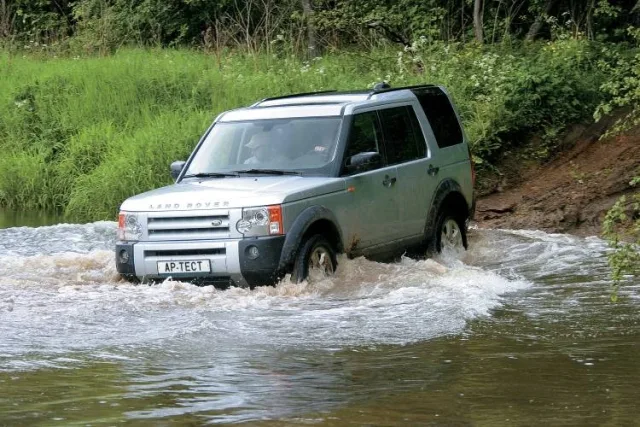
The Land Rover felt not so confident in the soggy mud. Even with its long-travel suspension and huge clearance, it lagged behind the Commander in the quarry. At the same time, the Terrain Response system does not add peace of mind. Why, for example, in "sand" mode does the car immediately dig into that very sand, while in "snow" mode it easily gets out of sand traps? And why, when leaving a slippery rut, does it crunch the brakes and shuffle the torque, making the driver nervous? We tried all modes and came to the conclusion that for Russian off-road, it is best to set the regulator to "snow" — it provides the best cross-country capability on any surface.
But the Touareg, despite its almost bald "asphalt" tires, with its honest all-wheel-drive transmission, did not lag behind the Discovery either on a slippery climb or in sticky mud. True, it did not drive so confidently on the sand quarry — the air suspension in the upper position no longer has travel reserve for rebound, causing the wheels to hang in the air from time to time. Overall, in terms of cross-country capability, we are ready to put an equal sign between Volkswagen and Land Rover.
It's time to move on to the awards ceremony. Let's start, as usual, with third place.
Jeep Commander. Its style and manners may be rough, but they have their own originality, and in our time, when everyone strives for unification, that is worth a lot. Moreover, it is a real Jeep with breed. And its furious engine and true off-road transmission remind of childhood experience: the scariest thing is not to climb onto a fence, but to get off it.
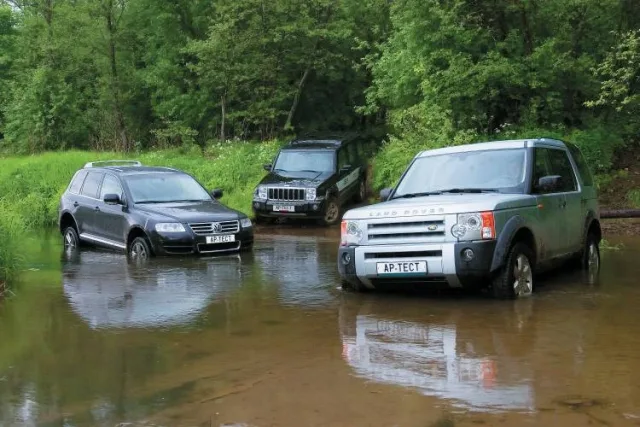
By the way, as agreed, we did not ford water obstacles, but after studying the design of the air intakes, we did not regret it at all. So another reminder from childhood: don't swim beyond the buoys!
Land Rover Discovery is a beautiful, purebred, comfortable, and spacious car. It drives great both on asphalt and off-road. And if it weren't for the transmission that lives its own life (this applies to both the gearbox and the Terrain Response system), Volkswagen's first place would be in big question.
But in our trio, it is the Volkswagen Touareg that turned out to be a jack of all trades. On asphalt and on dirt, it shows excellent and, most importantly, balanced results. And the fact that the Touareg lacks "historical charisma" is a matter of time.
| Expert ratings from Autoreview | ||||
| Evaluated parameter | Max score | Jeep Commander | Land Rover Discovery | Volkswagen Touareg |
| Design | 160 | 125 | 135 | 145 |
| Exterior | 80 | 65 | 70 | 70 |
| Interior | 80 | 60 | 65 | 75 |
| Ergonomics | 160 | 115 | 140 | 135 |
| Driver's seat | 80 | 60 | 65 | 70 |
| Visibility | 80 | 55 | 75 | 65 |
| Dynamics | 330 | 265 | 270 | 285 |
| Acceleration | 80 | 70 | 65 | 70 |
| Braking | 100 | 75 | 85 | 85 |
| Handling | 80 | 60 | 65 | 75 |
| Cross-country capability | 70 | 60 | 55 | 55 |
| Ride comfort | 180 | 125 | 150 | 145 |
| Ride smoothness, vibration protection | 70 | 45 | 60 | 55 |
| Acoustic comfort | 60 | 45 | 50 | 45 |
| Climate control | 50 | 35 | 40 | 45 |
| Cabin comfort | 170 | 130 | 150 | 135 |
| Rear seats | 70 | 60 | 65 | 55 |
| Trunk | 60 | 40 | 50 | 50 |
| Cabin transformation | 40 | 30 | 35 | 30 |
| Total score | 1000 | 760 | 845 | 845 |
| Jeep Commander 5.7, Land Rover Discovery V8, Volkswagen Touareg V8 (manufacturer data) | |||
| Vehicle | Jeep Commander | Land Rover Discovery | Volkswagen Touareg |
| Body type | 5-door wagon | ||
| Number of seats | 7 | 5 (7)* | 5 |
| Trunk volume, l | 1028/1940** | 1260/2558** | 555/1570*** |
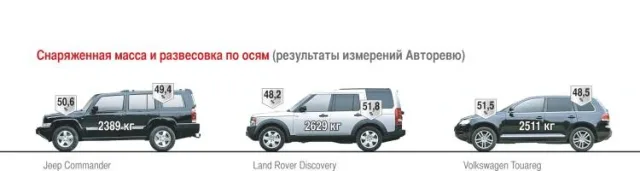
| Curb weight, kg | 2361 | 2704 | 2250 |
| Gross weight, kg | 2903 | 3230 | 2945 |
| Engine | petrol, with distributed fuel injection | ||
| Location | front, longitudinal | ||
| Number and arrangement of cylinders | 8, V-shaped | ||
| Displacement, cm³ | 5654 | 4394 | 4172 |
| Compression ratio | 9.6:1 | 10.5:1 | 11.1:1 |
| Number of valves | 16 | 32 | 40 |
| Maximum power, hp/kW/rpm | 330/246/5000 | 300/220.5/5500 | 310/228/6200 |
| Maximum torque, Nm/rpm | 508/4000 | 425/4000 | 410/3000 |
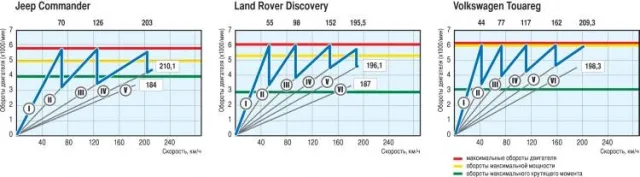
| Transmission | automatic, 5-speed | automatic, 6-speed | automatic, 6-speed |
| Gear ratios | |||
| I | 3 | 4.17 | 4.15 |
| II | 1.67 | 2.34 | 2.37 |
| III | 1 | 1.52 | 1.56 |
| IV | 0.75 | 1.14 | 1.16 |
| V | 0.67 | 0.87 | 0.86 |
| VI | — | 0.69 | 0.69 |
| Reverse | n/a**** | 3.4 | 3.39 |
| Final drive | 3.73 | 3.73 | 4.56 |
| Transfer case (high/low) | 1.00/2.72 | 1.00/2.93 | 1.00/2.70 |
| Drive | permanent, all-wheel, with electronically controlled center differential | permanent, all-wheel, with electronically controlled center differential | permanent, all-wheel, with symmetrical center differential |
| Front suspension | independent, spring, on transverse arms, with stabilizer | independent, pneumatic, on transverse arms, with stabilizer | independent, pneumatic, on transverse arms, with stabilizer |
| Rear suspension | dependent, spring, five-link, with stabilizer | independent, pneumatic, with stabilizer | independent, pneumatic, on transverse arms, with stabilizer |
| Tires | 245/65 R17 | 255/60 R18 | 245/65 R17 |
| Front brakes | disc, ventilated | disc, ventilated | disc, ventilated |
| Rear brakes | disc | disc, ventilated | disc, ventilated |
| Maximum speed, km/h | 208 | 195 | 225 |
| Acceleration time 0-100 km/h, s | 7.4 | 8.6 | 8.1 |
| Fuel consumption, l/100 km | |||
| urban cycle | 21 | 20.9 | 20.3 |
| extra-urban cycle | 12.3 | 11.6 | 11.6 |
| combined cycle | 15.5 | 15 | 14.8 |
| Fuel tank capacity, l | 78 | 86 | 100 |
| Fuel | petrol AI-92 | petrol AI-95 | petrol AI-95-98 |
| * With additional seats | |||
| ** With folded second and third row seats | |||
| *** With folded rear seats | |||
| **** N/a - no data | |||
Light in the night
To understand how well SUVs illuminate the road, we conducted night photography. The results were revealing: for the Jeep Commander and Land Rover Discovery, the low beam proved most effective - a pedestrian on the roadside is clearly visible even at a distance of 80 meters. The Volkswagen Touareg, however, disappointed: at 65 meters a person is barely visible, and at 80 meters - practically not illuminated. The high beam of the "American" and "Briton" is also strong, but noticeably shifted to the right. The Touareg's beam is slightly weaker, but directed strictly down the center.
During the shooting, only the driver was in the cabin, and the headlight levelers were in the zero position.
| Jeep Commander | Land Rover Discovery | Volkswagen Touareg |
| Low beam. Pedestrian standing on the roadside 65 m from the vehicle | ||
| Low beam. Pedestrian standing on the roadside 80 m from the vehicle | ||
| High beam. Pedestrian standing in the middle of the road 160 m from the vehicle | ||
What's under the hood and between the axles
Modern electronic transmission control systems blur the differences between SUVs. To achieve good handling, engineers have to use permanent all-wheel drive, and old solutions like a rigidly engaged front axle or hub clutches are no longer found.
All three test participants are arranged similarly: the engine is longitudinal, and a two-speed planetary transfer case transmits torque to the front axle via a Morse plate chain (although the Commander also comes in a simplified version - with a single-speed transfer case and even rear-wheel drive). Locking of the inter-wheel differentials is simulated by systems that brake the spinning wheels. A rigid connection between the axles is provided by a multi-disc clutch with electric drive, which locks the conical center differential - this is standard for all three vehicles. The same mechanism, operating quickly and smoothly, is used as an inter-wheel lock in the rear axle of the "advanced" versions of Land Rover and Volkswagen. But Jeep went further: on modifications with the V8 5.7 Hemi engine, such a lock is also installed in the front axle. It is this that gives the "American" an advantage on serious off-road.
The torque distribution algorithm is also important. For the Commander and Touareg, the program is the same for all occasions, while the Discovery has five operating modes of the optional Terrain Response system. At the same time, the Touareg driver can lock the differentials himself, but in the Jeep and Land Rover he is excluded from this.
The "moose" test
SUVs find sharp maneuvers difficult, but they are precisely what show how the vehicle will behave in a critical situation. First, four drivers, who were behind the wheel of these vehicles for the first time, tried to avoid a simulated moose at 60 km/h (for passenger cars - 65 km/h). Then an expert test driver sought the maximum speed of the maneuver.
The "moose" can feel safe with the Jeep Commander: none of the drivers could complete the maneuver without hitting a cone. Deep body rolls, vague steering responses, and unpredictable operation of the stability system interfered. The expert also struggled and ultimately showed only 68.8 km/h.
The Discovery may allow you to dodge an obstacle more easily, but returning to your lane after the maneuver is a problem. Only one of the four drivers did this without errors. The culprit is the stability system, which activates too early and suppresses the skid at the very beginning. Because of its "stubbornness," the tester could not achieve a result higher than the Jeep's - 67.5 km/h.
The absolute leader was the Volkswagen Touareg. Two of the four "novices" successfully completed the maneuver, and the expert showed 73.4 km/h. The vehicle held its trajectory clearly, and ESP intervened timely and gently: it did not interfere with the driver, helped cope with the skid, and kept the vehicle when returning to the lane.

| Maximum speed during the "moose test", km/h | |
| Vehicle | Speed |
| Jeep Commander | 68.8 |
| Land Rover Discovery | 67.5 |
| Volkswagen Touareg | 73.4 |
| "Moose test" on the first attempt at 60 km/h* | |
| Vehicle | Maneuver completed |
| Jeep Commander | 0 drivers out of 4 |
| Land Rover Discovery | 1 driver out of 4 |
| Volkswagen Touareg | 2 drivers out of 4 |
| * Four drivers participated in the tests | |
The view of sportsmen
And what will sportsmen say about these three vehicles? This time, the guests of the Autoreview expert group were two-time Russian rally-raid champions Dmitry Pavlov and Alexey Yelyshev. With them, we went to a special route laid out in the forest...
 Alexey Yelyshev, Russian rally-raid champion 1999, 2000.
drives Isuzu Trooper and UAZ-3162
I am used to holding the steering wheel myself and feeling the car, so I always choose a manual and try to avoid excessive electronics. But in this case, the "automatics" on all three SUVs did not disappoint me at all — they worked flawlessly.
The Commander is the easiest to figure out: one button — and the system is ready to storm any obstacles. However, understanding what this beast with three lockers is capable of was hindered not only by the highway tires but also by the impressive body overhangs along with the wheelbase. Such a powerful engine with incredible torque in mud is probably needed only so that the driver does not notice how the bumpers are being torn off. The car clearly lacks a stiffer suspension and a separate button for controlling the center differential lock.
To understand all the intricacies of the Land Rover Discovery's electronics, a new owner should take a vacation and spend it learning English and computer programs. And then — spend a whole day studying the manual under the supervision of an experienced mentor. I, for my part, after several hours still did not understand which way to turn the Terrain Response dial so that the car would respond normally to the accelerator pedal and not brake in the most inappropriate places. On a narrow slippery rut between trees, you feel very insecure. At the same time, the Discovery has enormous off-road potential, and if it were possible to manually engage the lockers and disable the system that brakes the wheels, it would not yield to the Commander.
The Touareg turned out to be a pleasant surprise: on almost bald tires, it overcame slippery ditches and ruts more confidently than the Discovery. Moreover, it has the best geometric off-road capability — short overhangs and beveled bumpers. The electronics intervene minimally and very logically. And the Touareg does not treat the driver as a fool: all off-road capabilities are activated manually, and their status is visible on the instrument panel.
If I had to choose from this trio, I would take the Touareg with the optional rear differential lock — it is the most understandable and friendly car. But I do not understand something else: why drag such vehicles into the mud at all, and even on highway tires? After all, an ordinary Niva on standard VLI-5 tires will handle this much better. And more fun.
 Dmitry Pavlov, Russian rally-raid champion 2001, 2003.
drives a Toyota RAV4
The Jeep Commander behaves predictably and understandably off-road. You easily feel the moment when the wheels start to spin, and by carefully working the throttle of the powerful engine, you can get out "on torque," catching onto irregularities. At first, I did not even notice that the lockers here are not rigid, and the degree of differential freedom is controlled by electronics. I realized this only on a slippery incline: the car stalled and began helplessly churning with torque. But as soon as I completely turned off ESP (for this, you need to hold the button for about 15 seconds), the Jeep confidently moved on. However, you will not be able to move quickly off-road in the Commander — the front suspension constantly bottoms out, and the rear springs with shock absorbers also lack energy capacity.
The Volkswagen Touareg also rocks. But its suspension has more travel, so bottoming out happens less often. However, if you raise the body to the upper position, you acutely feel the almost complete lack of rebound travel. Over bumps and forest roads, the Volkswagen drives as confidently as the Jeep. But if the car gets truly stuck, the electronics start to "go crazy": the brakes work uselessly, the center differential lock disengages... Fortunately, this rarely happens — the huge ground clearance saves it.
But the Land Rover Discovery is a Play Station off-road. To "advance to the next level," you need to be an advanced "gamer" and know which buttons to press at the right moment. The electronics intervene so brazenly and stupidly that they negate the car's strong off-road qualities. Why "choke" the powerful engine before a tricky spot that can only be passed with momentum? Why brake the wheels inappropriately when the car is being turned around in a rut? Even when driving across a field, you constantly feel the presence of a semiconductor genius that always "knows better." It does not know!
But the Discovery's suspension is the best of all. It, like a punching bag, withstands the strongest impacts. There is no discomfort even in the highest body position — the suspension travel is enormous! If I needed to drive a rally-raid in a stock car, I would choose the Land Rover. With such suspension, you can race anywhere.
From the point of view of geometric off-road capability, all three cars are quite close — they equally scrape their differentials in ruts.
Breathing through a tube
 Water, as is known, does not compress. That is why cars are so afraid of water obstacles. When water enters the cylinder through the intake tract, it "locks" the piston on the compression stroke — a hydraulic shock occurs. In the best case (if the engine took in water at low RPM), you can get away with unscrewing the spark plugs and forcing the water out through the spark plug holes when cranking the crankshaft. And in the worst case... If you are unlucky, the cost of a major overhaul can be comparable to the price of a new engine.
The main thing that determines the "depth of the ford to be crossed" is the height of the air intake and its design.
The most "aquatic" turned out to be the Land Rover Discovery. The pipe, located at a height of 920 mm from the ground, is hidden in the right front fender — its bell is behind the headlight, and it is shifted forward relative to the air intake opening in the fender. A very smart solution! Even though it is not a snorkel, we readily believe the manufacturer, who promises crossing fords up to 700 mm deep.
The Volkswagen Touareg is less suitable for bathing — the upward-facing holes in the air intake pipe are at a height of 885 mm. They are located under the hood and are less reliably protected from the oncoming flow than on the Discovery, although they partially protect against waves. The ford depth stated in the manual is already less — 580 mm, and it is noted that this applies only to standing water.
And the first candidate for hydraulic shock is the Jeep Commander: the air intake height of 805 mm looks pale in this company. The "official" ford depth is no more than 510 mm. The air intake brazenly sticks out right in front of the radiators and is not protected from the oncoming wave in any way, only bent 90 degrees to the side. As the sad experience of colleagues from other publications has shown, this does not save.
| Speedometer accuracy | |||||||||
| Speedometer readings, km/h | 40 | 60 | 80 | 100 | 120 | 140 | 160 | 180 | 200 |
| True speed, km/h | |||||||||
| Jeep Commander | 38 | 58 | 77 | 97 | 117 | 136 | 156 | 176 | 196 |
| Land Rover Discovery | 39 | 58 | 78 | 98 | 117 | 136 | 156 | 175 | — |
| Volkswagen Touareg | 37 | 56 | 75 | 93 | 113 | 130 | 150 | 169 | 188 |
What costs how much?
The entry ticket to the Commander world is the Laredo version with a 4.7-liter gasoline engine (231 hp), fabric interior, air conditioning, and Quadra-Trac transmission without lockers. It costs $60,193, but you will have to wait about four months for the car. If you do not want to stand in line, you can take the Commander 4.7 Limited for $68,500 — here you get leather, climate control, Quadra-Drive II transmission with lockers on all differentials, and parking sensors with a sunroof. The P2 version, which adds navigation, DVD player, roof rails, and tinting, is another $4,400 more expensive. The most powerful Commander 5.7 (330 hp) in the P1 trim, which was exactly what participated in our test, costs $79,963, and the top P2 version is $84,370.
The warranty on the Jeep is three years or 90,000 kilometers. In Russia, the brand is represented by 16 dealers in ten cities.
The Discovery S with a turbodiesel (2.7 L, 190 hp) and coil spring suspension turns out to be more affordable: from $53,900. This price includes a six-speed manual, eight airbags, air conditioning, and 17-inch wheels. The SE version with air suspension, bi-xenon, rain sensor, climate control, parking sensors, 18-inch wheels, and the Terrain Response system is already $57,900. An automatic will add $2,140 to the bill. The diesel Discovery in the top HSE trim with a six-disc CD changer and subwoofer is from $62,900. Gasoline versions with the V8 4.4 (295 hp) come only with an automatic: SE — from $66,900, HSE — from $71,900. Our seven-seat Discovery 4.4 HSE with 19-inch wheels and rear differential lock comes to $80,500. Any modification will have to wait up to three months.
Land Rover gives a warranty of three years or 100,000 kilometers. Sales are handled by 16 dealers in nine cities.
The cheapest was the diesel Touareg R5: the base version with a manual transmission costs $48,333. The gasoline V6 3.2 (247 hp) is noticeably more expensive — from $56,863. Both come standard with alloy wheels, air conditioning, and a pair of airbags. Everything else is in a long list of options. The six-speed Tiptronic adds $2,170. Next is the Touareg V6 3.6 FSI (280 hp) for $63,893, and above that is the V8 (4.2 L, 310 hp): here you already get leather, power adjustments, heated front seats, rain and light sensors, a multifunction steering wheel, and dual-zone climate control. The price starts at $78,907, with delivery in a month. Our test Touareg V8 Individual with air suspension, four-zone climate control, bi-xenon headlights, and multimedia with TV and navigation costs $101,785. That's more expensive than the version with the crazy V10 turbodiesel (5.0 L, 313 hp) at $93,510. And at the top is the W12 (6.0 L, 450 hp) in the Sport trim, which you wouldn't call basic: $156,500.
Volkswagen offers a two-year warranty with no mileage limit. The dealer network includes 39 dealers in 22 cities.

| Equipment of the cars tested | |||
| Make | Jeep Commander | Land Rover Discovery | Volkswagen Touareg |
| Base price, $ | 79,963 | 62,900 | 78,907 |
| Front airbags | + | + | + |
| Front side airbags | + | + | + |
| Rear side airbags | – | – | – |
| Inflatable "curtains" | + | + | + |
| ABS | + | + | + |
| Dynamic stability control | + | + | + |
| Adaptive electronically controlled suspension | – | + | O |
| Adjustable suspension | – | + | O |
| Automatic transmission | + | + | + |
| All-wheel drive | + | + | + |
| Rear locking differential | + | O | O |
| Tire pressure monitoring | + | – | O |
| Power steering | + | + | + |
| Adjustable steering column | + | + | +* |
| Multifunction steering wheel | + | – | + |
| Power-adjustable pedals | + | – | – |
| Leather-wrapped steering wheel | + | + | + |
| Central locking with keyless entry | + | + | + |
| Immobilizer | + | + | + |
| Power and heated exterior mirrors | + | + | + |
| Auto-folding mirrors | + | O | + |
| Power windows | + | + | + |
| Power-adjustable front seats | + | + | + |
| Driver's seat memory | + | + | + |
| Heated front seats | + | O | + |
| Sunshade for rear side windows | – | – | O |
| Tailgate closer | – | – | O |
| Rain sensor | + | + | + |
| Light sensor | + | + | + |
| Auto-dimming rearview mirror | + | + | + |
| Dual-zone climate control | + | + | + |
| Four-zone climate control | – | – | O |
| Third row seats | + | O | – |
| Folding rear seat | + | + | + |
| Roof rails | + | – | O |
| Child safety locks on rear doors | + | + | + |
| Cruise control | + | + | + |
| Power sunroof | + | – | – |
| CD stereo | + | + | + |
| CD changer | – | + | O |
| TV tuner | – | – | O |
| DVD | – | – | O |
| Monitor for rear passengers | – | – | O |
| Built-in phone | – | – | O |
| Leather upholstery | + | O | O |
| Wood interior trim | – | – | O |
| Leather-wrapped dashboard | – | – | O |
| Fog lights | + | + | O |
| Xenon headlights | – | + | + |
| Bi-xenon headlights | – | + | O |
| Cornering low-beam headlights | – | – | O |
| Alloy wheels | + | O*** | O*** |
| Full-size spare wheel | + | O | – |
| Parking sensors front/rear | –/+ | O/+ | O/O |
| Metallic paint | + | + | + |
| Headlight washers | + | + | + |
| Hill descent control | – | + | + |
| Price of tested car, $ | 79,963 | 80,850 | 101,785 |
| * Power-adjustable | |||
| ** Leather/wood | |||
| *** Special design | |||
| (+) Included in base version | |||
| (–) Not available in base version | |||
| (O) Options installed on the tested cars | |||
Autoreview readers' forecast
Before these tests began, we asked visitors to our website www.autoreview.ru to choose a favorite among the three participants. The votes were distributed as follows:
Volkswagen Touareg - 63.56%
Land Rover Discovery - 30.85%
Jeep Commander - 5.57%
A total of 13,459 people took part in the survey