
Lada Kalina. Peak of Patriotism
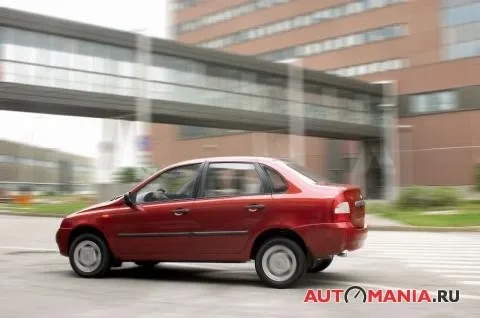
Domestic drivers have long learned that a car is not a luxury item but a means of transportation, yet mass car purchases began only recently. And even today, not everyone can save up the needed amount for a desired four-wheeled "steed" without outside support — be it a bank loan or parental savings. Therefore, for cars aiming to be "people's cars," this is especially relevant, and our today's subject — Lada Kalina — is exactly from that category.
The freshest (until recently) development of Russia's largest automaker was initially conceived as a nationwide bestseller. Firstly, its arrival was supposed to displace the ultra-budget Togliatti "classic" from the market, and secondly, a moderate price tag and relatively modern internals could seriously harm cheap "foreigners" like the Renault Logan. But reality, as usual, made adjustments. The "classic" — albeit in a truncated form — still rolls off the VAZ assembly line, and the conditional rival received reinforcement in the form of the Daewoo Lanos sedan, which transformed into a pseudo-American Chevrolet, and a whole brood of Chinese clones — from Chery QQ/Sweet to Hafei Princip. Nevertheless, the market, which has grown to gigantic proportions, absorbed not only competitors but also Kalina itself.
However, there is nothing to be surprised about here. In essence, Lada Kalina is the first Russian car that can be compared with foreign rivals without discounts or allowances for eternally failing suppliers. It's not a fact that it will ever "defeat" them, but at least it will give a worthy rebuff, and at most — it will pave the way for fundamentally new models from Togliatti in terms of design and quality.
More than two years have passed since the mass start of Kalina sales, so it needs no introduction. The narrow, elevated body with a somewhat truncated stern and a slanting "face" in Korean style was late by seven to eight years. But credit must be given: the Togliatti folks, almost for the first time, managed to create a car with a soft and logical exterior. Compared to its predecessors — a huge step forward, and with all the stylistic restraint, Kalina has noticeably caught up to the level of leading world brands. It's not even so much about the appearance (here much is subjective) as about the quality of assembly and painting — the previous complaints about gaps are gone, and the paintwork is unlikely to peel off after a couple of years. In a word, before the arrival of Priora, Kalina was rightly considered the best mass-produced car ever made in our country.
Inside, Kalina is even more interesting. "Korean notes" are felt here too, and the Russian origin of the interior is betrayed only by the logo of a boat on the steering wheel — especially if you move here from the first generation "nine."
Such an owner will also be pleased with the assembly quality. Alas, the car has not gotten rid of the notorious "crickets," but it can't be called a "rattle" either. The plastic in the trim is far from ideal, but these are no longer the "soapy" materials used on previous models of the Volga giant. The same applies to space and comfort. Although Kalina ranks below the "ten," its interior is wider and longer. Of course, there is never too much space on the sides and above the head, but there is no talk of crampedness either. People of decent height will no longer suffer with knees pressed to the chin. The range of longitudinal adjustment is sufficient for legs to be comfortable, and knees not to interfere with reaching the gearshift lever or the steering wheel, which, by the way, is easily adjustable for height. The seats themselves also deserve a kind word — a comfortable profile. They are, of course, far from Mercedes-Benz, but this is no longer the stool on which one had to ride before. Rear passengers can be promised a fairly comfortable ride, but only if there are two of them — three in the second row is a bit cramped. For two, it's easier to place knees and there's more room in the shoulders.
Kalina is equipped with a quite decent trunk of 380 liters. Nominally, the volume is not a record (the Logan's cargo area holds all 500 liters), but the space is not spoiled by architectural excesses, so using it is a pleasure.
By the way, the rear seat back in the Lada, unlike the same "Frenchman," folds in a 40:60 ratio, increasing the useful volume almost twice.
The fact that Kalina has come close to foreign cars is also felt in dynamics. At least, this applies to the new 1.4-liter engine, which, in my opinion, is the best power unit ever created by the Togliatti folks. It's a pity the acquaintance was short, but that time was enough to appreciate it. Among the obvious advantages are decent dynamics for such a volume and impressive stability at high revs, which was not typical of Volga engines before. Add to this lower fuel consumption, readiness for Euro-4 standards, and, of course, power of 90 horsepower — already comparable to engines of much more expensive Opel Corsa and the outgoing Ford Fiesta. The only thing that spoils the picture is the 5-speed "manual." The throws, in my opinion, are too long, and there's a lack of precision — gear changes require noticeable effort, which, naturally, does not best affect the resource. The Togliatti folks should also work on the settings. The gear ratios are clearly designed for the 1.6-liter 80-horsepower "eight-valve" engine that appeared first. With it, the transmission behaves much more decently: the "tight" lower gears gradually "expand," leaving a reserve for acceleration even on fifth, although precision, alas, is lacking here too. The engine itself in motion does not impress, but does not disappoint either. The engine already familiar from the "ten" works evenly in all modes, giving Kalina quite "Korean" (in a good sense) dynamics. But, I repeat, the new unit surpasses it in all respects, it's just a pity that only 3.5 thousand such cars will roll off the assembly line by the end of the year.
I would like to praise the car for stability and ride smoothness, but in these components it turned out to be absolutely unemotional. Kalina holds the trajectory normally, does not wander on the road, steers without complaints, but drives, so to speak, without flight. Energy intensity is also at an average level, although "breaking through" the structure is quite problematic. In general, having its own set of advantages and disadvantages, Lada Kalina, as it seems to me, does not yield to foreign competitors and is worth its money. The base version with electric power steering, central locking, and front electric windows will cost the buyer on average 227 thousand rubles or $8900 today, which by current standards is not so expensive.
Technical specifications
| Dimensions: | Lada Kalina |
| Length (mm) | 4040 |
| Width (mm) | 1670 |
| Height (mm) | 1500 |
| Wheelbase (mm) | 2470 |
| Weight (kg) | 1080 |
| Trunk volume (l) | 380 |
| Engine displacement (cm3) | 1596 |
| Max. power (hp) | 80 |
| Max. torque (Nm) | 120 |
| Max. speed (km/h) | 170 |
| Acceleration 0—100 km/h (s) | 12.9 |
| Average fuel consumption (l/100km) | 7.8 |
| Price ($) | from 8900 |
Magazine "Autoguide" August 17, 2007 No. 29(29)
Source – www.automania.ru