
Alexander DIVAKOV, Sergey ZNAEMSKY, Yaroslav TSYPLENKOV, photo by Stepan SHUMAKHER
The Togliatti plant kept its word: the five-door Kalina, as promised, rolled off the assembly line in July. This hatchback is 190 mm shorter than the sedan, but at the same time $140 more expensive. Interestingly, for the same $9,600, a buyer can consider the VAZ-2112 with an eight-valve engine and more complete equipment. So what should a fan of the domestic auto industry choose — the Kalina sedan, the Kalina hatchback, or the proven "twelfth"?
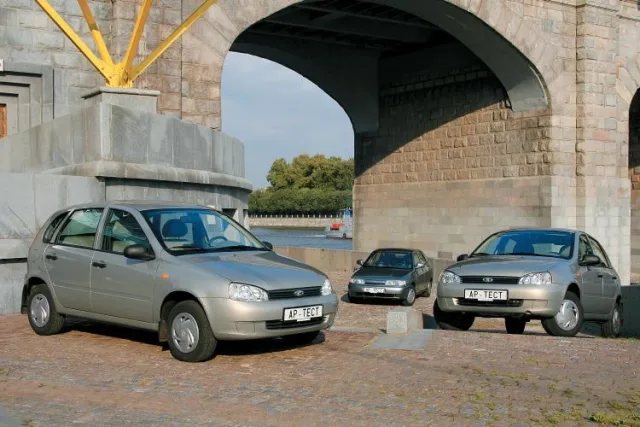
Among the current Togliatti models, the Kalina hatchback, also known as the VAZ-1119, looks the most "cultured." It may not be a beauty, but its appearance can hardly be called off-putting. The short rear overhang is enlivened by neat vertical lights — this looks much more cheerful than the dreary rear of the sedan. However, the grandiose wish that Mikhail Gorbachev wrote in April 1986 in the album of the future designer of the "tens" Vladimir Yartsev — "to become a trendsetter in the global automotive industry" — remained just a curious historical fact.
By the way, in February, the design of the "tenth" family cars will turn exactly twenty years old. And, surprisingly, the aged "pregnant antelopes" continue to stay afloat! Moreover, the "twelfth" hatchbacks are still a favorite base for homegrown tuning: they are adorned with dark tinting, impressive spoilers, rear wings, and loud "straight-through" mufflers. If we prioritize by appearance, the top three look like this: Kalina hatchback, then the "twelfth," and the Kalina sedan closes the list.
 |  |  |
| The Kalina's lever has moderate travel and decent precision. Engaging reverse gear is blocked by a convenient ring | VAZ-2112: the lever is long-throw, and to engage reverse it needs to be pushed down | The Kalina is late with biodesign, the plastic quality is poor. But the ergonomics are no worse than some foreign cars |
 |  |  |
| The interior of the tenth family cars — uncomfortable seating, gloomy tones, simple lines... A greeting from the eighties | The Kalina's instruments look nice, especially at night. But during the day the small numbers are hard to read | The "tenth" combination is simpler, but reads better at any time of day |
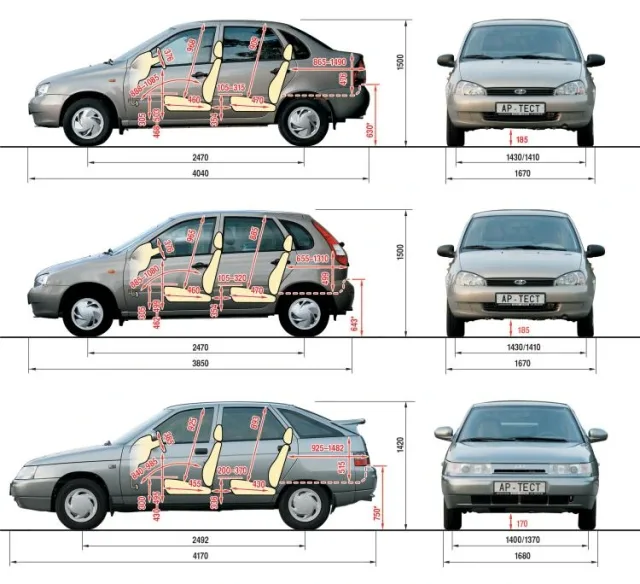
Previously, we classified the Kalina as class B, and the "tens" as the older class C. Indeed, the VAZ-2112 is 130 mm longer than the Kalina sedan and 320 mm longer than the hatchback. But the "twelfth" no longer reaches the current, noticeably grown golf class. The decisive indicator is the wheelbase, which exceeds the Kalina's by only 22 mm. So welcome to class B!
The difference in length mainly affects the trunk volume: the "twelfth" has 400 liters, while the Kalina hatchback has only 260 liters.
 |  |  |
| The stubby Kalina hatchback VAZ-1119 looks more cheerful from behind than the sedan | Three knobs is a normal solution. But why does increasing the heater temperature require turning counterclockwise? | The climate block of the "tens" is a masterpiece of engineering. There is no recirculation mode, but the knobs turn easily |
But here's the paradox: the most spacious trunk of the "twelfth" is the least convenient to use. The fifth door lifts with noticeable effort, and to fold the rear seat for transporting long items, you have to fiddle quite a bit — the latches are tight and inconvenient, and the headrests are hard to remove. The Kalinas have much easier access to the trunk, and the backrest with cushion folds without extra effort. The hatchback is, of course, more practical than the sedan in terms of transformation, and on the inside of the fifth door of the five-door Kalina, there's even a convenient handle for closing! True, closing the door almost never works on the first try — the lock is not properly adjusted. And there are problems with opening too: the button often jams.
 |  |  |
| The "twelfth" is 320 mm longer than the Kalina hatchback due to overhangs. The rear wing improves aerodynamic qualities but significantly spoils visibility | The Kalina's seats are too soft, so the side support bolsters don't work as they should | The "twelfth's" seats hold the body better, but the backrest presses excessively on the shoulders |
The interior of both Kalinas is identical: a cute biodesign in the spirit of the nineties, tolerable ergonomics, and a sharp smell of plastic. The seating position is high, the range of longitudinal seat adjustment is huge, the steering wheel is pleasant, the instruments are clear, and visibility is good — the driver is quite comfortable here. But the build quality lets it down. On one car, the glove box lid is skewed; on another, the climate control knobs turn with such effort that you might grab pliers. And to adjust the steering column, you have to apply such force that you could change the tilt of a non-adjustable steering wheel.
 |  |
| The glove box in the Kalinas is quite small… | …while the glove box of the VAZ-2112 fits A4 documents |
However, next to the "twelfth," the Kalina begins to seem almost exemplary. Here is truly outdated architecture, gloomy plastic, and frankly weak quality! Ergonomics are a step back: a tall driver has to constantly sit with a bent left leg and strongly recline the backrest just to reach the steering wheel with their hands. The picture is completed by a large, thin, and slippery steering wheel rim made of mismatched plastic, as well as limited visibility — the seating is low, the window line is high, and the rear view is blocked by the spoiler and the rear seat headrests.
The conclusion for a tall driver is clear: the Kalina and only the Kalina!
And what will the passengers say?
Two people in the back row are more comfortable in the "twelfth" — there's more legroom here, which is also aided by the limited adjustment of the front seats. But three people are better off in the Kalina: its bench is narrower than in the "tens," but the body pillars are not so "collapsed" inward. Overall, it's a parity. The only disappointment is that the Kalinas in the current single trim have no rear headrests at all — and this is a matter not only of comfort but also of safety!
 |  |  |
| The VAZ transformation scheme: the cushion folds forward, the backrest folds down. Its latches work more precisely in the Kalinas | On the soft bench of the Kalina, you sit higher, and the body pillars are not so collapsed inward | The "twelfth's" bench cushion is lower, but there are headrests |
 |  |  |
| Kalina hatchback: the smallest trunk (260 l), but the fifth door is convenient to operate | Kalina sedan: a longer trunk (380 l), but limited in height | VAZ-2112: the most spacious trunk (400 l) |
All three participants in this test are equipped with identical powertrains: 1.6-liter gasoline four-cylinder engines with eight valves and five-speed manual transmissions. But, as it turned out, identical units do not guarantee identical behavior. The sedan demonstrated a more lively character: it accelerates more briskly, and its engine runs more elastically in higher gears. Moreover, the sedan reaches its top speed in fifth gear, while the hatchback manages it in fourth.
Interestingly, the mass of both Kalinas is almost identical — the difference is only 5 kilograms in favor of the sedan.
Where did the difference in engine character come from? Apparently, it's simply a lottery. The usual spread of parameters during assembly typical for Togliatti cars.
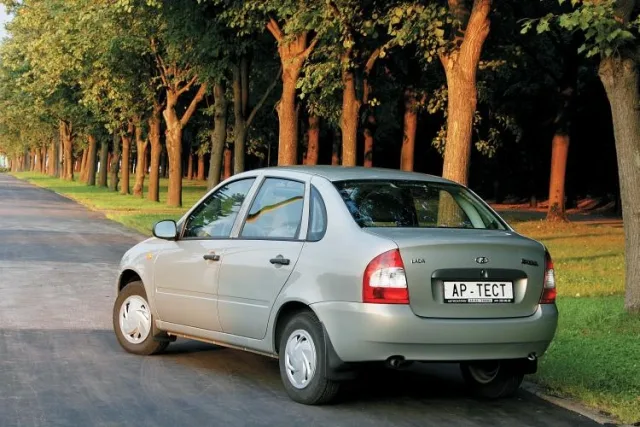
Kalina sedan VAZ-1118: rear view, to put it mildly, is not inspiring
Assembly quality also threw up another problem — a stiff gas pedal on both Kalinas. Combined with normal clutch effort, this turns pulling away into a real ordeal. As for the "twelfth," the gas pedal is set up normally here, but starting is no easier: the clutch engages only at the very end of the pedal travel, as if the discs are already worn to zero. And this is despite all three cars being brand new, just from the showroom.
Any experienced owner of VAZ products, of course, knows the solution — immediately go to a trusted mechanic. He will tighten the gas drive spring to make the pedal lighter and adjust the clutch. And especially skilled garage craftsmen will also take on the gearbox drive: in our "twelfth," the lever travels so long that when engaging even gears, it practically lies down between the front seats.
On the Kalinas, gear changes are much more pleasant and precise — the lever doesn't need to be "kneaded" through the air across the whole console. But here there's its own drawback: the gearbox drive itself is very stiff, and it's especially hard when engaging first and reverse gears. Okay, they say it will loosen up over time. But the question is: will the crunches and terrible ringing sounds that the gearbox drive makes on the Kalina hatchback disappear at high revs?
The picture with brakes is similar: when the wheels lock, all three cars tend to veer off the straight line. The excessively large free travel of the pedals is also concerning. However, the Kalinas look preferable here — their brake drive gives a bit more information than the "twelfth's."
The most noticeable difference in handling is the electric power steering on the Kalinas. Amid a funny buzzing, the steering wheel turns easily, even when the car is stationary. But the "twelfth" makes you remember your biceps at every parking spot.
 |  |  |
| If you exceed the speed in a corner, the Kalina hatchback goes into a deep understeer. But the sedan in the same conditions was eager to break into a slide | VAZ-2112 surprised: in a limit corner, it behaves more reliably than both Kalinas | Kalina sedan in the "moose test": fast maneuvers are hindered by deep slides, and the "lazy" steering wheel complicates correction |
Alas, the promised "short" steering racks for the Kalinas never appeared: the steering wheel makes 4.2 turns from lock to lock. This is the Stone Age! Combined with the electric power steering, the wheel is completely devoid of information near the center position. In the city, you can still turn a blind eye to this, but at speed the situation becomes truly alarming: you have to drive the car along a smooth arc almost blindly, and only at significant steering angles does any feedback appear.
On a straight line, both Kalinas behave confidently, not requiring steering corrections, but during sharp lane changes they noticeably lean and react to the driver's actions with a delay. But in a limit corner, despite identical tires, the cars behaved differently: the hatchback stubbornly slides outward with its front wheels, while the sedan, when lifting off the gas, more readily dives into the inside of the arc, trying to break into a slide. The reason for this different behavior is unknown — perhaps it's in the camber and toe settings, or maybe in springs or shock absorbers from different batches. The latter is even more likely, because in terms of ride smoothness, the five-door turned out to be noticeably more comfortable than the sedan. The hatchback practically doesn't notice small irregularities, works elastically and pleasantly on medium ones, as if "rounding off" potholes, and at the same time doesn't tire with rocking. The sedan, however, is set up stiffer: it meticulously counts all seams and joints, and on short waves it slightly tosses passengers.
However, who can guarantee that with other examples of the sedan and hatchback from different batches, the result wouldn't be the opposite?
By the way, the VAZ-2112 didn't lose face against the Kalinas. In terms of ride smoothness, our "twelfth" resembles the Kalina sedan — it's just as stiff. But the steering here is more responsive: in the same corner, the steering wheel has to be turned through a smaller angle. However, the standard set of ailments of the tenth family hasn't gone anywhere: the same understeer and "rubbery" responses due to the compliance of the front part of the body. The steering wheel of the "twelfth," although heavier, is more informative, but you have to pay for it by having vibrations from the road transmitted to it in full in corners — unlike the Kalinas.

As for sound insulation, all three cars are brothers. The hum of tires, the roar of engines, the howl of the transmission, and the rattling of plastic panels… Just take earplugs!
What's the verdict?
The verdict, frankly, is disappointing. Having compared three cars with their various flaws, you just want to conclude that it's six of one, half a dozen of the other — too much depends on how much a particular example deviated from factory tolerances during assembly.
Although no, that's not entirely true — one is still better than the other! In the sense that the Kalina hatchback, by the sum of scores, comes out as the leader of this difficult test. But I suspect its victory in ride smoothness (like the sedan's advantage in dynamics) is also a consequence of that same notorious quality spread.
And if we talk about the undeniable trump cards of the five-door Kalina, then perhaps it's only the more attractive appearance, greater practicality for transporting bulky cargo compared to the sedan, and the presence of power steering, which the outdated "twelfth" lacks.
The five-door Kalina will most likely be bought at least because it's the most affordable hatchback in the B class — both the Chevrolet Aveo and especially the Hyundai Getz cost noticeably more. The Chinese Chery Amulet is comparable in price to VAZ products, but it's significantly larger and persistently pretends to be a sedan.
For us, the conclusion is obvious: no Kalinas, regardless of body type. As Alexander Sergeyevich Pushkin said, "You wouldn't chase after cheapness, pop"…
Prospects?
As usual, AvtoVAZ promises to refine the Kalina right on the assembly line.
Firstly, from mid-September, new front springs will be installed on the cars, for which the front suspension strut dust covers have already been modernized. The factory workers claim that the new springs will reduce lateral loads on the strut, and ride smoothness and handling should improve. The springs themselves are wound cold from stronger steel — they are lighter and more durable than the current ones. Instead of the not-so-successful Makhachkala electric power steering, a gearless unit from the Kaluga company "Avtoelektronika" will appear in the fall. However, the steering mechanism itself will remain the same for now — with a "long" rack. The introduction of the "short" mechanism, according to factory representatives, is being held back due to the need to purchase new technological equipment.
From August 20, another body color appeared in the palette — greenish-gray "metalic" "sauvignon." Now Kalinas are available in five paint options.
Safety
Which of these cars are safer in an accident — the Kalinas or the tenth family?
We at one time conducted crash tests of both sedans — both the "tenth" (see AR No. 6, 2002) and the Kalina (see AR No. 20, 2005). If we focus on the rating calculated according to the EuroNCAP methodology, the Kalina significantly outperforms the "tenth": it scored 5.6 points out of 16 possible, while the VAZ-2110 barely earned 4 points. But in essence, both cars are roughly equal: in a collision, they are safer than the "Samaras" (not to mention the "classics"), but they are far inferior to modern classmates. For comparison: the Renault Symbol in the Autoreview crash test earned 11 points (see AR No. 17, 2002), and the Logan — 12 points (see AR No. 18, 2005).
 |  |
| VAZ-2110 | Lada Kalina (5.6 points out of 16) |
The bodies of the Kalina and the "desyatka" cope reasonably well with an offset frontal impact at 64 km/h — deformations barely reach the cabin. However, the belts without pretensioners and load limiters are archaic, increasing the load on the chest of front passengers, which can lead to rib fractures. And the absence of a driver's airbag is a direct threat of head injuries. Moreover, in the Kalina, the head overload of the dummy driver upon impact with the "safe" steering wheel turned out to be the highest. There is also a high risk of damage to the driver's knees from parts under the panel, although the Kalina's interior trim is still more injury-safe.
In the end: the "desyatka" and the "dvenadtsataya" may well save passengers' lives, but avoiding serious injuries will be extremely difficult.
What's the price?
AvtoVAZ has set recommended prices for eight-valve VAZ-2112 hatchbacks in the "Norma" version at 249,847 rubles (approximately $9,357), and official dealers' prices practically do not deviate from this figure. The basic equipment includes an immobilizer, a cabin with tweed upholstery, central locking, and front electric windows. The "Lux" version adds velour trim, a trip computer, 14-inch alloy wheels, fog lights, and heated front seats — for which they ask 256,505 rubles (about $9,606). True, cars in factory configuration often have to be ordered separately: most cars in showrooms are already modified by dealers, which naturally increases the price.
 |  |  |
| VAZ-21121 | Lada Kalina VAZ-11193 | Lada Kalina VAZ-11183 |
If you choose the "dvenadtsataya" with a 16-valve engine producing 89 hp, you will have to pay an extra 5,275 rubles, and in the "Lux" version — already 10,095 rubles. Hatchbacks that received the front panel from the "Priora" cost about a thousand rubles more, and the version with ZF power steering will add another 11,000 rubles to the bill.
The "Kalina" has a more modest choice: only one eight-valve engine and one "Norma" trim, which includes an immobilizer, electric power steering, an alarm, fabric seats, radio preparation, an onboard computer, central locking, front electric windows, and heated front seats. The sedan is priced at 254,286 rubles ($9,523), the hatchback at 258,031 rubles ($9,664), but due to high demand, dealers often add another $300–400 to these figures.
The warranty on all VAZ models is two years or 35,000 km of mileage, but almost all dealers are ready to extend it to five years and 75,000 km, but on one condition — maintenance will need to be done at their service centers.
| Equipment of the cars tested | |||
| Equipment | Cars | ||
| VAZ-1118 (sedan) | VAZ-1119 (hatchback) | VAZ-2112 | |
| Base price of the car, rub. | 254286 | 258031 | 249847 |
| Power steering | + | + | – |
| Height-adjustable steering column | + | + | + |
| Heated front seats | – | – | – |
| Central locking (remote) | + | + | +* |
| Immobilizer | + | + | + |
| Electric and heated exterior mirrors | – | – | O |
| Front electric windows | + | + | + |
| Trip computer | + | + | – |
| Split-folding rear seat | + | + | + |
| Audio system | – | – | – |
| Fog lights | – | – | – |
| Full-size spare wheel | + | + | + |
| Metal engine compartment protection | – | – | + |
| Alloy wheels | – | – | – |
| Metallic paint | + | + | + |
| Child safety locks on rear doors | + | + | + |
| Rear head restraints | – | – | + |
| Remote trunk lock | – | – | + |
| Ignition switch illumination | – | – | + |
| Price of the tested car, rub. | 254286 | 258031 | 258247 |
| (+) Included in base version | |||
| (–) Not available in base version | |||
| (O) Options installed on the tested cars | |||
| * Not remote | |||
| Expert assessments of Autoreview | ||||
| Parameters assessed | Max. score | Cars | ||
| VAZ-1118 (sedan) | VAZ-1119 (hatchback) | VAZ-2112 | ||
| Design | 160 | 110 | 115 | 105 |
| Exterior | 80 | 50 | 55 | 55 |
| Interior | 80 | 60 | 60 | 50 |
| Ergonomics | 160 | 130 | 130 | 110 |
| Driver's workplace | 80 | 60 | 60 | 50 |
| Visibility | 80 | 70 | 70 | 60 |
| Dynamics | 280 | 195 | 190 | 195 |
| Acceleration dynamics | 90 | 65 | 60 | 60 |
| Braking dynamics | 100 | 75 | 75 | 75 |
| Handling | 90 | 55 | 55 | 60 |
| Ride comfort | 200 | 145 | 150 | 140 |
| Ride smoothness, vibration protection | 80 | 65 | 70 | 65 |
| Acoustic comfort | 60 | 35 | 35 | 35 |
| Climate control | 60 | 45 | 45 | 40 |
| Cabin comfort | 200 | 140 | 140 | 150 |
| Passenger seats | 70 | 45 | 45 | 45 |
| Trunk | 70 | 50 | 45 | 55 |
| Cabin transformation | 60 | 45 | 50 | 50 |
| Total score | 1000 | 720 | 725 | 700 |
| Technical specifications (manufacturer data) | |||
| Parameters | Vehicles | ||
| Lada Kalina VAZ-11183 | Lada Kalina VAZ-11193 | VAZ-21121 | |
| Body type | sedan | hatchback | hatchback |
| Number of seats | 5 | 5 | 5 |
| Trunk volume, l | 380 | 260 | 400 |
| Curb weight, kg | 1080 | 1080 | 1040 |
| Gross weight, kg | 1555 | 1545 | 1495 |
| Engine | petrol, with distributed injection | ||
| Location | front, transverse | ||
| Number and arrangement of cylinders | 4, in-line | 4, in-line | 4, in-line |
| Displacement, cm³ | 1596 | 1596 | 1596 |
| Cylinder bore/piston stroke, mm | 82.0/75.6 | 82.0/75.6 | 82.0/75.6 |
| Compression ratio | 10.0:1 | 10.0:1 | 10.0:1 |
| Number of valves | 8 | 8 | 8 |
| Max. power, hp/kW/rpm | 81/59.5/5200 | 81/59.5/5200 | 80/59.0/5200 |
| Max. torque, Nm/rpm | 120/2700 | 120/2700 | 120/2700 |
| Gearbox | manual, 5-speed | ||
| Gear ratios | |||
| I | 3.64 | 3.64 | 3.64 |
| II | 1.95 | 1.95 | 1.95 |
| III | 1.36 | 1.36 | 1.36 |
| IV | 0.94 | 0.94 | 0.94 |
| V | 0.78 | 0.78 | 0.78 |
| reverse | 3.50 | 3.50 | 3.50 |
| final drive | 3.70 | 3.70 | 3.70 |
| Drive | front-wheel drive | ||
| Front suspension | independent, coil spring, McPherson, with stabilizer | ||
| Rear suspension | semi-independent, coil spring | ||
| Front brakes | disc, ventilated | ||
| Rear brakes | drum | ||
| Tires | 175/70 R13 | 175/70 R13 | 175/70 R13 |
| Maximum speed, km/h | 170 | 170 | 170 |
| Acceleration time 0-100 km/h, s | 12.9 | 12.9 | 13.5 |
| Fuel consumption, l/100 km | |||
| at 90 km/h | 5.3 | 5.3 | 5.5 |
| at 120 km/h | 7.2 | 7.1 | 7.2 |
| in urban cycle | 9.8 | 9.8 | 10.0 |
| Fuel tank capacity, l | 50 | 50 | 43 |
| Fuel | AI-95 | AI-95 | AI-95 |