
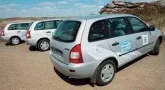
Two envelopes with invitations to test drives arrived at our editorial office almost on the same day. One offered a ride on classic rally stages, the other — participation in a rally raid. And both were from AvtoVAZ.
The editor handed me the invitation with a look as if he were giving out a quarterly bonus: "This is right up your alley!" Not waiting for my enthusiastic response, he added: "You're our sports department editor, so here's your topic."
When I started studying the conditions, it was like a guessing game — yes or no. The event was called a "rally raid." Well, let's say it's my topic. "Route — Astana, then Almaty." Seems like an "off-road road trip," but what does sport have to do with it? "Including special stages"... Now that's more interesting. "Sports car — production Lada Kalina station wagon." No, that doesn't look like sport at all. And only the participation of legendary racer Alexander Nikonenko convinced me that this all relates to motorsport.
Flight from Moscow to Astana, a short briefing, we split into crews — and off we go. Ahead are 1200 kilometers, and over such a distance, not only good relations in the crew matter, but also basic comfort. The first thing that catches your eye. With us in the car were my old acquaintance Grisha Golyshev from "Autosport" and the project's chief designer Vasily Batishchev. Both are not short, but they were quite comfortable in the back seat. All our things, including a box with dry rations, fit easily into the trunk, although it's small — only 350 liters. But if you fold the rear seats, the volume grows by another 300 liters. When I loaded the luggage, I had to slam the door twice to close it (while the car is clean, that's not a problem). Vasily looked at me reproachfully, opened the trunk again, and with one precise motion, like a mongoose attacking a cobra, slammed it shut. I tried to repeat the trick, but I couldn't. Fine, I'll learn in a couple of days...
Getting in and out is convenient thanks to wide openings and a large door opening angle. Behind the wheel is also comfortable: the steering column and seats have sufficient adjustment ranges, and the seat adjustment handles are now on the inside. The first day of the rally raid was over 700 km long, so I paid special attention to the climate system: in Kazakhstan, daytime and evening temperatures differ greatly. Looking ahead, I'll say that there were no complaints about it: the cabin temperature sensor holds the set mode quite accurately, and the heater flaps are electrically controlled. It's worth adding that we were given cars in "luxury" trim: climate control, two airbags, power windows on all doors, power-adjustable and heated mirrors, ABS, fog lights, heated front seats...
I tested the ABS operation back in Astana: the road book warned about large fines in Kazakhstan. There was a point about the prohibition of driving through a yellow traffic light, so I had to urgently "test" the brakes. Neither I nor the local traffic cop who watched this "test" had any complaints. By the way, all station wagons, regardless of trim, have 14-inch wheels and the same brake discs.
The landscapes outside the window exactly matched the figures from the reference book. The capital's population is just over 600 thousand, and Astana is now actively being built up. In architecture, European style perfectly combines with national flavor. But the suburbs end, and the straight road goes into the endless steppe. My expectations of off-road were not met: the surface is very decent. And the car's capabilities are clearly greater than the speeds allowed here. Okay, fines can wait... The car holds the road confidently, the steering is light when parking, and at speed becomes elastic — no questions about the electric power steering. I also liked the suspension: it behaves well on bumps, and body roll in corners is small. "The suspension is perhaps the only thing that distinguishes the seventeenth model from previous ones," says Vasily Batishchev. "The station wagon is 30 kg heavier than the sedan and hatchback, so we installed stiffer springs in the front suspension."
Just as we left the capital, I remembered a couple more figures: the area of Kazakhstan is 2,724,900 square kilometers, and the population density is 5.5 people per kilometer (just like in the fairy tale about the Land of Unlearned Lessons). Behind us was Karaganda with its metallurgical plant chimneys — the last major settlement. The highway turns into a fairway in a deserted steppe ocean, and due to the lack of landmarks, the sense of speed quickly dulls. Rare flocks of sheep and cows are almost like a mirage: around there is no housing, no water. Following the commands of navigators and GPS devices, we gather for mandatory special stages and again set off on the endless road. And since there's nothing for the eye to catch on, you involuntarily immerse yourself in the inner world limited by the cabin. The harmony is disturbed by the creaking of plastic on the dashboard and the vibration of the gear shift lever. In another situation, I would have long pondered the causes, but it would be foolish not to ask the chief designer sitting next to me. "You noticed correctly, but soon these shortcomings will disappear," explains Batishchev. "First, a program to reduce interior noise is almost ready. Second, we are modernizing the drive that causes vibration. For this, we use a tilger — an element with additional mass that changes the vibration frequency." It's clear: the problem is known and it's being solved.
Sometimes on the roadsides there are creations of human hands — statues of animals that have become symbols of the steppe: an eagle, a galloping horse... And also obelisks with wreaths. It seems that on this almost empty road, drivers simply fall asleep. And again a sculptural composition. A woman... Naked... And even without an oar... Am I falling asleep too? No, my partner also saw this masterpiece of small architectural forms.
Almost 700 kilometers behind, and GPS shows that the first day is ending — we are driving along Lake Balkhash. The organizers did their best here, creating a real rally raid bivouac. True, instead of the usual tents and the tent of chef Georges Gruan, we were greeted by real nomadic yurts and national cuisine dishes. Where else can you try real kumis and camel milk? And the night sky of Kazakhstan was simply stunning — I had never seen so many stars!
In the morning — breakfast, a photo session on the lake shore, and again on the road. The steppe gives way to semi-desert, where the wind drives tumbleweeds. The animal world of this belt is proudly represented by a herd of camels. "We've been together for the second day, and I still haven't heard serious criticism," complains Batishchev. Well, we won't let you down! For example, the front side windows don't lower all the way. And is a sound signal needed when engaging reverse gear? "The windows are due to their large size, this is done for better visibility," patiently explains Vasily. "And the sound signaling, in my opinion, is not superfluous. By the way, here the sound also duplicates the instrument readings in emergency cases — for example, when the coolant temperature rises."
The final special stages included a race on a dried-up lake and navigation exercises, and outside the windows the landscape changed again — greenery appeared along the route. We are approaching Almaty, where the rally raid ends. All 12 cars completed the route without a single breakdown. At the hotel, a shower and dinner await us, and the organizers need to prepare the cars for the next stage. Already tomorrow, a second group of journalists will set off on the Almaty — Astana route, 1200 kilometers long. About engines Chief designer of the project Vasily Batishchev: — The trim includes two engines: a 16-valve 1.4-liter and an 8-valve 1.6-liter. Surely they'll ask about the design of the second: now we're installing a 1600cc 16-valve unit on the Priora. This is explained by the fact that the factory's production capacity for such engines is limited. At the same time, there are plans to modernize the 8-valve engine, and its indicators promise to be better than those of the 16-valve 1.4-liter.
Driving
With this rating item, there were no difficulties. The car's behavior both on the highway and on dirt left a pleasant impression.
Interior
Everything suits here too. The interior looks cohesive, and the controls are conveniently located.
Comfort
Perhaps only the vibration of the gear lever and the creaking of plastic caused unpleasant sensations.
Safety
In tests — an honest "three stars." Compliance with current UNECE passive safety standards.
Price
Adequate: from 240,809 to 290,700 rubles for the maximum trim.
Advantages and disadvantages
+ Performs well both in the city and on country roads. Suitable for transporting long cargo.
- Improvements are needed to increase comfort, especially on long trips.
Technical specifications
Make and model - Lada Kalina station wagon
Dimensions - 4040x1700x1500 mm
Engine - petrol, 1400cc, 90 hp/5250 rpm
Transmission - manual, 5-speed
Dynamics - 165 km/h; 12.2 s to 100 km/h
Competitors - With a station wagon body, perhaps there are none...
Our opinion
The main plus of the LADA Kalina station wagon is the price-quality ratio. That's why we found no analogues with a station wagon body in this price segment. Over the entire 1200-kilometer route, there was no discomfort either behind the wheel or in the passenger seat.
© 5 Koleso