
KIA Sorento. Peace and quiet
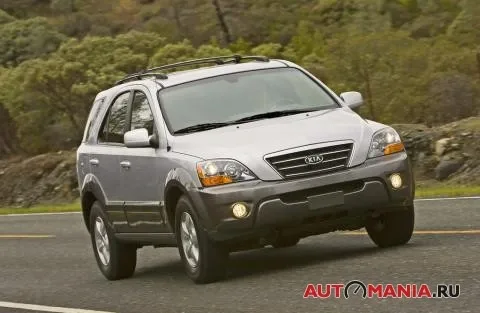
Body-on-frame SUVs today are true relics of the automotive industry. These massive, heavy, and spacious vehicles perform excellently off the asphalt, but their production is noticeably more complex and costly than that of competitors with unibody construction. In an era of total economy, manufacturers prefer to abandon such models. For example, Hyundai, with the advent of the new century, retired the Terracan, betting on the Santa Fe, which evolved from a compact car into an almost full-size SUV. Suzuki also reoriented the Vitara, stripping it of off-road ambitions in favor of asphalt manners. These trends did not bypass the Kia Sportage either—its first model with pretensions to off-road capability can now be found only on our market. However, the brand's largest all-wheel-drive vehicle, the Kia Sorento, and its successor, the Kia Barrero, apparently will avoid this fate. By showing the new seven-seat vehicle in Detroit, the Koreans made it clear where they are heading. Nevertheless, the story of the current Sorento is not yet over—it will definitely live for at least three more years.
The car, introduced in 2007 (we first saw it in July 2006), could well pass for a new model: the manufacturer claimed that serious work had been done on it. But a facelift is still not a generational change, and each has its own approach. In our opinion, Kia limited itself to cosmetics in the classic spirit: they changed the headlights, taillights, and bumpers. And why would the Koreans touch what already sells well? The Bavarians, by the way, have long turned such updates into a mere formality.
In terms of prestige, the Sorento may yield to the Germans, but its sales are quite decent: in Europe, about 40,000 units were sold in a year. In the US, the figures are twice as high. In our country, the car is not yet so popular—last year, about five thousand units were purchased. This is, of course, not the level of the Volkswagen Touareg, but it is not a failure either, although many compatriots refuse the Sorento due to its assembly in Izhevsk. In reality, the car turned out to be quite good—at least externally and to the touch.
The interior after the update did not undergo significant changes, if not to say it did not change at all. Before us is the same large, spacious, and American-style cozy car. Inside, traditional American constructivism reigns: a massive front panel, as if carved from stone, an almost vertical center console with large deflectors on the sides, an abundance of buttons, and no European stylistic refinements. There is no talk of super materials or advanced equipment—the car does not look expensive, but it is not so cheap as to give the owner complexes. In general, it is worth its money. And they ask relatively little for it—about 840,000 rubles. For comparison: about the same amount will be paid for not the richest version of the Nissan X-Trail, which is noticeably smaller than the Korean.
The ergonomics in the Sorento also pleased. Inside, it is, as befits an "American," simply huge. The adjustments of the seats and steering column (the latter, alas, by the same overseas tradition, moves only vertically) are enough for a person of any build to sit comfortably behind the wheel. In the back, three can easily fit, although two will be noticeably more spacious there. If necessary, the second row folds down, turning the SUV into a spacious van that can hold up to two cubic meters of cargo. So it will accept both five passengers and decent luggage without problems.
But there are also controversial points, especially for European perception. First, the trim: the front part of the cabin looks decent, but the second row and trunk are finished with frankly budget materials. With the trunk, it is clear—practicality is more important than beauty there. But why the Koreans deprived the rear passengers remains a mystery. However, even luxury American models sin with this.
The facelift also changed the engine lineup. Apparently, following the principle of "no third option," the Koreans left only two engines, dividing the markets. Americans, who love large gasoline engines, got a 3.3-liter V6 with 241 hp and 313 Nm of torque. Europeans are intended for the 2.5-liter CRDi turbodiesel: with 170 hp, it delivers maximum 400 Nm already from 2000 rpm, so adrenaline is guaranteed at the start. On the highway, the diesel, of course, loses to its gasoline counterpart, but off-road it will give a head start even to more powerful engines. The main thing is not to forget to engage the front axle (in more expensive versions, there is a permanent all-wheel-drive TOD system).
In standard mode, the rear axle remains the drive axle, and a rotary switch on the front panel is responsible for forcibly engaging all-wheel drive and the low range. If you do not set the goal of drowning the car in a ravine, then with skill you can drive almost anywhere: across a field, dirt road, and even a rut from an army "Ural." True, you should be careful when spinning. Due to the lack of inter-wheel locks on loose surfaces, for example, on dry sand, the Sorento buries itself instantly, and you will have to pull it out with at least a tractor.
But on asphalt, everything is much more unambiguous and pleasant. Here, Kia will surely please many. The Koreans managed to find the ideal balance between handling and comfort. The car is quite maneuverable, which is a big plus in urban conditions and parking lots. The impression is slightly spoiled by the too-light steering wheel: you can accidentally over-rotate it, and in a long turn, the car is almost not felt. But you quickly get used to it. Another plus is the smoothness of the ride. The suspension perfectly absorbs almost all irregularities, and the body does not sway even at cruising speeds. After 140 km/h, it, of course, gives up, but does not get out of control.
And most importantly—silence in the cabin. Neither during acceleration nor at speed do you have to speak in raised tones. Such sound insulation is not found in every Korean car. However, the Sorento is generally an extraordinary car—a kind of long-lived dinosaur capable of reproduction. But about its offspring—that is another story, with a different name and an unpredictable ending.
Technical specifications:
| Dimensions: | KIA Sorento |
| Length (mm) | 4590 |
| Width (mm) | 1884 |
| Height (mm) | 1810 |
| Wheelbase (mm) | 2710 |
| Ground clearance (mm) | 203 |
| Weight (kg) | 1990 |
| Trunk volume (l) | 897 |
| Engine displacement (cm³) | 2497 |
| Max power (hp) | 170 at 3800 rpm |
| Max torque (Nm) | 400 at 200 rpm |
| Max speed | 180 |
| Acceleration 0–100 km/h (s) | 12 |
| Average fuel consumption (l) | 7.9 |
| Price (rub.) | 839,990–1,149,990 |
Magazine "Autogid" January 25, 2008 No. 50
Source – AUTOMANIA.RU