
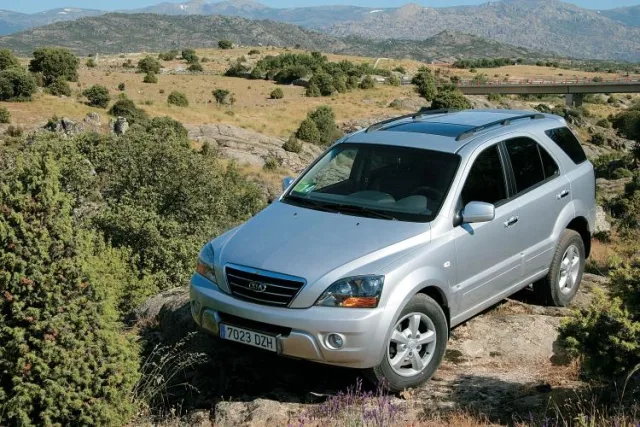
 In the case of a computer, update reminders can be safely ignored without consequences. But with cars, that trick won't work. Delay a facelift—and sales start to drop…
With the Sorento, sales are fine: every year in Europe, almost forty thousand cars find buyers, and in America—almost twice as many. And in our market, based on last year's results (3065 cars), this SUV only trails heavyweights like the Toyota Land Cruiser and Volkswagen Touareg. It seems the secret to success lies in a successful combination of price, looks, and quality: where else can you find such a neat compilation of ideas from the Mercedes ML and Lexus RX, at half the price of the originals?
Still, the Koreans decided to press "Enter."
On the outside, the changes are minimal. The headlights got separate low-beam sections (previously they worked on a "reflective" scheme—see AR No. 18, 2004) and orange turn signals. The lower edge of the taillights is now tilted a couple of degrees to the horizon, and the bumpers have become slightly more expressive. A light makeup, nothing more!
 |  | |
| The 2.5 CRDi diesel gained 30 hp and now produces 170 hp—given that the petrol 2.4 has been discontinued, it is destined to become the main engine for the Sorento: last year, 37% of buyers chose the diesel | As before, two versions of the electronic transfer case are available: with manual (left) and automatic (right) engagement of the front axle | |
On the center console, instead of temperature control buttons (two-zone climate control is now standard), convenient rotary knobs have appeared, and the other buttons are now more conveniently arranged. In the back, there's even more legroom thanks to the reshaped front seatbacks, although there was already plenty of space before.
Under the hood—two pieces of news, one good and one bad. The good: the refined 2.5 CRDi diesel has become more powerful by 30 hp and now produces 170 hp. Meanwhile, the previous 3.5-liter petrol V6 (197 hp) has given way to a stronger 3.3 V6 unit (241 hp).
And the bad news: the 139-horsepower 2.4-liter petrol engine, which accounted for 54% of "Russian" Sorento sales last year, has disappeared from the lineup. The Koreans reasoned that Americans need a V6, while Europeans prefer diesel. There is no third option, as the Romans said.
I got to ride in the updated Sorento 2.5 CRDi with a manual transmission (an "automatic" is also available).
I didn't feel the results of the chassis modernization—either they are extremely minor, or my senses aren't fine enough… On the highway, the Sorento, as during our winter test (see AR No. 6, 2006), excellently absorbs waves, doesn't rock even at "autobahn" speeds, and on small bumps, vibrations from unsprung masses are still noticeable. The cabin is quiet, which lulls you: I got talking with a passenger and didn't notice how the speedometer needle was already at 150 km/h. At such speeds, the comfortable Sorento can no longer contain longitudinal pitching on asphalt waves, but for a body-on-frame SUV with low range, that's not so scary, is it?
 |  |  |
| The front panel has not undergone changes, but rotary climate knobs and new deflectors have appeared on the center console, and the buttons have been regrouped |
Off-road, the Sorento feels confident. Two versions of the electronic transfer case are still available. The first offers three modes—4x2 Hi, 4x4 Hi, 4x4 Low (with low range)—and is switched manually via a rotary dial to the right of the steering wheel. The second box, which is installed for an extra charge in the EX version, operates in two modes—Auto (the front axle engages automatically when the rear wheels slip) and Low. In both cases, low range is engaged manually and only when fully stopped. On the off-road track, I only had to use the transmission dial once—to tackle a "vertical" hill.
And what about the diesel? The diesel is good. After the 2000 rpm mark, it confidently hauls the heavy Sorento weighing a full 2640 kg. The gear lever throws haven't shortened, but engagements are precise, no issues.
The question is whether the diesel version alone can meet the demand for the updated Sorento in Russia. After all, the petrol "six" wasn't a hit here before—for $43,000, people prefer more prestigious brands. And the most popular version with the four-cylinder petrol engine simply won't exist anymore.
But the Koreans look to the Sorento's future with optimism. This year, they plan to sell 145 thousand cars worldwide (about 60 thousand of them in Europe), and in the next two years—200 thousand each. More than half of the projected market is in the US.
And in a couple of years, as part of Kia's plan to introduce ten new cars by 2010 (including the Carens minivan debuting this year and a "Europeanized" golf-class hatchback with the code name ED), a second-generation Sorento will appear. But that will be a completely different car—with a unibody construction and, most likely, less "off-road capable."
We, meanwhile, will wait for the updated Sorento to arrive in Russia in July—prices will be announced then. Let's see if Russians notice the result of this update…
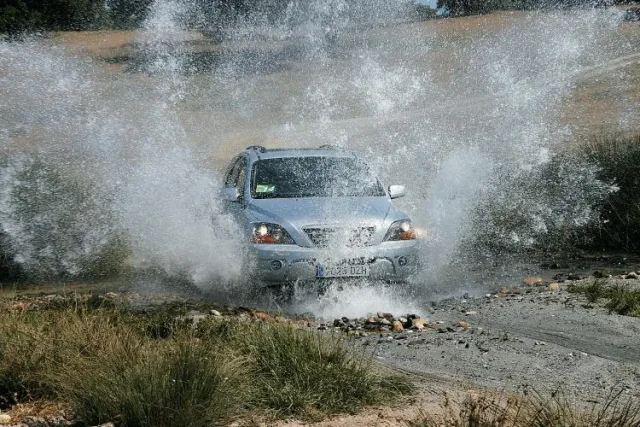
The Sorento's off-road capabilities remain the same—you can still take baths in it
| Kia Sorento (manufacturer data) | ||
| Body type | 5-door wagon | |
| Number of seats | 5 | |
| Trunk volume, l | 898—1849* | |
| Length, mm | 4590 | |
| Width, mm | 1863 | |
| Height, mm | 1730 | |
| Wheelbase, mm | 2710 | |
| Track front/rear, mm | 1580/1580 | |
| Ground clearance, mm | 203 | |
| Approach angle, deg. | 28.4 | |
| Departure angle, deg. | 25.8 | |
| Modification | 3.3 V6 | 2.5 CRDi |
| Curb weight, kg | 2550 | 2640 |
| Engine | petrol, with variable valve timing | turbodiesel, with variable geometry turbocharger |