
It's hard to imagine that the Russian office of KIA didn't know what surprises the route from Baikonur to Astana had in store. However, the organizers still dared to take on this adventure. The incident on the Sukhaya River is just one of many risky moments that awaited us along the way. Six crews covered fifteen hundred kilometers from the city closest to the stars to the Kazakh capital.
While flying to Baikonur, I couldn't shake the feeling that I was about to meet space. True, I knew in advance that I wouldn't make it to the spacecraft launch that was on the program—I was added to the group at the very last moment. You can't just get into a restricted facility. But my imagination painted a completely special city where any resident could seemingly reach out and touch the universe. It seemed everyone there walked with their heads tilted to the sky, and grandmothers on benches argued only about who was to blame for Gagarin's left boot lace not being tied all the way.
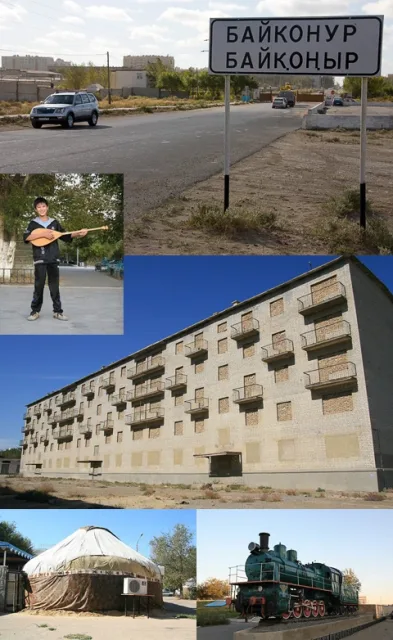
Baikonur, though spelled with a 'y', only formally belongs to Kazakhstan. During the Soviet period, exclusively Russians worked at the cosmodrome, so Kazakhs make up less than half of the city's population. When the military began leaving en masse in 1993–1994, some buildings were mothballed, with windows bricked up.
My illusions about Baikonur were dispelled already on the way from the airport. The bus without air conditioning drove with the door open, and the driver chattered endlessly on the phone, mixing Kazakh speech with Russian profanity. The city, designed by architect Nitochkin, is divided into blocks by perfectly straight streets—along which taxi drivers in old foreign cars race, constantly honking. Even in early October, the heat here is unbearable. That's why an imported air conditioner is attached to the side of a Kazakh yurt.
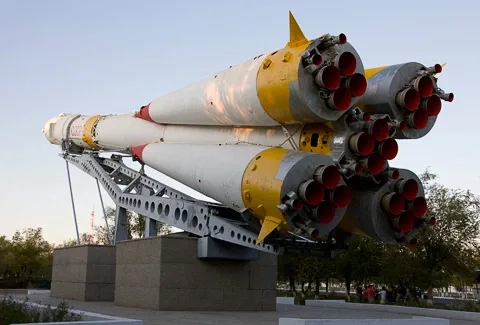
The Soyuz launch vehicle, mounted on a pedestal at a 45-degree angle, is one of the few testimonies to Baikonur's space life. Why was it tilted? Locals explain: the city is low-rise and also closed. If you stood the rocket vertically, it would stick out like a beacon, attracting spies and other undesirable individuals.
And the fur seat covers on the front seats of the Audi Q7, which made the side airbags useless, are also normal for these parts. Baikonur, according to residents, is not yet Kazakhstan, but it's not space either. The average worker's salary is six thousand rubles (rubles, not tenge), while big bosses from the cosmodrome earn about fifteen thousand. "Real space begins there," a heavily drunk Kazakh man waves his hand somewhere into the distance. "Going to Astana? Then keep your ears open—the desert doesn't forgive mistakes."
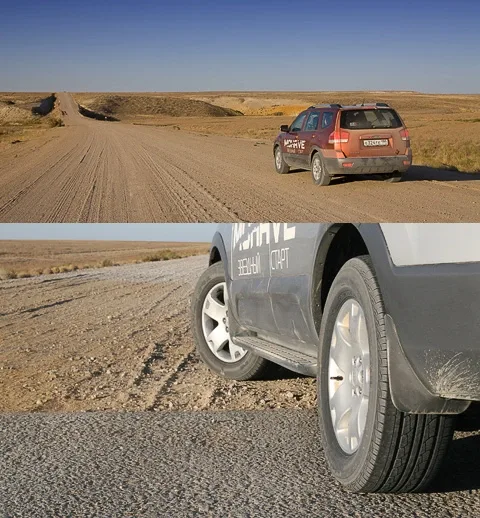
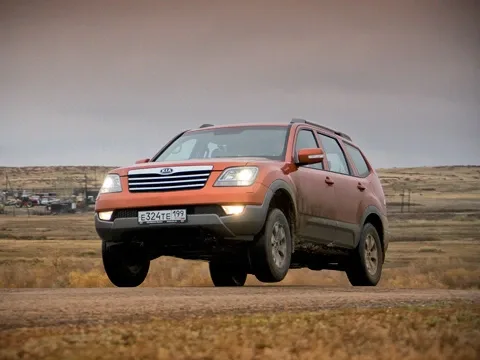
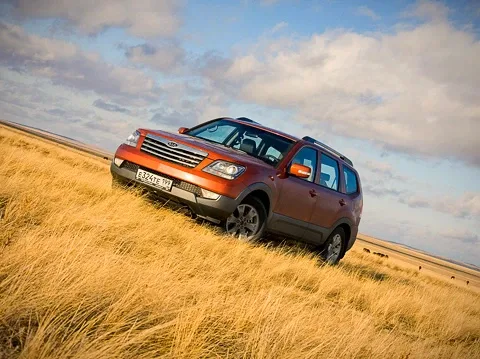
The Kazakh desert is a sun-scorched steppe stretching to the very horizon. The road, cracked by temperature fluctuations, is so deserted that you don't even need to pull off onto the shoulder to have a snack from a dry ration. You can have lunch right on the asphalt—with a hundred-to-one probability, no one will interfere. By the way, Mohave is also a desert, only Californian. So the Kia Mohave here seems like one of its own. True, in America it's been sold for six months under the name Borrego. And it turns out that for us, it's a new model. In Europe, they don't plan to sell the Mohave at all.
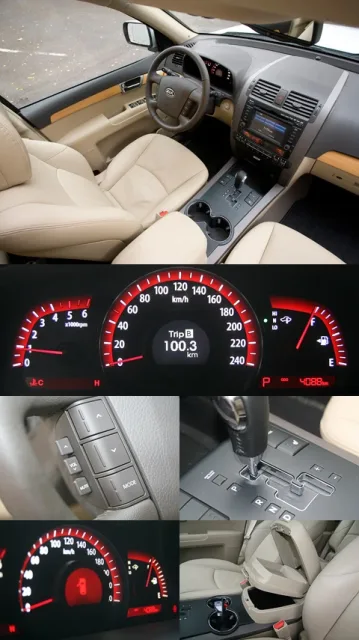
The Kia Mohave will be available in four trims: Classic, Comfort, Executive, and Premium (pictured). Three-zone climate control will appear already in the Comfort, but KIA representatives warn: no one is going to dump prices. The base Classic will cost from 1,459,900 rubles. Prices for other versions will be announced later. That is, a well-equipped car will cost about two million rubles.
So, the Mohave is not quite a new model. And, strictly speaking, not quite an SUV. The body rests on a sturdy frame, and the transmission has a low-range gear. But the Korean has no mechanical locks—only electronic imitations. The suspensions are independent, and the rear can be spring or air. Considerable overhangs limit geometric off-road capability, and road tires limit grip off the asphalt. In my opinion, the Kia Mohave is another all-wheel-drive crossover that decided to cross the ocean.
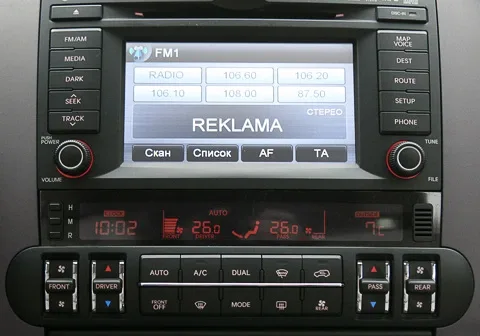
The front climate control unit has convenient buttons for adjusting temperature and airflow intensity.
The Mohave was brought to the Russian market for image reasons. Until now, the brand's flagship was the mid-size Sorento, and now wealthy brand fans have another way to satisfy their ambitions. Indeed, if a five-meter desert conqueror is sold under the KIA brand in America, why not try it in Russia too. Mazda and Honda with the Pilot and CX-9 have already paved this path.
All Kia Mohave giants for Russia will be assembled at the Avtotor plant using the SKD (Semi Knocked Down) scheme. This will allow quick changes to the design, for example, tuning the suspension and steering. Initially, all components will be brought from Korean factories.
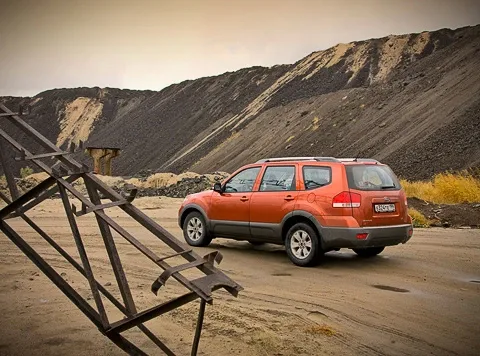
However, the burden of being a flagship might be too heavy for the Mohave. With solid dimensions, the car has a completely ordinary appearance. The image is as dry as soup from a packet, where taste and smell are separate. The eye catches only the large headlights, the shiny radiator grille, and the chamfer on the side windows. These windows, by the way, remind of the main competitor—the Mitsubishi Pajero—and noticeably worsen visibility when reversing.
Among the competitors are not only the mentioned fourth-generation Pajero and Honda Pilot, but also the Nissan Pathfinder and the related Hyundai ix55. And the Koreans are targeting the Toyota Prado. KIA's representative office doesn't hide that catching up with the Japanese in sales is unlikely, but the Mohave is quite capable of fighting for second or third place in its class. Especially since the "American" has at least two strong trump cards up its sleeve: a spacious interior and modern engines.
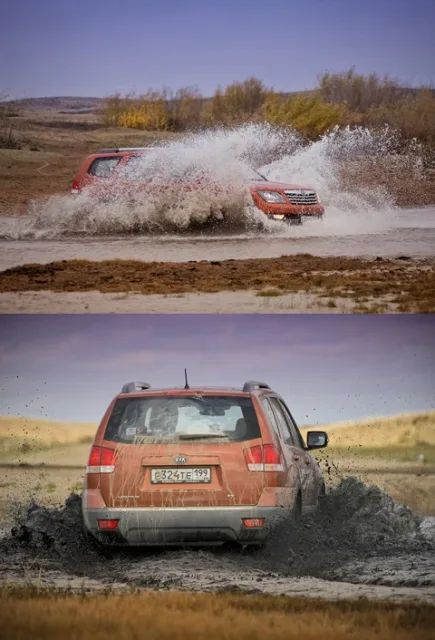
Clean puddle or dirty—doesn't matter. In Auto mode, torque is transferred to the front axle via a multi-plate clutch when the rear wheels slip. Off-road, you can switch the transmission controller dial to 4H mode, locking the clutch, and for those who wade into water without knowing the ford, the low-range gear in 4L mode will help.
The car's arsenal includes two V6 engines: a 3.8-liter gasoline and a three-liter turbodiesel with piezo injectors and a common rail fuel system. The latter is called by Koreans almost the best in its class. And it must be admitted, if they embellish, it's only slightly. The torque of 539 N•m, available already at 2000 rpm, confidently pulls the heavy car on any surface. Out of curiosity, I even drove to the mountain peak chosen by the organizers not in low range, as advised, but simply in first gear. Cutting through the steppe sunset with its headlights, the car took the height.
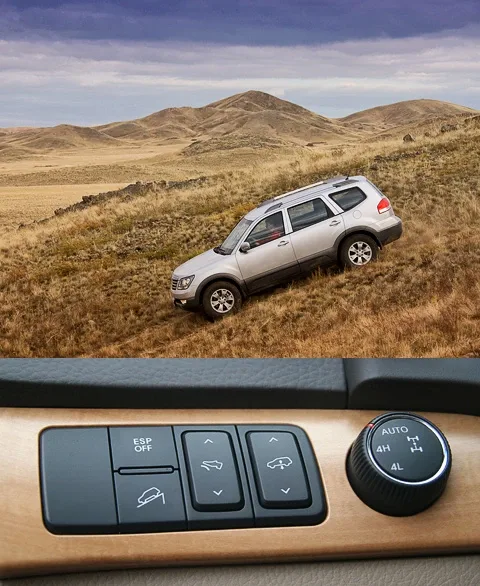
To the left of the steering column is the all-wheel-drive transmission controller dial. Buttons: air suspension adjustment, pedal assembly, and the DBC (Downhill Brake Control) system, which helps when descending a hill, maintaining a constant speed of 8 km/h. DBC works a bit roughly, and on steep slopes you want to lower the overestimated speed limit by pressing the brake pedal. You can't!
The diesel is paired with a six-speed automatic, which disappoints only with slight delays when starting from a standstill and during overtaking. In kick-down mode, too much time is spent searching for the right gear. On deserted Kazakh roads, this doesn't cause much trouble. But where traffic is denser, you'll have to get used to the American transmission settings. However, the smoothness of shifts is almost CVT-like. Gear changes are indicated only by the tachometer needle fluctuations and a change in the engine's hum tone.
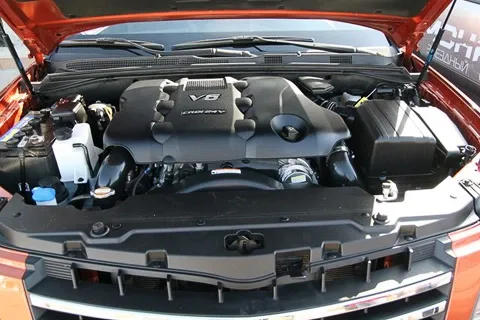
From the three-liter turbodiesel, Korean engineers extracted exactly 250 "horses."
Although calling it a hum doesn't feel right. Diesel notes are audible only in transitional modes, and otherwise the engine reaches the cabin as unobtrusive background noise. In terms of noise insulation, the Mohave can confidently claim a five with two big pluses: neither the road nor pebbles on the arches are heard, and you can talk without the slightest strain on your vocal cords.
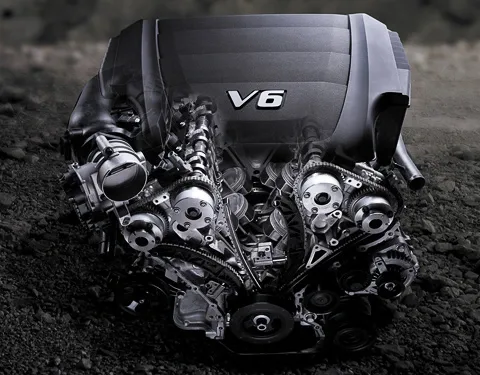
The 3.8 gasoline engine produces more power — 274 hp. Hence the eight and a half seconds to 100 km/h versus 9.6 seconds for the diesel version. The flip side is lower torque and worse fuel economy.
The gasoline six-cylinder is inferior to the diesel in torque, but it runs even quieter and smoother. Throttle response is quicker, and the working range is one and a half times wider. The engine deserves the highest rating! However, it only comes with a five-speed automatic. That too is tuned for smoothness, but pauses during shifts are more noticeable. And in terms of fuel consumption, gasoline loses outright: under the same conditions, the gasoline version's onboard computer showed over 18 l/100 km, while the diesel stayed within 14 liters.
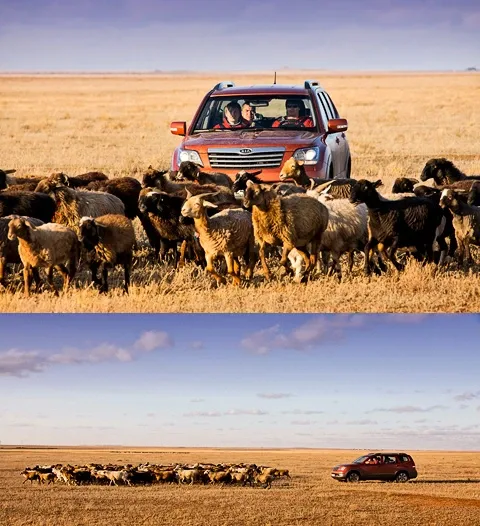
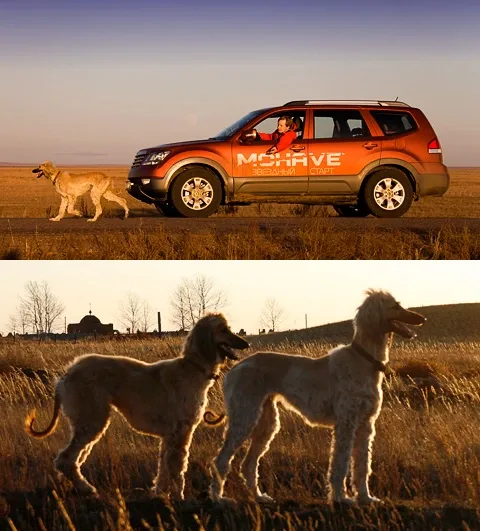
The American name for Mohave is Borrego, which translates from Spanish as "lamb." Its own crowd! By the way, the photographer who took this and many other beautiful shots for this material is named Alexey Barashkov...
The claimed 11.6 liters in the combined cycle for the gasoline version don't match reality — although our pace was brisk, we were confidently doing over a hundred. But common sense suggests that a two-meter giant with broad shoulders physically cannot be as economical as a D-class sedan. Especially with a heavily damped accelerator. You press the pedal halfway — the Mohave pulls away from the intersection without much enthusiasm. You add more — and the car seems to catch itself and rushes to chase the tachometer needle. How do you dose the throttle and save fuel here?
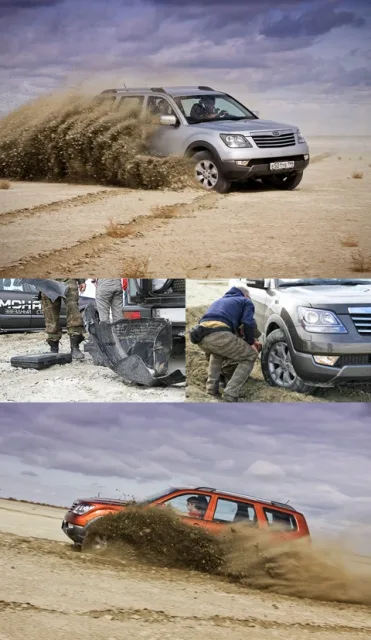
The price of wild rides along the bottom of a dried-up salt lake: a couple of wheel arch liners torn out with meat, a broken fog light, and battered lower lip of the front bumper. But it's not the Mohave's fault: the vastness made many drivers simply lose their own brakes.
And where do such official performance figures come from? Eight and a half seconds to sixty for the gasoline version is only a tenth slower than my two-liter Fiesta ST! The diesel, according to the documentation, should also easily fit within ten seconds. I doubt it. In practice, the Mohave with any engine doesn't feel like a fast car.
The Mohave's main trump card is cabin space. Four adults don't complain about cramped conditions, and if you fold out the third row (which is already standard equipment), two more passengers won't feel superfluous. In the stowed position, the third-row seats fold into a recess in the trunk floor, forming a flat area of almost a cubic meter. Four suitcases, equipment cases, bags with dry rations, and those two watermelons weighing a total of thirty kilograms — all of it fit "under the cover."
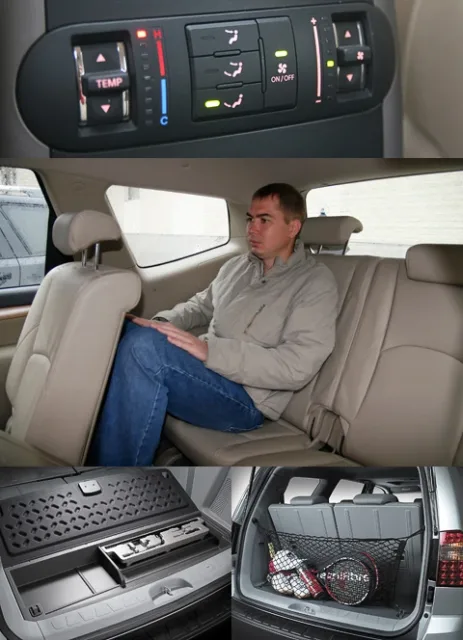
The Mohave's seven-seat capacity is not a marketing gimmick. An adult has enough space for a normal existence in the third row. The middle-row occupants have their own separate climate control unit (at the top).
Oddly enough, there's no American spirit in the interior. The center console looks copied from a Volkswagen, and the optitronic instrument cluster sports a nearly Toyota-like "button" for the trip computer. Everything is laid out in functional zones, logical and attractive. It's only a pity that you can truly get comfortable behind the wheel only in the top Premium version — there, in addition to steering column adjustments, the pedal block is also adjustable.
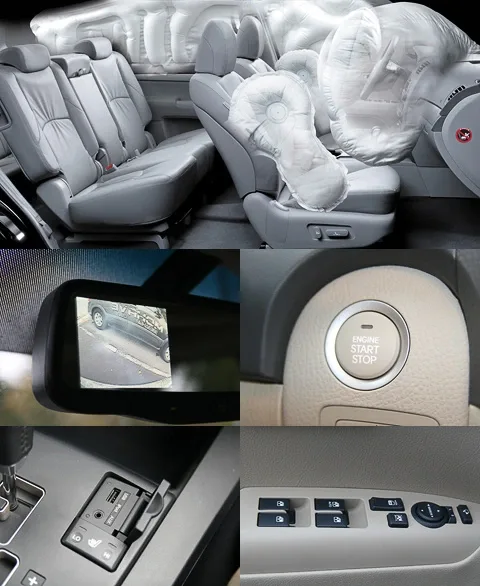
In terms of equipment, the Mohave is at least not poorer than its competitors: six airbags, a rollover sensor, three-zone climate control, ambient interior lighting, power seats and steering wheel, and much more. But the base car will lack all these delights: just a regular air conditioner and only two front airbags.
In simpler cars, the pedals don't move, and the steering wheel only adjusts for tilt. And if you scrutinize the Mohave's interior, behind the neat panel gaps you see Asian cost-cutting: the top is soft, the bottom is hard, smooth-looking — rough to the touch. As a result, even the generously equipped Premium doesn't reach premium status.
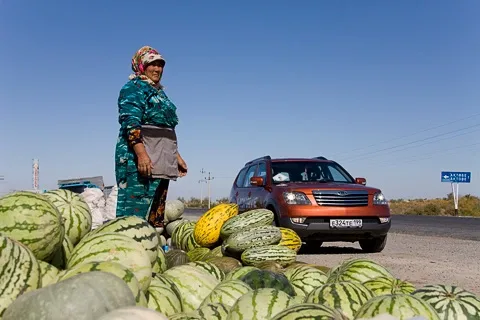
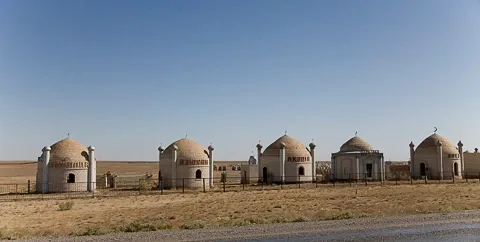
I start from Baikonur in just such a "Premium." Among other things, it has air suspension and adaptive dampers. The first hundred kilometers are a real shock. A monotonous flat desert, enlivened only by the minarets of Kazakh cemeteries. The road surface, ravaged by heat, frost, and time (in the steppe, the thermometer swings both ways from the 50-degree mark), throws buckled asphalt into the steering wheel. The worst surface, as luck would have it, is on the most dangerous sections. If something happens — there's no help to expect. No ambulance, no communication with civilization at all. The monuments along the road unambiguously remind of someone's recklessness or simple bad luck.
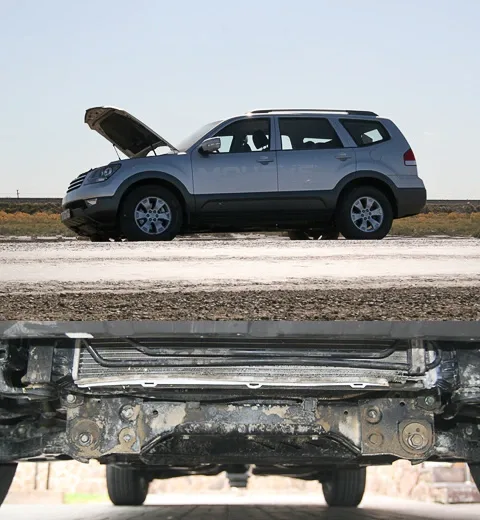
We, of course, have it easier than a random traveler: we're moving in a convoy of six cars. Each has a trucker's radio and a satellite navigator that occasionally suffers from memory lapses. You quickly stop paying attention to the murderous nature of the roads and race across the desert at full tilt, keeping the speedometer needle in the right part of the scale. The warnings of the tipsy Kazakh came to mind about three hundred kilometers later. One car already has a punctured radiator: the engine bay protection is weak, and the cooling line hangs too low. Worse is something else — the asphalt has ended. Completely! Ahead are a hundred and fifty kilometers of packed dirt road, and this is a regular Kazakh highway.
In places, the grader is surprisingly smooth, and the Mohave's air suspension smooths out the fine washboard perfectly. Such a suspension absorbs bumps much better than a spring one: less shaking on potholes, easier to hold the car after endless jolts. The bottoming out that plagued all crews of "spring" cars was unknown to us. On smooth sections, due to excellent sound insulation, the sense of speed completely disappears — it seems the Mohave is just standing still quickly. As a result, the vestibular apparatus, lulled by the air springs, barely has time to command braking before the next jump to avoid plowing the desert with the bumper.
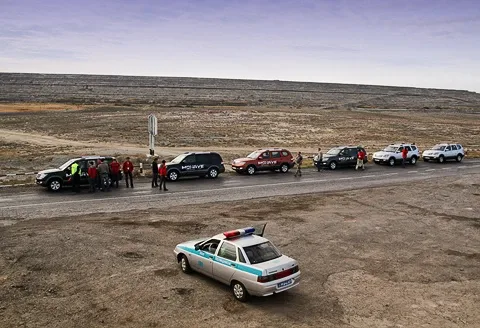
No one observes or enforces traffic rules in the Kazakh steppes. The two traffic police officers who stopped our caravan on the way out of Karaganda turned out to be the only ones along the entire route.
Worse is that the Mohave's steering with air suspension strongly resembles old American sedans. Neither a clear on-center zone nor intelligible feedback as the steering angle increases. On straights, this partly makes life easier, freeing the wheel from parasitic corrections. But it's much easier to unwind the car with a "dead" steering wheel on a broken road than to catch it. It's no wonder the poetic name of the ill-fated "special stage" turned from Dry River into Wet Pants.
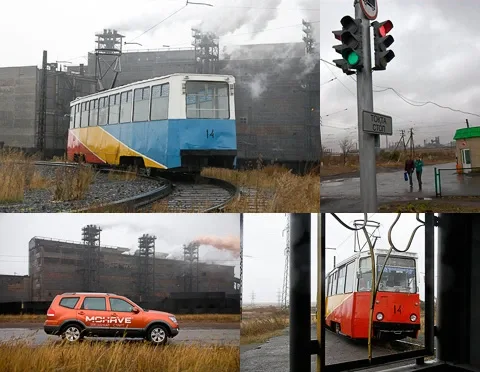
Karaganda is almost the middle of our route. "Five hundred back, five hundred forward..." — as per Vysotsky. According to legend, in 1833, a shepherd boy named Appak Baizhanov found coal near the city... and he'd better not have! In the industrial zone of Temirtau, bronze clouds fly across the sky. Just like that, without any quotation marks! Ore-processing plants emit tons of burnt rock into the atmosphere, painting the sky in the most unimaginable colors. The feeling of hopelessness is amplified by completely empty, dilapidated trams. Georgy Danelia could have filmed the cosmic saga "Kin-dza-dza!" in Karaganda.
Fortunately, the cars with conventional suspension, though inferior to the adaptive ones in ride smoothness, handled much more understandably. The steering here is quite informative even by European standards, although no adaptation is provided for SUVs supplied to Russia. Russians, the representatives assure, will drive the same cars as Americans.
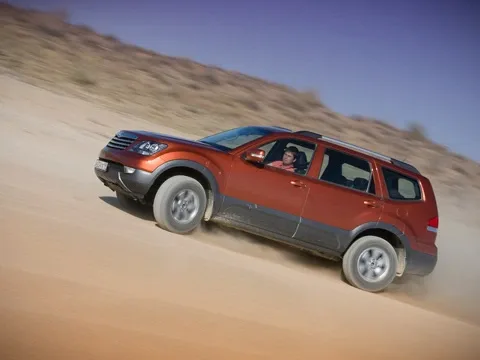
The car without air suspension behaves more composedly in corners, and the springs give a more honest feel of the road. True, you can forget about fast driving on any surface: after switching to the "simpler" version, our average speed over two hundred kilometers dropped almost by half. Bottoming out at every joint, bottoming out at every pothole — and so on endlessly.
There is a saying: “If showing off could shine, Moscow would be glowing.” Well, Astana is shining! It is an incredibly modern and beautiful city in its own way. The capital of Kazakhstan is only a few years old, and that has its own charm. Visitors stroll around the young city without the burden of history and simply enjoy what they see. It is refreshing. But we are not here to rest: we crossed almost the entire country and know that behind this glitter lies a desert, ruined roads, and a complete lack of any civilization.
And yet, despite the loss of comfort, I liked the option with the regular suspension more. Over the fifteen hundred kilometers of the journey, I managed to hate the desert, but I clearly understood what the optimal off-roader (or rather, crossover) Kia Mohave should be in terms of price and equipment. Under the hood is a turbodiesel, inside is a selector for a six-speed automatic transmission, and the suspension is on good old springs. Inexpensive, tough, and most importantly—dry.
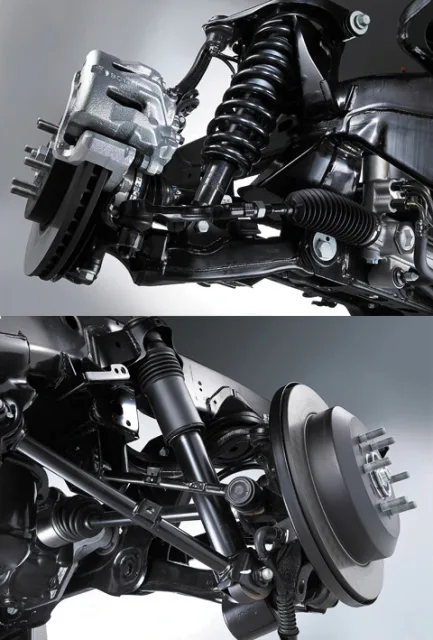 The Kia Mohave body sits on a ladder frame made of steel profiles, connected to it via eight rubber-metal mounts. At the front is a double wishbone suspension with an anti-roll bar. At the rear is an independent multi-link design, where the elastic elements are either springs or air springs. This layout improves on-road behavior but limits off-road potential. The air suspension can change the body height by 80 mm—just press a button on the panel.
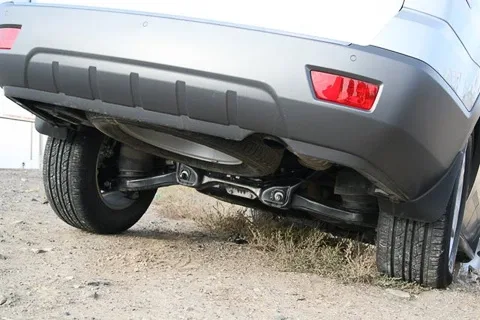 The full-size spare wheel hangs under the floor, which increases the rear overhang.
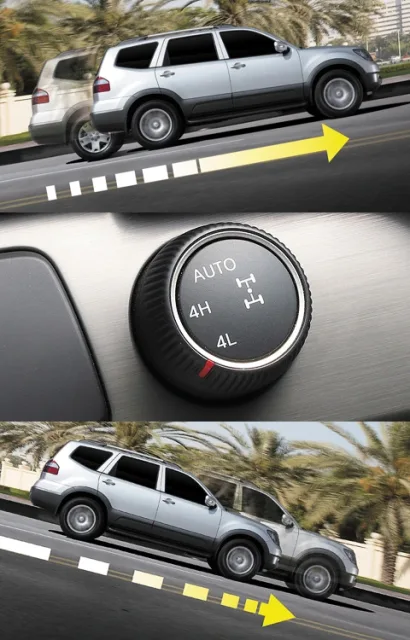 In addition to the DBC downhill assist system, there is also an HAC hill-start assist—it prevents the car from rolling back when starting on an incline. And for serious off-roading, you can even turn off the ESP.
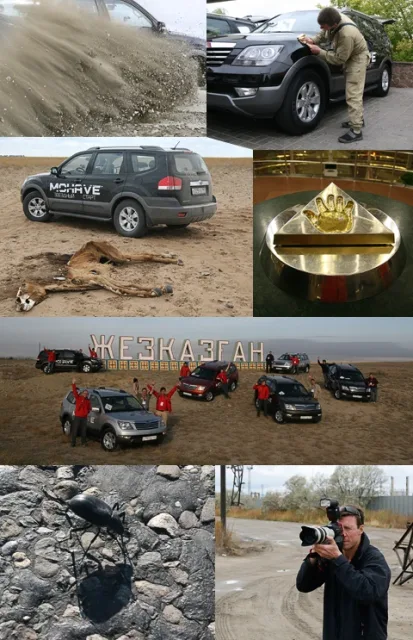 Honestly, I have never had a more thrilling trip. The car itself, of course, surprised me: for such a large vehicle, it has excellent off-road capability and pleasant on-road manners at the same time. But the main emotions were given by Kazakhstan. Everything we saw on the road can be divided into good and bad for a long time, but only a complete pessimist would say: “Finally, this scorched hell is over.” Fortunately, there are almost none of us. So we say: “We did it!”
Specifications
| Model | Kia Mohave 3.6 V6 | Kia Mohave 3.0 V6 CRDi |
|---|---|---|
| Body | ||
| Number of doors/seats | 5/7 | 5/7 |
| Length, mm | 4880 | 4880 |
| Width, mm | 1915 | 1915 |
| Height, mm | 1810 | 1810 |
| Wheelbase, mm | 2895 | 2895 |
| Track front/rear, mm | 1538/1532 | 1538/1532 |
| Curb weight, kg | 2159 | 2275 |
| Gross weight, kg | 2720 | 2800 |
| Trunk volume, l | 350 – 2765 | 350 – 2765 |
| Engine | ||
| Type | petrol | turbodiesel with common rail |
| Location | front, longitudinal | front, longitudinal |
| Number and arrangement of cylinders | 6, V-shaped | 6, V-shaped |
| Number of valves | 24 | 24 |
| Displacement, cm3 | 3778 | 2959 |
| Max power, hp/rpm | 274/6000 | 250/3800 |
| Max torque, N•m/rpm | 362/4400 | 539/2000 |
| Transmission | ||
| Gearbox | automatic, five-speed | automatic, six-speed |
| Drive | all-wheel drive | all-wheel drive |
| Chassis | ||
| Front suspension | independent, spring, double wishbone | independent, spring, double wishbone |
| Rear suspension | independent, multi-link | independent, multi-link |
| Front brakes | disc, ventilated | disc, ventilated |
| Rear brakes | disc | disc |
| Ground clearance, mm | 217 | 217 |
| Performance characteristics | ||
| Maximum speed, km/h | 190 | 190 |
| Acceleration time 0-100 km/h, s | 8.5 | 9.6 |
| Fuel consumption, l/100 km | ||
| urban cycle | n/a | n/a |
| extra-urban cycle | n/a | n/a |
| combined cycle | 11.6 | 10.2 |
| Emission standard | n/a | n/a |
| Fuel tank capacity, l | 82 | 82 |
| Fuel | AI-95 | diesel |
Kia Mohave trim levels
Standard equipment- Front airbags
- Alarm
- Fog lights
- Rear door child locks
- Automatic door unlocking in case of collision
- ABS
- Air conditioning
- Audio system with six speakers
- RDS Radio + CD + MP3
- USB and AUX inputs
- Rear parking sensors
- On-board computer
- Power steering
- Central locking with remote control
- Alloy 17-inch wheels with tires 245/70 R17
- Front fog lights
- Power-adjustable and heated side mirrors
- Full-size spare wheel
- Combined seat upholstery (fabric/leather)
- Driver's seat with height adjustment and lumbar support
- Heated front seats
- Second-row seats split 60 : 40
- Third-row seats split 50 : 50 and folding flat into the floor
- Metallic paint
Technology
Behind the scenes