
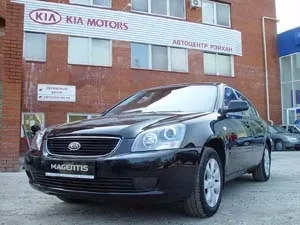
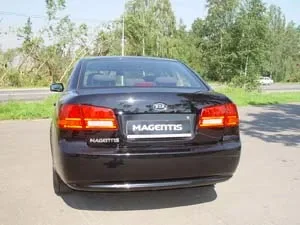
Kia Magentis
Magentis OPTIMAL
Engine - 1998 cc.
Max power - 145 hp/6000 rpm
Max torque - 19.3 kg/4250 rpm
Max speed (km/h) - 208
Acceleration time
0-100 km/h - 10.2 sec.
Fuel tank capacity (l) 62
Front-wheel drive
Wheelbase - 2720 mm
Length - 4735 mm
Width - 1805 mm
Height - 1480 mm
Ground clearance - 160
Tire size - 205/60 R16
KIA History
At the origins of Kia Motors is the company Kyungsung Precision Industry, founded in 1944. Its small enterprise in Yeongdeungpo (now a district of Seoul) produced bicycle parts. The first Korean bicycle of its own assembly appeared in the spring of 1952, and at the same time the company changed its name to Kia Industrial Company. The brand name is composed of Chinese characters: “ki” means “rising” and “a” means “Asia”. So Kia can be translated as “coming from the East” or “coming from Asia”.
In October 1961, the company began making C-100 motorcycles, laying the foundation for the Korean motorcycle industry. And already at the beginning of the next year, the three-wheeled truck K360 rolled off the assembly line, which was produced for 12 years and sold 25 thousand units. Motorcycles, by the way, were discontinued in 1981.
Brisa became the first passenger car of Kia and at the same time the first export model of the brand.
In 1971, when the factories expanded and truck production began, the company was renamed Kia Corporation. Then followed the purchase of Asia Motors, and with it appeared the four-wheeled truck Titan, which Koreans bought up with a bang. In 1973, Kia engineers created the first gasoline engine in Korea, and in October 1974 they presented the Brisa, the first domestic passenger car. Since the late seventies, the main direction was precisely the production of cars.
In 1979, Kia was the first in Korea to install diesel engines on its models, and also produced Peugeot 604 and Fiat 132 sedans. But soon the company fell into a period of financial troubles, and in the early eighties it was hit by a deep crisis. To get out, management focused on inexpensive cars. So in 1987, the small car Pride (also known as Festiva) appeared.
Kia's first design bureau opened in October 1984 in Sohari, near Seoul. Later, two more Korean bureaus and four foreign ones were added, the first of which appeared in Japan in 1989.
In the spring of 1990, the company officially became known as Kia Motors Corporation.
The main hit of the mid-nineties was the first Sportage: all-wheel drive, decent off-road capability and a modest price did their job.
Then the company entered a new phase: one after another, models that receive worldwide recognition are released, and modern factories are built.
In October 1991, the Sportage and Sephia were shown at the Tokyo Motor Show, and in June 1996, the Sportage successfully completed the “East-West” rally across the Sahara.
In 1996, sales reached 770 thousand cars. The company gradually expands its lineup, including more expensive models.
The Asian financial crisis of 1997 hit the corporation hard and drove it to bankruptcy. In 1998, Kia Motors Corporation was bought out by Hyundai Motors, after which the brand's economic policy changed radically. Thanks to the right course, since 1999 the company has returned to profit. In the fall of 2000, the Hyundai Automotive Group was formed.
In 2000, the Kia model range was seriously updated: Visto, Rio and Magentis appeared, and in total there were 13 families. The main bet was placed on the Magentis sedan, which promised an optimal combination of price and quality. Its premiere took place at the Paris Motor Show in 2001.
At the beginning of the new century, the American road safety agency recognized the Kia Sephia as “the safest car in the industry”.
By 2002, Kia had produced its ten-millionth car, with 60% of sales going to foreign markets. Now the brand's cars are sold in more than 170 countries.
In Russia, Kia has been loved for its successful price-quality ratio and reliability.
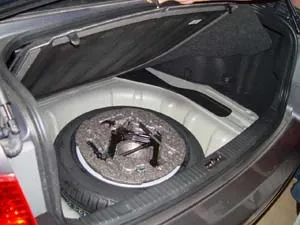
The new generation Magentis is built on the platform of the flagship Opirus. Thanks to this, the wheelbase has grown by 20 mm, and the car itself has become larger than its predecessor: 15 mm wider and 70 mm higher. The total length is 4735 mm. The trunk has also grown and now holds 420 liters.
In the appearance of the new Magentis, there is no longer an obvious “Koreanness” — it rather resembles Japanese cars.
In Russia, a version with a two-liter gasoline engine with 144 horsepower is available. The engine pleases with a variable valve timing system, quiet operation and moderate appetite: 10.5 l/100 km in the city and 6.2 l/100 km on the highway.
The two-liter unit with 144 hp is not known for excessive fuel consumption.
In the new generation, the Koreans used more expensive finishing materials than before.
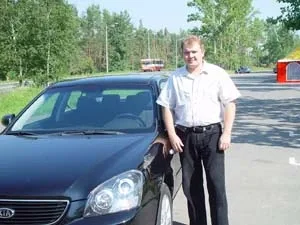
Andrey Kuzin, director of CarService. Driving experience — 13 years
A new Kia Magentis has hit the market, and this is another Korean representative of the business class. I want to believe that it will be able to compete not only with the related Hyundai NF, but also with Japanese and German classmates.
The fact that the new product will be successful is indicated by the popularity of the previous Magentis, which sold well here.
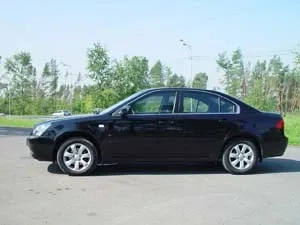
At first glance, it is clear: the car is completely different. The lines have become smoother and softer, there is less aggression. True, along with this, the new product, in my opinion, has lost in originality — in traffic it does not stand out among competitors.
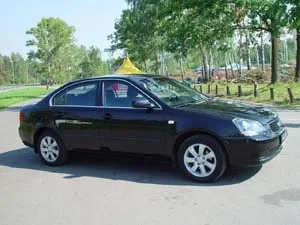
First impression of the exterior: it doesn't pull for racing, but you want to drive calmly and comfortably on business.
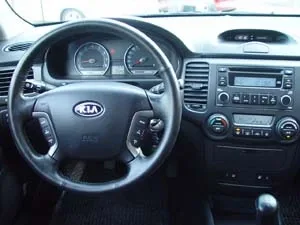
The interior has also been noticeably reworked. The equipment is rich: climate control, heated seats, on-board computer, ABS, stability control system and six airbags. Inside there is a lot of space for both the driver and passengers. I am 180 cm tall — to reach the pedals, I had to move the seat almost to the end.
You start the engine and immediately note excellent sound insulation. Even during active acceleration, the engine is almost inaudible in the cabin. The two-liter unit gives acceptable dynamics, but only for those who do not chase thrills.
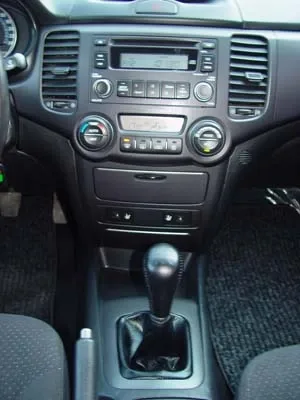
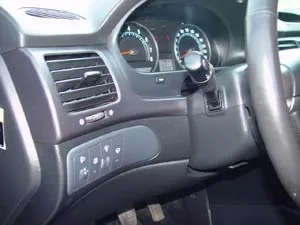
The suspension on our roads holds up decently, and at high speed the car does not sway on waves.
The brakes — disc front and rear — confidently slow the car even after fast driving.
The standard Korean tires turned out to be a bit noisy; I would replace them with something like Michelin.
The impressions of the car remained positive, it is clearly worth its money.

Alfred. Driving experience — 12 years
Remove the KIA badge from the radiator grille — and I would hardly recognize this Magentis in the parking lot. Why? Because I don't really know it either outside or inside. The only thing I knew was that it shares a platform with the Hyundai NF. It appeared quietly, without noise, dust, or advertising hype. I don't remember any TV commercials or radio ads in its honor, and in vain: new products in the E-class do not appear every day. In the exterior of the Magentis, modern fashion is felt, but the image itself turned out to be faceless and too smooth. Some find similarities in the shape of the headlights with the Lexus LS. I personally didn't see it, but that doesn't mean the car doesn't have its own character. As usual, I start the test from the rear seat. I admit, I didn't want to get out of there. It's truly spacious: enough room in both shoulders and knees. Which is not surprising — manufacturers are aiming for the E-class.
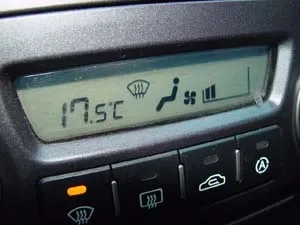
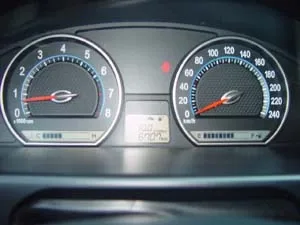
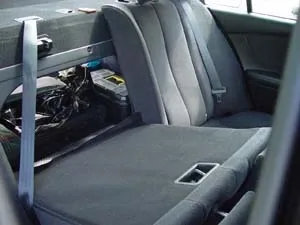
As for the amenities for rear passengers, there is essentially only an armrest, which can be transformed into a cup holder if desired. The rear seats themselves could be softer; the driver's seat is clearly more comfortable. The driver's workplace is organized thoroughly, and the front panel is slightly turned towards the person behind the wheel. The instruments, which I always look at first, are made simply and are perfectly readable. Even under bright sun, the liquid crystal screens do not glare, all information remains readable. The blue-white backlighting of the scales and arrows probably looks especially impressive in the dark. The only disappointment was the lack of normal steering wheel adjustments: reach does not change at all, and the tilt range is very small. Starting the engine with a key does not add any new sounds — sound insulation is at a high level, and the engine makes itself known only after 5,000 rpm. True, in the back row you can slightly hear the tires, but it is not annoying.
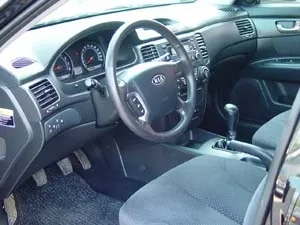

Let Vadim tell the details about the engine; I will only note that the two-liter engine does not shine with traction at low revs, but after 4,000 rpm there is a confident pickup. In pair with a manual gearbox, it shows a decent result. True, the gear lever is not located quite conveniently — you have to bend your elbow at an awkward angle; it would be better placed about five centimeters forward. But all other buttons and switches are at hand; you can find them without error. The steering wheel does not impress with the quality of finishing, but it lies comfortably in the hands, with a pleasant heaviness at speed. The car confidently swallows bumps and at the same time clearly holds the arc in corners, not deviating from the trajectory. For road behavior, I would give four plus on a five-point scale. The car treats occupants gently, maintaining silence and peace in the cabin. The brakes, in my opinion, are tuned perfectly: I check this at the first braking — if from unfamiliarity you can accurately dose the effort and feel the deceleration, then everything is in order. The trunk with a volume of 420 liters can fold, but this creates an uneven platform, and the folding levers are located in the trunk itself. I understand the logic of the engineers: this is an E-class car, and it is not bought for trips to the countryside. It is created for people who, by status, are not yet ready for a Mercedes or BMW, but already need a car with a driver. The main feature of the Magentis is its amazing evenness: nothing protrudes and nothing fails. There is nothing to particularly praise, but also nothing to scold. I encounter this for the first time. But a hook was found after two days — the salon manager called and said that now this car costs from 599,900 rubles. Just think about it: an E-class cheaper than 600 thousand! After this news, both the design and the interior are perceived completely differently. The key advantage of the car is the price-quality ratio, and the quality, perhaps, even outweighs. For such money, not every manufacturer will offer so much car.
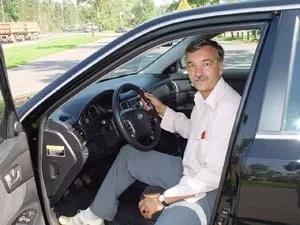
Vadim. Driving experience - 10 years
This test drive, perhaps, turned out to be the most unusual in my practice. Therefore, I will start the story non-standardly — immediately with conclusions.
Before us is a large solid car with high-quality interior trim and a soft smooth ride. Surprisingly, it really has nothing to scold, but there is also nothing to particularly admire. Its main advantage is the predictability of sensations and the balance of all characteristics.
At this point, the most impatient readers can close the article, and we will analyze some features of the car for the rest.
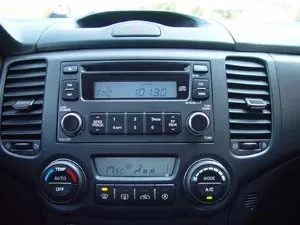
Interior. Everything is expected here: a lot of space, soft high-quality plastic, leather inserts, many compartments for small items in the front. But the most pleasant thing is to ride in the back, feeling like a real boss. You can, of course, grumble that there is no temperature and air direction adjustment in the rear row, but you remember the price, and all complaints disappear.
Suspension. An independent suspension is installed at the rear, which positively affects maneuverability. Naturally, it is silly to expect sporty handling from such a large sedan, but the Magentis passes smooth arcs perfectly. Plus — complete insensitivity to potholes and rails, while the suspension is not cottony, but elastic. I was not at all surprised that ESP is offered only in the most expensive trim. This is a typical approach of Korean manufacturers: even ABS in inexpensive models is only in the top. It seems the Koreans do not suspect the existence of winter with ice in Russia. And they certainly have no idea that in our country a tractor can bring lumps of wet mud onto the highway. Saving on active safety can cost too much.

Engine. Fortunately, now the Magentis is equipped with a modern two-liter engine. But our test sample had an old 2.0-liter unit. Such engines are distinguished by a small torque by today's standards of 175-190 Nm, which occurs at high revs — 4300-4500-5100 rpm. And here is what is interesting: on C-class cars like the Ford Focus or Hyundai Elantra, such an engine is very annoying due to the lack of traction at low revs, but on the Magentis its behavior even pleased me. Out of spite, I tried to "spur" it at 2000 rpm both in the city and on the highway — it is clear that there is no point. But sharp accelerations are not needed for such a big car; it is much more pleasant to drive sedately and solidly.
Trim levels. In the base version Comfort ($ 20 247 (161 973 UAH)), there will clearly be a lack of seat heating and an adjustable steering column. Probably, it is wiser to look at the Business version (625 thousand rubles), which adds active head restraints, side airbags, and curtain airbags. Well, the top Luxury (667 thousand rubles) will please with ESP, a rain sensor, and a leather interior. The maximum price — with an automatic transmission and a 2.7 engine — will be 852 thousand rubles.
Maintenance cost:
Maintenance A: 1000-2000 km - $71 (567 UAH)
Maintenance 1: 10,000 km - $142 (1,134 UAH)
Maintenance 2: 20,000 km - $125 (1,000 UAH)
Maintenance 3: 30,000 km - $142 (1,134 UAH)