
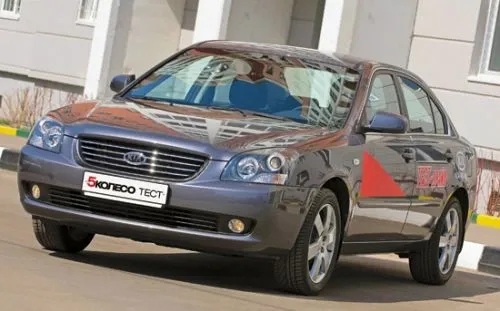
Kia Magentis first made its presence known five years ago, and at that time the model also began to be assembled in Russia at the facilities of Kaliningrad's Avtotor. A couple of years later, the exterior was slightly adjusted, but these changes were barely perceptible. Now, however, a completely different car takes the stage, and its production has already been set up in South Korea.
The first Magentis, which aimed at the European E-segment, can confidently be called a statement of intent from the Korean brand. Kia Motors made it clear that it does not intend to remain in the shadows as a manufacturer of purely budget models. Nevertheless, the price still remains a significant trump card. The combination of respectability and affordable cost made this car a favorite among mid-level officials, whose status does not allow them to drive around in BMWs or Mercedes-Benzes.
If you place the new Magentis next to its predecessor, finding anything in common between them would be difficult. However, its kinship with the Hyundai NF is easily traced — especially in the contours of the side panels and the design of the rear. This is not surprising, as both cars came from the depths of the same concern. The nose of the Magentis, however, vaguely echoes Lexus design: the triangular headlights with lenses for low and high beam inside immediately catch the eye. A chrome radiator grille, stretched horizontally, completes the look.
Although the car looks like the NF externally, the platform was borrowed from the bankrupt British MG. Thanks to this, the body became seven centimeters taller, and the wheelbase gained two centimeters. The trunk also grew — now its volume is 420 liters. The rear sofa can be folded either entirely or in a 60/40 ratio, but in this case, an uneven floor is formed, and the opening is not too wide. In short, the Magentis is not suitable for transporting bulky items, although such an ability is, by and large, not needed for a representative sedan.
Inside, the design of which was worked on in Korea, the USA, and Western Europe, you realize that the new Magentis has truly grown to the business class. Therefore, it is better to sit not in the front seat, but on the spacious rear sofa. The cabin has noticeably increased in size: there is enough space both above the head and for the legs, and if desired, you can even recline into a semi-reclining position.
The quality of finishing materials has stepped far forward. The plastic "wood" inserts that previously cheapened the interior have disappeared without a trace. They have been replaced by neat aluminum elements in a high-tech style. The plastic now looks neat and is pleasant to the touch.
Unfortunately, the editors of "5 Koleso" do not have personal drivers, so we had to move to the front and master the driver's seat. Getting comfortable did not work out immediately: the adjustment ranges were often insufficient. This especially applies to the steering column.
The upper part of the front panel has become soft, which is undoubtedly a plus. But the plastic on the steering wheel and gear lever disappointed — it feels as if someone has stripped the leather off them. Apparently, this flaw will be corrected in more expensive versions.
The placement of controls is well thought out — they are easy to reach, and the logic is intuitively clear. Within a couple of minutes, your hand finds the necessary buttons on its own. The central console houses as many as three liquid crystal displays. The top one shows the time and signals about unbelted passengers. Special mention deserves the seatbelt reminder system for the driver: as soon as you start the engine, a piercing beep fills the cabin. Well, safety first! Slightly lower is the CD player screen, and below it is the climate control display. LCD screens are also used to output other information, including engine temperature and fuel level. All these scales and icons are illuminated with a soft blue light. Additionally, the speedometer and tachometer dials are framed with chrome.
Starting the engine is almost imperceptible — only a slight vibration through the body. Almost no extraneous sounds penetrate the cabin, as special attention was paid to sound insulation. The engine's voice becomes audible only after 5000 rpm. By the way, currently, dealers only have versions with a two-liter gasoline engine, but a 2.7 modification is expected soon. It is also possible that a two-liter diesel will appear in Russia, but the exact timing is apparently known only to the highest marketing officials.
The dynamics of the 145-horsepower engine cannot be called outstanding. But is it needed for a solid sedan? The automatic transmission does not make the car more agile, but it noticeably simplifies life in the city. The manual shift mode, although present, does not add much briskness. The car seems to set you up for a calm, measured rhythm.
The steering wheel is not very informative in corners — there is a lack of feedback on the arc. However, the car holds its trajectory clearly. The suspension easily swallows any bumps, and in turns, the car confidently stays on the road.
The long bumper overhangs are compensated by a decent ground clearance. Moreover, the Magentis pleased with its maneuverability: with a length of over 4.5 meters, it easily turns around on a two-lane road.
The previous version cost about $17,000. The new one starts at $24,000, but already in the base it offers ABS, an electronic stability control system, six airbags, and seatbelt pretensioners. The main competitors of the Korean newcomer look like the Toyota Camry and the related Hyundai NF. At the same time, the Magentis turns out to be the most affordable of the trio, without yielding to them in equipment.
Technical specifications of Kia Magentis
Curb weight, kg – 1491
Gross weight, kg – 1920
Dimensions (length/width/height), mm – 4735/1805/1480
Wheelbase, mm – 2720
Maximum speed, km/h – 195
Acceleration time to 100 km/h, s – 11.2
Control fuel consumption, l/100 km:
- city cycle – 10.8
- combined – 8.1
Fuel tank volume, l – 62
Engine:
- type – gasoline
- displacement, cm3 – 1998
- power, hp at rpm – 145/6000
- torque, Nm at rpm – 193/4250
Transmission – automatic, 4-speed
Brakes:
- front – disc, ventilated
- rear – disc
Price, $ – 24,000.
Advantages and disadvantages
+ Spacious cabin, good sound insulation.
– Mediocre dynamics, noisy suspension.