
Kia Cerato. A Successful Transformation
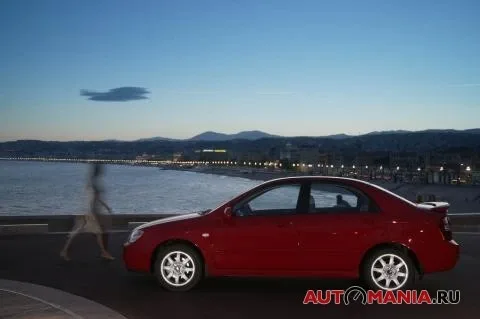
Just yesterday, Koreans couldn't compete on equal footing with renowned Japanese and European brands. Their cars were cheaper but fell short in elegance, ambition, build quality, and, of course, status. And it's precisely the prestige of personal transport that matters so much to European and Russian buyers. Fortunately, Korean engineers have managed to eliminate most of these shortcomings, and now they offer us a product that is not only better quality but also noticeably more respectable. Just recall the Hyundai i30 and Kia Cee'd – their impressive sales in Europe clearly prove that both brands have managed to create a product that is quite competitive by European standards. And it's precisely a 'product,' in the singular. After all, Kia, being under Hyundai's wing, received the honorable but not too grateful mission of a 'pioneer.' It's on this brand's models that all the corporation's technical innovations are tested, and only after successful trials do they migrate to Hyundai cars. That's why the Cee'd appeared on the market first, and only then the i30. And this isn't an isolated case. A few years ago, a similar story happened with the Cerato-Elantra pair: everything tested on the former was then implemented in the latter. But the Cerato was by no means a 'raw' car; rather, the opposite... But let's take things in order.
The exterior of the model, which came out almost three years ago, didn't claim originality, and today the Cerato is even less of a trendsetter. On the other hand, both then and now, its appearance doesn't look provocative or strange. Design was never Kia's strong suit – the company usually used others' solutions. When creating the Cerato, the Koreans again followed the beaten path, gathering bits and pieces from here and there, and this benefited the car. True, all this applies only to individual elements, but overall, the car turned out very similar to its closest relative and competitor, the Hyundai Elantra (of course, the previous generation). As you might have guessed, the Elantra also served as the donor for the technical content: the platforms of these cars are absolutely identical.
Still, one can't call the Kia Cerato a simpleton. Yes, it's not as fresh and stylish as, say, the Chevrolet Lacetti – a fruit of Italo-Korean-American cooperation. But the Cerato is quite attractive, draws public attention, and has gained a modest but worthy army of fans. And that's not surprising: the 'Korean' has many real advantages, the main one being a spacious cabin. Of course, the Cerato is far from executive level (the class and modest sedan dimensions take their toll), but there's an abundance of free space for the driver and three passengers. At my two-meter height, the author of these lines easily settled both behind the wheel and on the rear sofa. Of course, with such dimensions, you won't sit 'behind yourself' in the C-class, but if people of average build are in front, a couple of basketball players can comfortably fit in the back – the headroom allows it.
As for the driver's workplace itself, everything here is indecently simple. No frills, standard adjustments: the steering wheel only moves vertically, and the seat moves forward and backward. The base version we got for the test had only air conditioning, a couple of front power windows, an immobilizer, audio prep, two airbags, and ABS with EBD. For a modern driver, this set is, to put it mildly, insufficient. If desired, you can look into a fairly rich price list and choose a more serious trim – with an onboard computer, rear power windows, power-adjustable and heated mirrors, heated seats, a branded stereo, and even an 'automatic.' For a larger sum, they'll offer climate control, side airbags, leather, and a couple of electronic assistants – BAS (brake assist) and TCS (traction control). But the base version now costs a quite reasonable 466,116 rubles, which makes you think about whether it's worth 'ruining' your wallet. In short, an undemanding driver will have enough of the standard set, while a more demanding buyer will likely immediately turn their gaze to a more prestigious brand.
Continuing the conversation about the cabin, one can't help but note the build quality. The first thing that catches the eye is the massive two-tone front panel. You'd expect such a move from the business class, but not from a budget 'Asian.' And although the panel material is certainly not top-tier, everything looks quite presentable. The same applies to other interior details: simple but tasteful. And what's especially pleasing is that everything is assembled and fitted almost perfectly – at least, during the test, no squeaks were heard in the cabin.
However, there was a fly in the ointment, and a rather hefty one. If there are no complaints about assembly, then serious questions arise about the interior's practicality. The Koreans' (like other Asian manufacturers') love for light tones is completely incomprehensible: almost white carpet on the floor, cream fabric seats, beige plastic panels... It looks good, even with a claim to luxury. But given Russian realities – eternal puddles and sticky autumn mud, almost black snow generously seasoned with reagents in winter – it becomes clear that within a couple of months, the cabin will require at least a general cleaning, if not dry cleaning. And for a budget C-class model, this is more of a minus than a plus.
We've already mentioned that the Cerato is built on the platform of the old Elantra, so technically both cars were initially very close: identical suspensions (McPherson struts in front, multi-link in the rear), identical transmissions (5-speed manual and 4-speed automatic), and the same engines. To this day, however, only one of the engines has survived, and even that one has been seriously modernized. After the recent facelift, the Cerato received a new base unit. The 1.6-liter gasoline 'four,' which replaced the previous 105-horsepower engine, produces a quite respectable 122 hp and 157 Nm of torque by today's standards. The transmissions remained the same, but Russian buyers still hope that in the near future, in addition to the 2-liter engine, a very good turbodiesel will also appear.
Our 'test subject,' however, was equipped democratically: under the hood, a 1.6-liter 16-valve engine paired with a manual. The driving characteristics of such a car are quite typical: a brisk start, smooth acceleration, decent dynamics... The gearbox shifts easily and precisely. In the city, you immediately feel the advantages of the 'stretched' third gear, but you shouldn't get carried away: at the bottom, the engine lacks power, and at the top, it lacks torque. Moreover, after 3000 rpm, as with the pre-facelift version, insufficient sound insulation of the engine compartment makes itself known: given the unpleasant 'sound' of the unit, an unprepared passenger might experience a real shock. By the way, Korean specialists should also work on the sound insulation of the wheel arches.
The suspension, on the contrary, left very pleasant impressions. Moderately stiff, it handles both small and large bumps without issue, not annoying the driver with drifts or rocking like some classmates. The steering could certainly use more stiffness. But the Cerato is initially an urban car, designed for narrow streets, traffic jams, and low speeds, so light steering here is more of a plus. Especially since the sedan holds the road confidently, responding instantly and precisely even to a slight turn of the wheel.
One can't help but note the excellent brakes. Here, Kia's engineers did a five-plus job. And perhaps even overdid it: even with a light press on the pedal, the car literally 'stands on end,' so out of habit, you can easily 'nod' your nose into the steering wheel. And that's not a pleasant experience. But overall, the car leaves a pleasant impression. The Cerato has always been and remains a relatively moderate car for which relatively moderate money is asked. It has no obvious advantages, but also no obvious disadvantages. Some will say – 'neither fish nor fowl.' And someone will call it the 'golden mean'...
Technical specifications:
| Length (mm) | 4340 |
| Width (mm) | 1735 |
| Height (mm) | 1470 |
| Wheelbase (mm) | 2610 |
| Weight (kg) | 1220 |
| Trunk volume (l) | 345 |
| Engine displacement (cm3) | 1591 |
| Max. power (hp) | 122 at 6200 rpm |
| Max. torque (Nm) | 157 at 4200 rpm |
| Max. speed (km/h) | 190 |
| Acceleration 0-100 km/h (s) | 10.2 |
| Average fuel consumption (l) | 7.3 |
| Price (rub.) | 466,116 - 499,716 |
Source – AUTOMANIA.RU