
The history of Jeep began back in 1941, and since then six generations of this SUV have changed. But even in the seventh Wrangler, the features of that very legendary Willis are unmistakably recognizable.
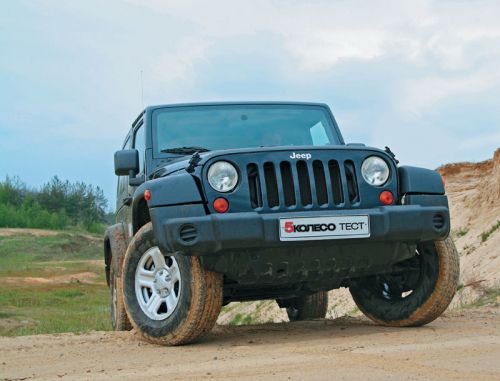
2007 Jeep Wrangler Sport
© Photo: 5 Koleso
Although outwardly the new model strongly resembles its sixth-generation predecessor, in essence it is a completely different car. It has grown in size, and the frame has been completely redesigned: bending rigidity has increased by a full 100%, torsional rigidity by 50%. The steering geometry has also been revised, and the axles are more durable, designed for serious loads. In addition, engineers managed to reduce the noise level of components and assemblies by 20%.
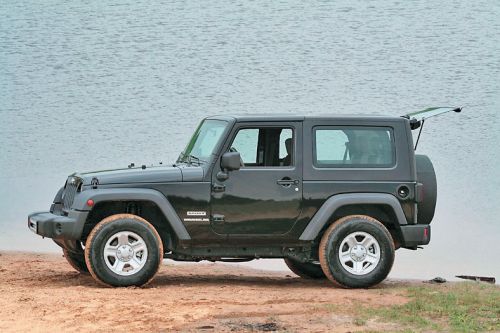
2007 Jeep Wrangler Sport
© Photo: 5 Koleso
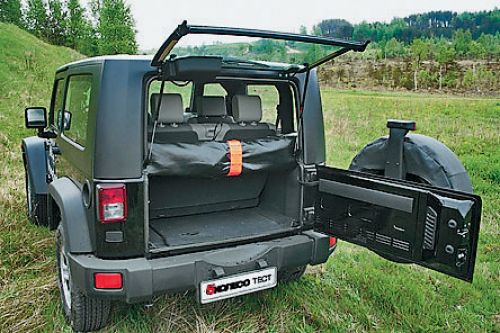
For the test, we got a three-door Wrangler in the Sport version with a 3.8 engine and a four-speed automatic. Additional equipment includes only air conditioning, a CD receiver, and the so-called dual top. This last option initially puzzled us. We figured it out: the car can be ordered either with a soft top, or with a hard plastic top, or with both at once. In the latter case, the bonus is all-metal doors with power windows. But we would not recommend this option as the most sensible. The folded soft top occupies a significant part of the trunk, and for those who travel for adventures, this is a clear minus — there will simply be nowhere to put things. We would advise settling on one thing, and preferably on the plastic top: the trunk remains more or less spacious, such a roof is quite easy to remove, and protection against break-ins is more reliable than with a soft top. Moreover, if you fold the rear row, a medium-sized TV in a box can easily fit in the car. By the way, the process of folding the rear seat is simple to the point of absurdity: you pull the handle, and it, thanks to powerful springs, moves forward folded by itself. Pull the loop on the backrest, and it is back in place. Convenient and elementary.
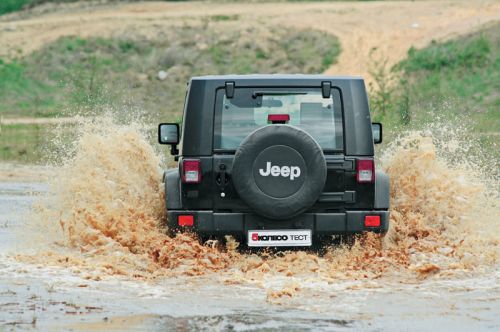
2007 Jeep Wrangler Sport
© Photo: 5 Koleso
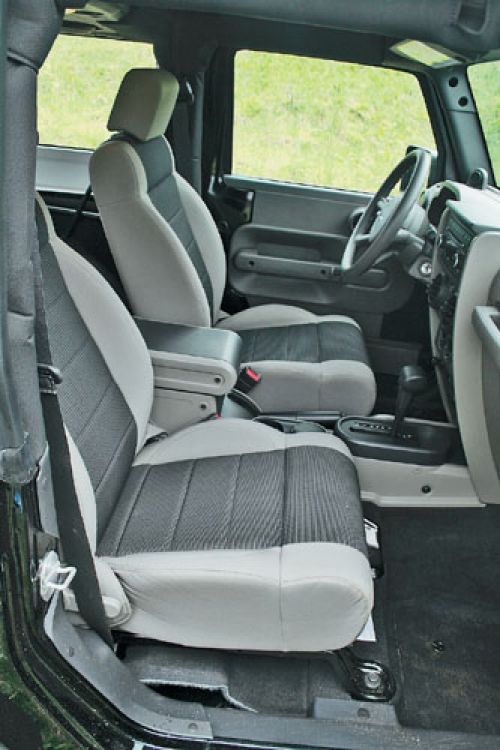
But getting to this very second row is quite a task. The opening that is formed when the front seat is moved forward is so narrow that even a nine-year-old child has difficulty squeezing through, let alone an adult. Why the developers did not increase the seat travel is a mystery. There is still room when the seat is fully pushed to the dashboard.
2007 Jeep Wrangler Sport
© Photo: 5 Koleso
We also found no justification for the lack of electric adjustment for the exterior mirrors. Getting behind the wheel, I unsuccessfully searched for a button or lever that would activate these huge "burdocks." As it turned out, the electric drive is not offered even for an additional fee. And this despite the fact that there is plenty of electronics and electrical equipment in the car — take at least the active and passive safety systems. A strange decision. In our opinion, such savings are completely unjustified.
2007 Jeep Wrangler Sport
© Photo: 5 Koleso
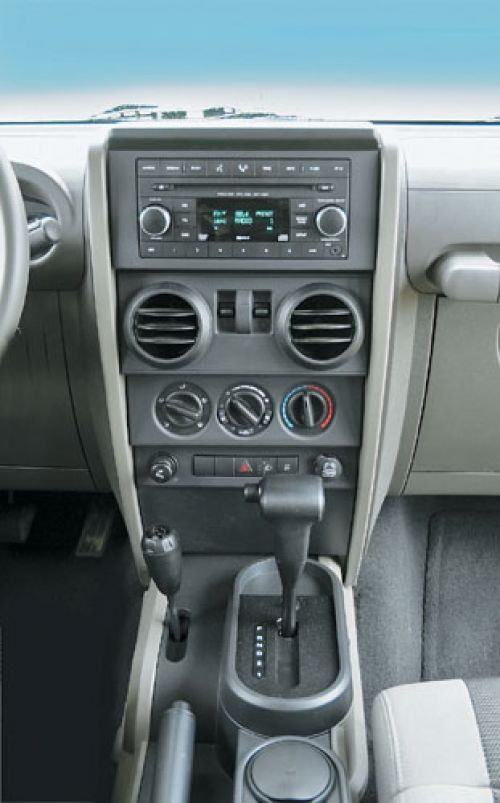
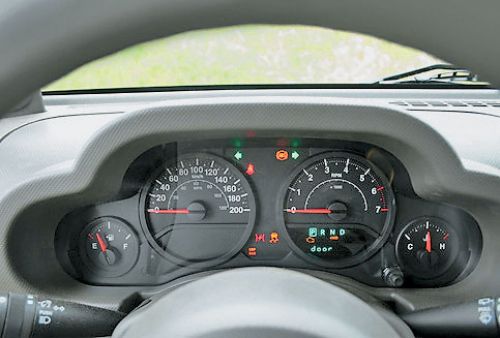
However, this shortcoming can be considered the only one — further on, no complaints arose about the interior and equipment of the car. Everything is in its place, everything is quite convenient. Even the widely spaced gas and brake pedals eventually ceased to be perceived as an ergonomic miscalculation.
2007 Jeep Wrangler Sport
© Photo: 5 Koleso
Despite its super-off-road essence, the Wrangler behaves quite decently on asphalt. Of course, at speeds over 100 km/h it is far from ideal, but driving is not stressful. Yes, it shakes and "bucks" on bumps, but it does so in a special way — delicately and even softly. Surprisingly, even on the most broken bumps, it is quiet in the cabin: neither the suspension nor the plastic makes a sound. Except that the tires slap, and that is only audible with the window open. So, the work on noise reduction was not in vain. But the claims about the steering refinement raise doubts. Perhaps they did work on it, but clearly half-heartedly. There is no question of any sharpness or feedback. The steering wheel is absolutely empty. And the culprit is an overly eager power steering. The wheel turns as easily as a ship's helm. Moreover, the effort on the wheel is constant: whether you are standing still or flying down the highway. However, due to the blurred "zero" in motion, this is not very annoying, because deviating the wheel by 10-15 degrees in any direction does not change the trajectory — the car goes straight as it did. You can play with the wheel in a long turn too. The main thing is not to over-twist: with the stabilization system disabled, the rear axle drift occurs almost instantly. However, what is there to be surprised about — the wheelbase is short.
2007 Jeep Wrangler Sport
© Photo: 5 Koleso
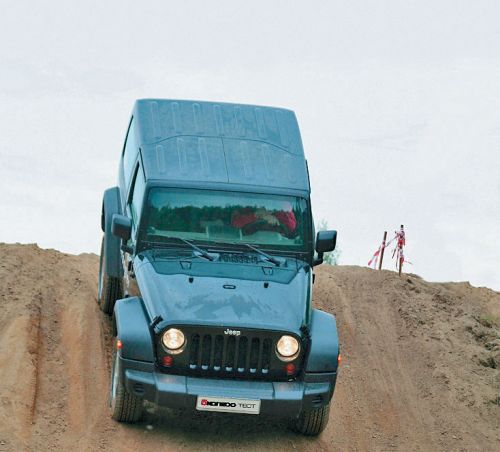
It is precisely thanks to its short wheelbase that the Wrangler works real miracles off-road. Of course, the powerful engine, the part-time four-wheel drive Command-Trac, and the low range also contribute. But it is the competent geometric cross-country ability that endows the car with phenomenal capabilities. Previously, we had to drive through these same places in cars with more powerful engines, but what the Wrangler did is incomparable. At times it became scary for both ourselves and the equipment, but this restless one kept climbing forward, showing not a shadow of doubt.
The culmination was a run up an almost vertical sandy hill. We spent a long time gathering our courage before the ascent: estimating, doubting, measuring. What if there is not enough torque or tire grip? And if the angle is critical — will we roll over? Only the Wrangler itself was calm. And we decided. Here it is, a sandy wall before our eyes, then the sky and… and a stunning view from the top of the surroundings. The car shot to the top in a couple of seconds — we did not even have time to get scared. The 198-horsepower engine easily pushed us to the very top. And then it began… Puddles, mud, hills. We finished everything with a motocross track. But even it could not embarrass the test subject: it covered it from start to finish in one breath.
The whole day flew by in one breath, which once again reminded us: there is still so much interesting in the world, and pleasure can be derived from simple things. Such as the Jeep Wrangler. Simple and functional.
Driving
On asphalt it behaves tolerably, off-road it has practically no equal. It is the ability to move over "directions" that deserves the highest rating.
Interior
Quite well equipped with the benefits of civilization. All controls are in sight and easily accessible.
Comfort
Maximum, as far as it is realistic for a car of this kind. But the second-row passengers are hardly to be envied.
Safety
Standard equipment includes two front airbags, ESP, ABS, and Brake Assist in the "base."
Price
Quite adequate: for this money you get exactly what you want. If, of course, you want an SUV.
| Dimensions, mm | 4223x1873x1840 |
| Engine | petrol, 3778 cm3, 198 hp/5000 rpm |
| Transmission | automatic, 4-speed |
| 0-100 km/h, s | 11.9 |
| Top speed, km/h | 174 |
| Competitors | Land Rover Defender |
Pros and cons
+ Absolute cross-country ability, good dynamics, soft ride.
- Empty steering, difficulty accessing the second row of seats.
Our opinion
2007 Jeep Wrangler Sport
© Photo: 5 Koleso
Undoubtedly, compared to its predecessors, the new Wrangler has become noticeably more comfortable. But, as it seems to us, in our market the five-door version will still be more popular — it is more practical. Even if it is a small sacrifice made for cross-country ability.
© 5 Koleso