Jeep Compass
YOUR FIRST JEEP
Engine -
petrol EURO-4
Engine displacement -
2359 cm3
Power - 170 hp
Max. torque - 220/4500 Nm/rpm
Acceleration 0-100 km/h - 11.3 s
Max. speed - 185 km/h
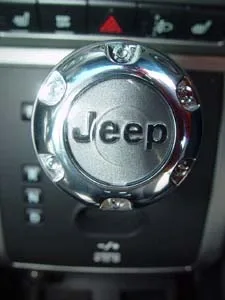
Transmission - continuously variable automatic CVT II
Drive - all-wheel drive
Fuel consumption:
city - 11.5 l/100 km
highway - 8.3 l/100 km
combined - 9.5 l/100 km
Front suspension - independent MacPherson
Rear suspension - independent Multi-Link
Brakes - disc
Dimensions:
Length - 4405 mm
Width - 1810 mm
Height - 1630 mm
Ground clearance - 200 mm
Curb weight - 1980 kg
Tire size - 215/60 R17
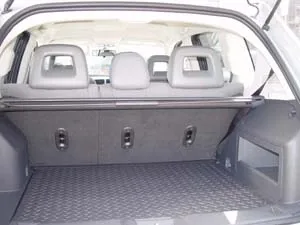
Trunk volume -
436/1277 l
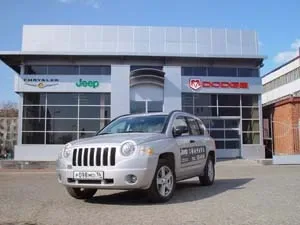
One of the most frequently asked questions is the origin of the name “Jeep”. Many people for some reason are sure that it all started with a character from the 30s comic “Popeye” nicknamed Eugene the Jeep. This villain and prankster from another dimension had enough strength to break through anywhere and get out of any situation with honor - just like a jeep.
Others claim that jeep is an indistinctly pronounced abbreviation G.P. (“Gee-Pee”, General Purpose, general purpose vehicle) - the name adopted in the American army for a small reconnaissance vehicle. Still others say that in Oklahoma back in the 30s, jeeps were called trucks with equipment for drilling oil wells.
Despite the fact that the debate about the origin of the name “Jeep” continues to this day, it is certain that this trademark has survived turbulent decades, but has not lost its worldwide fame, despite changes occurring in corporations and automotive markets. Back in 1938, when the invaders began their invasion of Western Europe, the US Army leadership set the task for all car manufacturers to create a new vehicle capable of replacing the three-wheeled motorcycles with sidecars that had long been used for communications and reconnaissance. By the summer of 1940, the army had developed the concept of a general purpose vehicle. It had to be light, maneuverable, durable and reliable. Detailed technical specifications were developed and handed over to three competing automobile companies.
The hard work of Ford, Bantam and Willys-Overland resulted in each of these companies producing 1500 vehicles for field testing. As a result, preference was given to the vehicle from Willys-Overland (in particular due to the low cost of $738.74), with minor improvements borrowed from Ford and Bantam models. Thus, the birthday of the jeep is considered to be July 23, 1941, when Willys-Overland (Toledo, Ohio) signed a contract with the US Army to produce Willys MB vehicles throughout World War II. Thanks to the inheritance of the main advantages of previous models, in many countries the word “jeep” is still synonymous with “Sport Utility” vehicles. But we should not forget that “Jeep” is a registered trademark owned by DaimlerChrysler, a company that has maintained its leadership in the market segment of vehicles for outdoor activities for many years.
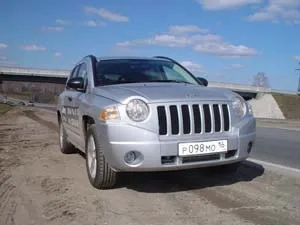
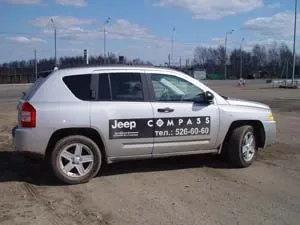
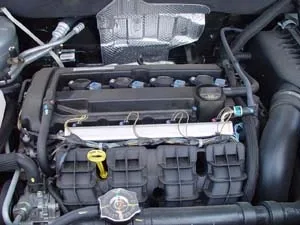
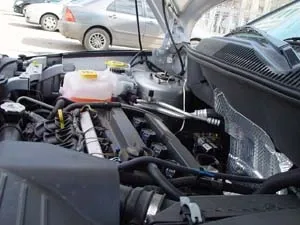
The Jeep Compass crossover is built on the Dodge Caliber platform. Compass combines convenient dimensions, style and practicality. The 2.4-liter World Engine petrol engine with 170 hp is characterized by an exceptional combination of high build quality, fuel efficiency, power, smooth operation and low noise level.
Excellent off-road parameters inherent in all Jeep vehicles are also characteristic of the Compass model: ground clearance is 200 mm, approach angle - 21°, departure angle - 32°, ramp angle - 20°, wading depth - 279 mm.
The permanent all-wheel drive system ensures confident driving of the Jeep Compass in any road conditions.
Both in standard and locked all-wheel drive modes, such active safety systems as traction control, three-mode dynamic stabilization system (ESP), brake assist system, electronic roll reduction system, as well as anti-lock braking system function.

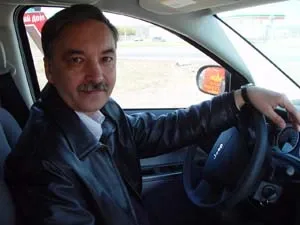
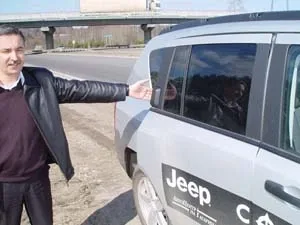
Eduard, director of “Auto-Style” LLC. I am practically unfamiliar with automatic transmissions - I have driven manual all my life. Therefore, the CVT (we found out that it was a CVT, not a classic “automatic”, only after the trip - editor's note) did not appeal to me from the first meters. The car accelerates slowly and with excessive noise. I think if there were a manual here, the dynamics would be more fun. But this is only the first impression - over time, perhaps because it is easier to drive an “automatic”, or perhaps thanks to the car itself, it began to please me more and more. You can not be afraid of bumps and small potholes on the asphalt. The suspension easily absorbs them without causing discomfort to the driver. This is extremely important to me. Visibility is simply excellent - there are no blind spots either in front or behind. Everything around the car is visible, and this adds confidence behind the wheel. In short, the car makes a good impression not only at first acquaintance, but can also please even more during long-term use.

Alfred. A legendary brand! It gave the world the word “jeep”, which is now used to call all SUVs. And this is only thanks to the Jeep brand.
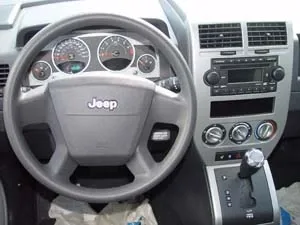
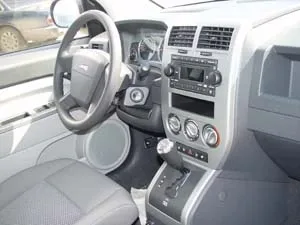
I'll start with the exterior. It is beautiful in its ugliness. And I like it! This is one of the few crossovers, sitting in which you don't feel like you took your wife's car while yours is in the shop. That is, it looks masculine and quite manly. The massive radiator grille symbolizes... come on, let's not talk about that. You get behind the wheel - and immediately see what excellent visibility there is and how comfortable you can sit. The side mirrors are so good that you stop using the interior one, although it is also informative (the rear seat headrest does not interfere with visibility). But the rearview mirror is for those who don't want to use the side ones. The steering wheel is comfortable, pleasant to the touch, but adjusts only by tilt - it cannot be adjusted by reach. However, there is cruise control. Such strange economy: they cut small things, but installed more serious things. Instruments and controls - everything is simple and clear, without excesses.
Vadim. As they say, there is no accounting for taste. For example, I frankly do not like the design of the Compass: solid angles, round headlights, disproportionately large radiator grille. Although it must be admitted that the style is consistent - the angles outside continue with angles in the cabin. True, one such angle near the driver's seat is clearly superfluous: both Eduard and I hit our knee on it quite hard. The plastic in the trim is not impressive, but for a price of 26,600 euros, it is probably forgivable. But the lighting fixtures of the Compass are a failure: they are simply absent in the sun visors. The front seats are comfortable, no questions here, but it is impossible to sit comfortably in the back row. We tried changing the backrest angle, sitting differently - useless. And sound insulation would clearly not hurt here.
Alfred. I fully support. It is uncomfortable to sit in the back, I also tried to adjust the backrest angle - still not right. The body is not fixed by anything, you want to hold on to something, but the handle is located so that you can't grab it - it seems it is only needed to help when getting in. In a long trip, rear passengers will be exhausted.
Vadim. We got into the cabin, started moving. And only then it dawned on me: what engine is under the hood? We agreed that it was definitely a two-liter unit. Although it produces more horsepower than the 2.4 version, its character is tuned for dynamics, not for storming off-road — even light mud or slush is hard for it. Let's look at the numbers: 170 hp at 6000 rpm, maximum torque — 220 Nm at 4500 rpm. To evaluate these figures, let's compare them with the Toyota Avensis 2.4: 167 hp at 5800 rpm, torque — 230 Nm at 3800 rpm. For a driver-oriented, aggressive ride, you want more: power around 6000–6300 rpm and torque in the 4500–5100 zone. But for confident crawling on muddy roads, in addition to 4WD, you need a torque peak at low revs, and the torque figure itself should be impressive. Let's look at the Compass's characteristics again, compare them with the Avensis's torque — and the conclusion suggests itself: the settings are not off-road at all. And the test confirms this: at the bottom, the engine sleeps, waking up only at high revs. The question of whether a Jeep needs city agility (seems undignified) when low-end torque is more important in the city, we'll leave aside. But the acceleration to 100 km/h is telling: Avensis — 9.1 s (automatic), Compass — 10.7 s with manual and 11.3 s with CVT. As you can see, dynamics are not all smooth either. Plus, under hard acceleration, the engine makes a lot of noise.
Alfred. The car is indeed noisy in motion. And almost all that noise comes from the engine. I admit, I didn't even immediately realize there was a CVT under the hood. Perhaps that's why the car drives reluctantly, despite the fairly powerful 2.4-liter engine. Honestly, I was shocked when I found out it wasn't two liters (as it seemed by the torque) but all two and a half. The car accelerates to 100 km/h seemingly briskly, but there's a hum under the hood, and then the speed builds up with effort. I'd venture to guess that overtaking on the highway is not an easy task for this car. But the brakes I liked right away. It would seem that all cars have them tuned similarly, but no. Here they are responsive and clear. It's easy to modulate the force and fully control deceleration. By the way, out of ignorance, we used an inconvenient way to switch from "manual" to "automatic" — we pushed the lever through neutral. But we just needed to hold the selector in the "+" or "–" position for a couple of seconds.
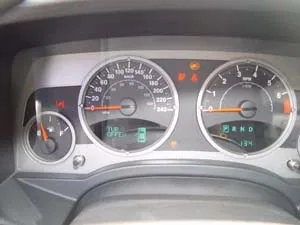
Vadim. Ashamed to admit, but I encountered a CVT for the first time. While driving, I was sure it was a regular, and a good, "automatic." All "shifts" are smooth, starting from a standstill or sharp acceleration in motion doesn't cause delays — what more could you want from an automatic? In a calm rhythm, the gearbox keeps revs around 2000 and below, which pleases with fuel efficiency. I also liked the transition to "manual mode": just push the lever right or left. Such quickness can be useful when overtaking. In "manual" mode, 6 fixed gears are available and two safeguards: in the red zone, the gearbox upshifts itself, and at 1000 rpm — downshifts. The car's character in this mode changes beyond recognition: instead of a sedate "Jeep" — a lively and angry car. You're unlikely to switch from "automatic" to "manual" often, but every time it will be a celebration. True, driving in "manual" for a long time is inconvenient: the gears are short, and you have to jerk the lever often.
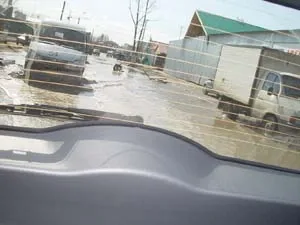
Compass is built on the same platform as the Dodge Caliber (which in the US is produced in both front- and all-wheel-drive versions). It's the chassis that reveals the "Jeep" breed in the Compass: no matter what broken road you choose, potholes and bumps won't disturb either the driver or passengers. Bravo, Compass! And how it swallows tram tracks — just a song! At the same time, there's no rocking on waves and no strong body roll in corners. Things are worse on wet, muddy roads, but even there it holds confidently if you forcibly engage 4WD and disable ESP. The chassis of this "off-roader" is to my liking.
Alfred. The neutral handling and stiffness settings also appealed to me. On one hand, a Jeep doesn't need excessive racing sharpness, but a leisurely rocking for a city car is not a gift either. Rails, potholes, bumps, sharp lane changes — this car's native element. I'll separately note that during the entire trip, the car never creaked, not a single plastic element made an extra sound. The quality of materials and assembly is top-notch. What can I say — a Jeep, paraphrasing a well-known expression, is a Jeep even in Kazan. An ideal first "Jeep" for brand fans.
Vadim. You may not believe it, but with every minute of the test, the Compass pleased me more and more. In the front passenger seat, comfort is captivating: potholes and bumps remain somewhere outside, and inside everything is soft and pleasant. In the driver's seat, it's even better: the seat is comfortable, lateral support is firm, visibility is excellent. The "automatic" gives smoothness, the "manual" gives brisk acceleration. After all, thoroughbred Jeeps have their own charm.