
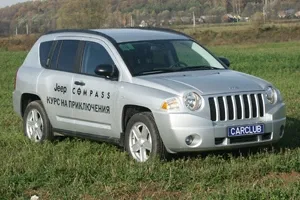
Jeep is a brand with a rich history that has come a long way from military vehicles of World War II to a symbol of a true SUV, albeit not the most comfortable, but with a bright character. It is thanks to the capabilities of these cars that the word "jeep" became a common noun for a whole class of vehicles. If you type "Jeep" into a search engine, the results will be full of links to various SUVs, and the brand's own cars will not always (and sometimes rightly so) be first on that list.
As for the Jeep Compass, its connection to the legendary brand is roughly the same as that of the Hyundai Tucson to the Mercedes G-Class. The gap between the "Jeep" in all its historical aura and the Compass is visible to the naked eye, and all the marketing positioning is nothing more than a publicity stunt. According to the PR people's plan, the Compass should become an object of desire for young and active people of both sexes who want to touch the legend but are not ready to shell out for a real SUV and sacrifice comfort. This audience seems to be afraid of brutal "real" jeeps. The Compass, on the other hand, is merely an imitation of an SUV, tailored for the city and its immediate surroundings.
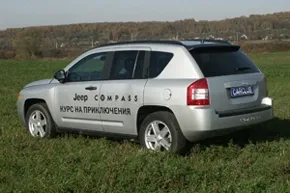 In essence, the Compass is a rebadged Dodge Caliber with almost the same interior, but supplemented with all-wheel drive. The reverse is also true: the Caliber is a Compass without all-wheel drive. The difference between them is that the former has its own zest (remember, have you ever seen a hatchback of such shapes and sizes?), while the latter has none at all.
Technically, the Compass is a front-wheel-drive car with an electronically controlled multi-disc Haldex coupling connected to the rear axle. In everyday life, that is, on asphalt, almost 100% of the torque goes to the front wheels. As soon as the front starts to slip, the rear axle comes into play, taking up to 50% of the traction — and the car becomes all-wheel drive. If desired, the coupling can be forcibly locked with a lever on the center console. And for those who are tired of the flashing stability control indicator, there is a button to completely disable it.
 Almost the entire daylight hours were allotted for the Moscow, or rather, Moscow region presentation. There were more than enough winding roads on both sides of the Novorizhskoye Highway and around the Istra Reservoir. Here's what seemed. On the highway, the Compass clearly gravitated toward a "sofa," though not an old and saggy one, but a new and elastically reassuring one. The ears got tired of the monotonous howl of the inline four-cylinder 2.4-liter engine, which was strangled by environmental regulations. Its appetite ranges from 12 to 17 liters per hundred kilometers. Paired with the engine is a CVT with the ability to manually shift virtual gears. It seems that the dynamics of the 170-horsepower (at 6000 rpm) and not particularly torquey (220 Nm at 4400 rpm) engine are present in any mode, but due to the monotonous howling on one high note, it is not felt at all. On the high-speed "new Riga" highway, the speedometer needle stubbornly refused to climb above 180 km/h, no matter how much the engine was revved. For a modern 170-horsepower car, that's a bit little, you'll agree. But forget about speed. The Compass is frankly not a fast machine, which persistently and tediously advises keeping to the allowed 110 km/h on the highway (plus or minus ten). But...
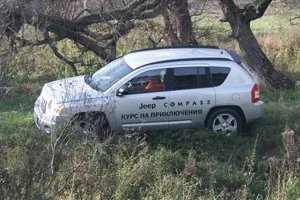
 But on winding roads, the imaginary jeep held up well. As soon as the front axle began to push wide out of the corner, demonstrating classic understeer, the rear wheels came into play, correcting the trajectory and adding excitement to active cornering. Body roll is small, and the fully independent suspension works perfectly — ride smoothness deserves a solid five. The Compass also handled light off-roading: it easily climbed grassy hills and slopes and churned through mud on a field of indeterminate purpose.
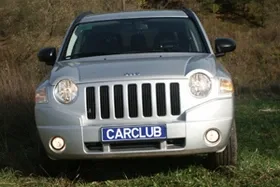
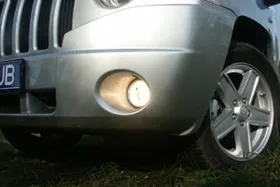
After a couple of hours of driving, there were no complaints about the driving position comfort. The audio system is decent, and the gray interior (almost identical to the Dodge Caliber's, but less cozy) is not annoying. But what really infuriates is the design, especially the front. The one who drew the front bumper apparently made it for another car and, having slept through all the deadlines, inserted it at the last moment. Looking at this heavy "jaw," you think the weight distribution should be 90/10, and during braking the rear would lift into the air, and the nose would plow the asphalt. In reality, it is 56/44.
 The target customer is by default an inexperienced and impressionable driver, but at the same time an experienced consumer attentive to details. Therefore, pleasant little things in the cabin were prepared for dessert. And they may turn out to be more important than driving qualities. Little thing number one — an iPod mount in the armrest between the front seats. It's convenient to route the wire both to the audio system and to the charger. Little thing number two — a removable flashlight in the overhead console on batteries. And the third little thing — MusicBox speakers on the tailgate for voicing beach parties. But here another, main little thing is missing that would justify all the other flaws — a huge, stylish, round analog compass on the front panel! Since you're playing with the Jeep brand, play stylishly and to the end — the boring green electronic compass on the instrument cluster doesn't count; such are installed on almost all American cars, including classic sedans.
However, the car is sure to be a success. One of the attractive factors is the price: from 24,900 euros for the base version with a manual transmission. The Compass in top trim with leather interior, CD/MP3 changer, and CVT is priced at 28,200 euros, which is noticeably cheaper than, say, the Toyota RAV4 with a 150-horsepower engine. According to Natalya Lisacheva, head of the marketing department of the Russian representative office of DaimlerChrysler, some customers who were in line for the coveted Dodge Caliber have already hastily re-registered for the Jeep Compass! Apparently, marketers were right for the thousandth time, and a not-at-all jeep-like Jeep is no longer nonsense, but a product in demand.
Leonid Pavlov