
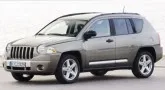
Jeep Compass. Price: ? 24,900. On sale: since October 2006.
It's hard to find another car brand that so precisely meets the expectations of its buyers. Commander, Cherokee, Liberty, and Wrangler seem made for tough guys in cowboy hats. However, Jeep has now decided to deviate from this tradition and introduced a model that stands out from the crowd. We're talking about the Compass.
2006 Jeep Compass
The Compass is a direct challenge to the Japanese hits Honda CR-V and Toyota RAV4, which have firmly won the affections of the fairer half of humanity. The American manufacturer is brashly breaking into the promising class of compact soft-roaders. Such cars, commonly called crossovers, are perfect for big city conditions where there's no serious off-roading, but plenty of ice, broken asphalt, and high curbs. A 20-centimeter ground clearance comes in handy here, which, along with a high seating position, adds confidence on poorly lit streets in residential areas.
2006 Jeep Compass
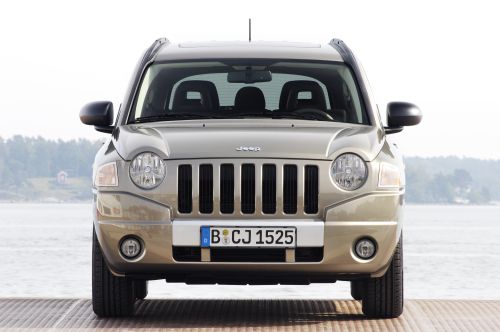
The Compass's exterior unmistakably reveals its belonging to the brutal family of American SUVs. If you look at it in the rearview mirror from another car, you might not notice the difference from the older models—they're true twins. The recognizable brand style is evident in the round headlights and the radiator grille with seven slots, making the car resemble a toothy but harmless little animal. The trapezoidal wheel arches were also inherited from its ancestors. But the silhouette with a revised windshield rake and expressive hood is completely new. The side profile boasts muscular fenders that visually enlarge the car. In reality, the Compass is the smallest Jeep after the legendary Wrangler. At 4405 mm in length, 1810 mm in width, and 1630 mm in height (CR-V: 4360x1780x1710, RAV4: 4245x1785x1695), the American is longer and wider than its rivals.
2006 Jeep Compass
Two exterior styling options are available for the new model. The first involves installing two additional lights positioned at the bottom of the radiator grille. Each light source is protected by a black plastic housing. The second option, called Rally, includes not only the lights but also bumper trim, side sills, moldings, and a rear spoiler. Naturally, this version doesn't skimp on 18-inch wheels (17-inch rims are standard) and a chrome exhaust tip.
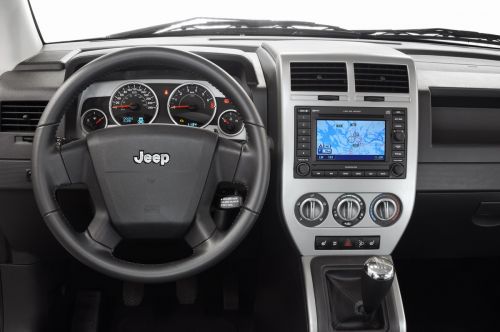
Inside, the little Jeep looks rather austere. Unfortunately, the dashboard and handles are made of cheap plastic reminiscent of parts from a children's construction set. Against this backdrop, the solid and comfortable steering wheel stands out, as do the perfectly readable dials for the speedometer, odometer, engine temperature, and fuel level gauges. In the dark, their backlighting pleasantly glows white, without irritating the eyes.
2006 Jeep Compass
Because of this "toy-like" feel, the interior deserves a solid B-minus, although some might actually like this style. But there's no accounting for taste, and it's safe to say that young people will appreciate Jeep's original touches. Take the Boston Acoustics sound system with speakers mounted on the tailgate door! When the trunk is open, they can be turned in any direction, directing the sound wherever needed. A real gift for street dancers.
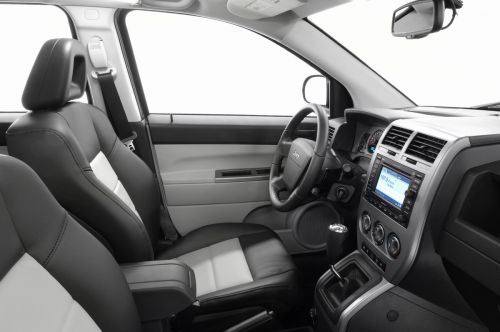
And that's not all. The center armrest can be slid forward by 76 mm, making life easier for shorter drivers. And its lid has a built-in tray for a mobile phone or player. The folding front passenger seat magically transforms into a table. The fabric covering the seats hardly gets dirty and doesn't absorb unpleasant odors. Upon learning this, my friend and test colleague Nikolai settled comfortably into the seat and lit a cigarette. The piquancy of the situation is that smoking in test cars is strictly forbidden. "Relax! No one will know," he confidently declared. And he wasn't wrong: the foreign smell never gave away the offender.
Jeep Compass
On the highway, the gasoline version with a 2.4-liter engine producing 170 hp behaves as a crossover should—admirably. If you close your eyes and momentarily forget which car you're in, you'd likely imagine some midsize sedan. It's only betrayed by the strained roar of the engine during dynamic acceleration. Acceleration from 0 to 100 km/h takes 10.7 seconds. With the automatic transmission, it's 0.6 seconds more. Admit it, that's a small price to pay for not having to work your left foot. The top speed is also nearly identical: 185 km/h with the manual 5-speed gearbox and 183 km/h with the automatic. Skeptics will, of course, say there's nothing outstanding in these figures. Agreed. But for a city car, such indicators are quite sufficient. At least, the Japanese competitors deliver roughly the same results.
I'd also like to note the large black side mirrors that provide the driver with excellent visibility. They say their design was specially tested in a wind tunnel.
The second test subject was the diesel Compass, which should arrive here next year. And it's not just any diesel, but a 2-liter 16-valve turbodiesel producing 140 hp, manufactured by Volkswagen. Indeed, why reinvent the wheel if someone has already done it? This engine works in tandem with a 6-speed gearbox. No automatic is available here.
Jeep Compass
Regardless of the engine, the Compass is genuinely good on narrow city streets where maneuverability matters. On high-speed highways, we confidently give the newcomer a B.
Now we move to the most fun part of the testing—off-road. Of course, as we've already said, the Compass can't be considered a full-fledged off-roader. The car was built for the city, and expecting more from it is pointless. However, genes are genes, and the vehicle is capable of some feats. Our test subject is prepared for driving on surfaces with a low coefficient of friction, thanks to the Freedom Drive I all-wheel-drive system with a locking center differential. In Lock mode, up to sixty percent of torque is sent to the rear axle. In practice, this means no problems on shallow snow or hard dirt roads. But driving into the forest in December for a Christmas tree isn't wise—you risk celebrating New Year right at the forest edge. Nevertheless, its off-road capability in urban conditions is more than sufficient. And if real off-roading is needed, the cowboy on his larger iron horse will come to the rescue.
Now about prices. The base trim with the 2.4-liter engine and 5-speed manual will cost 24,900 euros. The fully loaded version with the CVT costs 28,700 euros.
INNOVATION
If the party runs late, a detachable ceiling lamp with a self-charging battery will come in handy. It's built into the headliner. This lamp can be used as a portable flashlight. When the lamp is in its standard place, it serves as interior lighting.
Jeep Compass
Driving
Excellent handling and maneuverability are combined with decent dynamic performance.
Interior
Dashboard elements are made of cheap plastic.
Comfort
There's enough room up front for both driver and passenger. But in the back, two large men will feel a bit cramped.
Safety
Window airbags are standard equipment. The use of high-strength steel has reduced weight and increased body rigidity.
Price
Competitive pricing for compact SUVs. The minimum price for the new model is ? 24,900. An electric sunroof will cost an extra ? 809, alloy wheels ? 578, and metallic paint ? 462. The music system with GPS navigation is pricey at ? 2,543.
Jeep Compass Specifications
Dimensions: 4405/1810/1630 mm
Engine: gasoline, V6, 2359 cc, 170 hp/6000 rpm
Transmission: automatic, 5-speed
Performance: 185 km/h; 10.7 s to 100 km/h
Competitors: Honda CR-V, Mitsubishi Outlander, Toyota RAV4
Pros and Cons
+ Good maneuverability, extensive list of optional equipment.
– Acoustic discomfort during dynamic acceleration.
Our Verdict
There's a certain logic to the Compass's appearance. If Jeep makes SUVs for cowboys, then true conquerors of the prairies must have sweethearts who no longer travel in slow stagecoaches. Modern ladies need cooler transport, like a small and quite attractive Jeep with plush toys on the rear seat.
September 18, 2006
Author: Stanislav Pavlov
© 5 Koleso