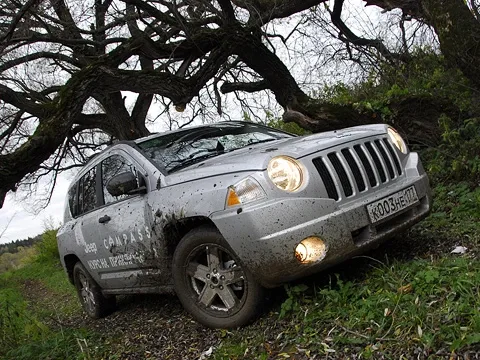
Even by its name alone, Jeep Compass makes it clear that this car is hardly suitable for a city driver. And it doesn't matter that this is the first crossover in the brand's history. In essence, it's no longer an SUV, but an "all-road vehicle" — no frame, no low-range gearing, no differential locks. But no matter how much you smooth it over, it's still a Jeep.
As for the appearance... I won't describe it in detail, but I'll say this. When Liberty (aka the latest-generation Cherokee) was first shown, I thought it was outright ugly. But over time, I changed my mind. Really, is it that bad? Let city passersby grimace in surprise and mild disgust, but who else can scare off wild animals so effectively just by their looks?
Or maybe Compass is a case of "ugly on the outside, kind on the inside"? Not at all! Inside, it's the same rough rural simplicity as in the Caliber (which, to put it mildly, is not a benchmark for interior finish), but without those interesting solutions that were implemented in it. Hard plastic, poor seating position... I would have liked the back row more — there's plenty of space, and the backrests can be adjusted for angle.
The first part of the route is a highway. So, we'll test the car's "adventurous" nature later, but for now — city conditions. The chassis is indeed not bad: the Compass holds a straight line confidently and handles corners decently. But the empty steering wheel ruins everything — you constantly have to correct both on straights and in bends. And acceleration... Have you ever ridden a vacuum cleaner? I haven't, but I think it looks something like that. You floor the gas, the CVT first thinks, then revs rise to six thousand, the torque converter locks up and... that's where the vacuum cleaner simulator begins. A monotonous and intrusive engine hum, absolutely even acceleration, and not even the most intense — you expect more from the 171-horsepower 2.4-liter engine. In manual mode it's a bit better, the "vacuum cleaner effect" disappears, but still without much drive. Oh, why weren't we given earplugs — even a good audio system and sound insulation don't save you from the engine sound.
Preliminary conclusions after the first kilometers: the car is ugly, the interior is terrible, and it behaves badly at speed. And there are still many kilometers of the test route ahead.
That's it, enough! We turn off the asphalt — we have nothing to do there. But off-road is already interesting! Judge for yourself. First, the ugly design will be hidden under a layer of mud. Second, since Jeep couldn't shine on the highway, we need to test it in its native element. The main thing is to get out of it afterward.
And here's the off-road section! There are no real swamps here, but the mud is decent. At least, most of those "modern city dwellers" in their crossovers wouldn't even venture here. And I wouldn't go without need, even in a Compass. But — I have to.
The Jeep Compass is built on the Dodge Caliber platform... Although, to be precise, it's the other way around: Dodge was created on the basis of Jeep, even though it came out earlier. But that doesn't change the essence: both cars have a unibody body with an "integrated frame" (a similar solution is now used by Land Rover) and independent suspension on all wheels. In normal conditions, the Compass is almost front-wheel drive — about 10% of torque is sent to the rear axle. When the front wheels slip, the clutch transfers more traction to the rear — one revolution of the driveshaft is enough. Not very Jeep-like. But the clutch can send torque rearward not only after slipping, but also in advance, with a sharp press on the gas. And you can even lock it completely (although this is more of an electronic, not a hard lock). And the ABS here is specially tuned for off-road — it engages later than on regular cars. And any crossover would envy that.
And here in front of me is some serious mud. Braking on it with regular tires is like on ice. And it gets deeper and deeper. Oh damn! Okay, it's too late to retreat, we have to go. We add some gas. We crawl. True, on such a surface the car becomes almost uncontrollable, but that's not a problem — we set a rough direction, and the Compass crawls surprisingly confidently.
But the "test" mud prepared by the organizers seemed too little for us, and we made a couple more "unauthorized" (and quite lyrical) exits from the asphalt. On a broken dirt road, the Jeep also feels great. I don't even know how you need to drive to break its suspension. My colleagues managed to do it, but they refused to share the "secret of success." And the geometric off-road capability is good: we never caught the bumpers. And how we jumped!
I was driving at a decent speed — the road seemed to allow it. And then ahead — a pothole. I brake, but it's useless: braking on such mud is like on ice. Well, nothing to do, we'll overcome it on the move. I press the gas, preparing for a loud "bang-bang!". But instead I hear "thud!". No, it's not the suspension bottoming out or the bumper tearing off — it's me hitting my head on the pillar. Very painful, by the way! But the Jeep, it seems, doesn't care about these potholes at all. At least, your head will get bumps faster than you'll break its suspension.
With a feeling of deep satisfaction and a desire to make it even deeper, we crawl back onto the asphalt. Of course, the Jeep hasn't gotten better to drive, but it looks more impressive now — all covered in mud from head to toe. I think if you bought this car, you can safely save on car washes, but take "mud baths" more often — mud suits it very well. We were even stopped by a traffic cop who, under the pretext of checking documents, started asking about the car: "So, how does it go?" — "Can't you see for yourself?"
So the Jeep Compass is not a "crossover" at all. While you're driving on a normal road — it's terrible. But when the road becomes terrible — it's normal. It's a light SUV for those who often drive on moderately rough terrain and who don't need the size (as well as the gluttony and price) of big Jeeps. In the base trim, the Compass costs 26 thousand euros — almost like its competitors, to which Jeep loses in almost everything except off-road capability.
Is the plastic in the cabin hard? It'll be easier to wash! And you'll have to do it often if you drive the Compass the way we did. Uncomfortable seating position? What difference does it make on such a road! Noisy engine? No time for that! Design? I won't even say anything... But how often do those notorious "modern city dwellers" storm anything more serious than parking curbs in their crossovers? For them, the word "compass" is just a model name.
Jeep Patriot: not just an "American" in the city
At first glance, the "Patriot" seems like a typical representative of the American school: brutal, angular, with square shapes. But is it really that simple? I managed to spend several days behind the wheel of this SUV, and I'm ready to share my impressions.
Let me note right away: the price of the test car was 26,600 euros. For this money, you get a car with a 2.4-liter gasoline engine producing 170 horsepower. The unit is inline, four-cylinder, with 16 valves and a DOHC system. Torque is 220 Nm at 4,500 rpm. The engine works in conjunction with a continuously variable transmission CVT II.
Honestly, the dynamics are not impressive. Acceleration to 100 km/h takes 11.3 seconds, top speed is 185 km/h. This is not the case where the gas pedal presses you into the seat. But it's not turtle-paced either — the engine is quite sufficient for everyday tasks. But fuel consumption makes you think: in the city, the appetite is 11.5 liters per 100 km, on the highway — 8.3, in the combined cycle — 9.5. For a car of this class, the figures are average, although the 51.5-liter tank allows you to travel about 836 kilometers without refueling.
Off-road — home sweet home
The interior of the "Patriot" is a classic of the genre. Spacious, functional, but without frills. There's a lot of space inside: two adults will fit comfortably in the second row, with almost a meter of legroom. The trunk volume of 436 liters increases to 1,277 liters with the seats folded, allowing you to transport large items. The plastic is hard everywhere, the assembly is neat, but without "European" gloss. However, for a utilitarian SUV, this is rather a plus: you won't mind scratching the panels during active use.
The Patriot's suspension is independent MacPherson struts in front and a multi-link in the rear. On asphalt, the car behaves confidently, but on bumps, some stiffness is felt. But off-road, the car really opens up. The ground clearance of 200 millimeters, approach and departure angles of 21 and 32 degrees, respectively, allow you to confidently tackle obstacles. The car can ford water up to 279 millimeters deep. For comparison: many "crossovers" lack such figures.
The steering with hydraulic power assist is precise, with a gear ratio of 16.4:1. In parking lots, the wheel turns easily; at speed, it fills with pleasant heaviness. The brakes are disc all around, ventilated in front, 294 mm. Deceleration is confident, although the CVT sometimes adds specific sensations during sharp maneuvers.
As for equipment, the test car had everything necessary: dual-zone climate control, cruise control, heated front seats, electric mirror adjustment, a CD player with four speakers, and even a compass. Safety is ensured by airbags — front, side, and curtain, as well as ABS and ESP systems. A small but nice touch: there's a removable flashlight in the cabin that can be used outside the car.
Conclusion
The Jeep Patriot is a car with character. It doesn't try to be a universal vehicle: in the city, it's a bit rough, fuel consumption isn't pleasing, and dynamics aren't its strong point. But if your plans include regular trips into nature, off-roading, or just driving on broken roads, this "American" will show its best side. For 26,600 euros, you get an honest, capable, and spacious car that you won't be ashamed to park in the garage next to more expensive "classmates."