
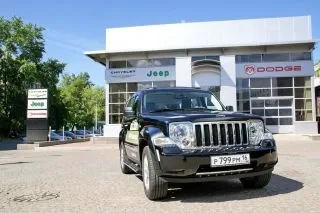
 Engine — 2.8 L diesel
Max power -
177 hp/3800 rpm
Max torque - 460 Nm/2000 rpm
Max speed (km/h) — 179
Acceleration 0-100 km/h — 10.5 sec
Fuel consumption:
combined - 9.0
city — 11.7
highway - 7.5
5-speed automatic
permanent all-wheel drive system with 4 transfer case modes (2WD, 4WD Auto, 4WD Low, neutral) electronic clutch.
Curb weight - 1985 kg
Length - 4493
Width - 1839
Height - 1736
Ground clearance - 189 mm
Tires 235\65R18
max trailer weight with brakes 2800 kg.
without brakes 750 kg.
Equipment:
door locks with automatic locking at 20 km/h, Sentry Key immobilizer, 4 airbags, alarm, 4 electric windows, electric mirrors + folding, climate control, AM/FM radio + CD(MP3) 6-disc/DVD + 8 speakers + subwoofer, leather interior, ABS, Brake Assist, ESP, hill descent control, hill start assist, traction control, light sensor, parking sensors, tire pressure monitoring, cruise control, heated front seats, auto start control system, electric seat, alloy wheels, fog lights, panoramic roof for 2 rows of seats.
Price $46,000
Service interval:
10,000 km
Service 1 — 6000 -$304 (2,430 UAH)
Service 2 - 6000 -$304 (2,430 UAH)
Service 3 - 6000 -$304 (2,430 UAH)
Service 4 - 6000 -$304 (2,430 UAH)
Service 5 - 6000 -$304 (2,430 UAH)
Service 6 —$372 (2,970 UAH)
Warranty - 2 years without mileage limit

Alfred Mardanov, «Autoclub-Kazan».
Probably, you won't find a person who doesn't know the legendary brand JEEP. This brand gave its name to a whole class of high-cross-country vehicles — SUVs. And the most famous representative of the family is, of course, the Cherokee. I remember the wild nineties, when the owner of a "wide" one was automatically considered part of some elite, and was supposed to be respected, and to be honest — even feared. That car was famous for its chopped body panels, angular exterior, hard plastic, and a large powerful engine — these were the constant features of the Cherokee. And here's what's especially pleasing: the current Cherokee has absorbed all the best. First of all, it's the appearance. It has abandoned the playful roundness of the headlights, taillights, and the body itself, and has become — or rather, returned to what was before and what befits a serious off-roader — to square, more brutal lines. Effeminate contours are no longer in fashion for such cars, and our Cherokee is a vivid confirmation of that. It is well-tailored, it exudes a sense of power and stubbornness. I can't ignore what the manufacturer is especially proud of — geometric cross-country capability. The approach and departure angles are 30 and 38 degrees respectively — an excellent indicator for a car of this class, and many modern civilian cars can't boast such figures. Another definite plus is the diesel engine. The peak torque of 460 Nm, available already at 2000 rpm, speaks for itself. It pulls great from the bottom, confidently overcomes muddy, loose, snowy, and soft areas without the risk of slipping, and should also climb hills calmly and, probably, handle towing trailers up to 2800 kg perfectly! Simply put, it's made for conditions where brute force is needed. Two engines are provided for this car, at least those officially supplied to Russia. 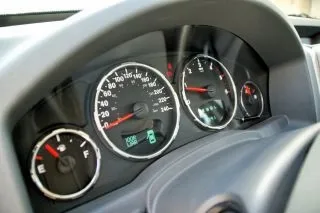
 The four-cylinder 2.8 L turbodiesel with piezo injectors — this is what's in our test vehicle — and a gasoline V6 3.7 L, producing 314 Nm at 4000 rpm. According to the specs, the diesel accelerates 0.2 seconds faster, and its torque is "lower," which is preferable for an SUV. Moreover, the diesel version has a 5-speed automatic, while the gasoline one is content with four gears. The car itself has become lighter, reliable winter starting is promised thanks to the electronic turbocharger drive, and the timing belt replacement interval has been increased to an incredible 140,000 km. So, the diesel version is more interesting. But it's a matter of taste, and the final choice is up to the buyer. One must dwell in detail on the proprietary Selec-Trac II system. Remember the stiff levers for engaging "low range" on old Jeeps? That's history now. Here — it's a regular switch for selecting transmission modes. The system combines the advantages of permanent all-wheel drive with a locking center differential, "low range," and simple rear-wheel drive. True, the role of the center differential is played by a multi-disc clutch with electronic control. Additionally, the rear axle has a BLD (Braking Lock Differential) system that simulates the operation of a self-locking differential and activates in 4WD Lock mode. As a result, torque between the axles is distributed forcibly. The 2WD mode, I think, is clear: the car is rear-wheel drive, ideal for asphalt and city — economical and dynamic. The 4WD Auto mode — torque to the front and rear axles is divided in a 42:58 ratio, but can change automatically depending on road conditions; it's great for winter roads and light off-road.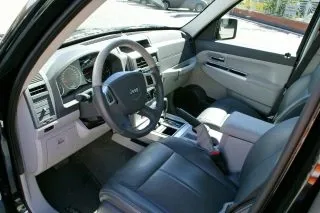
 The transmission is ready for any type of road and their complete absence across the vast expanses of our Motherland. Looking ahead, I'll say: near the transmission mode switch there's a letter N, meaning a mandatory transition through "neutral," and since this warning is poorly visible from the driver's seat, certain mishaps during switching are guaranteed. Apparently, previous test-drive participants neglected this rule, and when starting the engine, an incomprehensible and unpleasant jolt occurs in the automatic transmission. Perhaps this is a feature of the car itself, or perhaps it's already a transmission defect.
The four-cylinder 2.8 L turbodiesel with piezo injectors — this is what's in our test vehicle — and a gasoline V6 3.7 L, producing 314 Nm at 4000 rpm. According to the specs, the diesel accelerates 0.2 seconds faster, and its torque is "lower," which is preferable for an SUV. Moreover, the diesel version has a 5-speed automatic, while the gasoline one is content with four gears. The car itself has become lighter, reliable winter starting is promised thanks to the electronic turbocharger drive, and the timing belt replacement interval has been increased to an incredible 140,000 km. So, the diesel version is more interesting. But it's a matter of taste, and the final choice is up to the buyer. One must dwell in detail on the proprietary Selec-Trac II system. Remember the stiff levers for engaging "low range" on old Jeeps? That's history now. Here — it's a regular switch for selecting transmission modes. The system combines the advantages of permanent all-wheel drive with a locking center differential, "low range," and simple rear-wheel drive. True, the role of the center differential is played by a multi-disc clutch with electronic control. Additionally, the rear axle has a BLD (Braking Lock Differential) system that simulates the operation of a self-locking differential and activates in 4WD Lock mode. As a result, torque between the axles is distributed forcibly. The 2WD mode, I think, is clear: the car is rear-wheel drive, ideal for asphalt and city — economical and dynamic. The 4WD Auto mode — torque to the front and rear axles is divided in a 42:58 ratio, but can change automatically depending on road conditions; it's great for winter roads and light off-road. The transmission is ready for any type of road and their complete absence across the vast expanses of our Motherland. Looking ahead, I'll say: near the transmission mode switch there's a letter N, meaning a mandatory transition through "neutral," and since this warning is poorly visible from the driver's seat, certain mishaps during switching are guaranteed. Apparently, previous test-drive participants neglected this rule, and when starting the engine, an incomprehensible and unpleasant jolt occurs in the automatic transmission. Perhaps this is a feature of the car itself, or perhaps it's already a transmission defect.This time I had to go for the car alone. As usual, I drove up to the dealer center, and — lo and behold! — the Cherokee was already standing under the canopy, washed and already dried. Usually you have to wait, but here everything fell into place. A couple of minutes for paperwork — and the keys are already in my hands. First thing, I rolled it out from under the canopy and looked it over again with great pleasure. I can't help it — I like such chopped, brutal shapes. Before, I had only seen it in photos, and I'll be honest: in person it looks better. At least on the outside. But the interior remained true to the 100% American Jeep traditions. 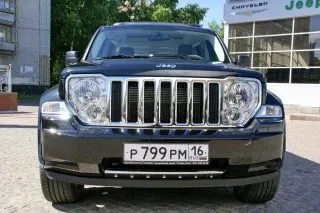
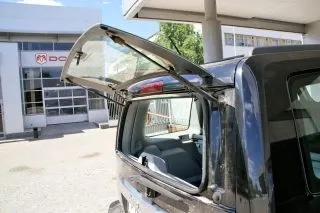
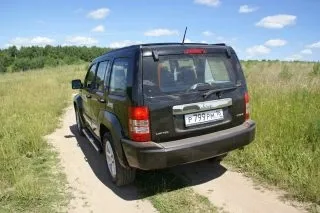 The plastic is hard, but credit where due — the gaps are fitted evenly, and during the entire test I don't recall a single squeak, even though we did diagonal articulation. Another pleasant surprise is the fabric folding roof that retracts entirely. You lower the windows — and you get practically a convertible. That's what I did: turned the car into a convertible and went to pick up Marat. Around — blue sky, sun, a light breeze, and you don't even need to turn on the climate control. Moreover, you sit high, as befits a Jeep, so the exhaust fumes from Kamaz trucks remain somewhere below and don't spoil the mood at all. On the move, the car didn't disappoint and showed a lively character. The engine eagerly picks up from the bottom and confidently accelerates the car, and the automatic gearbox shifts smoothly and without delays. I have no complaints about the engine and automatic transmission. But I do have complaints about the seat. I just can't get comfortable — that's all. The backrest, oddly enough, is adjusted manually, while all other adjustments are electric. It would be fine if it were just manual — but the adjustment step is too large, and I never found a suitable position. Plus, the seat cushion seemed a bit short to me. Otherwise, at first glance, everything is great. Hey! Look at that — on the instrument panel, which, by the way, is almost identical to the Compass or Liberty, an indicator for the low beam headlights has finally appeared. Those models didn't have it, and it annoyed me. On asphalt, the car behaves more comfortably than nervously: the long-travel suspension absorbs small bumps well, which are abundant on our roads, but on large potholes it doesn't have time to react and works harshly. However, body roll is not characteristic of it, and I even regretted that we didn't take it to the test site to try the slalom and lane change. I think it would have surprised us. Just as it surprised us off-road. At the spot where we usually do diagonal articulation, cars drive in with acceleration, but the Cherokee simply climbed calmly, without unnecessary fuss and dust. During the exercise, one wheel lifted off the ground and lost traction, but it still confidently overcame the obstacle. There it is — an excellent combination of a torquey diesel, automatic transmission, and the Selec-Trac II system. To sum up, I'll say: the car was more liked than not. Despite the careless attitude to trim materials and the outdated instrument panel, it's an excellent performer. There's something about it that inspires confidence and excitement.
The plastic is hard, but credit where due — the gaps are fitted evenly, and during the entire test I don't recall a single squeak, even though we did diagonal articulation. Another pleasant surprise is the fabric folding roof that retracts entirely. You lower the windows — and you get practically a convertible. That's what I did: turned the car into a convertible and went to pick up Marat. Around — blue sky, sun, a light breeze, and you don't even need to turn on the climate control. Moreover, you sit high, as befits a Jeep, so the exhaust fumes from Kamaz trucks remain somewhere below and don't spoil the mood at all. On the move, the car didn't disappoint and showed a lively character. The engine eagerly picks up from the bottom and confidently accelerates the car, and the automatic gearbox shifts smoothly and without delays. I have no complaints about the engine and automatic transmission. But I do have complaints about the seat. I just can't get comfortable — that's all. The backrest, oddly enough, is adjusted manually, while all other adjustments are electric. It would be fine if it were just manual — but the adjustment step is too large, and I never found a suitable position. Plus, the seat cushion seemed a bit short to me. Otherwise, at first glance, everything is great. Hey! Look at that — on the instrument panel, which, by the way, is almost identical to the Compass or Liberty, an indicator for the low beam headlights has finally appeared. Those models didn't have it, and it annoyed me. On asphalt, the car behaves more comfortably than nervously: the long-travel suspension absorbs small bumps well, which are abundant on our roads, but on large potholes it doesn't have time to react and works harshly. However, body roll is not characteristic of it, and I even regretted that we didn't take it to the test site to try the slalom and lane change. I think it would have surprised us. Just as it surprised us off-road. At the spot where we usually do diagonal articulation, cars drive in with acceleration, but the Cherokee simply climbed calmly, without unnecessary fuss and dust. During the exercise, one wheel lifted off the ground and lost traction, but it still confidently overcame the obstacle. There it is — an excellent combination of a torquey diesel, automatic transmission, and the Selec-Trac II system. To sum up, I'll say: the car was more liked than not. Despite the careless attitude to trim materials and the outdated instrument panel, it's an excellent performer. There's something about it that inspires confidence and excitement.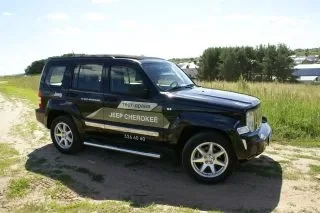
 Marat Makhmutov
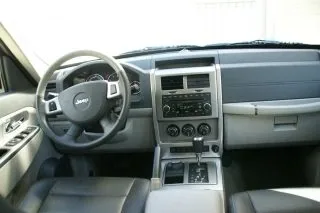
Not long ago I participated in a familiarization event for Jeep vehicles organized by the official dealer, and I didn't get a chance to try the Cherokee back then. I mastered the Grand Cherokee, the Dodge Caliber became almost like family, but I simply didn't have enough time for the plain "Indian" — the program was too packed. This time I intended to make up for lost time and calmly assess the car's strengths, while also noting its weak points if any. The new generation of the "Grand's" younger brother came out in 2008 and became brutally square again, unlike the previous, more "metrosexual" generation, which, in my opinion, only benefited the Cherokee. The seven vertical chrome slots on the radiator grille remained unchanged. Continuity of generations! This styling is much closer to the brand's spirit and again attracts the male audience that doesn't accept playfulness in the appearance of serious SUVs. Many manufacturers of "cars for real men" have recently been returning to deliberate angularity — take, for example, the Nissan Pathfinder, Honda Pilot, or the new GLK from Mercedes, which became a worthy successor to the legendary "Geländewagen." The front of the new model strongly resembles the flagship Jeep Commander, which also adds points to the "Indian," since it sits two steps lower in the class hierarchy. The squareness is also evident inside: the strict straight lines of the dashboard, air vent deflectors, the shape of the armrest and the stereo — everything is done in the same spirit. The cabin dimensions compared to the predecessor have hardly changed, as has the quality of the plastic — it's just as hard both in appearance and to the touch. A typical American. However, the build quality is at a very decent level: all parts are fitted evenly, and there wasn't a single sound while driving on roads with any surface. The chrome round instrument dials look nice, and the speedometer has dual calibration — both in kilometers per hour and miles. I also liked the climate control unit: a convenient and intuitive layout with round knobs. A row of rectangular buttons lined up under the climate system indicates the good equipment of the 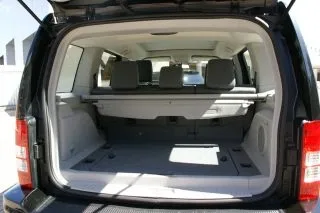
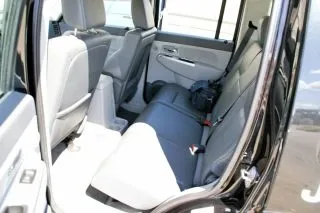
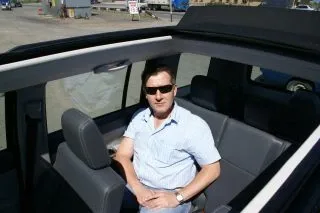
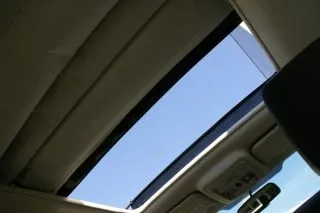
 Cherokee with various auxiliary electronic systems, including hill start and descent assist and rear parking sensors. The rearview mirror has auto-dimming, and there are rain and light sensors. The equipment also includes power-adjustable front seats, whose cushion is a bit short for long trips. I settled into the driver's seat without much trouble, but Alfred couldn't find a comfortable backrest angle. Getting into the rear seats is hampered by the door opening that narrows downward — when entering and exiting, you inevitably either hit the B-pillar with your foot or twist your foot in an unnatural way. The most noticeable feature of the sybaritic surroundings was the huge, two-row sliding sunroof Sky Slider — made of waterproof and vandal-resistant fabric covering, with a clever drive that instantly stops it if an obstacle appears in its path. Our test drive took place on a sunny and hot day, so such a sunroof came in handy: you can enjoy fresh air and sun without cursing the stuffiness inside the metal vehicle, especially since it's painted black. This communion with nature is especially felt on the highway and at some point reminded me of a safari tour. Indeed: the sunroof's size allows you to stand at full height in the back (the wide tunnel interferes in the front) and survey the surroundings without fear of being attacked by some predator like a lion. However, such a sunroof can also be seen as a convenient firing position for an African safari.
Cherokee with various auxiliary electronic systems, including hill start and descent assist and rear parking sensors. The rearview mirror has auto-dimming, and there are rain and light sensors. The equipment also includes power-adjustable front seats, whose cushion is a bit short for long trips. I settled into the driver's seat without much trouble, but Alfred couldn't find a comfortable backrest angle. Getting into the rear seats is hampered by the door opening that narrows downward — when entering and exiting, you inevitably either hit the B-pillar with your foot or twist your foot in an unnatural way. The most noticeable feature of the sybaritic surroundings was the huge, two-row sliding sunroof Sky Slider — made of waterproof and vandal-resistant fabric covering, with a clever drive that instantly stops it if an obstacle appears in its path. Our test drive took place on a sunny and hot day, so such a sunroof came in handy: you can enjoy fresh air and sun without cursing the stuffiness inside the metal vehicle, especially since it's painted black. This communion with nature is especially felt on the highway and at some point reminded me of a safari tour. Indeed: the sunroof's size allows you to stand at full height in the back (the wide tunnel interferes in the front) and survey the surroundings without fear of being attacked by some predator like a lion. However, such a sunroof can also be seen as a convenient firing position for an African safari.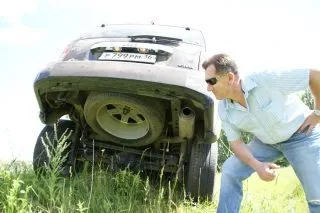
 For the test, we got an "Indian" with a four-cylinder diesel engine of 2.8 liters, producing 177 horsepower, paired with a five-speed automatic. Personally, I think this is an ideal combination for an SUV — a diesel with an automatic transmission allows you to finely dose the traction when the road becomes truly challenging. But we'll get back to that; for now, on the way to the place where we'll face if not real off-road, then something very close to it, let's assess how the car behaves on asphalt — handling, dynamics, and other "asphalt" parameters.
The car starts briskly and confidently, though calling this acceleration hurricane-like doesn't quite fit. The combination of the five-speed gearbox and the diesel's enormous torque of 400 Nm, available almost from the very bottom, allows the all-wheel-drive vehicle to accelerate up to 60 km/h even faster than the more powerful gasoline version with the 3.7-liter engine. Plus, the diesel version has a more favorable weight distribution across the axles than the gasoline one. Given the diesel engine's inherent efficiency, it's no surprise that the company's marketers made it their main focus.
On minor road imperfections, the car feels a bit stiff, but on sharp turns it doesn't lean — this instills confidence that you won't tip over this sizable vehicle with a high center of gravity. However, on a "washboard" road at 120 km/h, the Cherokee required constant steering corrections and instinctively easing off the throttle: the rather light steering wheel didn't allow for precise tracking of the intended trajectory. On smooth surfaces, the car goes easily and calmly, overtaking slow trucks and smoky lorries almost effortlessly. Above a hundred kilometers per hour, aerodynamic noise becomes audible and increases with speed — its source is that very huge panoramic sunroof that I liked so much, and this is despite it being closed. Rear visibility through the large mirrors is excellent — just what a Jeep needs.
We reached the off-road testing site via a road that was a continuous proving ground of potholes and 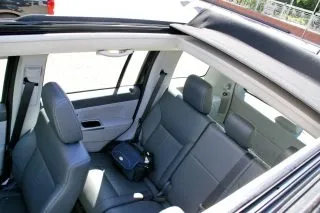
 large craters. It was here that the Cherokee demonstrated what it was created for. Softly and comfortably overcoming large bumps — that's its true calling. True, against this backdrop, a small flaw emerged: the horizontally positioned handle for the front passenger. Holding onto it during shaking on uneven roads is extremely inconvenient. It's only appropriate when tackling steep ascents and descents. In our conditions, a handle above the door or on the A-pillar would have been much more logical.
large craters. It was here that the Cherokee demonstrated what it was created for. Softly and comfortably overcoming large bumps — that's its true calling. True, against this backdrop, a small flaw emerged: the horizontally positioned handle for the front passenger. Holding onto it during shaking on uneven roads is extremely inconvenient. It's only appropriate when tackling steep ascents and descents. In our conditions, a handle above the door or on the A-pillar would have been much more logical.Having reached the main goal, we check geometric off-road capability. Mud exercises weren't part of our program — there simply was no mud, so we limited ourselves to testing how the Jeep climbs slopes of varying steepness and descends them. The combination of the Selec Track all-wheel-drive transmission and excellent energy capacity allows the car to perform real miracles even on hard off-road: the vehicle goes almost anywhere you point it — whether it's a steep hill or a deep grass-covered rut. And what's especially important, the electronic assistants work flawlessly both on descents and ascents. Moreover, unlike similar systems from other manufacturers, on the Jeep, pressing the brake or gas pedal during a descent doesn't disable the electronics — it re-engages as soon as the driver stops interfering with the controls.
Separately, I was amazed at how the "Indian" effortlessly, in reverse, climbs our favorite spot for diagonal articulation. And honestly, I can't recall any other production car doing it so calmly and high. It was amusing, standing at the top of the hill, examining the rear suspension design of the Cherokee, which had just driven up with truly noble dignity. For me, getting out of the car in that position turned out to be much harder than it was for it to drive up there.
And that's how this car turned out: modern, recognizable, fast, and, most importantly, truly off-road capable. And aren't these the qualities that every self-respecting JEEP should possess?