
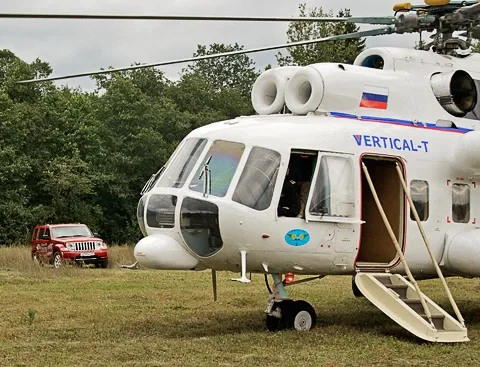
"Maybach!" — that's exactly what crossed my mind when, after fiddling with the power adjustments, I settled into the driver's seat of the Cherokee. The organizers' clever move worked: after the helicopter, this most ordinary Jeep seems the height of luxury. Even despite the hard, sometimes "cheap" plastic and the chopped interior, as if hewn with an axe. The steering column adjusts only by height — that's a drawback, of course. But the leather seat has an excellent profile, the steering wheel is also leather-wrapped, the instruments are easy to read, and overall the driver's workplace can be called successful. Well, shall we go?
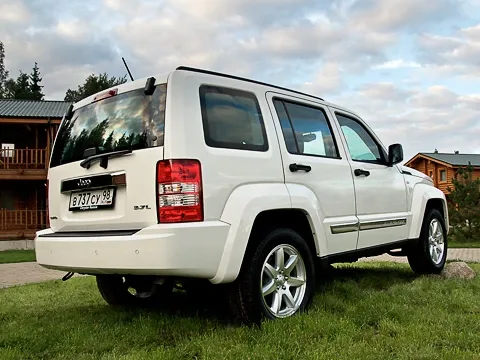
Not yet. There's a passenger with me in the cabin, and he can't stop admiring the massive white handle. No, not his own — but the one on the dashboard. In anticipation of a trip through real Russian off-road in a real American SUV, it's at least reassuring. And what about the second row? Good thing there are only two of us. Rear passengers would have to squeeze in. At 183 cm tall, I sit "behind myself" without much trouble, but a taller person would sit in a fetal position, knees pressed against the front seatback. Although Jeep doesn't claim to be a family minivan. It's made for places where there are no fellow travelers.
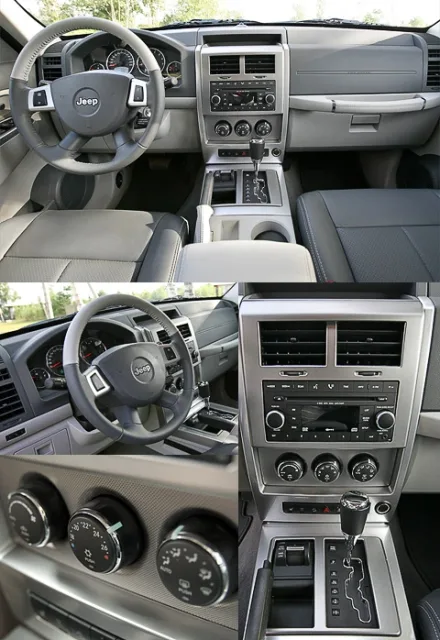
- Ergonomics are in perfect order: all buttons are in place, your hand doesn't search for the needed switch. The instruments don't strain your eyes.
- A navigation system with a 20 GB hard drive is promised. It's already installed, but without Russian maps — they'll be delivered later.
- The standard Infinity audio sounds great. Instead of a CD/DVD player, you can connect your own iPod.
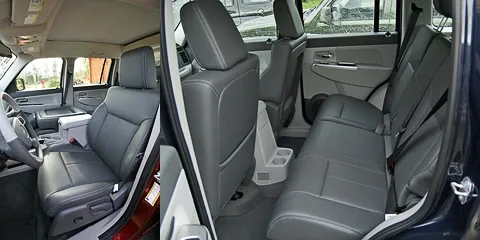
- The seats are comfortable, but in corners there's a lack of lateral support.
- The rear seatbacks adjust their angle, but it doesn't help rear passengers much behind tall front occupants.
Jeep's entire brand image is currently built on an off-road persona. The reputation of a mud-fighter is firmly attached to the American brand and has even become a common noun. But times change, and now Jeep is not about mud — the main thing is to survive. The saddest part is that in the struggle for survival, it's the brand's core values that suffer! In the pursuit of profit, they try to push on us the Compass and Liberty crossovers, which are completely helpless off the asphalt. And a crossover with a Jeep badge is like "Gazprom" soda. You can seriously discuss that only after a couple of bottles of beer. The Commander has one foot in the grave, so the only real Jeeps left are the Wrangler and Grand Cherokee. And what about the plain Cherokee?
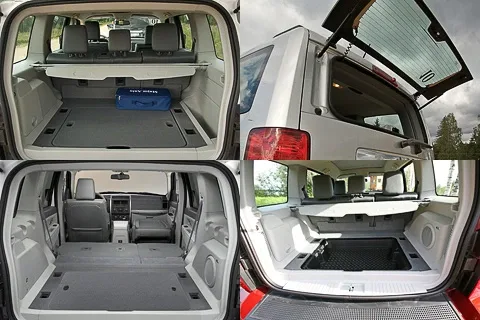
- The trunk is 419 liters, and with the rear row folded, it becomes 1404 liters. I wonder if the volume from the folded front passenger seatback is counted? There's also a waterproof tray for dirty things. Probably for diapers.
- The rear door glass opens separately, which is convenient for loading.
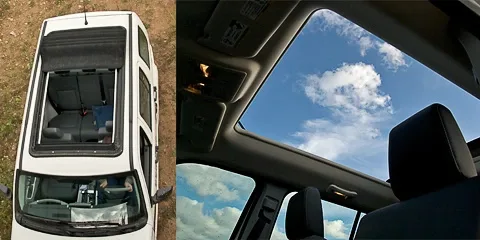
For an extra charge, a Sky Slider sliding roof made of reinforced fabric is available.
The manufacturers promise everything at once. On the roads, they say, the new Cherokee is incredibly good. The past generation with its cartoonish face and rounded body should be forgotten. The current Cherokee — square and strict — is real masculine strength. And the smart all-wheel drive with an electronically controlled multi-disc clutch will bring true joy to off-road life. It's just that in my head, the concepts of "off-road life" and "multi-disc clutch" don't fit together. Previously, that was akin to Tom and Jerry.
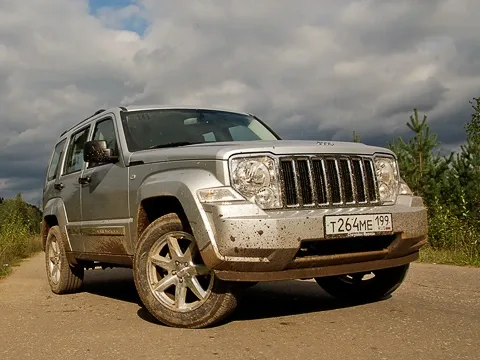
Maybe that's why the test organizers at Seliger made us promise not to abuse the cars? Or because all the off-road on the route consisted of a couple of puddles and three potholes? In marketing language, this is called soft-road. Over the entire run, the front axle engaged a couple of times. And even then — when it could have been done without it. Passing Zhigulis handled that section on two-wheel drive. It seems the Cherokee is being promoted as a car for those who need not four driven wheels, but just four familiar letters on the hood.
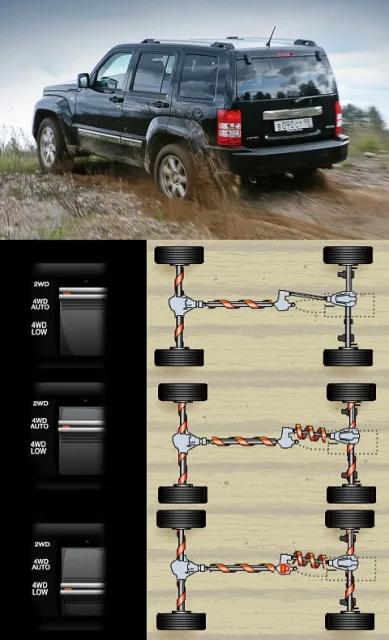
The Selec-Trac II transfer case in 4WD Auto mode engages the front axle when the rear slips. You can limit torque transfer to the front (2WD mode) or make the Cherokee permanently all-wheel drive with a low range (4WD Low). We never tried the latter mode — there was no place. Mode switching is via a slider on the center tunnel; for 4WD Low, you need to engage neutral.
Unsurprisingly, the emphasis is now on city comfort. But wait! On asphalt, the Cherokee behaves terribly. The gasoline V6 3.7 (205 hp and 314 N•m) is incredibly voracious: the trip computer showed about 20 l/100 km. There's no thrust, the gears of the thoughtful four-speed automatic are stretched, the engine howls, and together it just doesn't go. Plus strong body roll, pitching, annoying tire hum, sluggish steering responses with no feedback. Are these the manners of a decent city dweller?
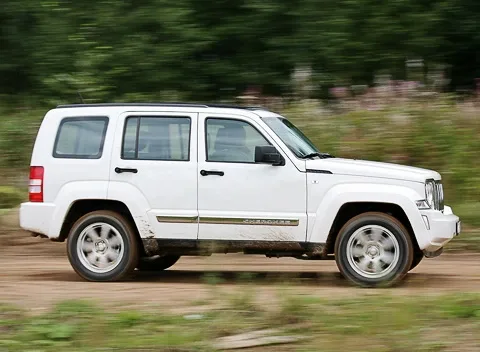
But the countryside is a different matter. The Cherokee conquers bad roads with ease. The bet on comfort paid off here. On a broken road — sand or dirt — the Jeep is wonderful. Honestly, the "Indian" bounced over the broken dirt road as if there were smooth asphalt under the wheels. Ruts, potholes, holes — all retreated before the menacing grin of the fake radiator grille and bulging headlights. With increasing speed, the pleasure doesn't diminish. The Cherokee bites into corners, taking them quickly and precisely. The not-too-informative steering wheel is just right for such roads. Reactions are accurate, and the firm suspension absorbs bumps without depriving occupants of comfort. And the sound insulation is decent.
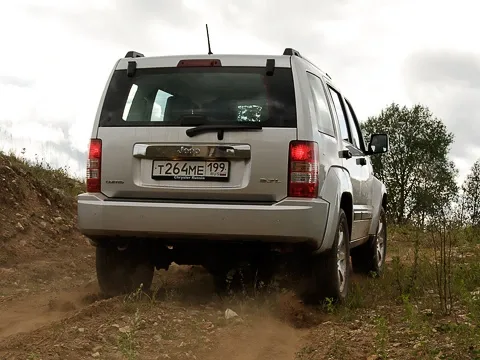
Moreover, I liked not the gasoline Cherokee, but the version with the new diesel "four" of 2.8 liters (177 hp and 460 N•m). Such a Jeep is a bit sluggish, and the engine's working range is narrow. But there's more torque, the car consumes less fuel (we got about 10 l/100 km), and on any serious off-road, the diesel is more handy. Plus, the "automatic" here is five-speed and more responsive. By the way, there's no more "manual" for the Jeep — another stone in the Cherokee's windshield. But there are no questions about the brakes, on any surface.
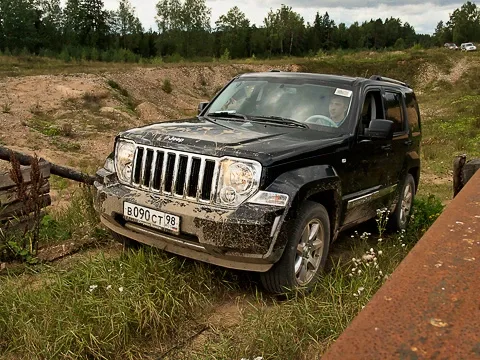
This is one of the most "difficult places" on the route. Maybe it's for the best: ground clearance is only 189 mm. A bit little for an SUV. But the departure and approach angles are good — 28.2 and 30 degrees, respectively.
But you can't live on dirt roads alone — even if they are special stages of the Pena rally. It's a shame they didn't let us onto real off-road. Mud suits the Cherokee. But they don't want to see a dirty face on our pages — the Jeep dealers must think it repels the target audience. City dwellers. Those who prefer packaged firewood, waterproof matches, lighter fluid, and marinated shashlik in cellophane over tents and campfire food. That's the arsenal of a modern jeep owner in the official interpretation.
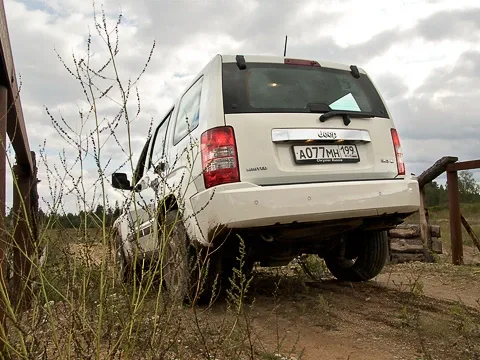
The Hill Descent Control system helps maintain a minimum speed on a slope. The speed can be adjusted. HDC mode activates only when the low range is engaged.
Then give us a car suitable for the city! But this one seems to have crawled out of the mud, yet hasn't firmly stepped onto the asphalt. So it's stuck somewhere in between. It drives well on bad roads and poorly on good ones. A car for the dusty roadside. It seems the marketers simply invented a civilized buyer for the Jeep — and now they're looking for such an original marginal. Whether they'll find enough is a big question. Jeep still exploits its dirty past, but doesn't want to get into real mud anymore. And there are plenty of clean-cut cars in this class without the Cherokee. As for the union of asphalt and off-road, only Russian road builders know that ancient recipe. They keep it carefully, pass it from generation to generation — and not a bit to the Americans.
Technical specifications
| Specifications | 2.8 CRD | V6 3.7 |
|---|---|---|
| Body | ||
| Number of doors/seats | 5 | |
| Length, mm | 4493 | |
| Width, mm | 1839 | |
| Height, mm | 1736 (1797 with roof rails) | |
| Wheelbase, mm | 2694 | |
| Front/rear track, mm | 1549/1549 | |
| Curb weight, kg | 1985–2090 | 1935–2040 |
| Gross weight, kg | 2520 | 2540 |
| Trunk volume, l | 419–1404 | |
| Engine | ||
| Type | diesel, direct injection | petrol, multi-point injection |
| Location | front, longitudinal | front, longitudinal |
| Number and arrangement of cylinders | 4, in-line | 6, V-shaped |
| Number of valves | 16 | 12 |
| Displacement, cm3 | 2768 | 3700 |
| Max power, hp/rpm | 177/3800 | 205/5200 |
| Max torque, N•m/rpm | 460/2000 | 314/4000 |
| Transmission | ||
| Gearbox | automatic, five-speed | automatic, four-speed |
| Drive | all-wheel drive, with electromagnetic clutch in front wheel drive and low range | |
| Chassis | ||
| Front suspension | independent, coil spring, double wishbone | |
| Rear suspension | dependent, coil spring | |
| Front brakes | disc, ventilated | |
| Rear brakes | disc | |
| Ground clearance, mm | 189 | |
| Performance | ||
| Maximum speed, km/h | 179 | 193 |
| Acceleration 0–100 km/h, s | 10.5 | 10.7 |
| Fuel consumption, l/100 km | ||
| urban cycle | 11.7 | 16.9 |
| extra-urban cycle | 7.5 | 8.9 |
| combined cycle | 9 | 11.7 |
| Emission standard | Euro-4 | |
| Fuel tank capacity, l | 70 | 73.8 |
| Fuel | Diesel | AI-95 |
Jeep Cherokee trim levels
Standard equipment
- Front airbags
- Side airbags
- ABS
- Electronic stability control
- Hill descent and ascent assist
- CD/DVD audio system with six speakers and MP3 support
- Alarm
- Immobilizer
- Power-adjustable and heated rearview mirrors
- Auto-dimming interior rearview mirror
- Central locking
- Front and rear power windows
- Power-adjustable driver's seat (six ways) and front passenger's seat (two ways)
- Heated front seats
- Tilt-adjustable steering column
- Manual lumbar support adjustment on driver's seat
- Multifunction steering wheel
- On-board computer
- Cruise control
- Fog lights
- Leather upholstery
- Spare tire — temporary
- Folding front passenger seat
- Tire pressure monitoring
- Rear parking sensors
- Climate control
- Chrome roof rails
- 18-inch alloy wheels
- Leather-wrapped steering wheel and gear shift knob
- Metallic paint
- 60/40 split-folding rear seat
Additional equipment with prices in US dollars
- Platinum-colored R18 alloy wheels — $640
- Factory window tinting — $490
- Reinforced disc brakes — $190
- Power sunroof — $1590
- Sky Slider panoramic roof — $1900
- Premium Sound Group package: CD/DVD radio with MP3 support, eight speakers and subwoofer, six-disc CD/DVD changer, auto-dimming rearview mirror with microphone — $1350
- Navigation & Sound Group I package: CD/DVD radio with MP3 support, eight speakers and subwoofer, hands-free, GPS navigation system with built-in 20 GB hard drive and color display, auto-dimming rearview mirror with microphone — $2770
- Travel Convenience Group package: protection for fuel tank, gearbox and front suspension, full-size spare wheel — $500
Price of base trim with 2.8 CRD engine — 1,315,000 rubles ($52,600)
Price of base trim with V6 3.7 engine — 1,290,000 rubles ($51,600)
Technology
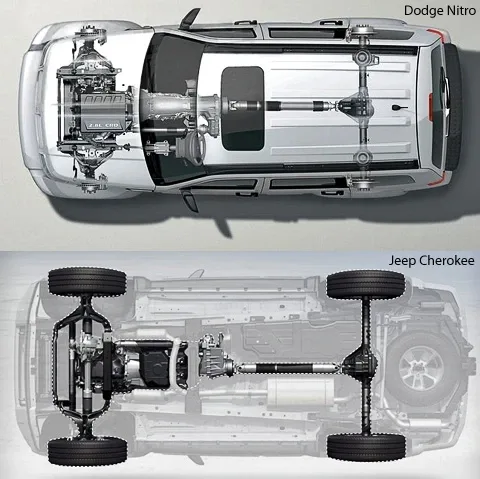
This SUV has a unibody construction and is built on the same platform as the Dodge Nitro, with the architecture of the previous Cherokee at its core. The most notable innovation compared to its predecessor is the design of the rear suspension. Instead of the previous layout with two trailing arms and one V-shaped arm, two transverse arms with a Panhard rod are now installed. An equally important change is the abandonment of permanent all-wheel drive: now the front wheels are engaged via a multi-disc clutch.
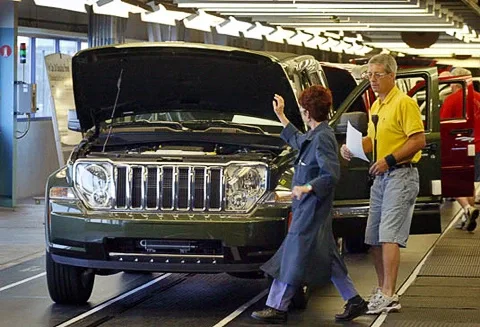
The Cherokee rolls off the assembly line in Toledo, Ohio, at the same plant where the Nitro is built. From its platform sibling, the new Cherokee differs in a wheelbase shortened by 7 cm, the presence of a low range and a clutch in the transfer case. In the Dodge, the front axle is engaged without a clutch — rigidly.
History
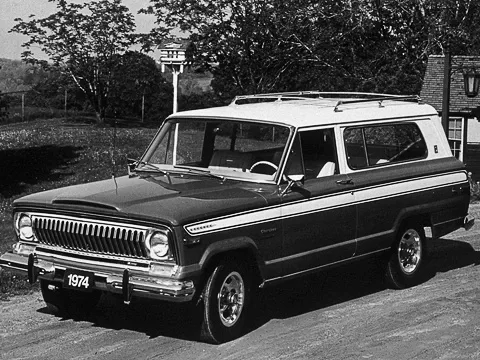
The first Cherokee appeared in 1974 and was a three-door version of the Wagoneer with a different front end design. Under the hood could be three petrol engines: an inline six-cylinder 4.2-liter and two V8s — 5.9 and 6.6 liters. Cars with part-time front axle came with a four-speed manual, while versions with permanent all-wheel drive were equipped with a three-speed automatic. Three years later, a five-door modification appeared.
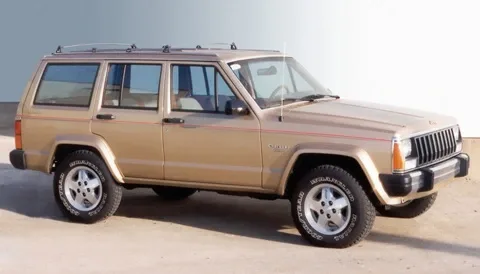
The second generation of the "Indian" debuted in 1984. They decided to abandon the frame construction, switching to a unibody, and the front leaf springs were replaced with coil springs. Engines became more modest: the base ones were a four-cylinder 2.5 and a V6 2.8. In 1985, a 2.1-liter turbodiesel was added to the range, and in 1987 the "six" grew to four liters. In 1994, the old turbodiesel was replaced by an Italian VM 2.5-liter. The second-generation Cherokee was produced with both three and five doors, and there was also a rear-wheel-drive version! Production lasted 15 years, and in China this Cherokee is still assembled under the Beijing brand.
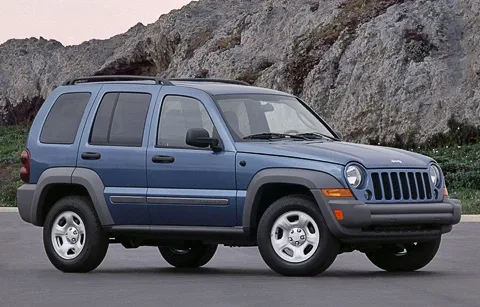
In 2001, the Cherokee noticeably grew in size, received independent front suspension, and coil springs appeared at the rear instead of leaf springs. The all-wheel-drive system with a center differential remained the same. For the Cherokee (known as Liberty in the US), three engines were offered: a 2.8 turbodiesel four-cylinder and two petrol engines — 2.4 and 3.7 liters.
Behind the scenes
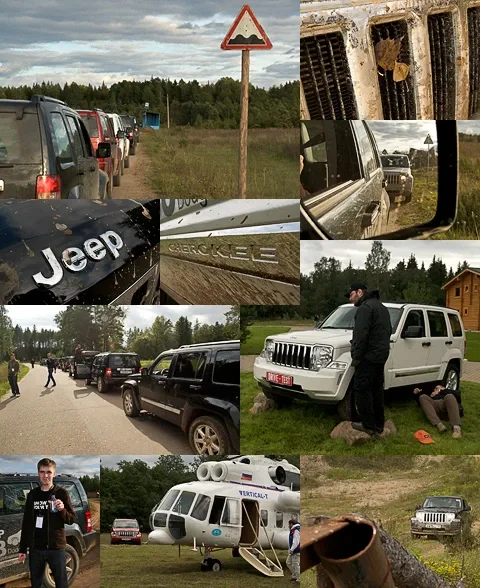
A day before the tests at Seliger, I was in the Ural Mountains area. To make it to the Cherokee presentation, I had to fly by plane, ride a train, take a taxi, go up by helicopter, and cross by hovercraft. After such a set of vehicles, the new Jeep felt like an old friend.