
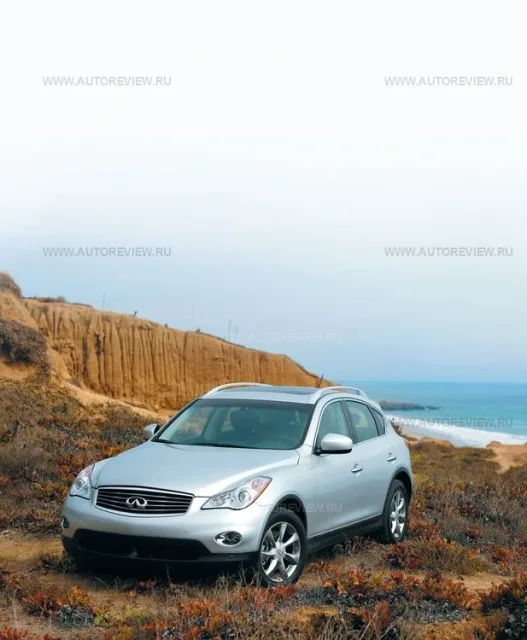
Organic products are a new Western fashion trend. And, as usual, this wave will soon reach us — with the power of an ocean surf that I watch rolling onto the beaches of Santa Monica. We settled into a steakhouse, studying the menu. If a regular steak costs just over twenty dollars (just imagine!), then for "organic" they already ask all forty. These extra twenty dollars are payment for the confidence that the cow that went into the meat was not of a genetically modified breed and ate exclusively natural grass. Here in the menu there are also "organic" side dishes and desserts. In America this has already become the norm: you can take just yogurt, or you can pay extra for "organic." Even bagged tea comes in two varieties.
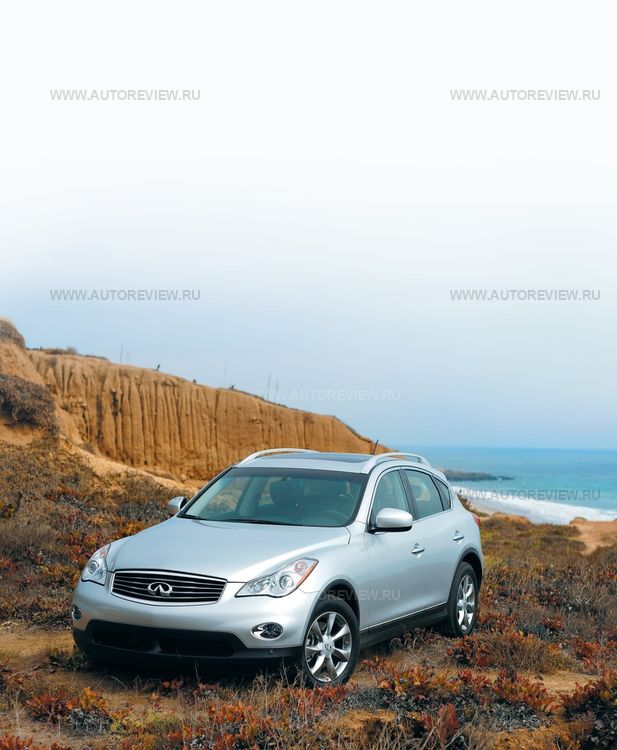
It is curious to what "menu" can the new Infiniti EX35 crossover be attributed, whose sales start in the States is scheduled for December?
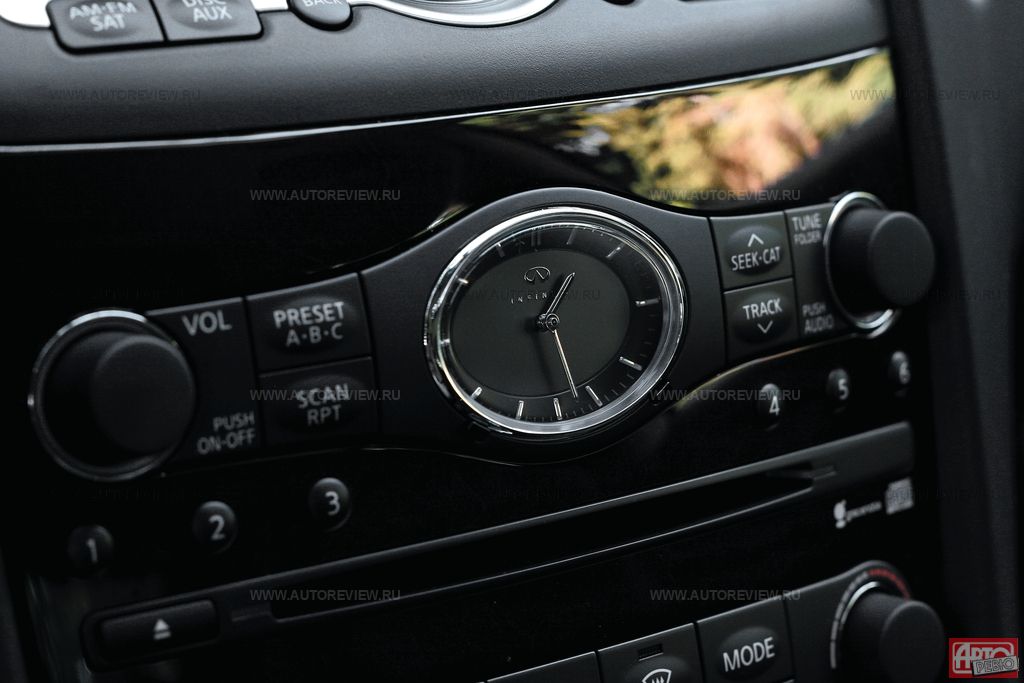 |
| No Infiniti car is complete without the signature oval clock |
The Infiniti EX35 is based on the well-known FM platform, in which the power unit is shifted inside the wheelbase. With a length of 4.6 meters, in the Infiniti hierarchy it stands a step lower than the FX series SUVs. Moreover, in the world's "biological" classification, only two cars have so far been classified as compact premium crossovers with a sporty character — the BMW X3 and Acura RDX. But Infiniti marketers are trying with all their might to avoid comparisons with them. According to their version, the EX35 is the result of crossing an SUV and a luxury coupe, almost Adam, the progenitor of a new species.
In fact, the Infiniti is 80 millimeters lower "at the withers" than the BMW, but externally it is built like a crossover and nothing else. In length, the EX35 has outgrown the Bavarian car by 60 mm — not so much, and I am ready to argue that the new generation of the "X-Third," which is expected in a year, will be larger than the current one. Therefore, avoiding parallels between Infiniti and BMW will not work.
For example, the engine on the EX35 is also located longitudinally. The well-known VQ35HR engine here produces 297 hp — 25 hp more than the most powerful version of the current BMW X3. The ATTESA E-TS all-wheel drive has a rear-wheel-drive accent: the front wheels are connected by an electromagnetic clutch only when the computer understands or predicts the need for it. Moreover, in America you can order a purely rear-wheel-drive EX35.
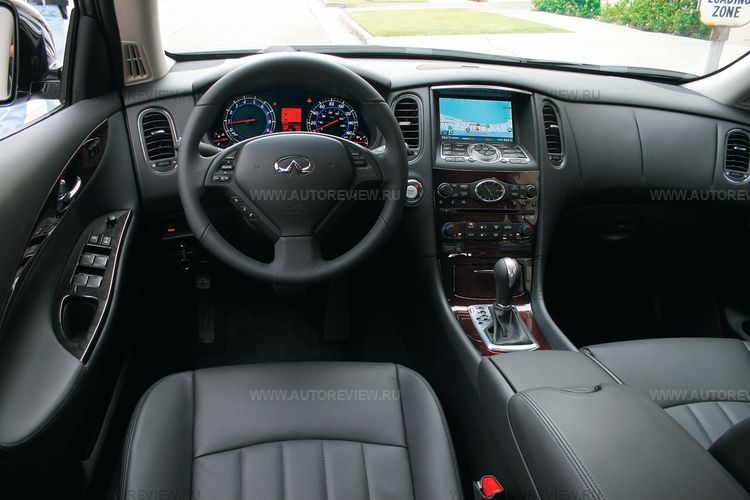
The interior is quite harmonious, ergonomics are excellent. The seating position is without "SUV" compromises, close to a passenger car. The excellent steering wheel is covered with grippy leather, and the legs themselves find their places on the left footrest and the floor-mounted gas pedal
But the appearance of the Infiniti is, of course, its own. The characteristic mixture of sleekness and short chopped lines here appears in a softer form than on the G series sedans and coupes, and even more so on the FX crossovers. The EX35 looks especially good in three-quarter rear view, but from the front, individuality has given way to Korean "blurriness." Although there is an excuse for this in the form of the drag coefficient: 0.32 is a very good indicator for such cars.
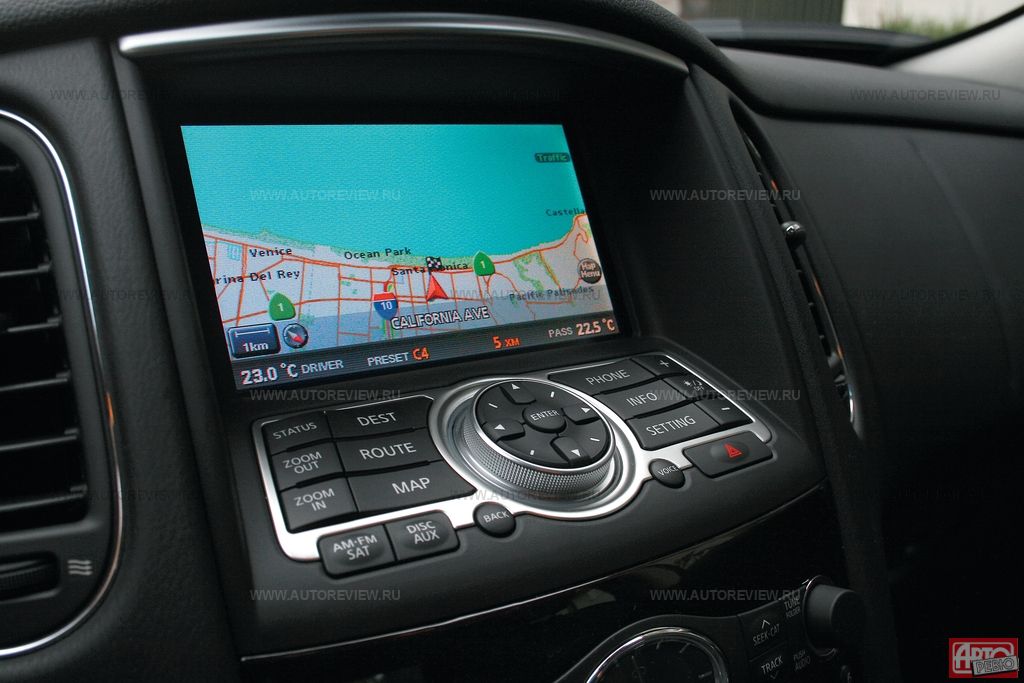 | 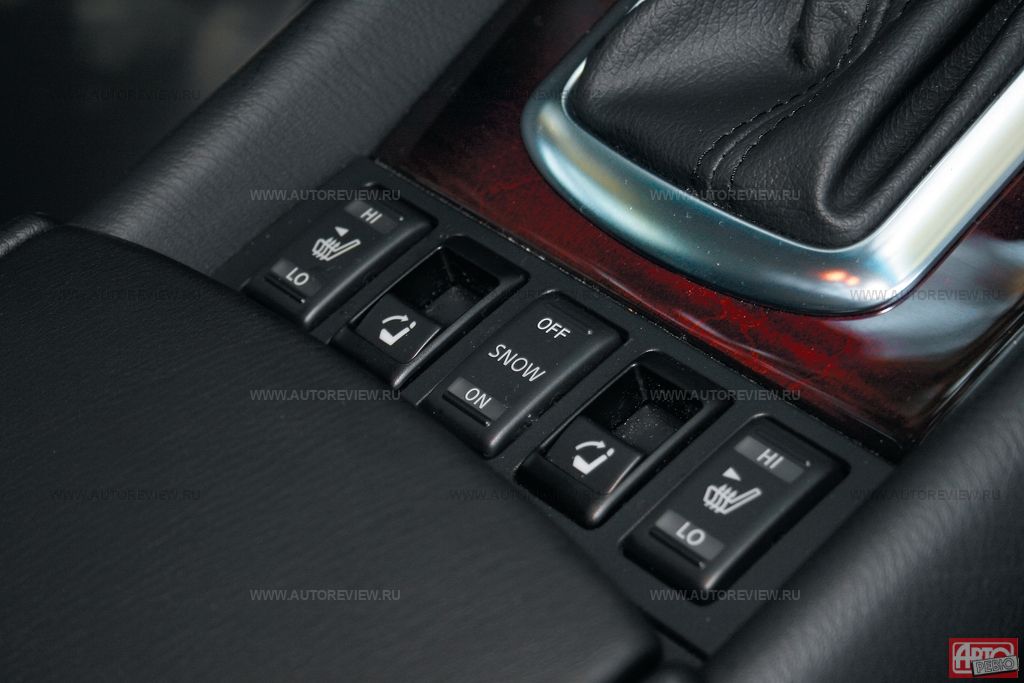 | |
| Engine start — by a button under the right hand, but the slot for the electronic key is located on the left | Convenient multifunction display with touch screen — the same as on the Infiniti G series | On the console — buttons for electric drive to raise the rear seat backs from the folded position |
In terms of interior design, the Infiniti EX35 is very similar to the G35 sedan: without frills, but also without flaws. Except that the steering wheel here is adjusted separately from the instrument cluster. The steering wheel itself, by the way, I especially liked — both for the comfortable bulges at the grip points and the grippy leather. The seating position is quite car-like, not SUV-like. The seat is medium hardness, with widely "open" side bolsters and a comfortable profile.
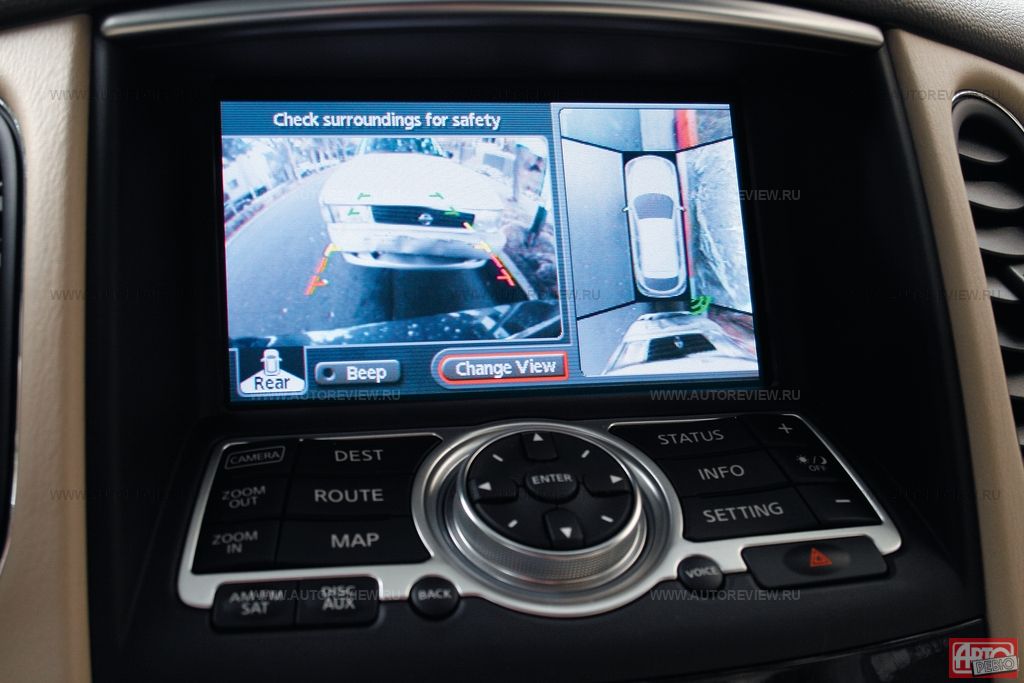 | |
| On clean streets, the AVM "around view" is an excellent aid for parking in tight spaces | The ICC active cruise control and LDP lane keeping systems are switched on separately |
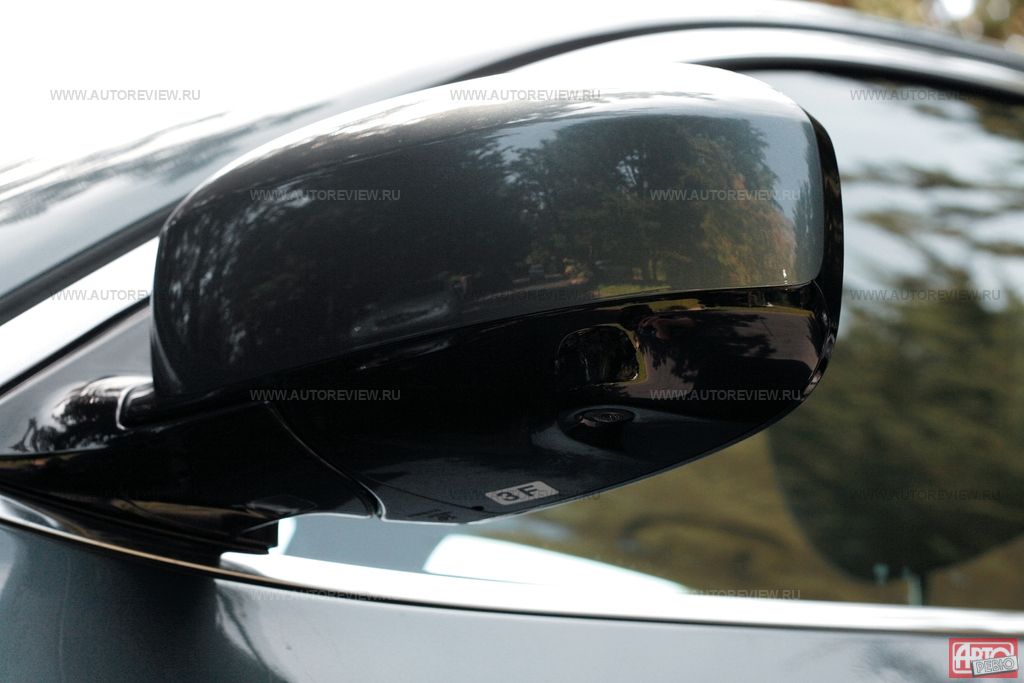 | |
| It will be interesting to see what this camera shows after a trip through our slush | And another button turns off the "beep" of the LDW system, which triggers when crossing lane markings at speeds above 72 km/h |
The key fob is inserted into the slot, press the button — and along with the fashionable optitronic instruments, the engine comes to life. From low revs it pulls without complaint, and from two thousand it begins to show enthusiasm. And the higher the tachometer needle, the deeper the six cylinders breathe, the more life there is. And after five thousand, a thoroughbred voice appears — and the car cheerfully dives into the next turn of Mulholland Highway...
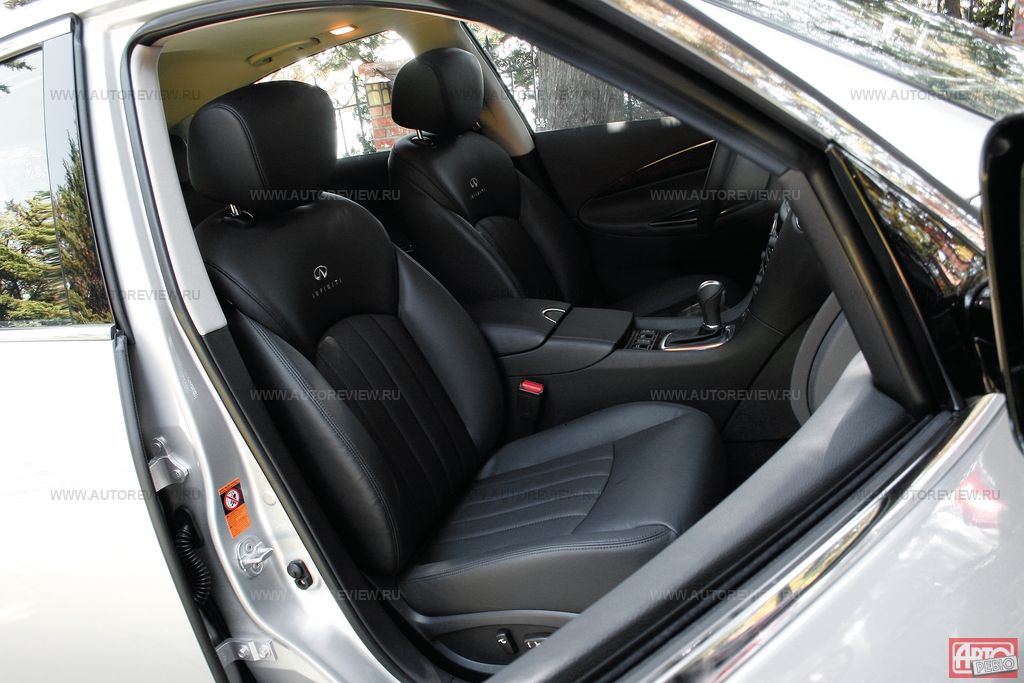 | 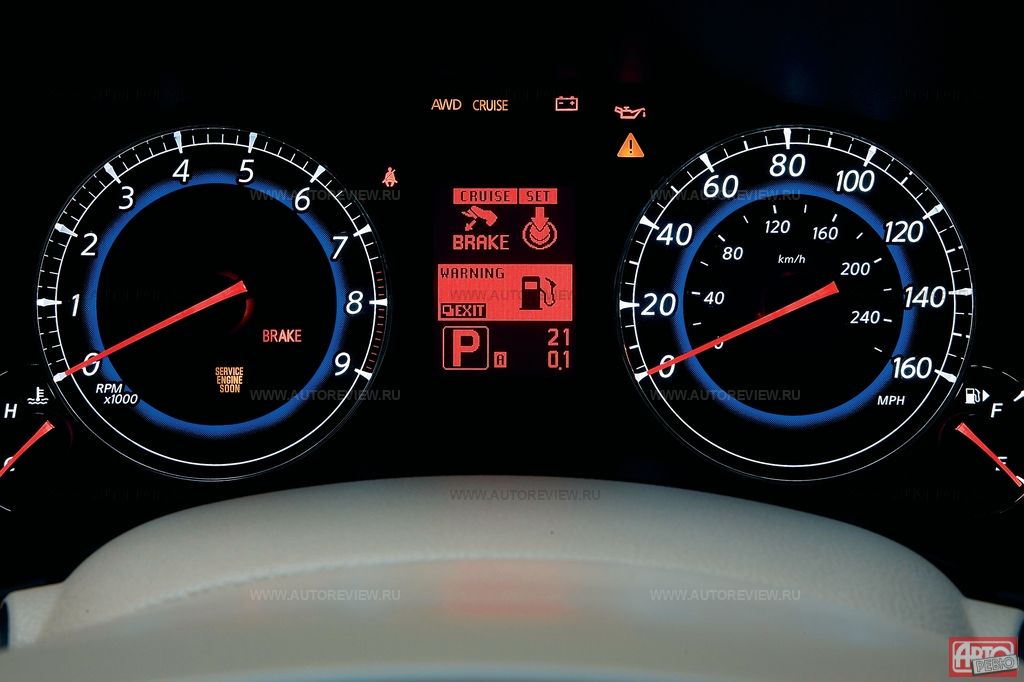 | |
| The seats please with the correct profile, but lateral support is moderate | The readability of the instruments could have fallen victim to embellishment. Fortunately, it did not | Retractable hangers for outerwear — a new "invention" from Infiniti. So far — for an additional fee |
Throttle control is completely understandable, as is the algorithm of the five-speed "automatic." Its adaptation logic always coincided with my wishes, and the gears changed quickly and smoothly. I switched on the sport and manual modes only for a test: if you want something more, then only paddle shifters for manual downshifting before a turn — such are even on the G35 sedan, but here — no.
There are many turns in the mountains of California. And on Mulholland Highway — especially. By Moscow standards, there is no traffic here: occasionally a huge pickup will pass — and silence. Following the turn of the moderately sharp steering wheel, the EX35 accurately and softly takes the trajectory. The steering is slightly ambiguous only near "zero," and in corners it gives an almost perfect feel for the road. Turning the wheel is a little easier than in the BMW, and yet the overall effort level is un-American high. And at the limit, the EX35 does not trade pleasure for fear: it drifts with the front axle, but not very strongly.
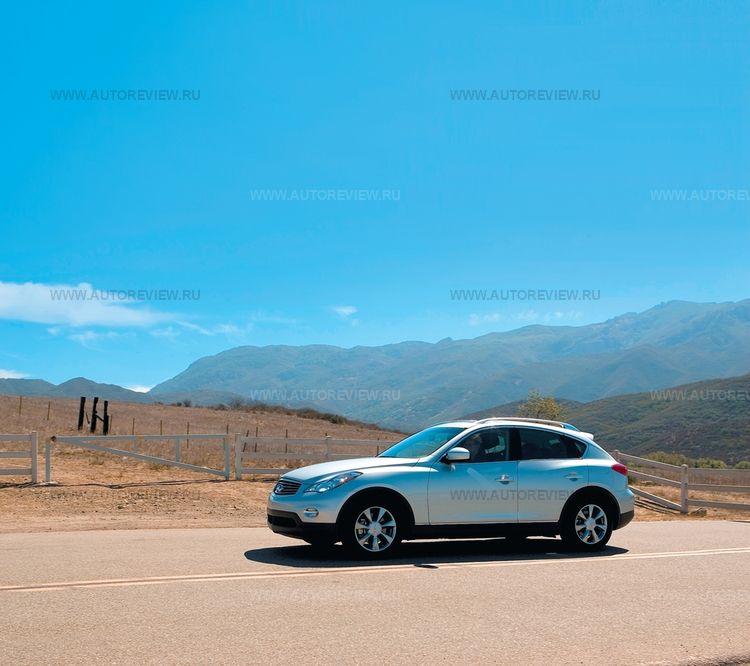
The Infiniti EX35 is the first production car painted with self-healing lacquer. Thanks to the elastic top layer, it can pull together scratches while maintaining shine. Depending on the air temperature, this takes from 15 minutes to seven days. True, only shallow scratches that have not reached the paint layer are covered — for example, those left after an automatic car wash or from fingernails around door handles. The service life of the coating, developed jointly with Nippon Paint, is up to three years
This is not synthetic. This is organic! And the suspension is tuned "not in the spirit of the New World" — moderately stiff: it does not allow rocking and only on large potholes hints at a repeated oscillation. And thanks to two-valve shock absorbers, which reduce resistance more than usual at high rod speeds, it swallows bumps also nobly, organically.
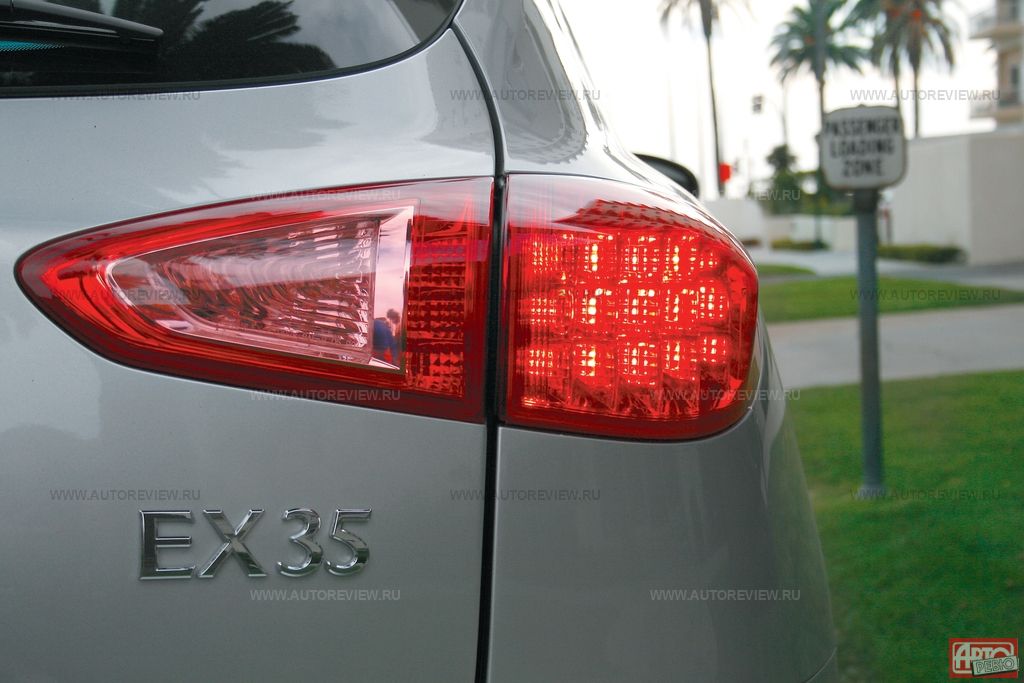 | 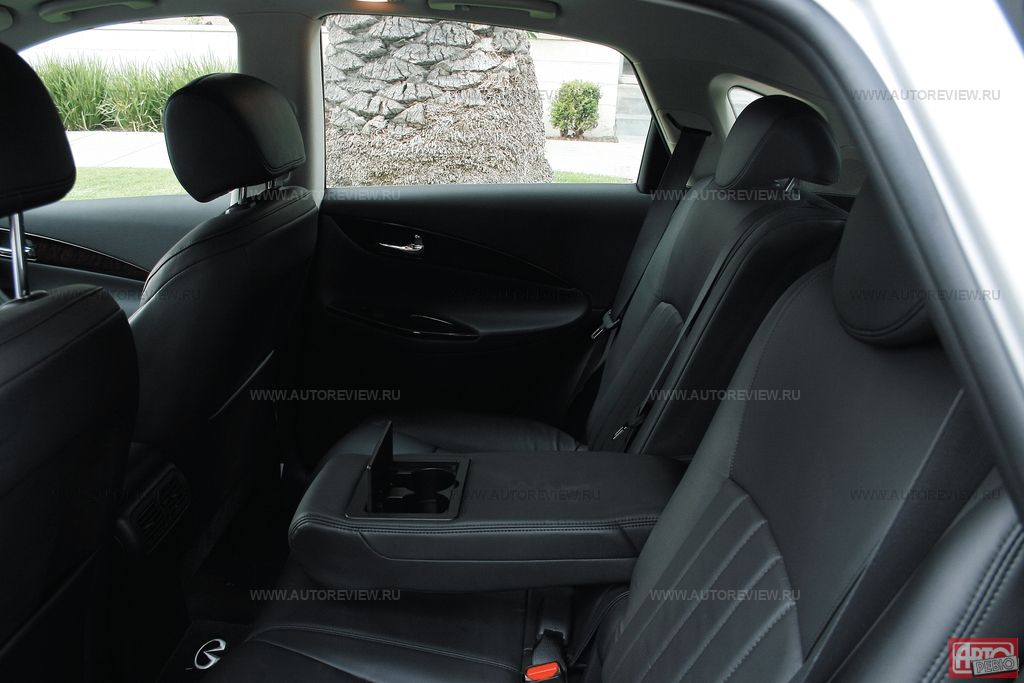 |
| Brake lights, rear position lights, and turn signals — with LEDs | It is not cramped in the back: "behind myself" at a height of 187 cm, I sat normally |
But where there was a complete failure was with the tires. The universal tread of the 17-inch Michelin Latitude Tour HP tires either floated in the thirty-degree heat, or turned out to be not intended at all for winding asphalt and spirited journalists. They began to squeal plaintively in corners long before the limit speeds, and when braking "to the floor," the car stopped much later than I expected. And the brake pedal, very understandable in normal modes, "sinks" during intense deceleration.
Special mention deserves the Around View Monitor (AVM) system, which combines four parking cameras. The lenses are hidden in the mirror housings, as well as under the front and rear emblems — a solution familiar to us from Nissan experimental prototypes, which we wrote about in AR No. 19 for 2007. The central display simultaneously shows four images, forming a panorama of all 360 degrees. If desired, with one press you can display the image from the most important camera at the moment — say, the right one, which helps control the distance to the curb.
The system is certainly curious. The only concern is that the cameras do not retract and have no additional protection. However, since the Japanese decided to supply this option to the Russian market, it is worth assuming that they are confident: AVM will not show dirty-gray mush on the screen for six months.
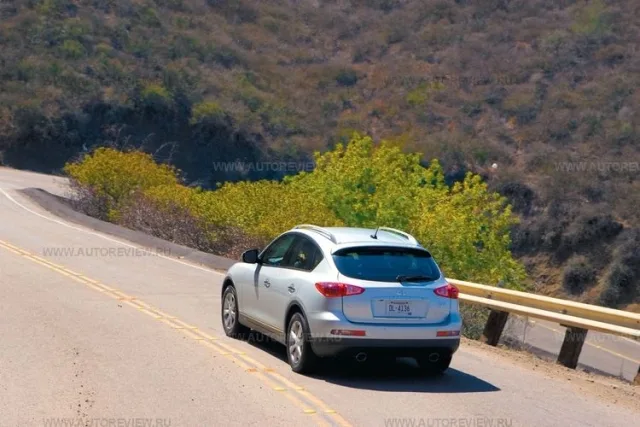
EX35, like its "big brother" FX, is based on the FM platform, known since 2001. A distinctive feature of this architecture is almost perfect weight distribution: for EX35 it varies from 52/48% for rear-wheel-drive modifications to 54/46% for all-wheel-drive ones. When creating the younger model, engineers deliberately reduced the sporty component compared to the larger FX, because, according to their calculations, only 35% of Infiniti buyers are women
The cameras in the mirrors are also used in the Lane Departure Protection (LDP) system. True, this option is not provided for our market: it tracks the vehicle's position relative to road markings, and with that, as we know, we still have problems. The principle of operation is as follows: when the computer notices that the car is crossing the lane marking without the turn signal on, it gently brakes the wheels on the opposite side and returns the car to its lane. I had the chance to drive such an "active" car for only half an hour, but even that time was enough to understand: LDP can back up the driver in a couple of situations, but no more. On the highway, I deliberately steer the car to the right without turning on the turn signal. When the wheels are already rustling over the reflectors, a short sound signal sounds — and the Infiniti, braking, shifts to the left. If you continue to ignore the prompts, soon the car will begin to move beyond the left boundary of the lane. The system will return it again, but at a larger angle. And after the second or third such oscillation, the electronics will decide that the angle between the car and the markings is too large, and... simply turn off.
However, all these electronic "gadgets" are far from the main thing. The key is that the Infiniti EX35 is the second "organic" after the BMW X3 in the compact crossover class. A real, lively car, if such a definition applies to the "genetically modified" segment. It is only a pity that initially the main sales channels will be "gray" dealers: official deliveries to Russia will begin only in the summer of 2008. And soon new BMW X3 and Mercedes GLK will arrive, followed by Audi and Porsche. So the menu of "organics" will not remain so scarce for long.