
Hyundai Tucson. The Younger Brother
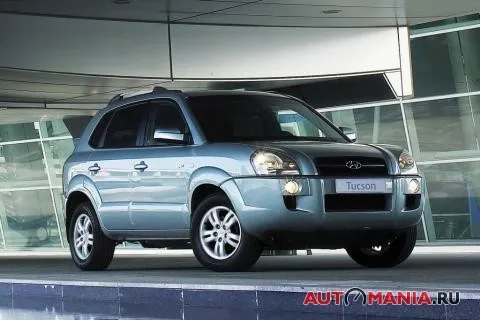
The Korean manufacturer, frankly, did not lack compact SUVs — the all-wheel-drive Santa Fe successfully covered the needs of most buyers, and the company's marketers had no reason to worry. However, in the early 2000s, they took a non-standard step and introduced another "crossover," which, like the older model, was named after a town in Arizona. This is how the Hyundai Tucson appeared, which over time surpassed not only the Santa Fe in sales but also all its competitors in the segment.
For a long time, Hyundai was in no hurry to explain why they needed two almost identical cars in the same class. The most logical version seemed to be a marketing one: the more massive and solid Santa Fe remained an affordable all-wheel-drive car for family people, while the young and energetic Tucson was supposed to attract the youth — hence its swift, visually lighter design. The true reasons for this decision became clear later, when the second generation of the Santa Fe came out, moving into the mid-size class. By that time, the "younger one" left alone no longer needed backup — there were simply no equals left in its segment.
This statement, of course, can be argued — there are plenty of worthy rivals in the class. But in fact, no competitor (except perhaps Kia and Nissan with its ultra-compact Qashqai) could offer a clear alternative. Judge for yourself: the most affordable all-wheel-drive Tucson today will cost 726,000 rubles, which is about $28,000. For this money, you get a 2-liter engine with a manual transmission, ABS, EBD, TCS, a couple of airbags, power windows and power mirrors, heated seats and windshield, air conditioning, and alloy wheels. For comparison: a nearly similar RAV4 costs at least $34,500, Ford Maverick — $30,000, and there is nothing to say about the new CR-V. If you choose a more modest version of the Tucson, you can fit into 646,000 rubles. True, then you will have to sacrifice all-wheel drive and some options, but for purely asphalt operation, such losses are not critical. In short, there is a choice.
By the way, despite its solid age by automotive standards, the Tucson looks quite decent. There is nothing supernatural in it — it is an ordinary cute compact SUV with classic proportions, streamlined shapes, a tall body, and acceptable ground clearance for our roads. We will not describe the exterior in detail — there are plenty of such cars on the streets. We only note that, despite the obvious kinship with the previous Santa Fe, it looks more lean and fast, which positively affects its popularity.
The interior is made in the same spirit — simple but tasteful. Inexpensive but solid plastics, a strict classic layout that clearly divides the cockpit into driver and passenger zones. The advantages include decent build quality and a moderate number of decorative elements, which Koreans often overdo. The equipment, as we have already found out, is at a good level, although handling some equipment initially causes inconvenience. For example, controlling the ventilation system blindly is quite problematic. And not everything is smooth with ergonomics — this was noticed not only by me but also by many colleagues who have dealt with this car. The high "command" seating position is expected (after all, the interior is borrowed from the Santa Fe), but the fact that people taller than 180 centimeters will hit their heads on the ceiling was a surprise. The fact remains: a tall driver will either have to put up with it or recline the seat back. The second option is preferable, but there are limitations here — the steering column adjusts only vertically. So the backrest can be tilted only to a certain point, otherwise, you simply cannot reach the steering wheel. At the same time, the seat itself turned out to be quite successful: moderately firm cushions do not let you slide and provide decent lateral support, but at the same time do not push the body out — this happens in Korean cars, though not often.
The rear row is also quite hospitable: three adults will sit without much trouble — fortunately, there is no central tunnel. This is more convenient for the middle passenger and gives more legroom (they can easily be placed under the high cushions of the front seats). The only inconvenience is the small amount of headroom, even less than in the front. True, if necessary, the rear seat backrest can be adjusted to fit a specific passenger.
The trunk deserves special praise. The rear seat backrest folds in a 60:40 ratio and completely folds into the floor, forming a flat loading area that can also serve as a double bed in nature. Among the design features, it is worth noting the rear window, which opens separately from the door — this is convenient when loading small items like a briefcase or supermarket bags.
Now about the practical part. Depending on the specification, the Tucson is supplied to our market with front or all-wheel drive, two gasoline engines, and two types of transmissions. Of course, the top version with a 2.7-liter V6, producing about 175 horsepower at 6000 rpm, has the best dynamics. This engine is installed exclusively on all-wheel-drive cars and works only with an "automatic." Such an SUV reaches a hundred in 10.5 seconds. At the same time, the engine is so elastic that even the outdated 4-speed automatic does not spoil the picture, providing comfortable, smooth, and at the same time dynamic movement.
You cannot say that about the two-liter version. Acceleration is noticeably slower — the claimed 12.7 seconds, in my opinion, is clearly underestimated. Moreover, the sound of the engine during intense acceleration leaves much to be desired. The unit begins to strain the ears already at 3000–3500 rpm, then it only gets worse, and by the "red zone," the howl is so annoying that the foot itself releases the gas pedal. With a manual transmission, driving such a Tucson is more pleasant: both acceleration is better, and the ears do not suffer. However, practice shows that you can get used to the "automatic" as well — the main thing is to dose the pedal pressure more clearly and not bring the engine to hysterical "kick-downs."
As for off-road, here you need to consider the specifics of the Tucson, like any other "crossover": it can drive off asphalt onto dry dirt or a mowed field. But I would not go into serious obstacles. Firstly, of the off-road attributes, it only has a forced locking of the center differential, which is useless in most cases. And secondly, neither the short suspension travel, nor the ground clearance, nor the overhangs contribute to hard off-road. In general, asphalt, asphalt, and again asphalt.
Technical specifications:
| Dimensions: | Hyundai Tucson |
| Length (mm) | 4325 |
| Width (mm) | 1795 |
| Height (mm) | 1730 |
| Wheelbase (mm) | 2630 |
| Ground clearance (mm) | 195 |
| Weight (kg) | 1628 |
| Trunk volume (l) | 325/1375 |
| Engine displacement (cm3) | 1975 |
| Max power (hp) | 142 at 6000 rpm |
| Max torque (Nm) | 184 at 4500 rpm |
| Max speed (km/h) | 160 |
| Acceleration 0–100 km/h (s) | 12.7 |
| Average fuel consumption (l) | 9 |
| Price (rub.) | 645,900–902,900 |
Magazine "Autoguide" July 20, 2007 No. 25(25)
Source – www.automania.ru