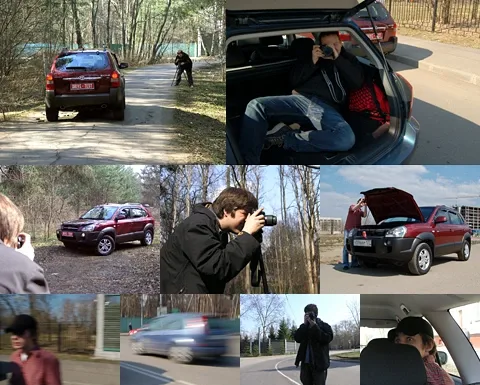
The city that gave this car its name has existed for many years, and the Hyundai Tucson itself debuted at the Chicago Auto Show in 2004. Inspired by the success of the first-generation Santa Fe, the Koreans decided to repeat the successful experience and create another crossover — only more modern and attractive. It was supposed to attract a younger and more energetic audience than Santa Fe owners.
I, perhaps, am not yet that old and move quite briskly, so the Tucson, according to the marketers' idea, should appeal to me. I don't mind — let's check.
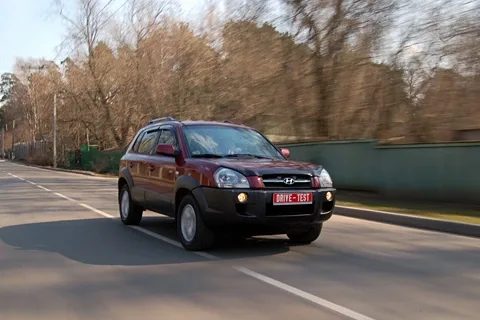
Having gained speed, the Tucson confidently holds the road, and only the increasing engine noise and tire rustle can distract from driving.
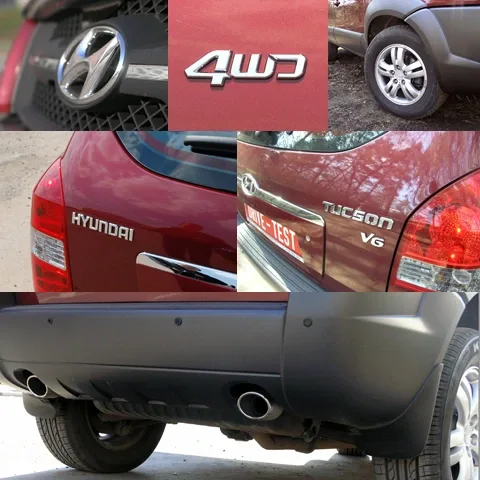
So this is what spring at the foot of the mountain looks like. True, the mountain turned out not black, but cherry-burgundy. And not a mountain at all, but just a hill. The modest but fit and well-tailored silhouette of the car fully matches the declared activity. And the two exhaust pipes, cast 16-inch wheels, and the V6 badge gleaming in the sun only reinforce this impression.
Getting behind the wheel, I buckled up and slowly moved off. All-wheel drive, under the hood — a 2.7-liter gasoline "six" with 172 horsepower. Sounds like a real muscle car! Deciding to test what the nearly three-liter V6 can do, I pressed the gas harder... And I get overtaken, grunting and puffing, by a "six" loaded with seedlings — and it's not a BMW. What's the matter, Korean comrade, what are you thinking about?
I listen and seem to hear a quiet cough from the poor horses... Could half the herd have died while I was getting to the car? No, the horses are fine. The problem is the archaic four-speed automatic, which will think seven times before shifting. You press the gas — the Tucson ponders: "What do they want from me?", then remembers: "Ah, gas!" — and starts to accelerate. And this applies not only to starting off or driving in traffic jams. On empty morning streets, the Tucson continues to doze along with the city, not trying to impress with dynamics. It drives leisurely, only grumbling with the engine at the press of the pedal. However, this growl is almost inaudible — the sound insulation copes better than the "automatic". But the higher the speed, the more intrusive the engine noise mixed with tires and other howls becomes. You take your foot off the gas — the thoughtfulness returns.
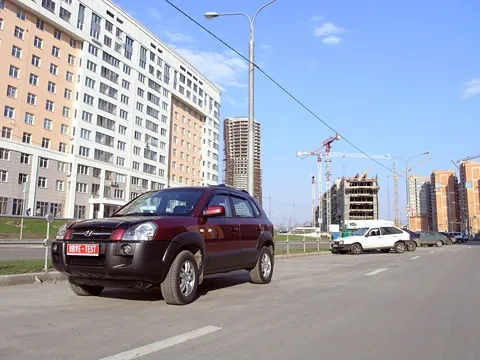
Despite the fact that the Tucson is almost an SUV, its main habitat is city streets.
The same can be said about handling. In an emergency situation, for example during a sharp maneuver, human thought wins a convincing victory over the reaction of the steering. The car brakes, fortunately, faster than it accelerates. I can call the brakes truly informative, but only under threat of reprisal. The pedal travel is a bit long, and during intense braking there is not enough full confidence and reserve.
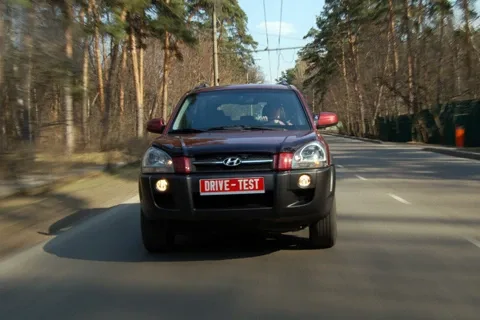
But with calm driving, the Tucson begins to please. You can relax, all the "Schumacher" antics evaporate, giving way to calmness and common sense. It's nice that behind the wheel you don't feel like a truck driver, as often happens in such cars. Everything is visible, audible, and clear. You feel the dimensions from the first minutes, and no problems with maneuvers arise later.
The ride smoothness is the golden mean: it doesn't rock you like on an ocean liner, but it doesn't toss you on every bump either. The balance is perfectly maintained. Smoothly taking turns with noticeable body roll, the Tucson shows no interest in understeer, oversteer, or other antics. It simply moves along the given trajectory, as prescribed at the factory. The rough operation of the ESP surprised me: with a sharp press on the gas at the exit of a turn, the system simply cuts off the fuel supply. Completely. But on a straight road with poor surface, the stabilization allows you to feel safe — the car goes straight. Don't forget, no one promised us a sports car. For unforeseen situations, the "automatic" has a manual mode, which somehow helps during prolonged overtaking. To hell with active driving, let's drive calmly!
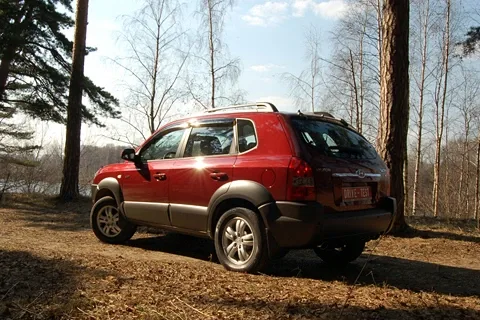
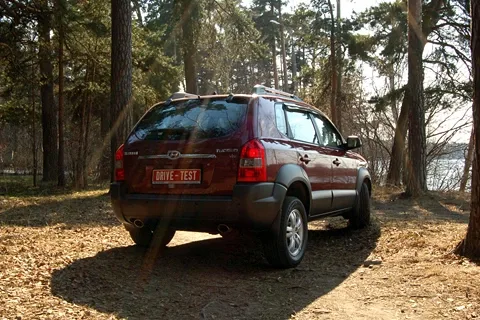
The Tucson's element is not viscous swamps and impassable sands, but forest dirt roads and concrete jungles with their numerous obstacles.
Better yet, let's stop and inspect the interior. Not bad, very not bad! Cozy and nice. True, the gray plain plastic is not the most pleasant to the touch, but it collects dust perfectly. Otherwise, the interior does not cause antipathy, but it looks somehow very simple. There's nothing for the eye to catch on, except maybe the steering wheel. But you can catch your head on it — it's quite large. And slippery, like a freshly caught fish. But the numerous pockets, glove boxes, compartments for small items, and an abundance of cup holders will appeal to those who always carry a bunch of things and cups. Rear passengers will be delighted with the reclining backrests, the absolutely flat floor without a tunnel, and real legroom.
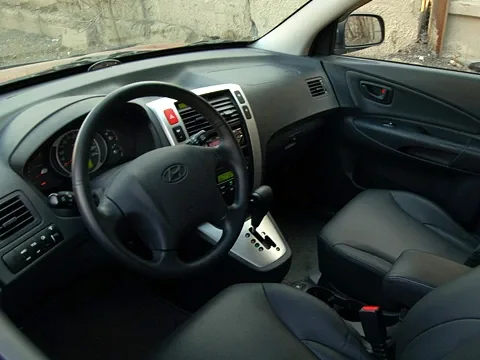
The Hyundai interior, although full of plain plastic, knows how to win you over.
Having kicked out the passengers, the rear seats can be folded down, getting a flat floor (also without a tunnel) and increasing the useful space several times. It feels like you could now roll a Daewoo Matiz into the trunk. Unfortunately, I couldn't test this in practice. Although even without that, the trunk is not among the smallest — its volume is 644 liters, and loading and unloading things is convenient.
The rear window opens separately from the door — you can throw small purchases into the opening without getting dirty on the main "gate". And if you have to escape a chase, you don't need to break the glass, just open it. Convenient.
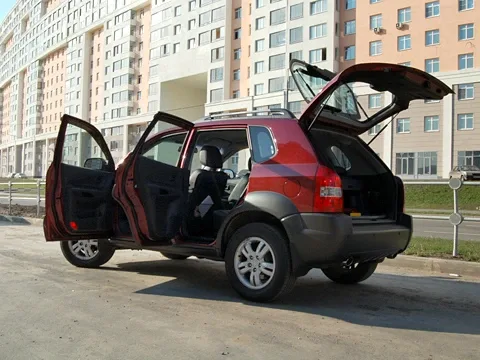
The car has only five doors, but you can perform as many as six actions like "open".
By the way, the seats in our trim are leather. The leather, of course, is not from a crocodile, but some animals still suffered during the production of the Tucson. In addition to all the pleasant little things, the climate control does its job perfectly — largely thanks to the well-placed air ducts.
After such a session of tranquility, I didn't want to get into the mud on the Tucson at all. And there's no need. Its element is curbs, yard snowdrifts, and other urban irregularities. Short overhangs at the front and rear will help. But if the desire to stir up mud has become an obsession, it's worth remembering: despite the permanent all-wheel drive, the Tucson essentially remains front-wheel drive. The rear wheels are connected by an electromagnetic friction clutch when the situation requires it. The clutch locks depending on the degree of front wheel slip. If you've gotten into the mud "up to your ears" — you lock the clutch yourself by pressing a button in the cabin. And either you get out onto dry land, or you continue to spin, but with a doubled external effect.
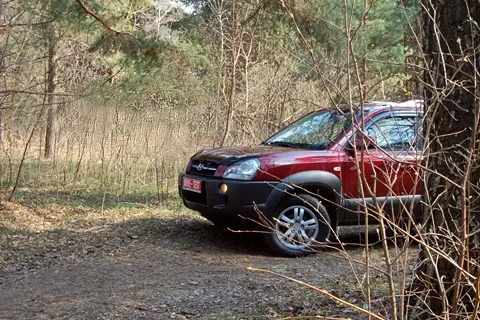
Massive plastic protection around the entire car will save you from tears over a scratched door or bumper.
So, thirty-three and a half thousand for the maximum, quite rich trim. By the way, the more economical (and our Tucson on average ate like a seasoned soldier — 14.7 liters per "hundred") 2-liter version with the same "smart" automatic will cost almost five thousand less, and with a "manual" — all six. But they will drive even more calmly. As for youth and activity, in my opinion, a young dad with a wife, two kids, and a dacha near Moscow is more suitable for the role of an "activist". And whether the leather interior from an unknown animal and the V6 badge are worth that kind of money — let them decide together at a family council.
So, a spring trip to the foot of the black mountain for $33,490 is a choice for those who need a versatile car for everyday use. To get to the dacha on a rough road, park in the yard without problems in winter, and look decent at the office in any season. The car handles all these tasks with comfort, looks pleasant, and remains practical. As a bonus, there's a five-year warranty and the ability to fill up with 92-octane gasoline. That's the deal.
Technical specifications
| Body type | SUV |
|---|---|
| Engine | Petrol |
| DOHC | 2.7 |
| Number and arrangement of cylinders | V6 |
| Displacement, cc | 2656 |
| Number of valves | 24 |
| Power, hp | 175/6000 |
| Transmission | 4-speed automatic H-Matic |
| Drive | 4WD |
| Front suspension | McPherson struts with springs and anti-roll bar |
| Rear suspension | Double wishbone, springs, anti-roll bar |
| Tires | 235/60R16 |
| Front brakes | 15" ventilated discs |
| Rear brakes | Discs with a diameter of 284, parking brake — drum |
| Trunk volume, l | 644 |
| Curb weight, kg | 1678 |
| Gross weight, kg | 2190 |
| Maximum speed, km/h | 180 |
| Acceleration time 0-100 km/h, s | 10.5 |
| Fuel consumption, urban cycle | 13.2 |
| Fuel consumption, suburban cycle | 8.2 |
| Fuel consumption, combined cycle | 10.0 |
| Fuel tank, l | 65 |
| Dimensions | |
|---|---|
| Length, mm | 4325 |
| Width, mm | 1795 |
| Height, mm | 1730 (with roof rails) |
| Wheelbase, mm | 2630 |
| Track, front / rear, mm | 1550 / 1550 |
| Ground clearance, mm | 195 |
- ABS
- EBD
- TCS
- TOD (Torque on Demand)
- Front airbags for driver and passenger
- Power steering
- Immobilizer
- Alarm
- Central locking with remote control
- On-board computer
- Power-adjustable and heated mirrors
- Power windows (driver's with auto-open function)
- Audio preparation (antenna, 6 speakers)
- Climate control with air quality control system
- Cabin filter
- Leather-wrapped steering wheel and gear shift knob
- Height-adjustable steering column
- Metal-look inserts on the front panel
- Front seats adjustable longitudinally and by backrest tilt
- Driver's seat cushion height and tilt adjustment
- Driver's seat lumbar support adjustment
- Height-adjustable front seat belts with dual pretensioners and load limiters
- Pockets on the backs of front seats
- Tray under the front passenger seat
- Heated front seats
- Height- and tilt-adjustable front headrests
- Height-adjustable front center armrest with two compartments for small items
- Electronic clock
- Fabric inserts on doors
- Carpet floor covering
- Ashtray and cigarette lighter
- Cup holders
- Fabric headliner
- Fabric-covered sun visors
- Sun visor extenders
- Illuminated mirrors in visors
- Rear seat back folds in a 6:4 ratio, forming a flat floor
- Rear seat backrest tilt adjustment
- Height-adjustable rear headrests
- Rear center armrest with cup holders
- 3-point inertia seat belts for rear passengers
- Child seat anchors
- Clothes hooks in the rear
- Plastic side trim of the trunk
- Trunk net
- Trunk cover
- Power outlet in the trunk
- Adjustable intermittent mode of front wipers
- Intermittent mode of rear wiper
- Heated windshield in the wiper rest area
- Instrument panel backlight brightness adjustment
- Front and rear fog lights
- Central interior lighting
- Reading lamps
- Door courtesy lights
- Engine sump guard
- Alloy wheels 16"
- Tires Hankook / Kumho 215/60R16
- Full-size spare wheel (alloy rim)
- Front and rear disc brakes
- Light window tinting
- Roof rails
- Mechanical remote fuel filler flap release
- Additional brake light
- Mirrors and door handles in body color
- Rear door lock
- Rear wiper
- Opening rear door glass
- Battery charge preservation system
- Mud flaps
- Leather interior
- ESP
- Side airbags and curtain airbags
- Automatic headlights
- Automatic speed adjustment of windshield wipers
- Auto-dimming rearview mirror with compass
- Tires Bridgestone 235/60R16
- Protective plastic body and bumper moldings in gray
- Dual exhaust tips
- Gray interior color
The car for the test was provided by
CJSC "Karnet-2000" — the exclusive importer
of Hyundai cars in the Russian Federation. Behind the scenes