
Hyundai Santa Fe. Santa. But not Claus.
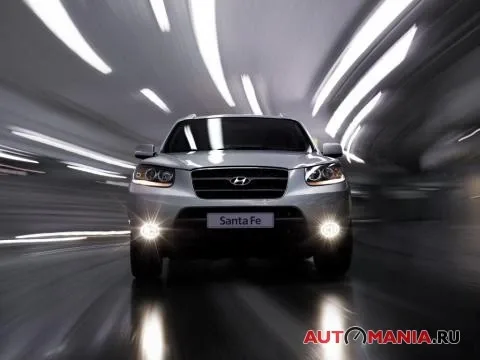
The times when a Korean SUV could be bought for pennies are long gone. This became finally clear after the new Hyundai Santa Fe appeared on our market. A year ago, for 25 thousand dollars, you could get a fresh first-generation SUV. Now, for an updated all-wheel-drive Korean model, they ask at least 995 thousand rubles — that's about 40 thousand 'evergreens'. Previously, for that kind of money, the buyer got a maximally equipped car with a 2.7-liter V6, automatic transmission, and an 'all-inclusive' interior. The list of options, in addition to factory ones, even included dealer bonuses like parking sensors and a spare wheel set. Today, from all that variety, only a powerful engine is available — and even then only with a manual, since no other choice is provided for Russia. In short, a new generation means new rules of the game.
However, a generational change almost always leads to price increases, especially when it comes to crossovers designed for picky and affluent Americans. For this, you don't even need to get into the cabin — a quick glance at the car is enough. If the exterior of the first 'Santa' raised questions in terms of style, the second 'Santa' is already a real Yankee. It has grown noticeably: length increased by 15 cm, width by 5.5 cm, and height by 5 cm. It now looks much more solid, and there is no trace of the former simple Korean originality. When creating the new crossover, Hyundai designers focused not on their own vision of an SUV, but on the images of more prestigious classmates in high demand in the US — the Lexus RX and Volvo XC90. By the way, at the Russian presentation, the Koreans did not hide this, but rather emphasized it, calling it almost a revolution. But buyers are unlikely to be offended: the new 'Santa' at least remained distinctive and did not get lost among competitors, and at most — acquired the contours of a modern SUV capable of looking decent among other all-wheel-drive vehicles.
And yet, no matter what the Korean stylists claim, I see more features of the VW Touareg and even Audi Q7 in this crossover than Lexus or Volvo. If desired, you can also spot hints of the predecessor — for example, the inexplicably preserved tacky handle on the fifth door. But, as they say, it's a matter of taste. The same saying comes to mind when you find yourself in the cabin. Here, no associations with the Touareg, let alone the Lexus, arise. In terms of interior design, finish quality, and assembly, the Santa Fe is closer to the 'younger brother' Hyundai Tucson than to European and Japanese rivals. The plastic of the front panel looks good, but it feels somewhat hard and overall does not reach the level of the mentioned crossovers. The 'wood-look' inserts do not add charm either: some might like them, but on the same Tucson, the metal imitation looks better and hides the flaws of the architecture and the true nature of the materials. However, in terms of functionality and ergonomics, few can compare with this car. First, it is very spacious. The Santa Fe II was initially designed as a seven-seater, so the designers paid a lot of attention to the cabin and trunk dimensions. Since only five-seat versions are supplied to us, our buyers can fully appreciate their work.
The trunk of the modifications sold here is quite capacious: its useful volume when loaded up to the removable shelf is 470 liters. The rear sofa folds in a 60:40 ratio, and the backrests lower to the level of the false floor, forming a huge cargo area — when loaded up to the glazing, the volume grows to 1000 liters. If necessary, you can even arrange a full sleeping place here. So in this component, the Korean crossover can give many competitors a run for their money.
Passengers will also be comfortable. Three adults can easily fit on the rear sofa. True, tall people may feel a lack of headroom, but you can't say that about knees — this is rare even for crossovers. There will be plenty of legroom even behind a very tall driver, and feet can easily hide under the high cushion of the front seat. If desired, the seatback can be reclined and travel half-lying. True, there is one nuance: a central tunnel runs along the cabin. It is small, but it still interferes with the legs of the middle passenger.
The driver, as befits an SUV, is offered a vertical 'jeep-like' seating position. But those who prefer a more 'driver-oriented' position will not be left out either — the steering column adjusts both for height and reach. In the first generation, there was no such possibility, and it was a mistake. In addition, in some versions (exactly the one that came to us for testing), the driver's seat is equipped with electric drive, which somewhat limits the range of movement and increases the height of the cushion. Oddly enough, buyers of such a modification (in the base, the steering wheel moves only vertically) will find it even easier to find 'their' seating position. Otherwise, there are minimal complaints: the controls are conveniently and functionally located, although this was also characteristic of the first generation.
As already mentioned, the current version of the Santa Fe is equipped with only one gasoline engine. The Koreans modernized it, raising power and torque to 189 hp and 248 Nm, respectively. The all-wheel drive and automatic transmission were also refined (although it was initially assumed that a new 5-speed 'automatic' would work with the engine). However, even in its current form, the car is unlikely to cause complaints about dynamics. The updated 2.7-liter V-shaped 'six' delivers maximum power at 6000 rpm, and peak torque occurs at 4000 rpm. The driver can switch to 'manual' mode, but it should be noted that it is not very 'honest'. The electronics do not allow revving the engine and do not shift up without asking. The only consolation is that, according to the documentation, the shift occurs when the torque curve begins to fall — so it is pointless to strain the engine in this gear.
The suspension also turned out to be very decent. At first, it seems stiff — the ride smoothness is low, but with increasing speed, this plays into your hands: body rolls, contrary to expectations, remain within reasonable limits, and 'nose dives' during hard braking are no longer as noticeable as on the previous 'Santa'. The steering wheel also pleased: reactive forces allow you to adequately assess the situation, although in the zero zone, the 'wheel' may seem overly heavy — but that's a matter of habit. Off-road, the car will not let you down either, but do not forget that it is still a 'crossover'. You can drive off asphalt onto a dirt road or virgin land, but trying to storm impassable swamps is risky — you might have to look for a tractor. The all-wheel drive system, although refined, is only partially so. The Koreans replaced the old viscous coupling in the rear-wheel drive with a multi-disc electromagnetic one, and from the off-road arsenal, the 'Santa' still has only electronic locking of the center differential. There is no talk of any reduction gears or rigidly lockable cross-axle differentials. The short-travel asphalt suspension and large overhangs have not gone away either. In short, in mud, the driver should be extremely careful.
Technical specifications:
I had the chance to drive this car, and I am ready to share my impressions. The dimensions of the car are solid: it reaches 4500 mm in length, 1845 mm in width, and 1730 mm in height. The wheelbase is 2620 mm, and the ground clearance is 190 mm. The curb weight, typical for this class, is considerable — 2240 kg. The trunk holds from 470 to 1475 liters depending on the position of the rear seats.
Under the hood is a gasoline engine with a volume of 2656 cubic centimeters. It produces 189 horsepower at 6000 rpm, and peak torque of 248 Nm occurs at 4000 rpm. With such an engine, the car accelerates to 100 km/h in 12 seconds, and the maximum speed is limited to 173 km/h. Fuel consumption in the combined cycle is stated at 9.8 liters per 100 km.
Prices for this version range from 994,900 to 1,166,900 rubles. For this money, you get a car that, of course, does not claim to be a sports car, but its capabilities are quite sufficient for everyday tasks.
The dynamics here feel exactly as you would expect from a car with such characteristics — without jerks and unnecessary fuss, but also without a sluggish response to the gas pedal. However, for comfortable driving, this is more than enough. On the highway, you confidently maintain speed, but on uneven surfaces, you should be more careful: the suspension is tuned more for density than softness, and small asphalt joints transmit noticeable vibration into the cabin.
Overall, the car leaves the impression of a solid and predictable partner. It does not try to surprise, but it does not let you down in key moments either. If you need a practical car with a serious amount of space and a confident character, this option is definitely worth considering.