
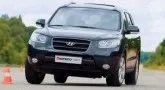
The Korean SUV Hyundai Santa Fe has already managed to win the sympathy of Russian drivers. The car pleases with quality assembly, attractive appearance and an adequate price tag. Now the model has a diesel modification, which we decided to test at the Dmitrovsky autopolygon.
Initially, the new generation Santa Fe was equipped exclusively with a 2.7-liter gasoline engine. The V-shaped "six" with 189 hp coped well with a car weighing about two tons. However, Korean engineers decided that the engine range needed to be expanded, and the most obvious step was the appearance of a diesel. Since summer, the Santa Fe has been offered with a 2.2 CRDI engine, which works either with a 5-speed manual or with the same 5-range automatic. For the test, we chose the automatic transmission, since it is the one most often ordered by Russian buyers.
The diesel version is available so far in a single, but maximally equipped version. The equipment list includes leather interior, rain and light sensors, six airbags, ABS+EBD and ESP systems, full electric package - and this is far from all the options. There is enough free space in the cabin for everyone: with a total body width of 1890 mm, front passengers get 1555 mm, and rear passengers get 1540 mm. Therefore, even three people in the back will be quite comfortable, not to mention the front occupants.
The electric adjustments of the front seats have a large range of settings, so it will not be difficult to find a comfortable position. By raising the seat higher, you can sit "commander-style", when the hood and a couple of cars ahead are perfectly visible. The only thing you can find fault with is the complete lack of lateral support.
When starting, the diesel emits a characteristic rattle, but after a moment it works quietly and without vibrations. At idle, the noise in the cabin does not exceed 45 dB, and while driving the maximum reaches 67 dB. Thanks to such sound insulation, you can talk without the slightest strain on your voice. Outside, the car also does not make excessive noise: when accelerating from 50 km/h and at a steady speed of 80 km/h, the indicators are almost the same - 76 dB.
The diesel Santa Fe does not shine with dynamics. For a two-ton car, 150 hp is clearly not enough. The peak torque occurs at 4400 rpm, but the SUV starts confidently only after 3000 rpm. Up to this point, the diesel noticeably "sleeps" in the turbo lag, but after that the turbine kicks in, quickly spinning the engine up to 4500 rpm and forcing the gearbox to shift to the next gear. The most intense acceleration occurs after the 60 km/h mark.
The automatic transmission has a manual mode, but it will be more useful in winter - shifts occur the same as in the normal D mode. However, it allows you to drive quite dynamically in first or second gear, which is useful on muddy roads.
The manufacturer's claimed 11.6 s to "hundred" looks acceptable for such dynamics. True, in our measurements we managed to accelerate the Santa Fe to 100 km/h only in 12.6 s. However, the difference of a second is almost not felt in practice. The diesel Santa Fe is clearly not created for racing - its element is measured driving. The car covers four hundred meters in 18.5 s, reaching 120 km/h at the finish. The kilometer distance takes 34.1 s, and the speed by this time reaches 150 km/h.
In handling exercises - lane changes - the SUV showed itself worthy, even better than expected. The car passed the long ISO lane change at a speed of 125.3 km/h. On the short one, the entry speed was 72 km/h, but at the exit it dropped to 43 km/h. Such a drop is explained by the suspension design: multi-link systems with McPherson struts are installed at the front and rear. The settings are made in favor of comfort - the suspension mercilessly "swallows" even large bumps. But you have to pay for this with noticeable rolls, due to which during emergency maneuvering the car requires increased attention from the driver and constant correction of the trajectory. The rolls also dampen the exit speed on the short lane change. The result on the slalom is also modest - 58.9 km/h without load and 58 km/h with full load.
The brakes of the Santa Fe deserve special praise. From 100 km/h, the SUV stops in a decent 39 meters, and from 140 km/h - in 79 meters. For a car weighing 2006 kg, these are very respectable figures.
Our assessment
The Hyundai Santa Fe receives a "good" rating. Without bright victories, but also without failures - a typical golden mean. However, if you take into account the dimensions, the new diesel and the automatic transmission, the car definitely deserves respect. This SUV is created for sedate people who value comfort.
Body
- + spacious cabin
- + roomy trunk
Ride comfort
- + soft suspension
- - uninformative steering wheel
Power unit
- + economical engine
- - weak dynamics in automatic transmission mode
Handling properties
- + comfortable suspension
- + informative brakes
Safety
- + front, side airbags and curtain airbags
- + standard ISOFIX child seat mounts
Environmental friendliness
- - low fuel consumption