
The car's body is large, with pronounced relief and impressive, but at the same time it feels light and elegant. Your gaze involuntarily catches on it, and it looks very dignified, even solid. Sometimes this solidity is even excessive: at dusk, the Santa Fe can easily be mistaken for a more prestigious and expensive model. And how the left lane parts before it on the highway is impressive in itself, even without considering the xenon headlights. Beautiful!
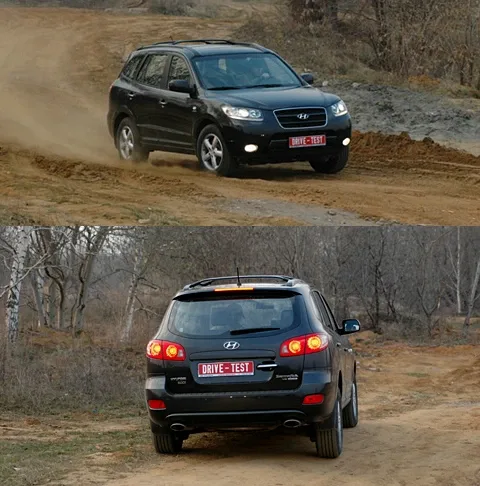
For most cars, driving on a country road is slow and bumpy, but in the Santa Fe you don't even have to ease off the gas.
Another detail that cannot but please: Korean designers cannot be accused of plagiarism. The Santa Fe's appearance is their own development; not a single line or curve reminds of other brands. Moreover, there are signature touches, such as the glowing strip of the front parking lights. And only during the day, when the Hyundai emblem is clearly visible on the body, does it become clear what's what. And then the surprise of those around becomes even stronger: "Can Hyundai really be that beautiful?".
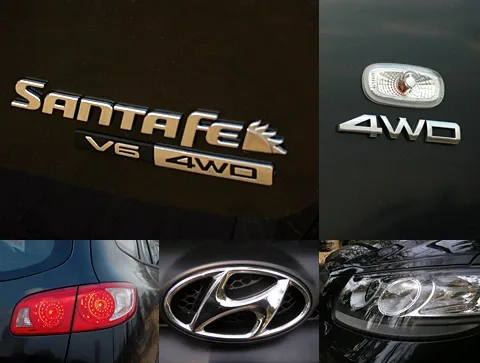
In terms of attention to detail, few cars can compete with the Santa Fe. The glowing "strips" of the front parking lights look especially good.
I believe that in the case of this car, Hyundai could well borrow Nissan's slogan "beyond expectations". Because you don't expect from a Korean car what you get. Usually, when buying a Hyundai, we count on a good price-quality ratio, inexpressive looks, and a simple interior finish. But here — just look: stylish design, quality materials, everything is top-notch. Both outside and inside, the car looks very decent. The leather on the seats is excellent, and combined with red stitching, it looks stylish too. The blue backlighting of all instruments and buttons adds a special charm to the interior. Even the wood inserts, which are usually a subject of mockery, look organic and appropriate here.
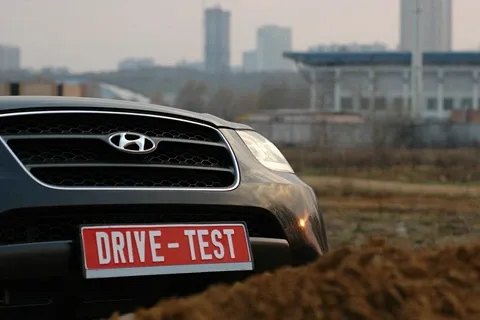
The Santa Fe is another step up for the Hyundai brand. Moreover, a step successfully conquered.
So, the exterior and interior are fine. But what about the Koreans' main trump card — the price-quality ratio? The price, it must be said, is not small at all: from $36,990 for the base version and up to $42,490 for a car with a full set of options, like ours on the test. Well, let's figure out how justified such a price is.
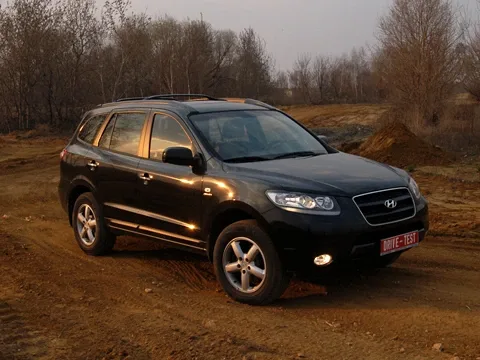
Behavior on the road is also pleasantly surprising. Under the hood here is the same unit as on the Tucson — a 2.7-liter V6 paired with a four-speed automatic. On that car, the combination didn't work very smoothly, but here it seems that the engineers managed to fine-tune their interaction — on the Santa Fe they work much more harmoniously. Delays are fewer, reactions to the gas pedal are faster. The engine, by the way, has become a bit more powerful than the Tucson's: the increased body dimensions should compensate for the additional 14 horsepower (now there are 189). True, unlike the exterior, in terms of dynamics the Santa Fe cannot compete with the Infiniti or Porsche Cayenne. A 2.7-liter displacement for such a car is essentially the minimum. The car is certainly not slow, there's enough thrust, but you'll have to forget about driver's "flights". No, this is a completely different car — calm and smooth, like an ocean liner.
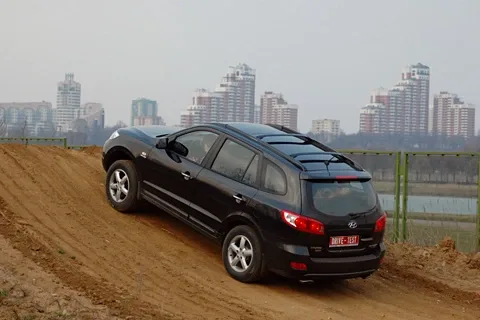
The Santa Fe's off-road capability is decent. But don't forget that it's still a crossover, not an off-roader.
Speaking of liners. The car's handling is quite interesting. You understand that under you is not a passenger car or even a compact crossover, but a big, serious "SUV". And it behaves accordingly. Reactions to steering wheel turns are precise, without delays, but very smooth. It feels like you're steering a boat or a yacht: you glide along an asphalt river, maneuvering between the little "dinghies" of passenger cars. There's something to that! At the same time, you can't say the reactions are inadequate — the car, of course, rolls, but it clearly holds its line. Of course, this is not a speed glider. Rather, a high-speed yacht. I also like its behavior on long "transatlantic" crossings: on the highway, the car goes with the confidence of the "Titanic" (before April 14, 1912), not noticing bumps, potholes, and not rocking on the "waves" of asphalt. So passengers are unlikely to be threatened with seasickness. And our trip won't be that long anyway — we're just going on a picnic.
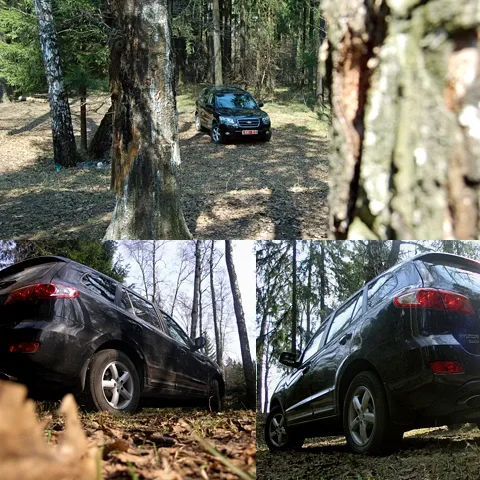
Unlike its Japanese and German "colleagues", a lone black Hyundai SUV in the forest doesn't look criminal.
Unlike the "Titanic", the Santa Fe can't swim. But it can drive on roads of varying degrees of badness — from German autobahns to Russian country roads. It's certainly not an off-roader, but the high ground clearance, torquey engine, automatic transmission, and on-demand all-wheel drive allow it to go much further than passenger cars. The energy-intensive suspension allows you not to reduce speed even on very bad roads (by European standards) and only slightly brake on uneven ones (by Russian standards). At the same time, the cabin maintains a quite comfortable environment.

Our family car expert rated the space, comfort, and convenience of the cabin so highly that he refused to give detailed comments.
Therefore, a "round-the-world cruise" from home to the dacha and back will please everyone. There's plenty of space, lots of little boxes and shelves for small items, and comfortable seats. But passengers in the second row are especially well off. They have everything: their own air vents on the middle pillars and seats with adjustable backrest angles. But the main thing, of course, is the TV with a DVD player.
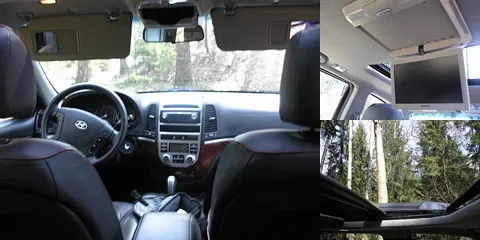
The interior is of a quality completely unusual for Hyundai. And the equipment too.
However, front passengers are not deprived either: they have dual-zone climate control, and the "captain" can, if desired, rotate the screen 180 degrees and watch cartoons through the rearview mirror. Though, it's better not to allow him such liberties — let him rather turn the steering wheel. It's a pity that seven-seat versions of the Santa Fe with a third row of seats are not supplied to us. But then the trunk is bigger, and in size it's only slightly smaller than a dry cargo ship's hold.
But what "exceeds expectations" most in this car is the price of $42,490. Especially at first glance at the car. Many will immediately say: "Such money for a Korean car? For that money, you could buy a three-year-old ML!". And I must say, at first I didn't share the optimism of those who wrote the numbers on the Santa Fe's price tag. But I compared it with new cars. Compact Japanese crossovers like the Toyota RAV4 cost a bit less and win over with their Japanese origin, but, no matter how you look at it, they're not in the same "size" class — the Santa Fe is bigger. Roughly like the Nissan Murano or Subaru B9 Tribeca. But to this pair, the Santa Fe will lose in almost all parameters — both in equipment and engine power. But especially in price. It costs about one and a half times less.
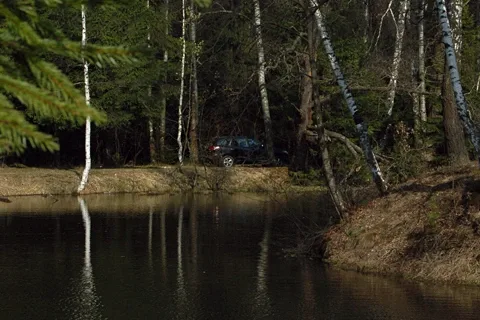
And after being in the role of its driver and driving it for several hundred kilometers, you understand that this "vessel" is quite good. There's enough comfort. Dynamics (with some reservations) too. And if you want to save money, you can buy a "perpetual ticket" on the same ship, but with an economy-class cabin — in the base configuration without leather, dual-zone climate control, TV, and with a manual transmission, the Santa Fe will cost $36,990. If compared with the same Murano and Tribeca, it's almost a steal. And if you're ready to forgive the Korean steamer its origin and not-so-powerful engine, then this is a good option. Compared to most competitors, you'll get more space, comfort, and, if you want, prestige. After all, the Hyundai brand is rising higher and higher in various ratings every year (especially those concerning reliability). At least, the fate of the captain and passengers of the "Titanic" definitely doesn't threaten Santa Fe owners.
This Korean SUV with a 2.7-liter V6 engine, to put it mildly, does not impress with its dynamics. Acceleration to 100 km/h in 11.7 seconds — figures that do not inspire awe. But, as it turned out, that's not what matters at all.
The interior greets you with a pleasant contrast: leather, wood inserts, a neat instrument panel. The list of equipment is impressive even now, and for a car of that time — it's simply luxury. Here you have dual-zone climate control, heated everything you can think of, and even a TV with a DVD player. Ergonomics are well thought out: you sit high, visibility is excellent, all buttons are at hand.
You start the engine — and hear a quiet rumble of the V6. On the move, the car feels heavy and solid, but that's rather a plus. The suspension, independent on both axles, is energy-intensive but not too stiff. It swallows small joints and potholes with enviable calm, although on large bumps the body noticeably rocks. The power steering is light, but it lacks feedback — on the highway you have to constantly correct the steering.
Fuel consumption in the city was about 14.4 liters, on the highway — about 8.4. For such a large and heavy car, this is acceptable, though not record-breaking. But the trunk is huge: 774 liters in the standard position, and with the rear seats folded down — almost 2274. Inside, the rear is very spacious: three people will fit without any problems, and the seat back is adjustable for recline.
The 4-speed automatic raises no questions: it shifts smoothly and without delays. All-wheel drive with a rigid coupling lock allows you to feel confident on dirt roads or light off-road. But no more than that: the ground clearance and body geometry clearly hint that the main element of this car is asphalt.
In the end, this is a very honest and predictable car for those who need a spacious, comfortable, and well-equipped SUV for the city and highway trips. It won't delight you with driving excitement, but it will become a reliable and cozy home on wheels.