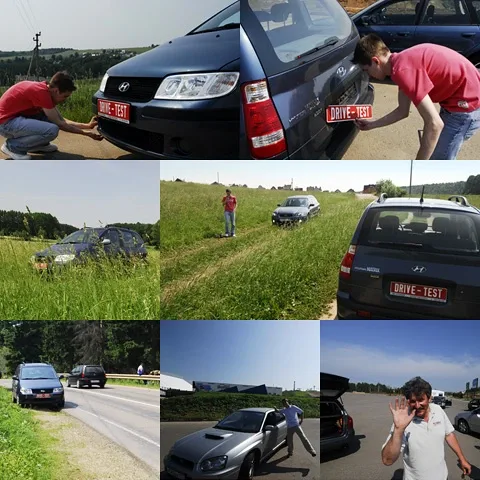
One can only be glad that this car shares only its name with the famous film. Of course, it can hardly be called a revolution in the automotive world, but it never claimed to be one, quietly and steadily existing in its niche... Although wait, which class exactly should it be assigned to? A compact MPV? Not quite. A golf-class hatchback? That's closer to the truth.
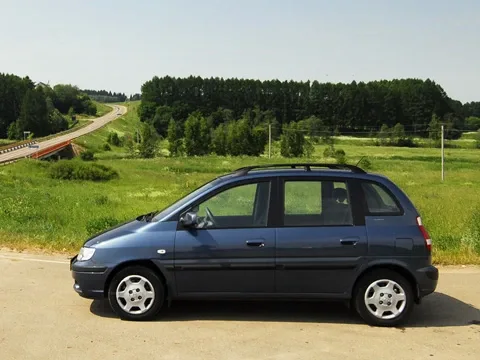
Most likely, we have a hatchback with hints of a family compact MPV. Small dimensions with short overhangs and a high roof that gives a sense of spaciousness in the cabin. The interior feels simple to the touch but looks rather amusing. The plastic, trim materials, and even the seats — flat, with no hint of lateral support — all justify the car's low price. The base version of the Matrix costs only $16,190. For the test, we got a car that includes everything from the price list, i.e., the top trim, which costs $19,490.
However, on the outside, the Matrix looks much more attractive. Even in this gloomy dark blue color, it looks unusual. One of the most memorable details is the broken line running along the side. It loops along its whimsical trajectory from the front fender to the intricate rear lights. This same line visually lowers the window line indecently low, which, by the way, only improves visibility. This flight of design thought is completed by the "Pininfarina" badge. Yes, it is the famous Italian studio that designed the exterior of this "Matrix" on wheels. It is unlikely that this work can be called the best in the studio's history, but the Italians certainly did not spoil the image of the Korean.
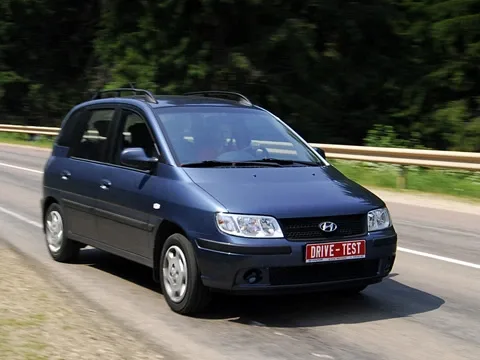
But this car lives not by design alone. It turns out it can drive, as hinted by four wheels, a steering wheel, pedals, and other necessary attributes. And indeed it drives! Rustling its tires on 15-inch wheels, the Matrix with a 1.8-liter 123-horsepower gasoline engine accelerates confidently, doing so quite quietly — thanks to the quiet engine and good sound insulation. It accelerates to 100 km/h in 12.7 seconds, and the top speed is 170 km/h. These are not outstanding figures, but quite suitable for a family car. For a moment, it even seemed to me that in terms of dynamic sensations, this Hyundai model outperforms the previously tested Tucson 2.7 V6, not to mention the Getz 1.6 with an automatic.
However, this is only the first impression. The high seating position (hello to the high roof!) and a fairly responsive automatic, whose lever, along with the instruments, is placed on the center console, which is unusual for Hyundai automatics, play their role. It certainly does not make the Matrix a sports car, but it can provide a couple of fun minutes. Especially if before this, you, say, have not driven a Ferrari Enzo.
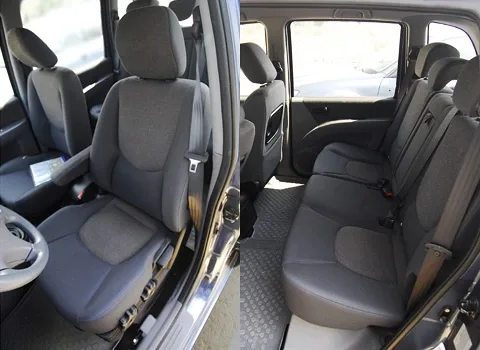
The driver's seating position, although high, is quite comfortable. And rear passengers will not be cramped even three abreast.
If you really have not had a Ferrari, then you will have no complaints about the Korean's handling either. Completely devoid of sporting ambitions, it goes through corners just like any average car. Without spark, with noticeable body roll if you enter a corner too sharply, but very confidently, instilling a sense of security.
The suspension is soft enough during calm and careful driving, but if you let a pothole pass your eyes, the car will immediately remind you of it, shaking noticeably on the next hole. So I advise you to slow down to avoid trouble. Fortunately, there are brakes here, although calling them very informative is hard. They certainly stop the car, but not the way you intended before pressing the pedal. However, it's tolerable.
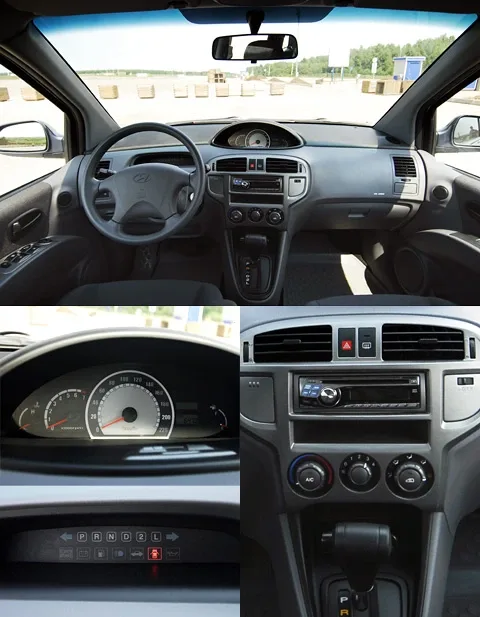
The unpretentious interior of the Hyundai Matrix, woven from simple trim materials, is "amusing" only by the original placement of the instrument cluster.
But what is hard to get used to at first is the instrument cluster located in the middle of the dashboard. You drive, glance at the speedometer — and it's not there, only some lights (as it turned out, a set of warning lights). The solution is not the most successful: you have to search with your eyes for a long time, "what speed am I, damn it, going?" But you quickly get used to the various pockets, compartments for small items, and other pleasantries with which the Matrix is generously endowed. All the small junk you carry with you will be perfectly sorted in the "Matrix." There are even tables for rear passengers. Apparently, that's why there is no sporty streak in the Matrix — so that passengers eating in the back do not get their lunch on their laps. In general, there is everything for a good life: whether you go to work or with friends to the dacha.
There is indeed a lot of space in the back; three people will not be cramped. Moreover, the rear seat is split into parts, each of which adjusts in length and backrest angle. But you can't stuff many things into the trunk — it is quite small. You can, of course, fold the rear seat (by the way, there are hidden compartments under the rear seats for various small items), but then you get a small delivery van. Additionally, you can order roof rails as an option for installing a roof rack. But even without that, the transformation capabilities of the Hyundai Matrix are quite good.
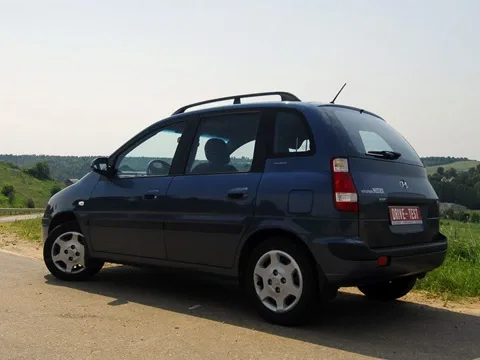
We concluded that the Korean "Matrix" on wheels is a car average in all respects. Not the golden mean, of course, but at least silver, well, okay, you've convinced us — bronze. A good car that, during the entire ruthless testing with trips to numerous suburban dachas and giant supermarkets, left only pleasant impressions and a full wallet of money: the average fuel consumption of its 1.8-liter engine over three days was 9.3 liters per "hundred" of the traditional for Hyundai 92-octane gasoline. It is also traditional to regret that our chief expert on family cars has still not returned from vacation.
He would definitely note that the Matrix is a car without sporting fervor, but with a bunch of practical little things, excellent climate control, adequate handling, and decent dynamics. And that is actually enough. After all, such a car will not be bought by a former world rally champion or a lover of junkyard tuning of the Russian auto industry.
The Hyundai Matrix is ideal for those who do not chase image, but at the same time want to stand out from the crowd at least a little, even with the "Pininfarina" badge. This car is for someone who cares not only about the comfort of their beloved self but also remembers that they have a family. But for a person buying a car exclusively for themselves, the Matrix is unlikely to suit. Of course, unless they are lured by Hyundai's five-year warranty and, in fact, the affordable price of the car.
Or maybe I am wrong? What if it is not so good and skillfully hides its shortcomings, putting the driver into a trance or plunging them into the Matrix? Perhaps that is exactly what happened.
| Technical specifications | |
|---|---|
| Body type | micro-minivan |
| Engine | Gasoline 1.8 |
| Number and arrangement of cylinders | 4 in-line |
| Displacement | 1795 cm3 |
| Number of valves | 16 |
| Power | 123/5500 hp |
| Transmission | 4-speed automatic |
| Drive | front |
| Front suspension | McPherson, with anti-roll bar |
| Rear suspension | multi-link, with anti-roll bar |
| Tires | 195/55 R15 |
| Front brakes | Disc, ventilated |
| Rear brakes | Drum |
| Curb weight | 1285 kg |
| Gross weight | 1840 kg |
| Top speed, km/h | 170 |
| Acceleration 0-100 km/h | 12.7 s |
| Fuel consumption, urban cycle | 12.5 |
| Fuel consumption, extra-urban cycle | 7.2 |
| Fuel consumption, combined cycle | 9.1 |
| Fuel tank | 55 L |
| Dimensions | |
| Length | 4025 mm |
| Width | 1740 mm |
| Height | 1685 mm |
| Wheelbase | 2600 mm |
| Track, front/rear | 1485/1485 mm |
| Ground clearance | 160 mm |
Equipment of the tested car
The basic equipment of this version includes everything needed for comfortable everyday use. At the front, there are height-adjustable belts with pretensioners, and the rear row can be slid and the backrest angle changed. The second-row seats fold in a 60:40 split, which significantly expands the luggage compartment's capabilities. For rear passengers, three-point inertia belts and adjustable headrests are provided.
The electrical system includes power windows on all doors, power-adjustable and heated mirrors, rear window heating, and a rear wiper with washer. The front wipers have an intermittent mode adjustment. The fuel filler flap opens remotely via a mechanical drive. Inside, there are fabric inserts in the doors, pockets in the front doors, central lighting, fabric headliner and sun visors, with mirrors hidden in the visors. The floor is covered with pile carpet. There is a cigarette lighter with ashtray, a glove box and an additional compartment for small items, cup holders, and an electronic clock. The central locking is supplemented by a rear door opening lock.
The trunk is thoroughly prepared: side trim, shelf, net, socket, lighting, a compartment under the floor, and a side box. Outside, the bumpers and door handles are painted in body color, while the mirrors and side moldings are black. The brakes are disc at the front and drum at the rear. The wheels are steel 15-inch with decorative hubcaps, fitted with 195/55 R15 Hankook or Kumho tires. A full-size spare wheel, rear fog lights, mud flaps, and roof rails are included. The audio preparation includes four speakers, an antenna, and wiring.
The suspension here is reinforced, which is immediately felt on the road. The steering column is height-adjustable. The driver's seat is adjustable in height and cushion tilt, with an adjustable lumbar support. The front seats are heated. The interior includes both armrests — front and rear — as well as air ducts for rear passengers. The front panel is decorated with aluminum-look inserts, and the speakers are high-frequency. There is a passenger airbag.
The test vehicle was provided by- Power steering
- ABS
- EBD
- Driver airbag
- Air conditioning
- Cabin filter
- Front seat adjustment in longitudinal direction and backrest tilt
- Side pocket of driver's seat
- Tray under front passenger seat
ZAO "Karnet-2000" — the exclusive importer
of Hyundai cars in the Russian Federation. Behind the scenes