Hyundai i30
INSPIRATION
Engine - 1.6 L CVVT
Max power -
122 hp/6200 rpm
Max torque - 154 Nm/4200 rpm
Max speed (km/h) - 188
Acceleration 0-100 km/h - 12.1
Fuel consumption:
city - 9.0
highway - 5.7
combined - 6.9
4-speed automatic
front-wheel drive, front independent McPherson suspension, rear independent multi-link with anti-roll bar
Curb weight - 1214 kg
Length - 4245 mm
Width - 1775 mm
Height - 1480 mm
Ground clearance - 150 mm
Tires 205/55R16
Price $22,745 (181,953 UAH)
Equipment:
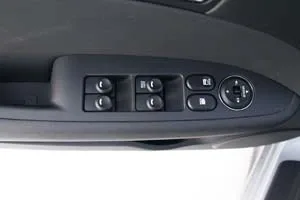
Comfort: 6 airbags, ABS+EBD, immobilizer, 4 electric windows, alarm, climate control, cooled glove box, heated wiper rest zone, rain sensor, USB+AUX ports, CD/MP3 radio with 6-disc changer, multifunction steering wheel, fog lights, alloy wheels
Service interval:
15,000 km
Service 1 - 15,000 - $188 (1,503 UAH)
Service 2 - 30,000 - $266 (2,127 UAH)
Service 3 - 45,000 - $255 (2,036 UAH)
Service 4 - 60,000 - $282 (2,255 UAH)
Service 5 - 75,000 - $188 (1,503 UAH)
Service 6 - 90,000 - $366 (2,923 UAH)
Service 7 - 105,000 - $188 (1,503 UAH)
Service 8 - 120,000 - $282 (2,255 UAH)
Warranty - 3 years or 100,000 km, on engine and transmission - 5 years or 120,000 km

Marat Makhmutov, “Kazan School of Advanced Driving Skills”
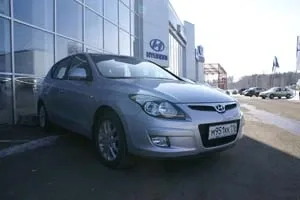
Hyundai i30 is the first model from the Korean manufacturer to receive a designation of a letter and a number instead of a traditional name. With this car, HMC completely abandoned its own names for new models. The logic is simple: the letter “i” stands for “inspiration,” and the number indicates the class. Here, ten corresponds to segment “A,” twenty to “B,” and so on, up to “E,” which is designated as 50. Our hero, therefore, belongs to the European “C” class. Admittedly, at first we considered the car with its 4245 mm length and 1775 mm width (factory data) a representative of the “B+” segment, but the 2.65 m wheelbase immediately raises the newcomer a step higher. Looking ahead, I’ll say: the extended wheelbase gives rear passengers complete comfort — there’s enough legroom, and headroom is also decent. Involuntarily, you recall domestic “eights,” “nines,” and their clones: they are also positioned as golf-class, but the space in the back is so scarce that it’s only suitable for small children, and it doesn’t withstand criticism.
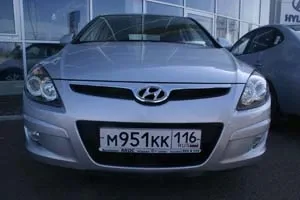
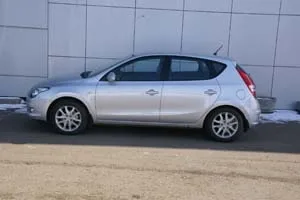
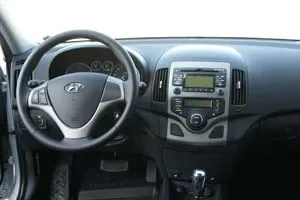
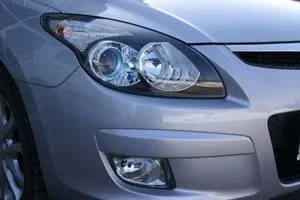
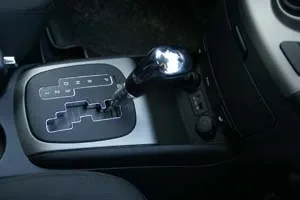
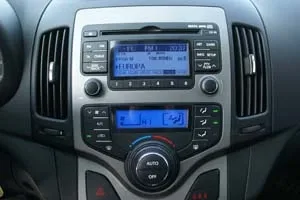
HMC products have recently made a giant leap — both in design, build quality, and finishing materials. The new i30 is no exception: it looks quite attractive, and in places even sporty. This is facilitated by the twin radiator grille, high beltline, and hood with headlights that boldly extend onto the front fenders. The rear of the silver hatchback somewhat resembles the BMW 1 Series. For a city car, the comparison is, you’ll agree, flattering. Inside, everything is neatly fitted, materials are solid, and the instruments please the eye with soft blue LED backlighting. There’s single-zone climate control, the audio system plays decently, though without thrills. A funny detail: when saved radio stations are displayed, instead of standard numbers 1, 2, and so on, their operating frequencies are shown. Very convenient! Six airbags, MP3, AUX, and USB ports, light and rain sensors, heated wiper rest zone (though we never managed to find it, but according to the description it should be there), leather steering wheel with a rubberized silver insert in the center and radio control buttons — all this added pluses to the first impression. I’ll especially note the chrome automatic transmission selector: it looks stylish, and it lies in the hand so that you want to shift it again, so well it’s ergonomically designed. The trunk, frankly, is small — 340 L up to the rear seatbacks. But if you travel together, the seatbacks fold down, and the volume grows to 1250 L — that’s serious. The rear emblem in the form of a slanted letter “H” initially tempts you to pull it toward yourself, as done on Volkswagens, but that’s a deception: the door opens with a button hidden under the emblem. The European origin of the i30 is also indicated by the spare tire in the trunk floor instead of a full-size wheel. And thank you for that — they could have limited it to a can of sealant!

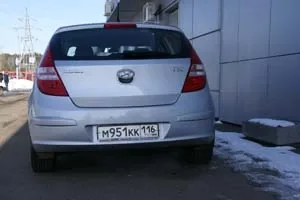
Now about how it drives. The test car in the “Comfort” trim — second from the top — has almost everything from the options list for the 1.6 L engine, except leather upholstery. I already mentioned the automatic transmission, but there are 122 horses under the hood — the same as the new Toyota Corolla with its VVT-i system. The Korean is also equipped with a 16-valve DOHC CVVT head, hence such output from an engine of standard displacement for this class. When starting from a standstill, if the selector is in “D,” the car briskly takes off, and it seems the Hyundai will remain a “live wire.” But no — after the torque converter shifts to higher gears, the fervor fades, and the car turns into an ordinary means of transportation. It’s a pity; the start was promising… Perhaps the outdated four-speed automatic is to blame, or the gear ratios are chosen at the expense of dynamics for fuel economy. To be fair, I’ll note: if you move the selector to position “2,” the thoughtfulness disappears — the engine happily revs up to 5200 rpm, and dynamics become quite decent.
I’m sure it’s with a manual transmission that this car fully reveals its potential. But the i30 handles very well: navigating the “slalom” at 50-55 km/h on packed snow and thawing ice was a true pleasure. The steering wheel, despite the electric power assist, is filled with pleasant heaviness, which is uncharacteristic for this type of mechanism. Of course, everything is learned in comparison, but a fact is a fact. Overall, the sporty appearance is not empty words! On small bumps at low speed, the car seems a bit stiff, but on real city roads, this feeling turned out to be deceptive — the “Korean” is quite comfortable, softly swallowing asphalt cracks and small potholes with bulges. On the highway at speeds above 120 km/h, the sound insulation pleased: only the studded Michelins and a slight whistle of wind in the area of the front pillars were audible. Given that the car is clearly tuned for the city, it’s hard to call this a drawback. The maneuverability check in traffic was more a tribute to our testing methodology than a necessity. The platform sibling Kia Ceed, which the new city Hyundai essentially is, showed full adaptability to urban jungles: compact dimensions, decent capacity, and a powerful engine. It’s no wonder this model was named Car of the Year 2008 both in faraway Australia and in sophisticated Spain, where they know a thing or two about city cars. Attractive looks and a large number of options previously available only to larger cars — this is a serious claim to leadership in the most in-demand segment in Europe, and here too, the golf class. The price of the newcomer, of course, can’t be called cheap, but the old rule applies: “We are not rich enough to buy cheap things.” And in current economic conditions, this argument sounds especially convincing.

Vadim Sadykov, “Autoclub-Kazan”
This time I had to pick up the car from the dealership alone. While taking interior shots, I noticed how neatly the finishing materials are matched and how nicely the front panel is designed. And the volume of the luggage compartment for B-class cars is simply huge! It seems this is already the “B+” level. And only after looking into the technical materials did I surprisingly discover that this hatchback is classified as C-class (and for B-class, the Koreans have a separate new model — i20). Where does this confusion come from? It’s simple: the fresh i30 is almost 10 centimeters shorter than its direct hatchback competitors (a sedan, of course, would be even longer) like the Fiat Bravo or Nissan Tiida. In other words, in length it’s comparable to the compact Skoda Roomster.

With the photo shoot done, it's time to hit the road: we need to get from Gorkovskoye Highway to the new hippodrome, and time is running out. And right away, first impressions: the studded Michelins hum too loudly, and the sound insulation in city traffic leaves much to be desired. I turn on the music. Volume is sufficient, no argument there, but the sound quality of the six speakers is mediocre. While driving and trying to "listen" to the car, I suddenly realized—the i30 is actually very comfortable for the driver. Levers and buttons are at hand, the control logic is simple and clear, the seat is comfortable, and visibility is excellent in all directions. On smooth asphalt, driving is pure pleasure. True, in sharp turns there's a slight roll, to my taste, but it doesn't throw you off the chosen trajectory. Now let's check how the car handles a broken road (our road workers, as always, have provided plenty of opportunities for this). At 20 km/h, the car reacts too harshly to every pothole and bump. Honestly, I can't recall any other car shaking like this. I accelerate to 55–60 km/h—it shakes, but it's more tolerable. I add up to 70—and here real magic happens! I see the potholes but don't feel them at all—you drive as if on smooth asphalt. Now that's a result! And another detail that catches the eye immediately is the very grippy brakes. I had to get used to them: better not to press the pedal but barely touch it. But the braking distance is short—that's safe.
Under the hood is a modern 1.6-liter engine with variable valve timing, producing 122 hp at 6200 rpm, paired with a 4-speed automatic. I think I don't need to elaborate on my attitude toward four speeds—it's long been known. But each gearbox has its own settings, so let's look at this particular automatic. If you engage mode "2" (that is, lock out third and fourth gears), the car becomes quite peppy. But as soon as you switch to mode "3" (and even more so to "D"), the enthusiasm evaporates: acceleration is sluggish, and shifts occur with noticeable pauses. Alas, my favorite test—overtaking a slow truck on the highway—the i30 passed with a C grade. Sharp presses on the gas pedal don't help here, but with smooth pressing, the tachometer needle quickly crawls from 2000 to 3000 rpm, and we accelerate more or less confidently. At 5000 rpm, the car drives very spiritedly. True, not everyone is ready to constantly keep high revs—being a "racer" is more a state of mind. However, this 4-speed automatic has an obvious plus—it's tuned for fuel economy. After a mixed cycle (city and highway), the onboard computer showed 8.5 l/100 km, and after resetting and driving only in the city—9.0 l. That's a good figure. For the most curious readers (whom I especially appreciate), I'll add: the gear ratio from the engine through first gear to the gearbox output is 13.6 (a bit low), but with the manual it's 15.8 (more interesting). Doing a bit of math on a calculator, we conclude that with the manual, the i30 will be quite dynamic. And briefly about the entire engine lineup.

There's also a 1.4-liter unit with variable valve timing, developing 109 hp, but the peak torque at high revs (5000 rpm) is concerning. The most powerful is the two-liter, 143 hp and 186 Nm at 4600 rpm. It's curious how the 4-speed automatic works with the 2.0 in the Hyundai Elantra (you can read about that in the "Test Drive" section on the "Autoclub-Kazan" website). If the i30 has the same settings, then the claimed city fuel consumption of 10.3 l will remain an unattainable dream—driving that economically is unlikely.
I'd also like to say a few words about road behavior. On the test site, the car performed excellently: everything is predictable, and it handles very precisely. I genuinely enjoyed watching the master—Oleg Shatov—work from the passenger seat. And I did a bit of hooliganism myself—knocked over a couple of cones. At high speeds and in smooth highway turns, handling is also top-notch. After all, the rear independent suspension is a big advantage.
Another pleasant surprise is the rich base Comfort trim. Essentially, everything you need is there. Though, for me, it's already customary for a car to have a stability control system—safety above all. In that case, it's worth looking at the Style version, which has a leather interior, a light sensor, and a couple more useful options. Credit where it's due: Hyundai has made a solid, truly European car.