
 It happens that you get into a car and immediately understand unconditionally: this is definitely yours (or not yours). But the choice between the long-proven Volkswagen Polo, essentially a small Golf, and the i20, a representative of the newly minted Hyundai lineup, which should not yield to the unpretentious and comfortable, like favorite slippers, Getz, and at the same time occupy a new niche, turned out to be difficult to make.Comments (4)
The cars turned out to be so similar and at the same time diametrically different that when one pulled ahead, the other quickly gained points of its own advantages and evened the score.
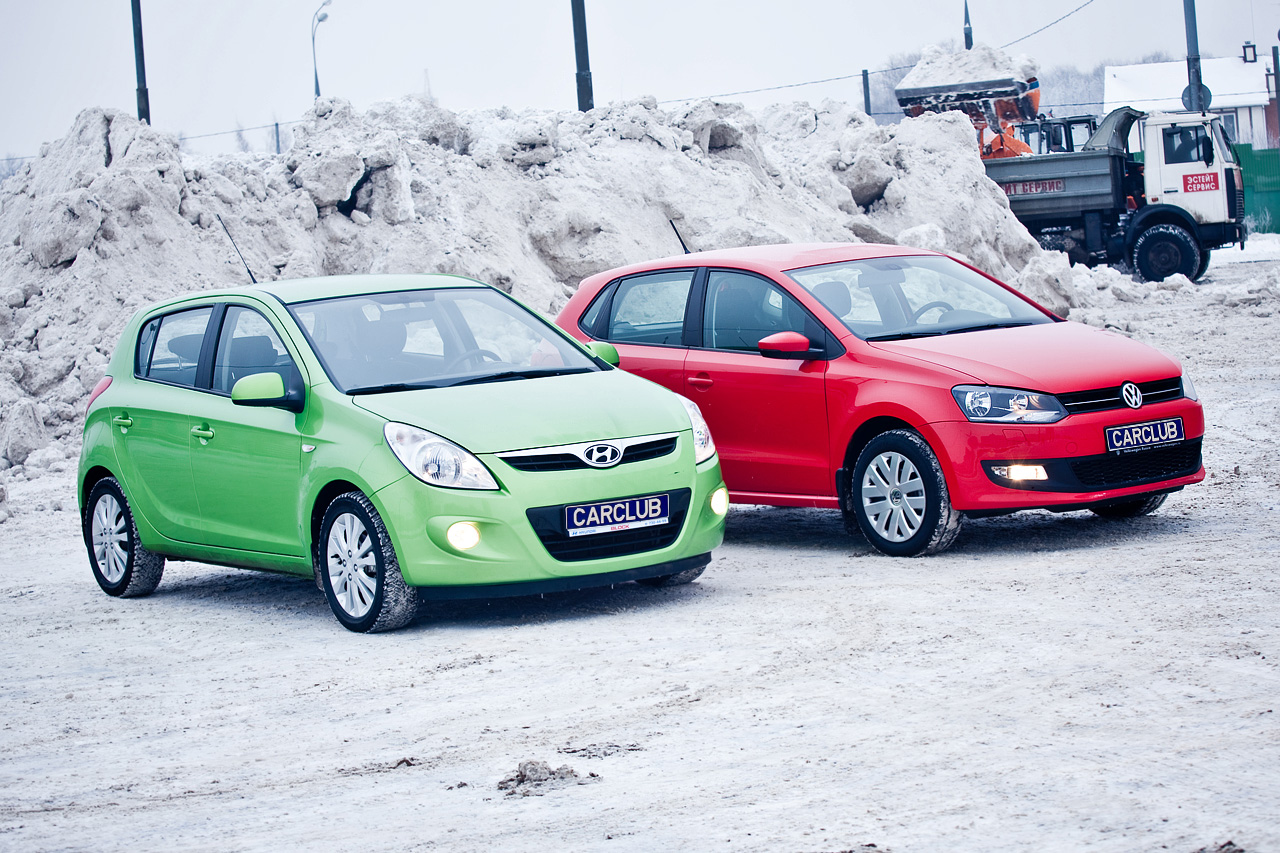

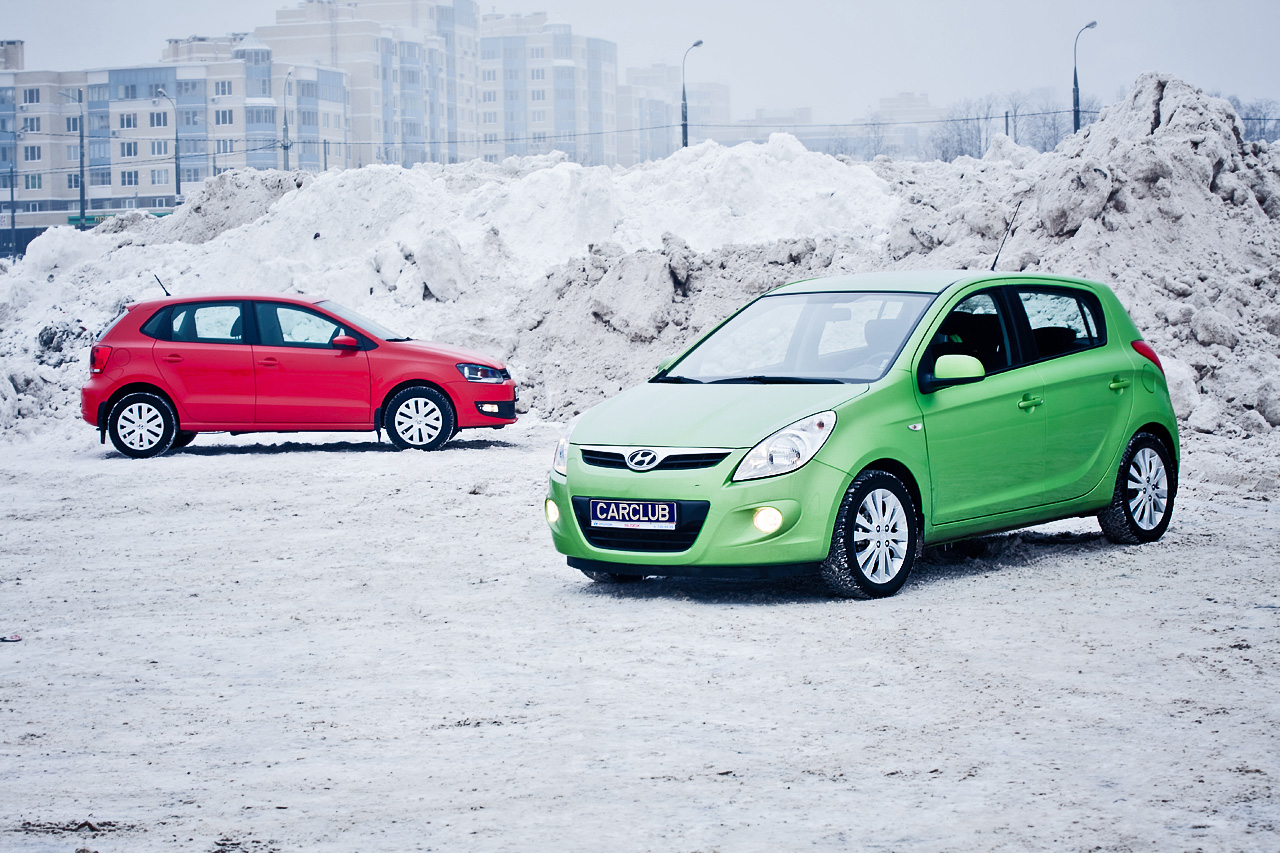
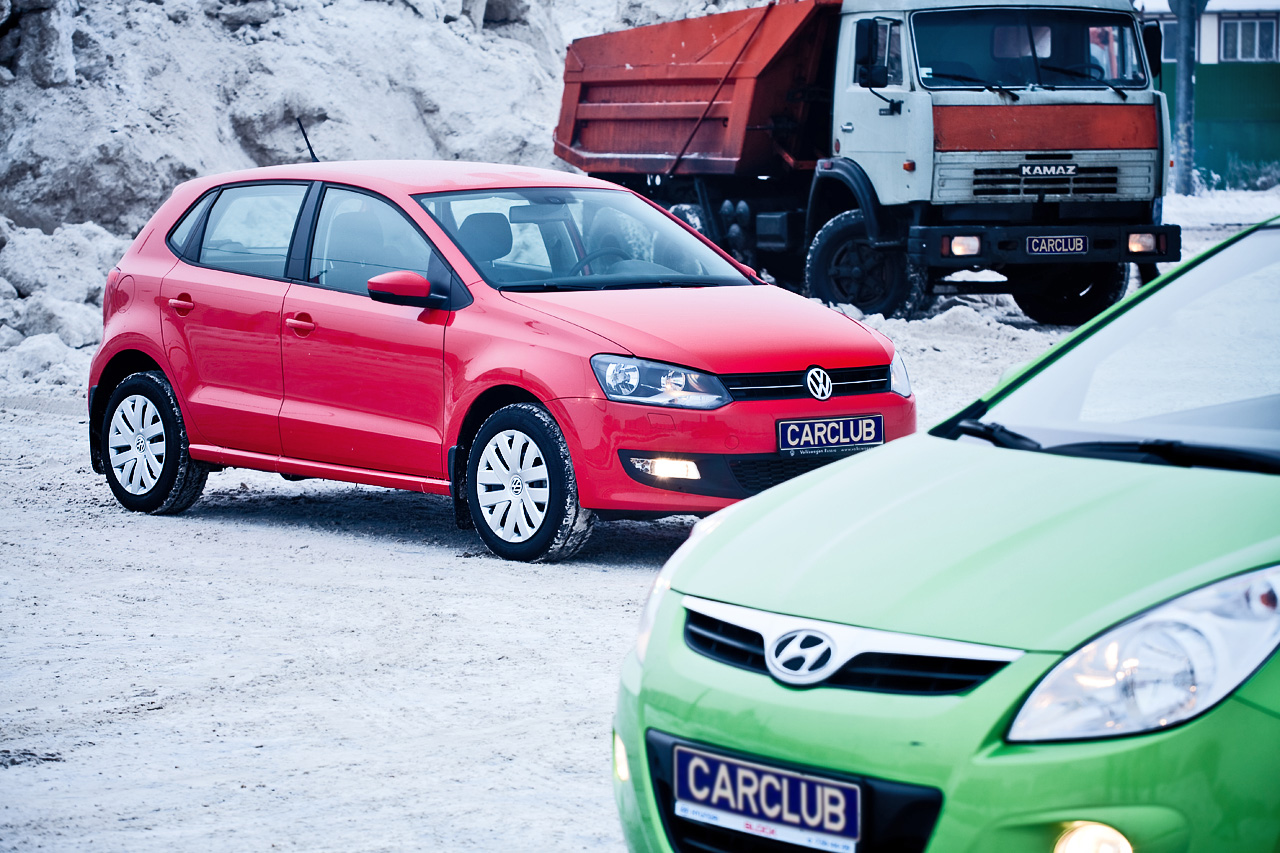
Take, for example, the appearance. At first glance, the exterior of the i20 wins against the serious and "adult" look of the Polo. As if the same, beloved Getz (each of us has an acquaintance driving a red or green "Getz"!) rounded at the corners, came alive with the "facial expressions" of cheerful relief lines and now mischievously peeks around with self-confident headlights. Due to the fact that the designers of Hyundai preserved the recognizable calm appearance of the Getz, the car does not blend into the crowd of round-sided and sharp-eyed B-class hatchbacks. Undoubtedly, the "i20" is externally much more interesting than the boring "Polo"! Until you look at the little VW in person, not in a photo.
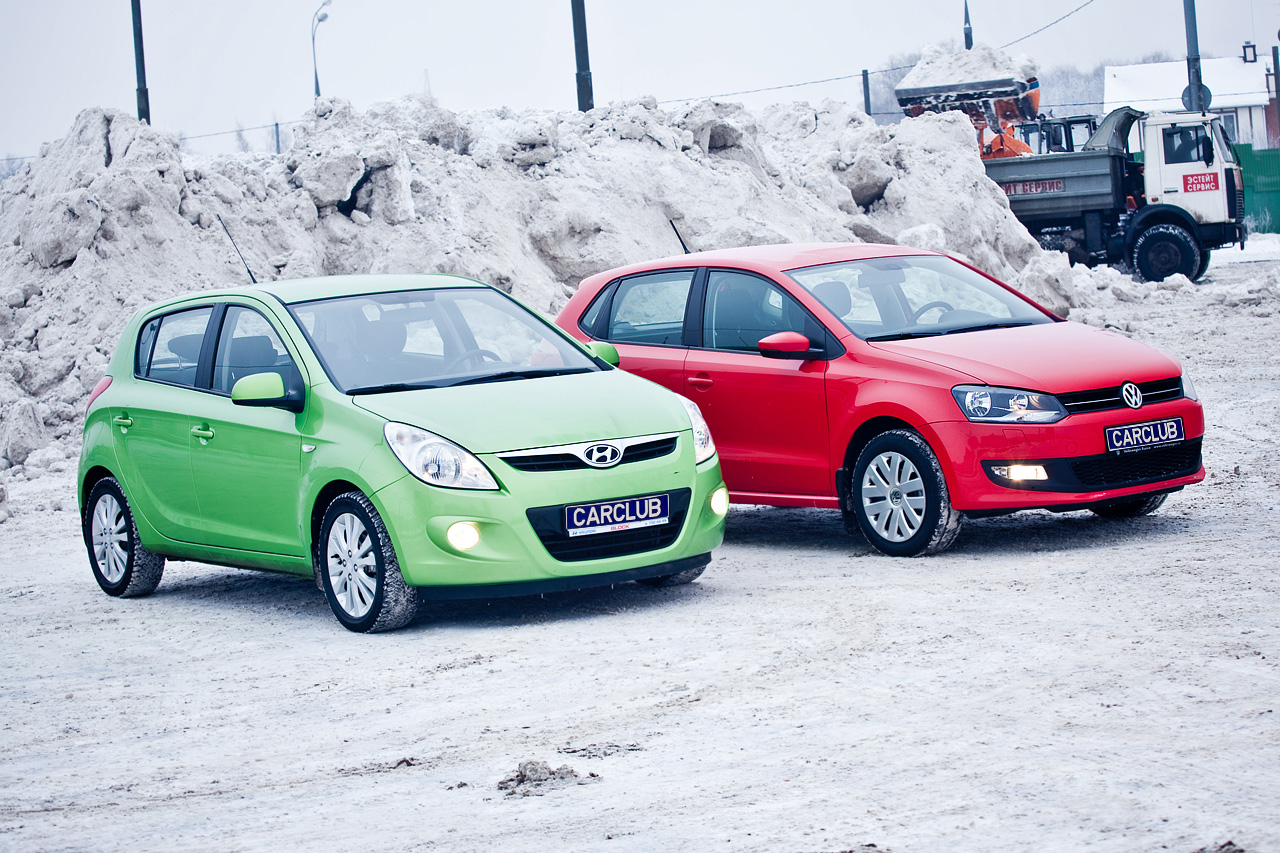 |
| The differences in the exterior are obvious: typical oriental design with slanting optics against German laconicism and strictness. |
The new Polo is the most severe of small cars! That squinting look... The taut sporty silhouette and the grin of the bumper can make it be mistaken for the older Golf, and the spoiler above the fifth door hints at potential. The non-standard square rear lights with flashing clear lines of stop signals are especially good. Stylish, serious, inspiring confidence with its very appearance.
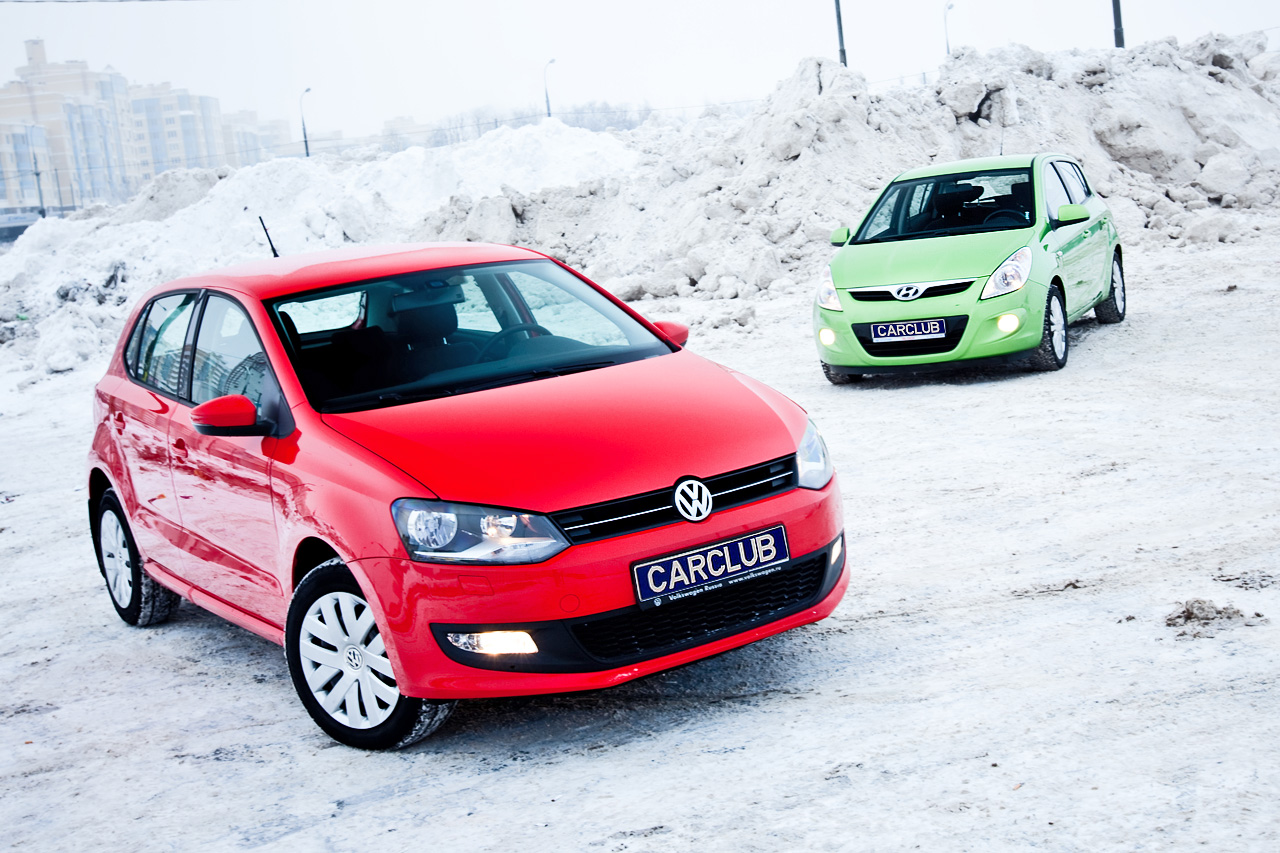 |
| Similar in technical characteristics and equipment, these compact hatchbacks are completely different in perception, character and, of course, price... |
The stylish interior of the Hyundai i20 is "cheered up" by silvered inserts on the center console, steering wheel and air deflectors. The German-style rigid front seats have a good profile and good lateral support. Ergonomics are at a high level. However, the quality of the plastic is lacking – there is not a single soft detail in the cabin. However, visually everything looks pleasant and even elegant, all screws are neatly covered with plugs, the seats are comfortable, the doors close easily and do not rattle. True, already with a small mileage, a cricket settled somewhere in the panel.
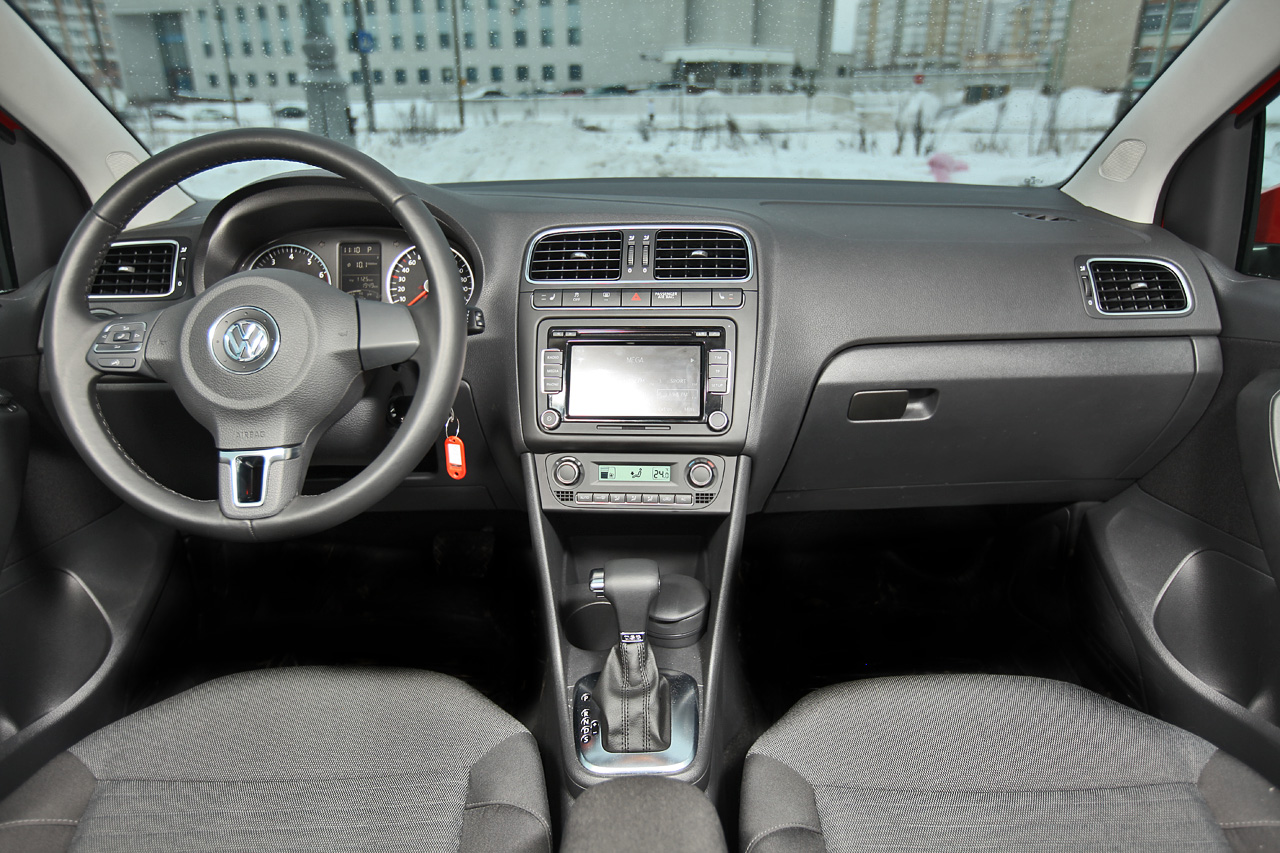 |
| The interior of the VW Polo is the standard of ergonomics and quality of finishing materials. Pleasant to the touch textured plastic coexists with noble fabric on the seats. The design of the Volkswagen interior is a tribute to unification in the automotive industry. |
After the Hyundai interior, the VW Polo seems like a business class. It is indecent to write banal enthusiastic reviews about the build quality and materials of "Volkswagen" cars, but what to do if everywhere there is really soft and high-quality plastic, and the steering wheel is covered with pleasant to the touch leather. All switches and buttons are activated with a noble European effort. Even by the sound of the closing door, you can determine that in front of you is a purebred German. Ergonomics – you can't find fault. Among the aesthetic features is the unusual acute-angled shape of the side mirrors with dots of built-in turn signals. The touch color display, which shows audio system data, pleased. But the folding center armrest blocks access to the handbrake – inconvenient.
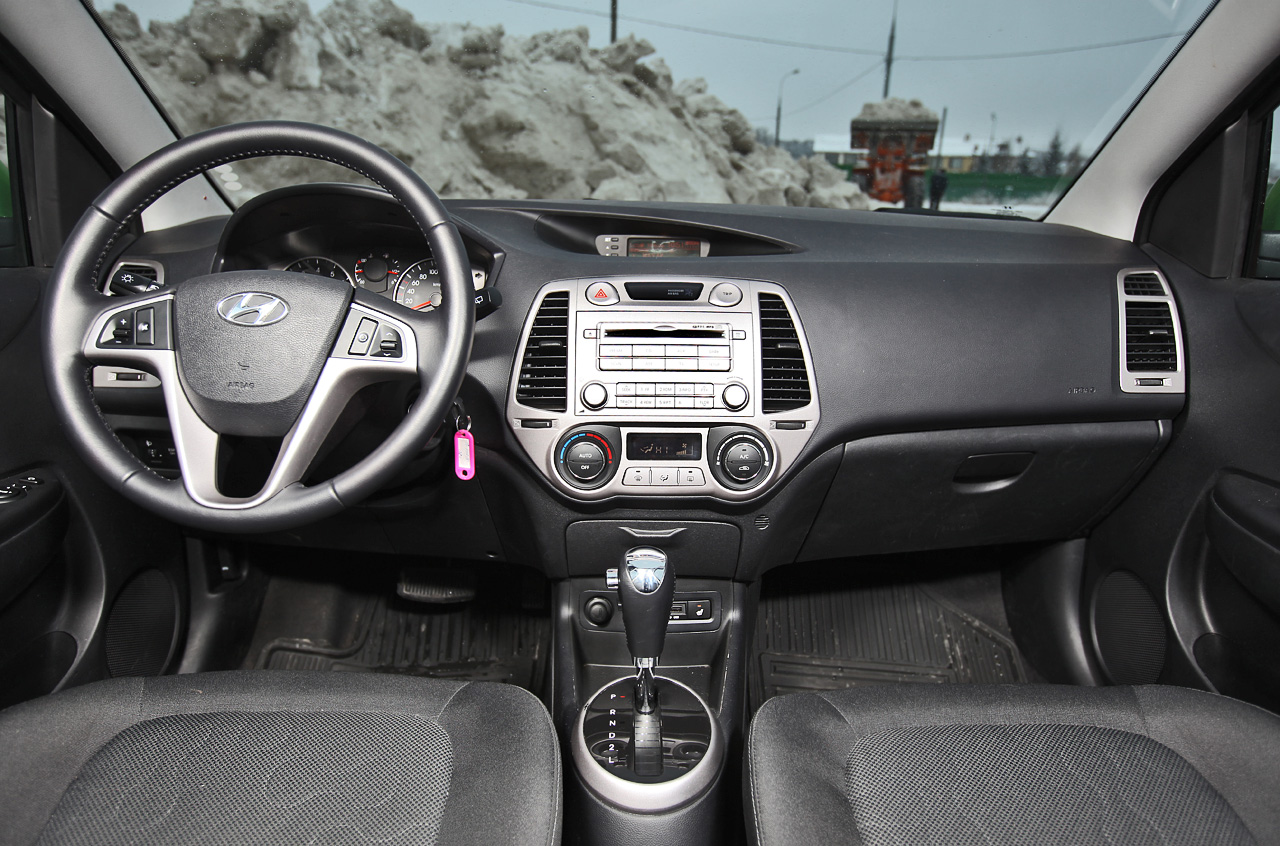 |
| The interior of the Hyundai i20 is no less comfortable, but the quality of finishing materials is significantly lower, which, however, is more than compensated by the difference in price. |
The driver's seat is good: the range of adjustments is enough for both a tall and a sporty seating position. The only thing you can complain about is the small distance between the pedals, which makes it difficult to control the German strongman in winter shoes.
In both cars, various containers for small items are well thought out: pockets, boxes, cup holders. The glove box of the i20 is especially impressive – it seems so deep that it reaches almost to the engine compartment. And both have USB flash drive ports already necessary for a modern motorist, because it is so much more convenient not to look for the right disc among 20, but simply select the desired folder with a finger movement.
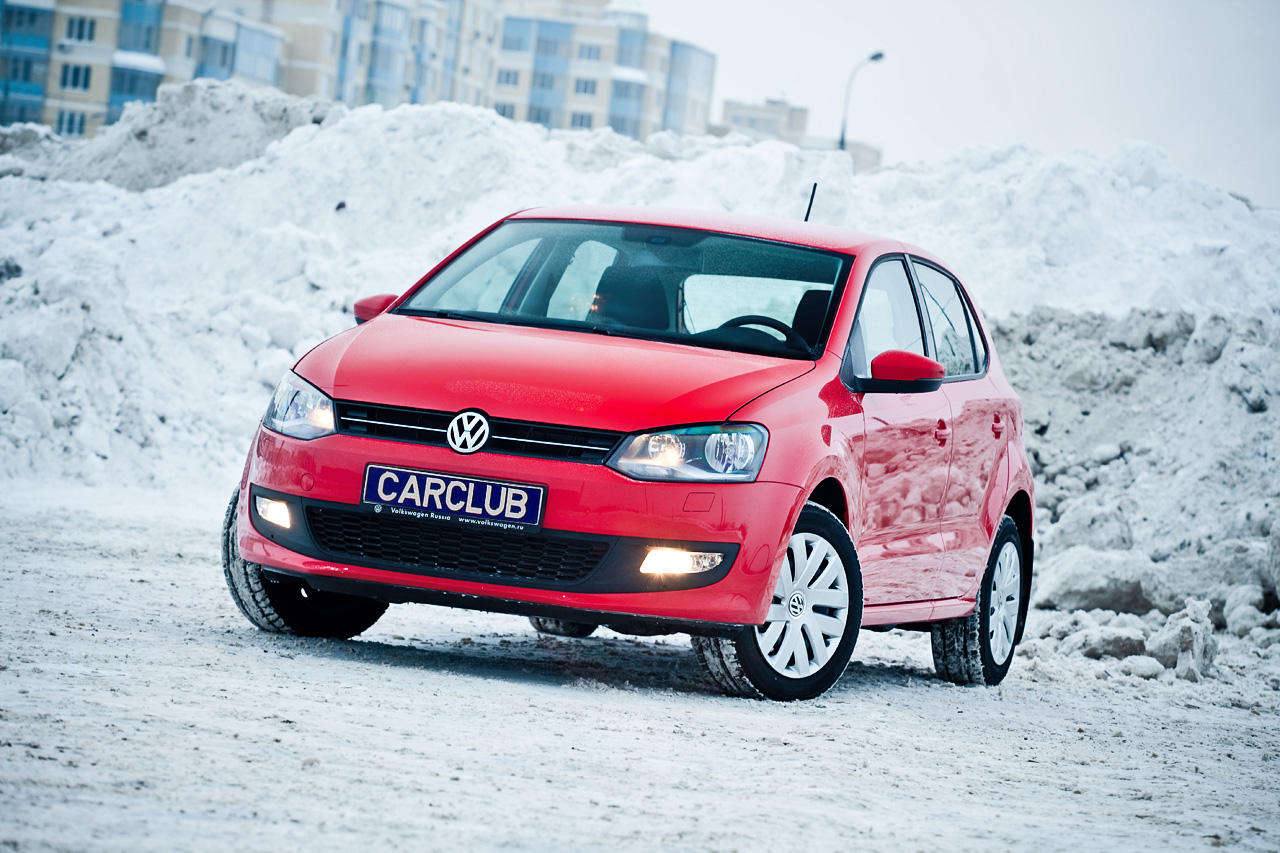 |
| For the comparative test, we chose a five-door body. Under the hood is an 85-horsepower 1.4-liter gasoline engine, which is paired with a new 7-speed robotic DSG transmission. |
Both duelists are equipped with 1.4-liter gasoline engines, however, their technical similarities end there. The VW Polo engine produces 85 hp. In the passport data of the Korean, there are 15 hp more. But according to the declared acceleration to 100 km/h, the Volkswagen is faster than the i20 by 0.8 seconds – 12.9 versus 12.1 seconds. The fact is that for the Polo a new 7-speed robotic gearbox DSG is offered, while the Hyundai is content with an ancient 4-speed automatic.
 |
| The Polo is built on a modernized platform of the previous generation of the model, and the Hyundai i20 received its basis from older models of the Hyundai-Kia concern - the i30 and cee`d hatchbacks. |
The new Volkswagen Polo is based on a modernized platform of the previous generation. To improve handling, engineers re-tuned the front McPherson suspension and modernized the rear, installing improved silent blocks.
As for the platform of the Hyundai i20, here it is unified with the older models of the Hyundai i30 and Kia cee`d, from which it inherited engines with a volume of 1.4 and 1.6 liters.
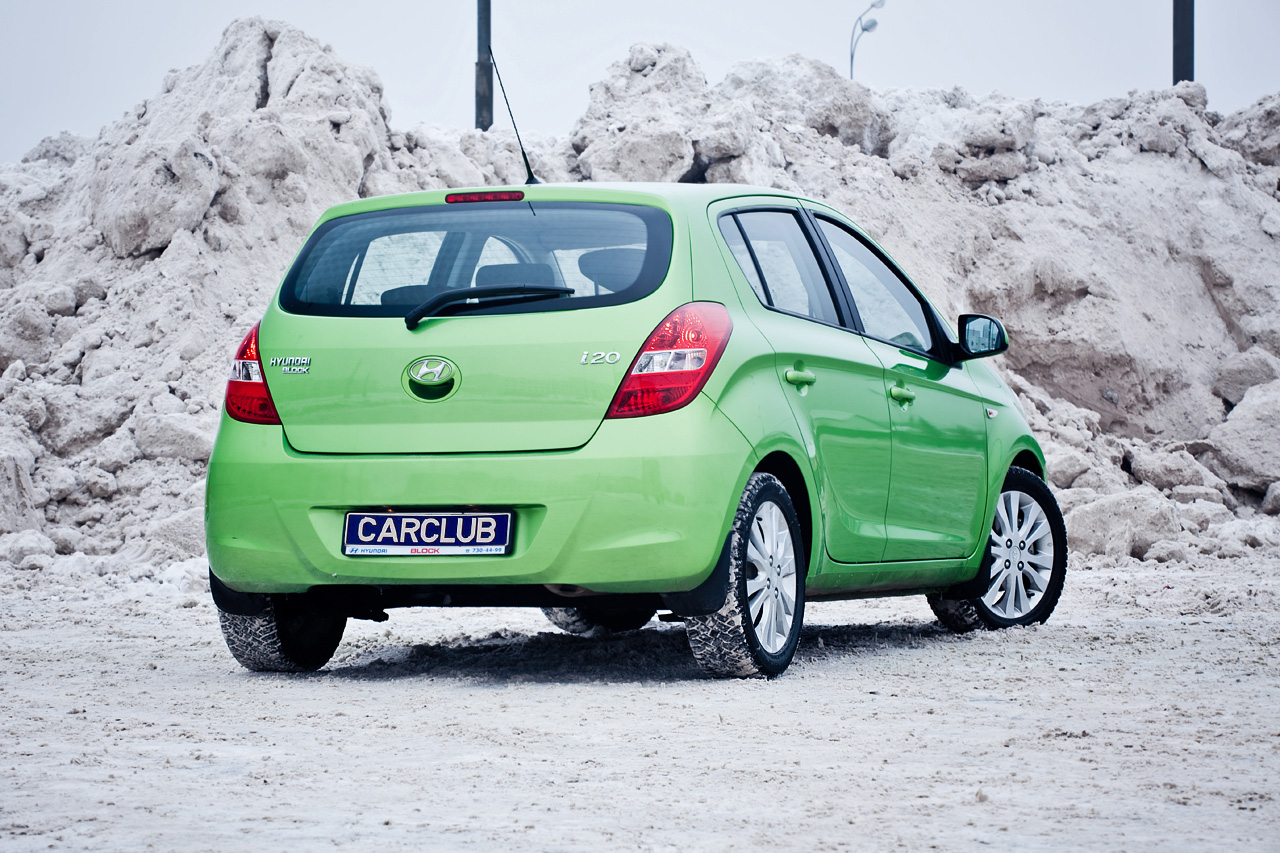 |
| The Hyundai i30 is powered by a 100-horsepower 1.4-liter engine. The advantage over the Polo is as much as 15 hp. However, according to the passport acceleration to "hundreds", the Korean loses 0.8 seconds. The old 4-speed "automatic" cannot withstand competition with the modern DSG. |
The "i20" justifies its bolder appearance in motion. The sensitive gas pedal constantly provokes wheelspin of the studded tires of the Korean hatchback. The car responds very responsively to the accelerator and, having endured the pause characteristic of "automatics", easily rushes forward, reliably clinging to the road. Even on winter studded tires, the spirited handling of the Hyundai i20 presented a real surprise. Already after the first trip in the bright green hatchback, we immediately rushed to the Internet: did the Koreans really leave the power steering? Oh no, there is an electric motor on the steering shaft. You can't remember such an electric assistant: the reactions of the sportily tight steering wheel are clear and understandable. However, at speed "zero" it smears. In addition, after 120 km/h, the i20 begins to yaw with its nose, requiring constant correction of the trajectory.
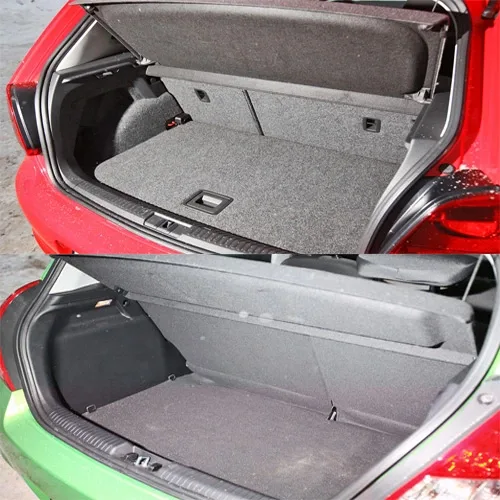 |
| The trunk volume of the Hyundai (photo below) is 295 liters. The Polo holds a little less - 280 liters. But under the floor of the trunk of the German, a convenient box for various small items is hidden. |
And this shows the difference in the characters of the "German" and the "Korean". If the i20 is sensitive, sometimes to extremes, sometimes seemingly trying to get out of control, allowing you to scare passengers with dashing steps, then the Polo is different. Everything is correct and under control.
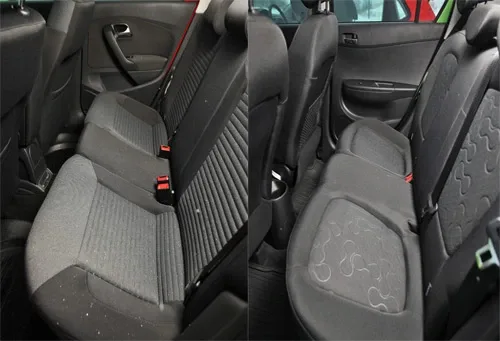 |
| In terms of the amount of space for rear passengers, both duelists are similar. Tall passengers are clearly not welcome here. |
The 85-horsepower Polo engine pulls quite well from the bottom, but starts to feel lively only after 3000 rpm, and when the tachometer needle passes the five-thousand mark, the surge disappears. Fortunately, the new DSG has as many as seven gears, which can keep the Polo in good shape over a wide range. Upshifts from the dual-clutch robotic gearbox are as quick as a machine gun. But when you need to downshift, the DSG pauses for a second before engaging the required gear. To avoid the delay, just give the accelerator pedal a slight tap a second before the maneuver, and the smart transmission will immediately prepare the necessary gear. Now the driver can confidently press the throttle without fear of losing precious time. The gears of the 4-speed automatic in the Korean are stretched, but thanks to the 15-horsepower advantage, the i20 is no less nimble. The automatic transmission shifts are smooth without major delays.
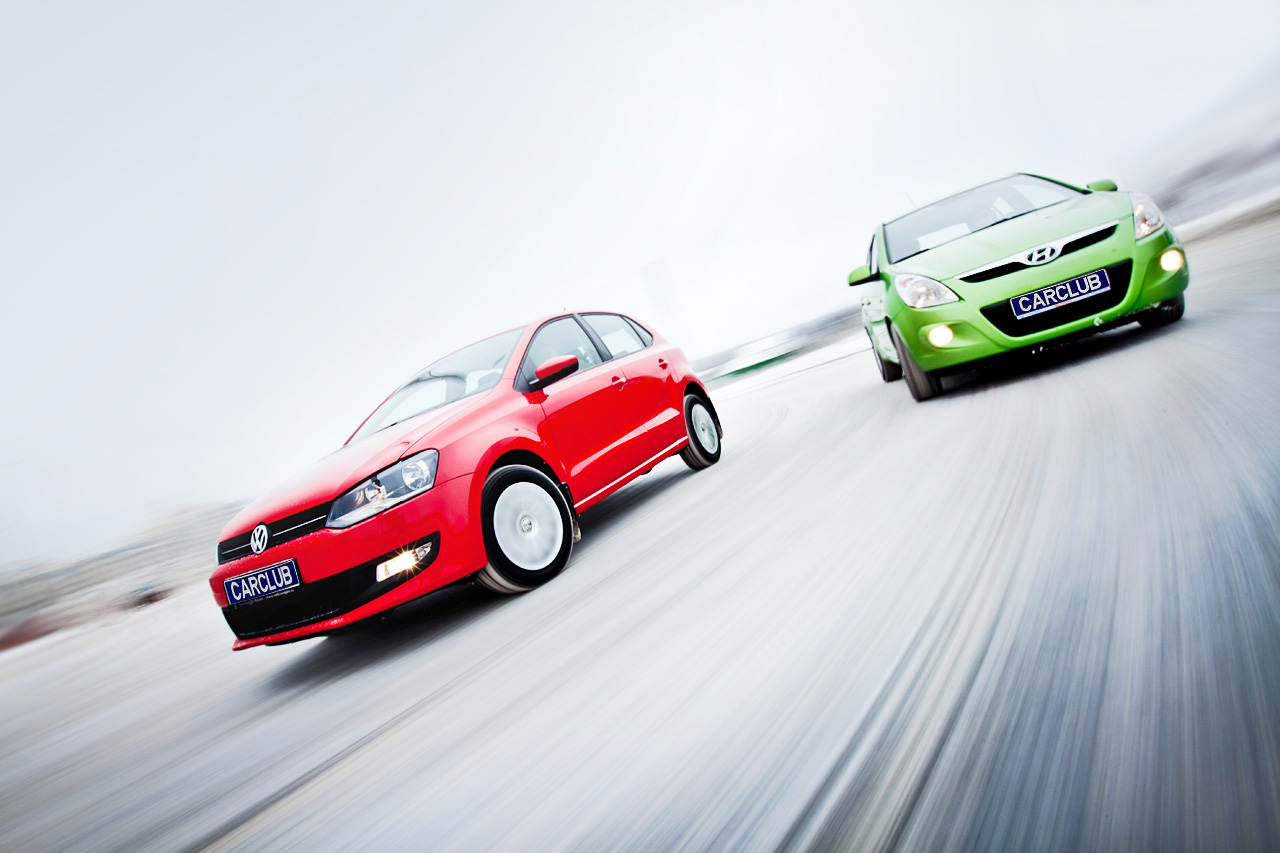 |
| The VW clearly follows the set trajectory and stays stable in a straight line. The Hyundai can boast a more adequate steering feel and more excitement in corners. But on a straight road, the Korean's nose wanders, requiring constant steering corrections. |
The VW Polo power steering has a more synthetic feel than the i20's. But in parking lots, the steering is light as a feather. Perfect for the ladies. Steering responses are not as sharp as in the Hyundai, but all movements feel more solid. On a straight road, the German hatchback holds its line perfectly. If the Hyundai i20 is as exciting in a corner as a roulette player, the VW Polo prefers to take it with the coolness and calm of a chess player. The stability system never lets the car off its trajectory for a second – you feel like a professional extreme driver! And if you turn off the ESP, the Polo allows a bit of fun, but still remains exceptionally stable and controlled.
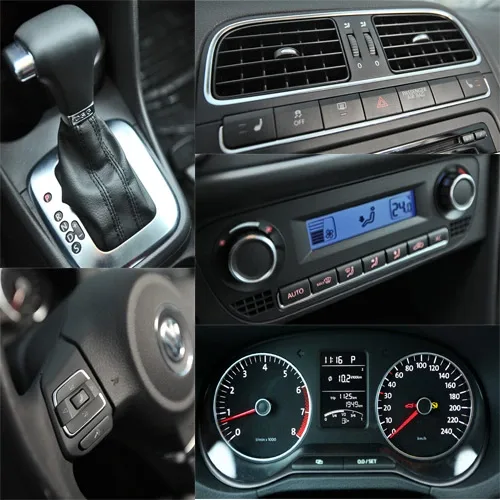 |
| The test VW Polo has optional two-stage front seat heating (11,800 rubles), multifunction steering wheel (12,970 rubles), and electronic climate control (48,990 rubles). |
The sound insulation of the German is top-notch. The VW's suspension swallows small road imperfections without a trace, and only on larger bumps does the cabin start to shake. In terms of acoustic comfort, the Hyundai lags behind the Polo. The stiffer suspension pays more attention to small bumps, and more serious potholes are accompanied by strong shaking.
 |
| The Polo's suspension swallows small bumps with the agility of a business-class sedan. The Hyundai is more sensitive to road surface imperfections. |
The brakes on both hatchbacks raised no complaints, but the pedal on the VW Polo is too sensitive, causing passengers to nod their heads at almost every traffic light at first.
Without a doubt, the Volkswagen Polo, which received the honorary title of Car of the Year 2010, wears it for a reason. The strict and solid exterior, excellent interior quality, reliable, precise handling, and a large list of additional equipment have rightfully made the VW Polo one of the leaders in its segment.
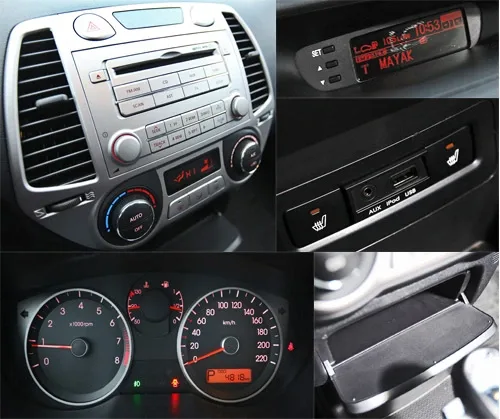 |
| The Hyundai's equipment is no worse than the Volkswagen's. It has climate control, seat heating, and a stability system. For audiophiles, there is an iPod and USB connection. |
What can the Hyundai i20 counter with against the younger brother of the legendary VW Golf? Stylish looks, good ergonomics, exciting handling, and an options list almost matching the Volkswagen – that's not too little.
Exciting nervousness of the i20 or controlled excitement of the Polo? The spirited and harmonious Hyundai or the stylish and austere Volkswagen? The higher quality and more stylish interior of the German or the price advantage of 200,000 rubles for the Korean?
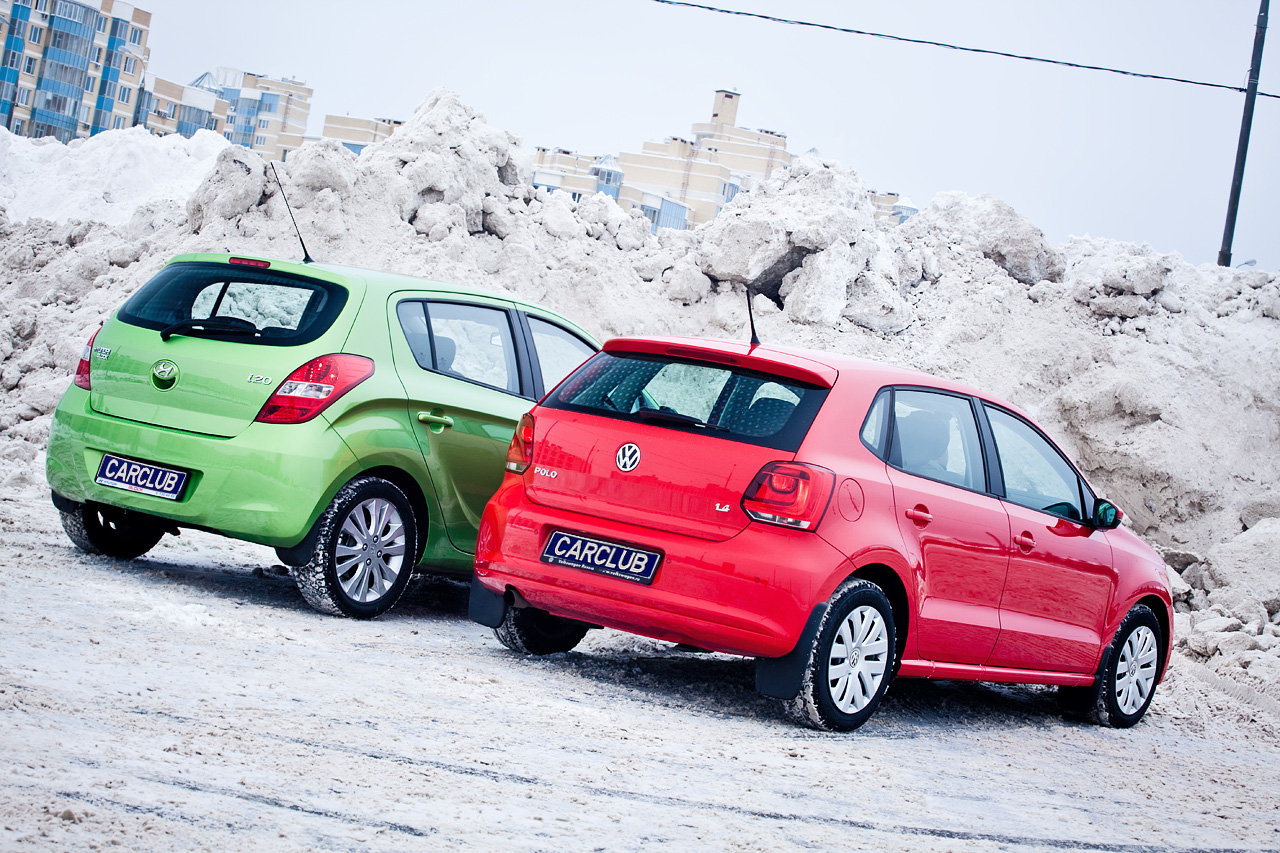 |
| The base price of the Hyundai i20 with a 1.2-liter engine and manual transmission is 419,900 rubles. The starting price of the VW Polo is 52,000 rubles higher. The price difference between the test cars is even more striking. If the Korean compact with a 1.4-liter engine and automatic transmission in the top Elegance trim costs 601,900 rubles, a similarly equipped Polo will require 811,000 rubles. |
Yes, in similar trims, the Hyundai is 200 (!) thousand cheaper than the Polo. This is where priorities clash, and you have to determine how big the price of the question is.
 |
| Technical specifications (according to the manufacturer) | Volkswagen Polo | Hyundai i20 |
|---|---|---|
| General data | ||
| Body | Hatchback | Hatchback |
| Year of manufacture | 2009 | 2008 |
| Number of doors/seats | 5/5 | 5/5 |
| Curb weight, kg | 996(1029) | 1035(1063) |
| Gross weight, kg | --- | --- |
| Maximum speed, km/h | 177 | 180(172) |
| Acceleration time from standstill to 100 km/h, s | 12.1(11.9) | 11.6(12.9) |
| Dimensions | ||
| Length | 3970 | 3940 |
| Width | 1682 | 1710 |
| Height | 1485 | 1490 |
| Wheelbase | 2470 | 2525 |
| Engine | ||
| Displacement (cc) | 1390 | 1396 |
| Engine type | Petrol with distributed fuel injection | Petrol with distributed fuel injection |
| Location | Front, transverse | Front, transverse |
| Number of valves | 16 | 16 |
| Maximum power (hp at rpm) | 86/5000 | 100/5500 |
| Maximum torque (Nm at rpm) <\/td> | 132\/3800 <\/td> | 137\/4200 <\/td> <\/tr> |
| Transmission <\/td> | <\/td> | <\/td> <\/tr> |
| \tType <\/td> | Manual 5-speed (Robotic 7-speed DSG) <\/td> | Manual 5-speed (Automatic 4-speed) <\/td> <\/tr> |
| Drive <\/td> | Front <\/td> | Front <\/td> <\/tr> |
| Suspension <\/td> | <\/td> | <\/td> <\/tr> |
| \tFront <\/td> | MacPherson type with anti-roll bar <\/td> | MacPherson type with anti-roll bar <\/td> <\/tr> |
| Rear <\/td> | Semi-independent, longitudinal interconnected arms, coil springs <\/td> | Semi-independent, longitudinal interconnected arms, coil springs, anti-roll bar <\/td> <\/tr> |
| Brakes <\/td> | <\/td> | <\/td> <\/tr> |
| \tFront <\/td> | Disc <\/td> | Ventilated disc <\/td> <\/tr> |
| Rear <\/td> | Drum <\/td> | Disc <\/td> <\/tr> |
| Fuel consumption, l\/100 km <\/td> | <\/td> | <\/td> <\/tr> |
| City <\/td> | 8.0(7.7) <\/td> | 7.2(8.0) <\/td> <\/tr> |
| Highway <\/td> | 4.7(4.7) <\/td> | 4.7(5.1) <\/td> <\/tr> |
| Combined <\/td> | 5.9(5.8) <\/td> | 5.6(6.2) <\/td> <\/tr> |
| Fuel <\/td> | Petrol AI-95 <\/td> | Petrol AI-95 <\/td> <\/tr> |
| Fuel tank capacity, l <\/td> | 45 <\/td> | 45 <\/td> <\/tr> |
| \t <\/td> | \t <\/td> | \t <\/td> <\/tr> |
| Data for vehicles with automatic transmission are given in parentheses <\/td> <\/tr> <\/tbody><\/table> Ruslan Galimov, Svetlana Aleeva.<\/p><\/div> | ||