
Hyundai Grandeur
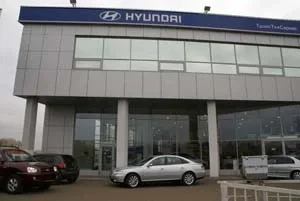
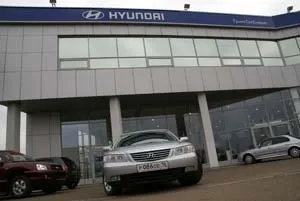
... his majesty
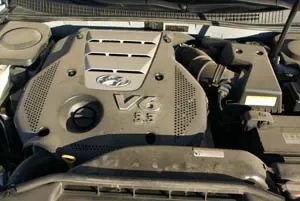
Engine - 3.3 L V6 DONC
Max power -
235 hp/6000 rpm
Max torque - 304 Nm/3500 rpm
Max speed (km/h) - 237
Acceleration 0-100 km/h - 7.8
Fuel consumption (l/100 km):
city - 15.1
highway - 7.4
combined - 10.2
Front-wheel drive
5-speed automatic
Length - 4895 mm
Width - 1865 mm
Height - 1490 mm
Curb weight - 1739 kg
Tires 225/60R16
Ground clearance - 162 mm
Price $ 41,678 (333,423 UAH), base trim price $ 36,211 (289,683 UAH)
Equipment:
GLS, side curtain airbags, seatbelt pretensioners, ABS+EBD, ESP, Brake Assist, auto-folding mirrors + auto-adjust when reversing, optitronic panel, dual-zone climate control, auto headlights, rain sensor, parking sensors, cruise control, power rear sunshade, leather interior, Infinity audio, wood and aluminum interior trim
Maintenance cost:
Service interval:
15,000 km
Service 1 7,500 km - $165 (1,318 UAH)
Service 2 15,000 km - $224 (1,791 UAH)
Service 3 30,000 km - $272 (2,169 UAH)
Service 4 45,000 km - $406 (3,240 UAH)
Service 5 60,000 km - $481 (3,843 UAH)
Service 6 75,000 km - $224 (1,791 UAH)
Service 7 90,000 km - $453 (3,619 UAH)
Service 8 105,000 km - $224 (1,791 UAH)
Warranty 3 years or 100,000 km
Competitors:
Nissan Teana
Toyota Camry
Ford Mondeo
Chevrolet Epica

Marat Makhmutov, deputy director of the Kazan School of Higher Driving Skills
This Hyundai has been on our market for about two years now, but my personal acquaintance with it happened only recently. The model's name translates from French as "grandeur" and "authority." Isn't that too bold a statement from the Koreans for a business-class sedan?
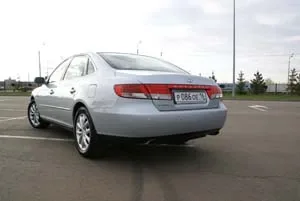
I began checking how well the car lives up to its name by examining the large silver sedan from the outside. The front looks stern and even a bit bland, but Hyundai's signature style is unmistakably present — it clearly echoes the fresh Santa Fe and the NF sedan.
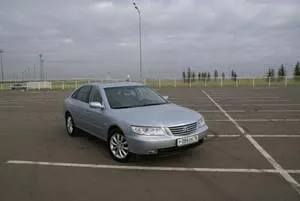
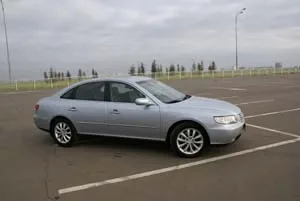
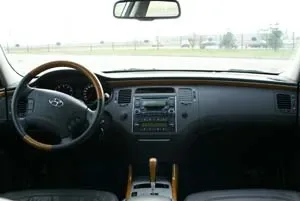
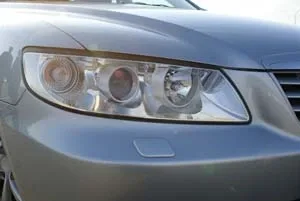
From the front, the squinting xenon headlights, chrome radiator grille, and heated wiper rest zone stand out. From the side, the car looks strict and noble, but what stuck in my memory most was the rear: large LED lights wrap around its entire width, and at the bottom of the bumper, a pair of rectangular exhaust tips are symmetrically placed. Overall, the Grandeur's design reminded me of the Bavarian school — and that, you'll agree, is a compliment. The interior combines both luxury and simplicity. I'll start with the latter. The plastic on the dashboard is soft, but its quality doesn't quite reach the level of this class; some buttons clearly came from cheaper models of the brand, and the green LCD screens for climate control and clock look archaic. Moreover, the stereo can play compact cassettes — a nod to retro enthusiasts! And the luxury is everything else.
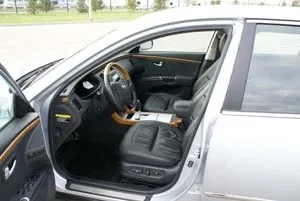
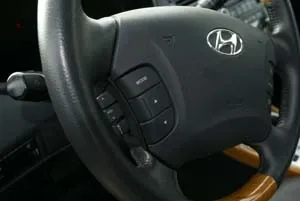
Here you have a gorgeous optitronic instrument cluster, rain and light sensors, an electric sunroof, and power-adjustable seats: the driver's seat adjusts in eight directions with memory for two drivers, the passenger's in four. The steering wheel also adjusts in two planes. The leather interior is solid and prestigious, the dashboard and steering wheel are trimmed with Karelian birch inserts (a specific taste; I'd prefer walnut), the front tunnel is adorned with aluminum, the rearview mirror auto-dims, and the power rear sunshade automatically lowers when reverse gear is engaged. To top it off — excellent Infinity audio, power-folding mirrors, and steering wheel audio controls. Everything looks solid and neatly assembled. The driver's ergonomics are successful: everything is clear and at hand, and there's plenty of room up front for a person of average height (I think taller folks won't complain either). The only nitpick is the small side mirrors — they could be larger.
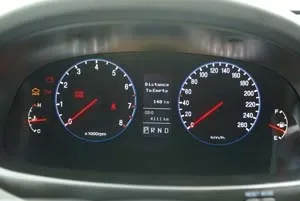
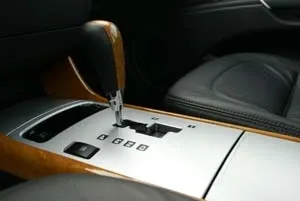
Now about how the car drives. The test car is equipped with a 3.3-liter engine producing 235 hp and a five-speed automatic with manual mode. Handling tests showed that the Grandeur, considering its class, holds up very respectably, clinging to the asphalt with its 235/55 seventeen-inch tires until the last moment, and there's enough power even for an impressive drift. However, there's a nuance: the handbrake here is foot-operated, so police-style U-turns won't work. From a standstill, the business sedan moves off softly and smoothly, accelerating quickly. The engine pulls quite briskly, but the automatic, when sharply pressed (without kick-down), seems to pause for a moment — there's no sensation of a shot. Although the speedometer needle is already racing forward. Overall, the dynamics are decent. However, in city traffic, the gearbox's slight thoughtfulness sometimes got in the way, and manual mode solved that problem. The instrument cluster shows the selected mode, and in manual, the gear number. Through experimentation, I found that when braking to a full stop, the gearbox automatically downshifts all the way to first — foolproof protection. The chassis — multi-link front and rear — never lets you doubt the car's class: all the bumps on our roads are swallowed with due softness and composure. Ground clearance is increased to 162 mm, so small potholes and ledges are not a problem. I'd call the sound insulation solid: neither street noise nor the voice of the six-cylinder engine at low and medium revs penetrates the cabin. I should note that all impressions are from city driving; I didn't get to take it on the highway.
In the end, I'll return to the name I started with. The Koreans have created a truly successful car, to which the word "majestic" is quite applicable. It's attractive, well-built, with a powerful engine and rich equipment. But in this price segment, buyers still prefer more "authoritative" players — Toyota Camry and Nissan Teana, as sales figures show. In the business class, even the "budget" one, trust is earned over years, so Hyundai will have to wait to win over customers in our market.
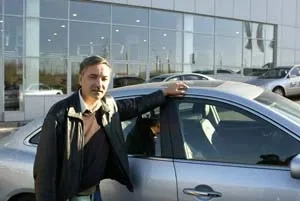
Vadim Sadykov, "Autoclub-Kazan"
A large and powerful Korean sedan of the representative E-class. Sounds a bit unnatural, doesn't it? On the other hand, the phrase "E-class for the poor" has already caught on — these are E-segment cars at D-class prices. The same Toyota Camry, Nissan Teana, and many others. A lot of car for moderate money — a quite logical approach.
Traditionally, we started with an inspection on the lot. Surprisingly, this long and big car turned out to be quite manageable. True, you have to pay for everything good — here the price is overly stiff behavior on a "washboard" road, which for an E-class is rather a minus. Moreover, a huge sedan still maneuvers worse than a compact hatchback with a stiff suspension. I tested the car twice in real conditions. The first was an overtake on the outer radius on uneven pavement. No miracle happened: such a maneuver requires caution and low speed. The second was a series of turns on the highway. The car remained stable at 90 km/h, but at 100 it honestly made it clear: I can't handle more. And you might tell me the same thing Alfred said: such a big sedan doesn't have to handle well!
I fully share that opinion. And I would never have conducted such tests if the car were truly soft and comfortable on any road. But when a sedan noticeably shakes on bumps (is the suspension really stiff?), then it's only natural to test it on a winding road. At the same time, on smooth asphalt, the car rides surprisingly smoothly, and an important person in the back seat is unlikely to complain about discomfort.
There's practically nothing to fault in the interior. The rear seats are very comfortable, with a perfectly chosen backrest angle. The front passenger seat is simply luxurious, with power adjustments. The only "but": the leather is not perforated, so it's cold in winter and scorching in summer. Overall, the car feels very cozy and welcoming to passengers.
We discovered another drawback completely by accident. When we had to bypass a road repair section and drive a bit on a dirt road, we suddenly scraped the underbody on the ground. On my sedan, such bumps are passed without any problems. Alfred confidently noted that in his car he wouldn't even slow down here. You could again brush it off with the phrase "it's not meant for country roads." And again, I'd agree with that.
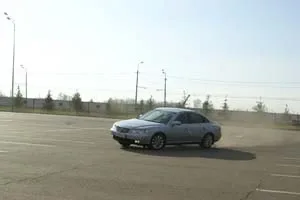
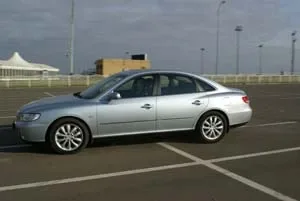
But this works when it comes to Europe with its impeccable road surface. Here, though, we have mud, uncleared snow, and endless potholes. Boring everyday reality. I am convinced: the engineers made an excellent and inexpensive business-class sedan, but it is clearly designed for European roads. For our conditions, it would not hurt to increase the ground clearance and make the suspension softer. Can this be fixed on your own? Quite possibly — just replace the standard 235/55/17 tires with 235/60/16. The profile will become taller, and ride comfort will improve.
Now about my favorite test: overtaking a truck on the highway at 80–90 km/h. Here, the 5-speed automatic did not show its best side: when shifting down, there is a noticeable pause, and the acceleration itself is not impressive. If you switch the gearbox to manual mode and select fourth gear, everything happens noticeably more lively. Alas, even a 5-speed gearbox (let alone the 4-speed one) has its own almost unavoidable quirks. But this automatic transmission has a plus: with it, the modern 3.3 V6 engine with variable valve timing works smoothly and surprisingly economically.
Did I like this car? More yes than no. If I lived in Europe, I would answer a definite yes. But our realities, alas, make their own adjustments to the ideal rating.
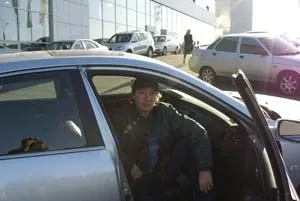
Alfred Mardanov, Avtoclub-Kazan
Honestly, in the automotive world, I hold conservative views. I do not quite understand the modern trend when manufacturers try to cover all segments at once with their models. If a brand sells B- and C-class cars well, that does not guarantee that a more expensive model of the same brand will be equally popular. Hyundai already had experience with an E-class car that was sold on the domestic market in South Korea. Apparently, having gained experience, they decided to bring it to us as well. But our audience is much more picky than the Americans, for whom this car was created, so the model does not have much fame. Let us figure out, setting aside the badge for a minute, whether the car lives up to the claimed standard. The Grandeur certainly impresses with its dimensions, but there are questions about the interior. Some elements here are from the recent past, and some are from ancient times. For example, next to the CD player, they placed a completely useless cassette deck, which genuinely surprised me. I think most of us, like me, threw out our cassettes about three years ago, along with VHS tapes. Who even needs a cassette player? A mystery.
Following traditions (for example, the green displays of the clock and stereo with small digits, like on the old Elantra) is, of course, good. But is it not time to update the design? Take the instrument panel, for instance — it is simply magnificent: optitronic, with excellent readability. As for taste — I do not really like the light wood inserts; I would choose something darker. There is only one tiny complaint about the plastic: the Koreans were a bit disingenuous — the plastic on the door cards mimics the texture of the dashboard, but it feels hard, unlike the soft one on the front panel. Otherwise, there seems to be nothing else to nitpick. As for ergonomics — everything is just excellent! A huge number of adjustments allow you to sit in the seat with maximum comfort and... Stop! The side mirror is a bit small — all in the name of aerodynamics. What else? Oh yes, the exterior! Well, let us say, nothing outstanding, not a single memorable detail, just like most competitors. I start reversing and — wow! — the rear sunshade elegantly lowers along with the mirrors, providing excellent rear visibility. A small thing, but nice! I am the first to get behind the wheel at the dealership, and we head to the test track. Judging by how the car handles bumps and potholes, one might assume it will perform well on the slalom. The suspension is not at all like typical American — you can feel European composure. The car does not absorb irregularities as softly as you would expect from such a machine. The slalom did not live up to expectations: the car responds to steering inputs with a delay. So why make the suspension stiffer if the handling still will not let you feel like Schumacher?
Vadim is right: for a five-meter sedan, this is not the most important indicator. It is not made for racing on mountain roads, but for calm and dignified driving. By the way, its classmate — the Superb — is even stiffer and more tiring on broken roads. Here the situation is better: the Grandeur is softer, but still not as much as one would like. Although, on the other hand, on our roads excessive softness can cause motion sickness, so I do not know who is right here. On the highway, I really liked the car: it goes smoothly and confidently. I learned to find a common language with the automatic transmission. I work the pedal carefully, with pauses. Like when taking a photo: you press the button halfway, wait for focus, and only then press it all the way. In this mode, the gearbox keeps up with my actions, and shifts happen faster. Manual mode noticeably livens up the car, but I do not want to use it constantly. It is much more pleasant to just settle in comfortably in the front or rear seat and drive wherever your eyes lead. And who cares what badge it has, the main thing is to feel good. And as a passenger, it is really great here: you relax and rest. By the way, I reset the trip computer, and by the time we returned the car to the dealership, the average fuel consumption was only 13 liters per 100 km. Quite good for such a large car with a 3.3-liter engine.
(C) Avtoclub-Kazan.