
Hyundai Grandeur. First in Line
The Korean auto industry has recently become noticeably bolder: manufacturers no longer feel insecure about their "non-aristocratic" past and are seriously targeting world market leaders. Hyundai is no exception. It already has worthy rivals for famous competitors — the mid-size Elantra, the updated Verna (formerly Accent), or the maximally "Europeanized" i30. True, such a transformation comes at a price: prices for these models have come close to those of more established brands. The Elantra, for example, is already almost stepping on the heels of the Mazda 3, and the base Verna has closely approached the larger Ford Focus in price. Next, apparently, will be the i30, which should reach our dealers in the summer... However, in some segments, the "Koreans" still keep a distance from the leaders, albeit not as impressive as before. We are talking about the largest Hyundai sedans — the NF and Grandeur. The first is the direct heir of the Taganrog Sonata, which recently underwent a major update, so we will talk about it separately next time. The second is just from the category of those catching up.
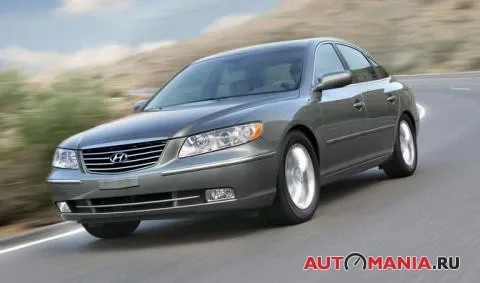
Here, however, it is important to make one caveat. Once, the Grandeur became Hyundai's first attempt to make a name for itself in the executive class — before it, no model of the brand had aimed so high. Having calculated all scenarios, including the most disastrous ones, the Koreans decided not to take risks and chose a proven path: they styled their flagship according to the canons of the American market, betting on local buyers. And, apparently, they did not miscalculate. A huge wheelbase, a classic three-box body, a "face" in the spirit of an adult Lexus with squinting xenon headlights, and a rear overloaded with optics... Too pretentious? Maybe. But it is precisely such cars — large, comfortable, and with character — that are in demand overseas. And on our roads, such a car looks quite appropriate and, importantly, respectable. At least, our black test car did not get lost at all against the background of the parked Toyota Camry and Honda Legend. And thanks to the dealer's efforts, the car also had tinted windows, adding solidity.
If anyone still has doubts about the positioning of the Grandeur, it is enough to look inside. Everything here is grown-up: leather seat upholstery — even in the most affordable version, plastic that is pleasant to the touch and look, a moderate amount of wood inserts, an impressive optitronic instrument panel... The only thing that slightly spoils the impression is the center console, or rather, its standard control unit, which combines the radio and the climate control panel. There are no complaints about ergonomics, nor about build quality: the parts are perfectly fitted, the gaps are minimal... But the material from which this unit is made would look more appropriate in a more modest and cheaper NF, not in a car claiming a place in the executive class.
If we continue to list the shortcomings, we cannot fail to mention the traditionally short seat cushions. Moreover, oddly enough, this is especially noticeable in the second row. The rear seat is so short that the passenger has to keep their back almost vertical. Good thing there is enough headroom even for very tall riders — you don't hit your head on the ceiling. In short, if some undemanding executive decides to use the Grandeur as a company car with a driver, they are unlikely to count on a lounging posture on the rear sofa. The same problem applies to front passengers, although they have the opportunity to adjust the seat to themselves by reclining the backrest or moving the cushion. However, this helps little on a long journey — after a couple of hours, the lower back and knees begin to ache.
But overall, the "Korean's" interior is quite cozy. The seats are American-style soft and pliable. The range of adjustments will not disappoint either — a person of almost any build can sit behind the wheel. In addition, the sedan pleases with spaciousness: three adults can easily sit in the back, and there is enough space for shoulders and elbows.
The trunk deserves a special mention. From an ergonomic point of view, it is nothing special — the side panels are quite massive, and given the external dimensions of the car, the volume could have been larger. Nevertheless, there is enough useful space to fit a couple of large tourist suitcases. There will also be room for small items like hand luggage. And if you fold the backrest in a 40:60 ratio, the possibilities become even wider.
Naturally, the claim to the executive class obliges appropriate equipment. And here the Grandeur did not disappoint. The base configuration includes almost everything one could wish for. In addition to the already mentioned leather and wood trim, the car will definitely get dual-zone climate control with an air purification system, a multifunction steering wheel, a rain sensor, an auto-dimming mirror, athermal glass, a radio with cassette, CD, and MP3 support, as well as power front seats. I think there is no need to mention power windows and mirror drives. Eight airbags (two front, four side, and two curtain), pretensioners with force limiters, and a whole range of electronic assistants — ABS, EBD, TCS, and ESP — are responsible for safety. In short, for the starting price of just over a million rubles, the buyer will not get only a power sunroof, xenon, parking sensors, and a rear window shade.
But under the hood, they will find not an inline "four," but a full-fledged V6 with 192 hp paired with a modern five-speed "automatic" with a manual mode. And by paying an additional 67,000 rubles, you can get a maximally equipped version that has absolutely everything. The top modification is equipped with the most powerful 3.3-liter V6 in the lineup, producing 235 hp and 304 Nm of torque. With such an engine, the sedan accelerates to "hundred" in an acceptable 7.8 seconds and can reach 237 km/h. And all this on 92-octane gasoline. However, those who paid $50,000 for the car are usually not bothered by such trifles.
A more affluent buyer is usually interested in dynamic comfort — and here the Grandeur is able to provide it. On the road, it behaves imposingly and even lazily. The suspension easily "swallows" any irregularities, including those very thermal seams on the capital's overpasses. The Korean "firstborn" of the premium class in motion is a typical "American." You have to pay for this with noticeable body rolls in corners and diagonal pitching at high speeds. When braking, the car also "nosedives" — although here the considerable mass by European standards is more of a factor. By the way, the brake pedal seemed overly "soft" to the author: it presses almost to the floor without much effort. So those who are not used to such lightness should be more careful at first. This does not affect braking efficiency, however.
But the steering pleasantly surprised with its informativeness, even despite the rather vague "zero" position. The car obeys perfectly, repeating all the driver's commands without delay. Moreover, the Grandeur turned out to be very maneuverable in confined spaces — from a sedan almost five meters long, you would expect such agility last.
So, despite its not-so-"noble" origin, this car is quite good. It looks presentable, is solidly assembled, and, importantly, costs noticeably less than its famous competitors. Of course, its successor, announced by the Koreans back in 2007, will be not only more modern but also more expensive. So the era of affordable "Koreans" in this segment is gradually coming to an end.
Specifications:
| Dimensions: | Hyundai Grandeur |
| Length (mm) | 4895 |
| Width (mm) | 1865 |
| Height (mm) | 1490 |
| Wheelbase (mm) | 2780 |
| Ground clearance (mm) | 162 |
| Weight (kg) | 1700 |
| Engine displacement (cm3) | 3342 |
| Max power (hp) | 235 at 6000 rpm |
| Max torque (Nm) | 304 at 3500 rpm |
| Max speed | 237 |
| Acceleration 0-100 km/h (s) | 7.8 |