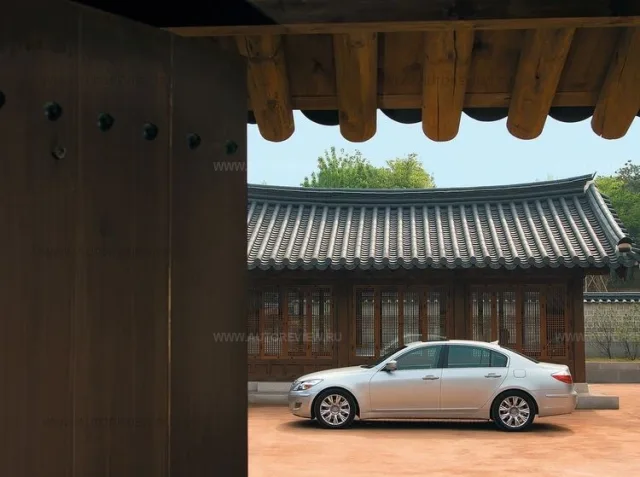
Skyscrapers with mirrored facades, multi-level interchanges, rice and seafood at every meal, endless bows from staff... Sounds like Japan? Not at all — this is Korea. South Korea. It was for the affluent and respectable locals that the new Hyundai Genesis sedan was created, which is simply called Genesis here.
Hyundai in luxury?
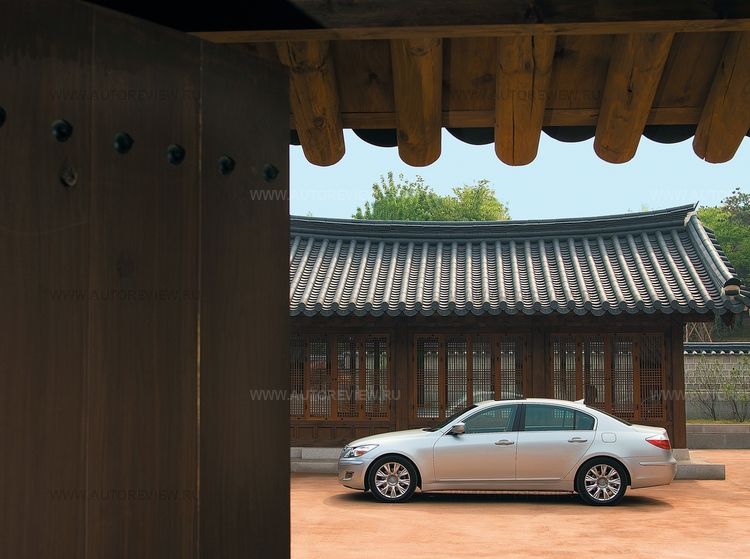
 The idea of producing a rear-wheel-drive premium car had been brewing at Hyundai for nearly two decades — since the Lexus LS400 debuted on the American market. At that time, Toyota was also associated only with affordable "mass-market" models. However, Lexus forever reshuffled the balance of power. Today it is the most sought-after premium brand not only in the States but also in Hyundai's homeland.
It is worth noting that foreign cars are not very common here — import duties bite. Nevertheless, in the premium segment, about 70% of sales go to foreign brands. Wealthy Koreans willingly pay extra for Audi, BMW, and Mercedes, but the highest status is enjoyed by Lexus — a brand that has existed for less than two decades. So why shouldn't the Hyundai Kia concern repeat such success?
Of course, in the nineties, Koreans were only learning the basics of creating full-fledged cars. But five years ago, work on the Genesis began on all fronts at once. The development center became Hyundai's largest research and design center in Namyang, located thirty kilometers from Seoul. Exterior, aerodynamics, chassis, engines — Koreans claim that everything was created in-house from scratch, and specialists from the California studio led by Joel Piaskowski only "polished" the appearance.
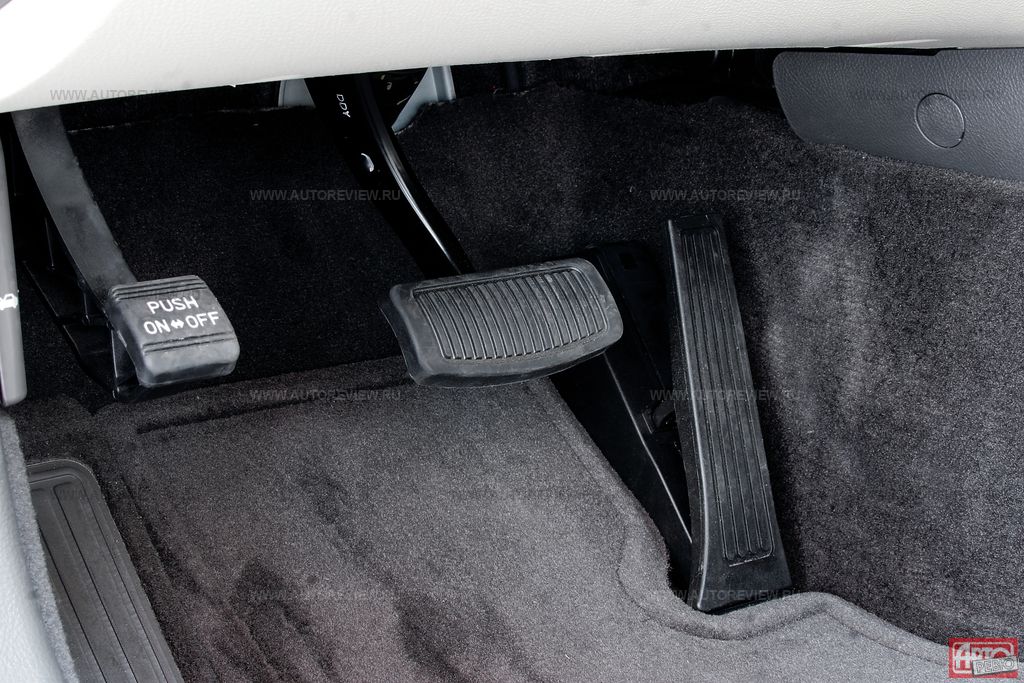 | 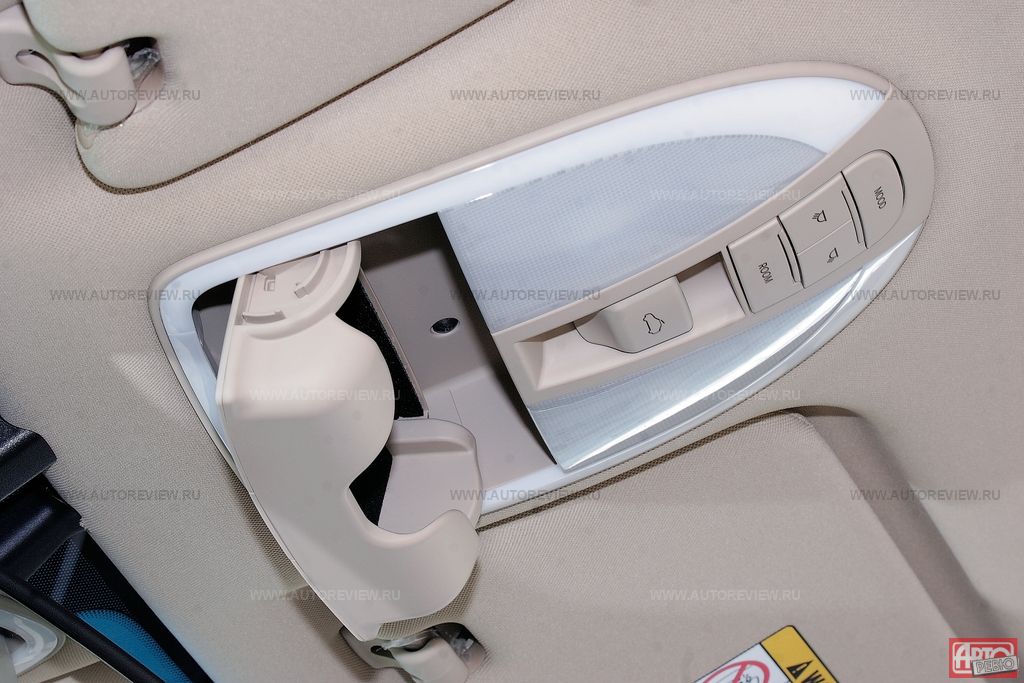 | |
| Start button — like Lexus and Toyota | Floor-mounted gas pedal and foot "handbrake"... Mercedes? No — Hyundai Genesis! | The ceiling is finished simply, but the stylish lighting unit is almost like in a Mercedes |
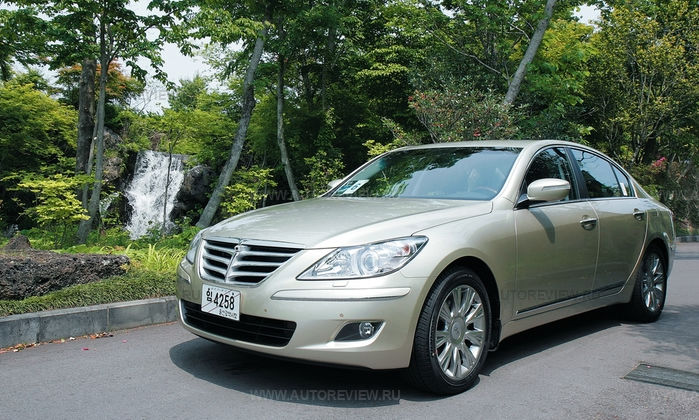
And here I am on the famous Jeju Island — a land of stones, winds, and women. Picturesque coastline of black lava, countless waterfalls, mountains in tropical forests, collections of stones, and funny figurines of "grandfathers" — harubangs, as the locals call them... And against this backdrop — the Hyundai Genesis.
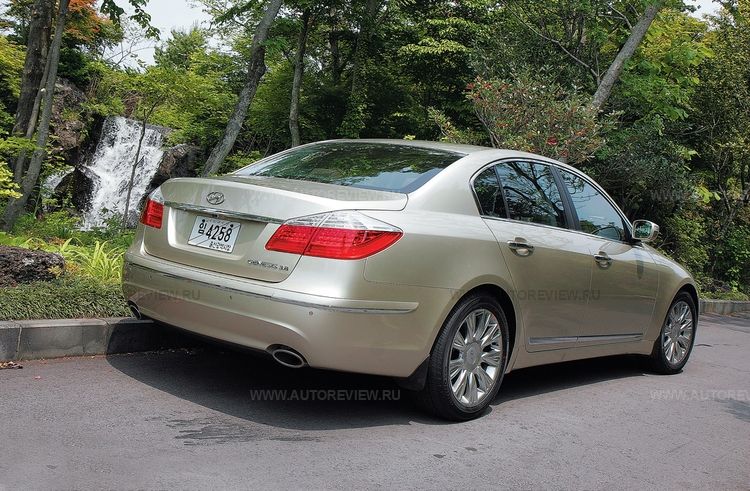
Stop... This is a restyled BMW "five"? But why did they stick on a foreign front end with a "toothy" grille and Lexus-style headlights? Koreans do not hide that they were guided by the BMW 5 Series, although they also took other German and Japanese premium cars as references. And hiding it would be foolish. As for the similarity — Hyundai simply does not yet have its own recognizable style. So aligning with the leaders is not the worst option.
It is only a pity that the car is assembled without European pedantry for details: from the sloppy broken line of the rear bumper joint with the taillights to the deliberately applied "eyelashes" on the front bumper. But it did without flashy "Asianness" — except for the wide chrome molding along the lower edge of the doors.
I grab the solid, almost Mercedes-like door handle — and what's inside...
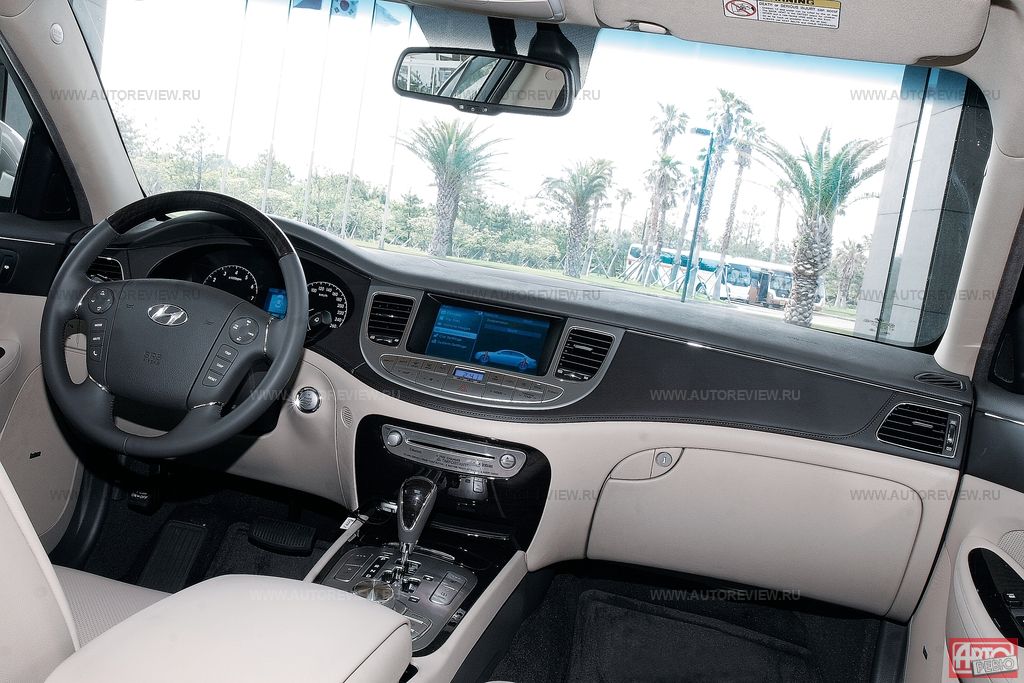 | 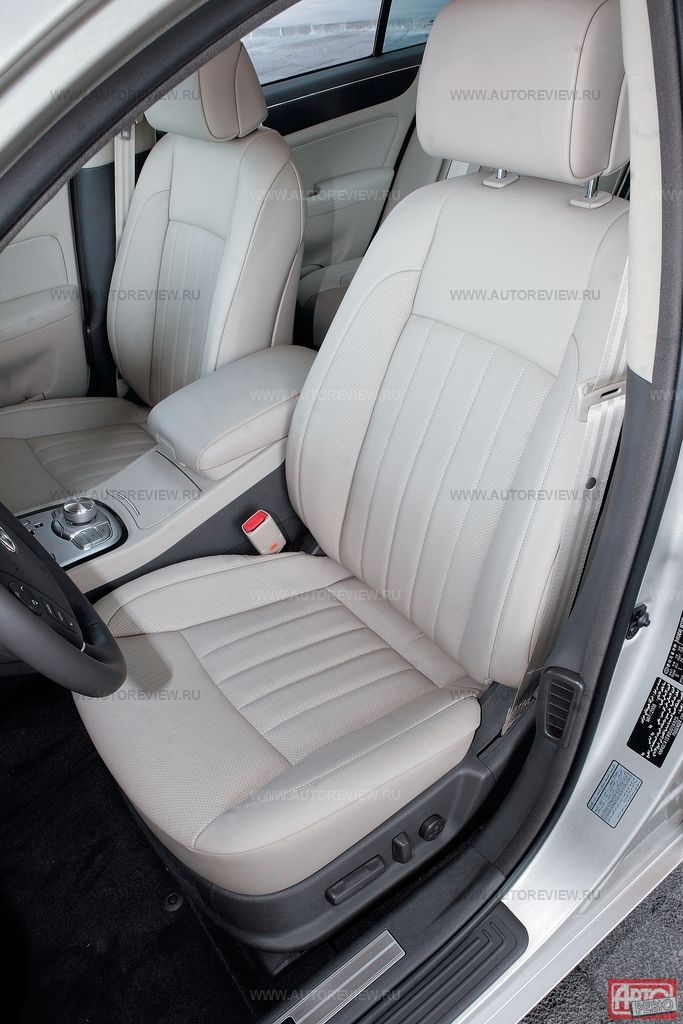 | 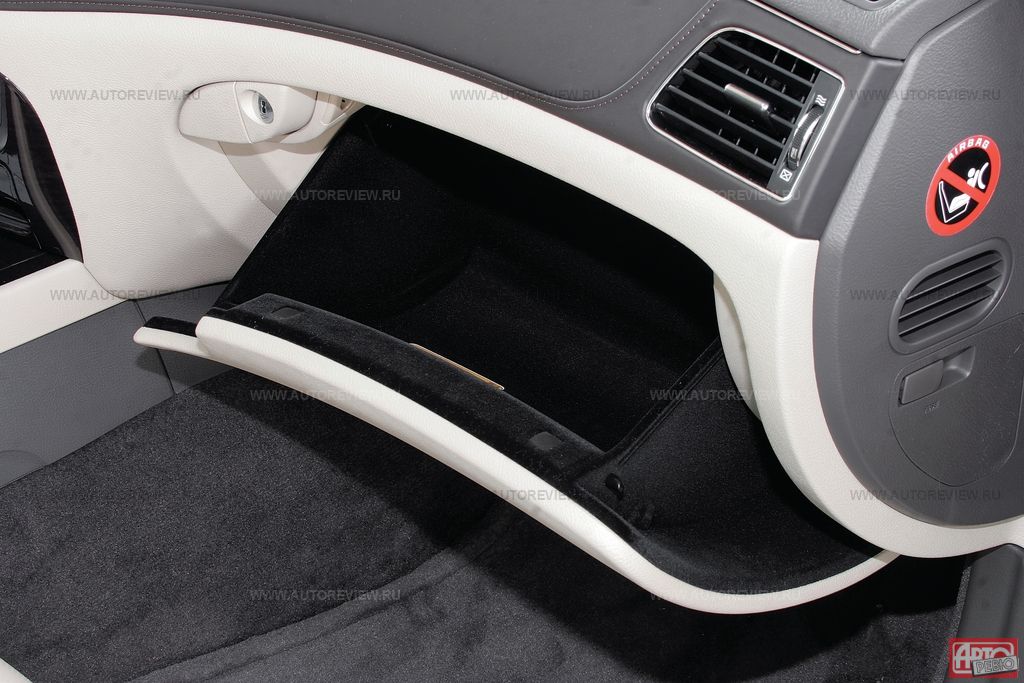 |
| The design cannot be called original, the quality of materials is sometimes lacking, and the seating position was adjusted for short drivers. But overall — progress! | Seats in perforated leather are even equipped with ventilation | The "glove box" is trimmed with velvet. Premium... |
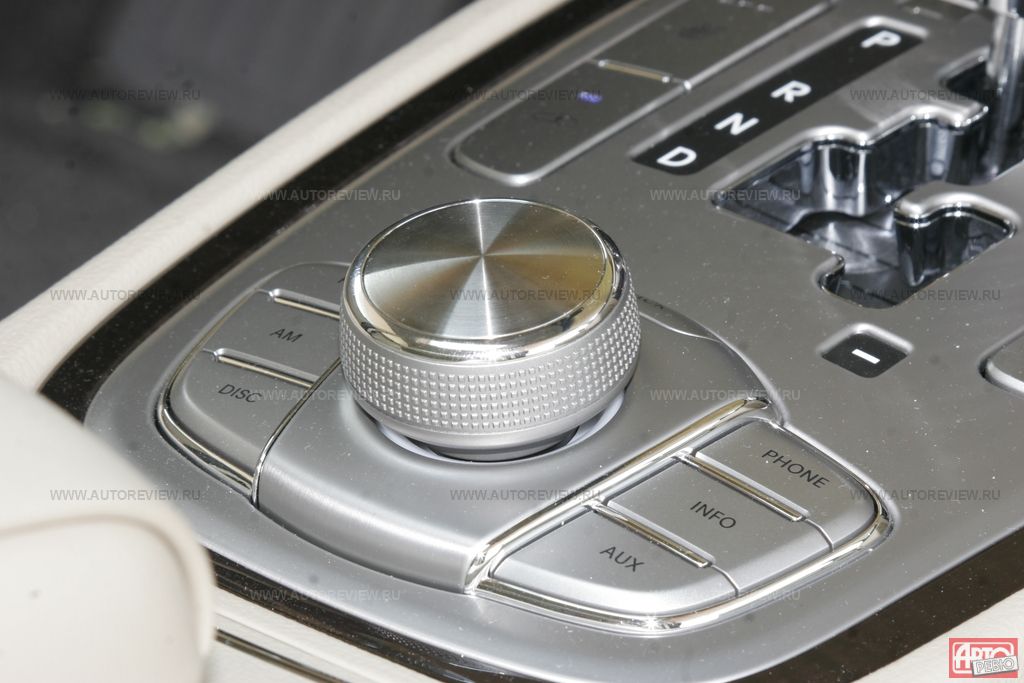 | 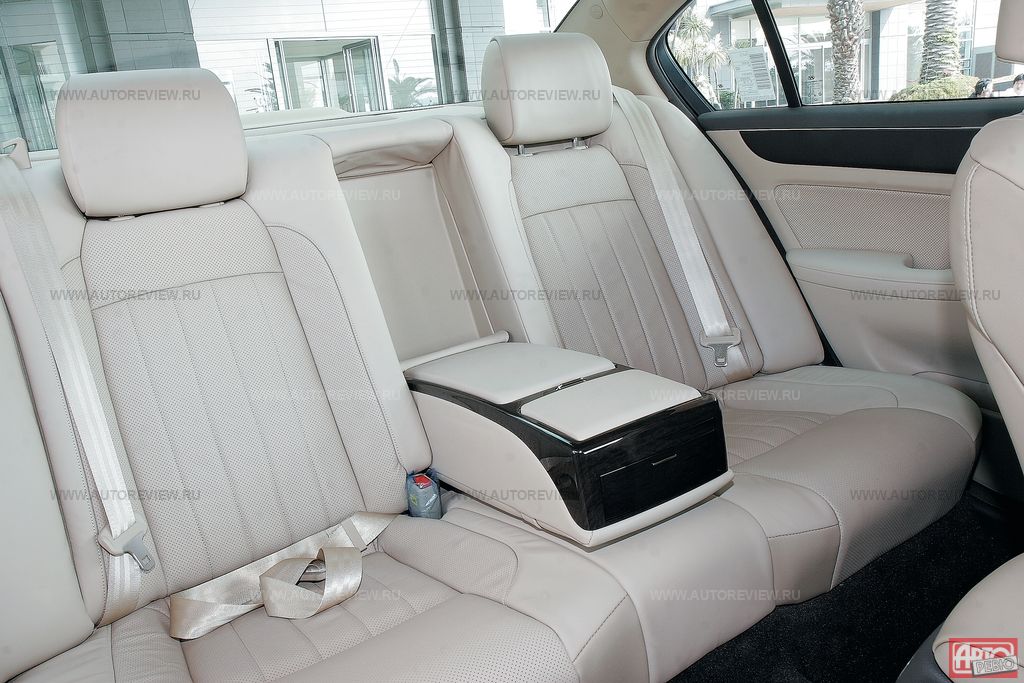 | |
| The metal knob of the Korean "i-drive" is pleasant to the touch, but switches with unclear effort | The rear sofa is moved forward-backward by a servo drive by about 100 mm — the backrest angle remains unchanged |
Inside — a typically Korean rounded, faceless interior. The selection of materials surprises: decent leather coexists with pseudo-wood on the upper part of the hard and slippery steering wheel from the Sonata, next to it — hollow cheap plastic. But the seats are magnificent, with a good profile and elasticity, and even with ventilation. And under the right hand — a massive metal "washer". Korean iDrive! But in terms of effort, travel, and "clicks", the Korean controller is inferior to the German one — you constantly miss the desired items. And the ergonomics let down: the basic seating "geometry" was built for short Koreans — the seat is raised too high, and the steering wheel is too close to the driver.
But in the back — space! The almost three-meter wheelbase (a record in the E-class!) gives the Genesis passenger incredible freedom. In addition, the rear sofa has electric adjustment! If you use the buttons in the armrest to move the seat all the way back, and the right front seat — all the way forward, then even a tall European can stretch out their legs. Plus, in the back, there is a separate music remote, a climate control unit, deflectors on the middle pillars... And a powerful Lexicon audio system.
Real business class!
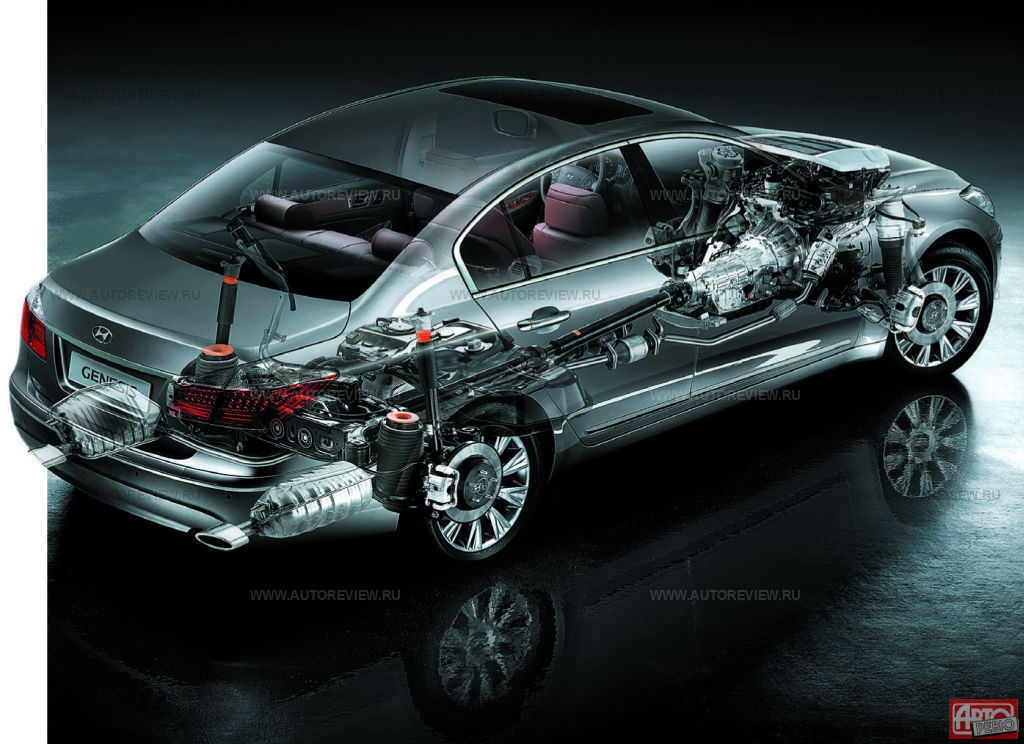 | 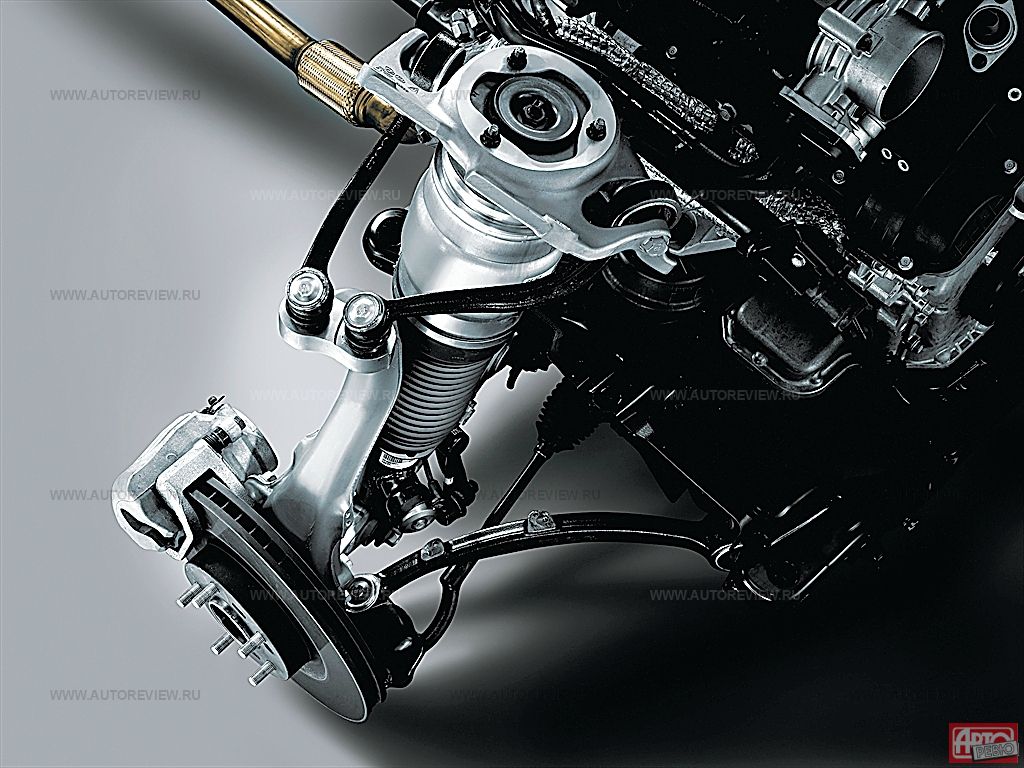 |
| The rear-wheel-drive platform is an engineering breakthrough for the Korean concern. Multi-link rear suspension with steering elastokinematics, electronically controlled shock absorbers... | The front suspension features aluminum steering knuckles with a virtual pivot axis (two ball joints at the top and bottom) and rigid lightweight "mini-subframes" (like on the new Audi A4) for the air strut mounts and upper arms |
For the drive along Jeju's roads, the Koreans lined up the cars in a column — with a leader and a closing "sweeper". Russian journalists got Genesis with V6 3.8 engines and six-speed Aisin "automatics", while the lucky ones from India got V-shaped "eights" paired with ZF automatic gearboxes (also six-speed).
And we took off — at speeds up to 120 km/h. Although the signs say 80 km/h! Does that remind you of anything?
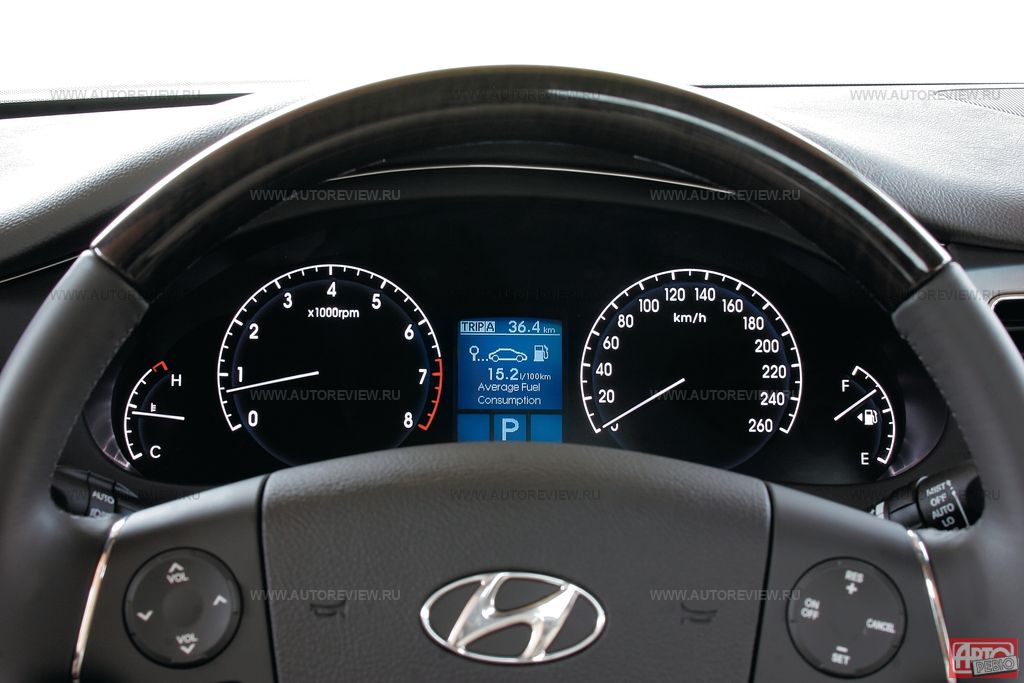 | 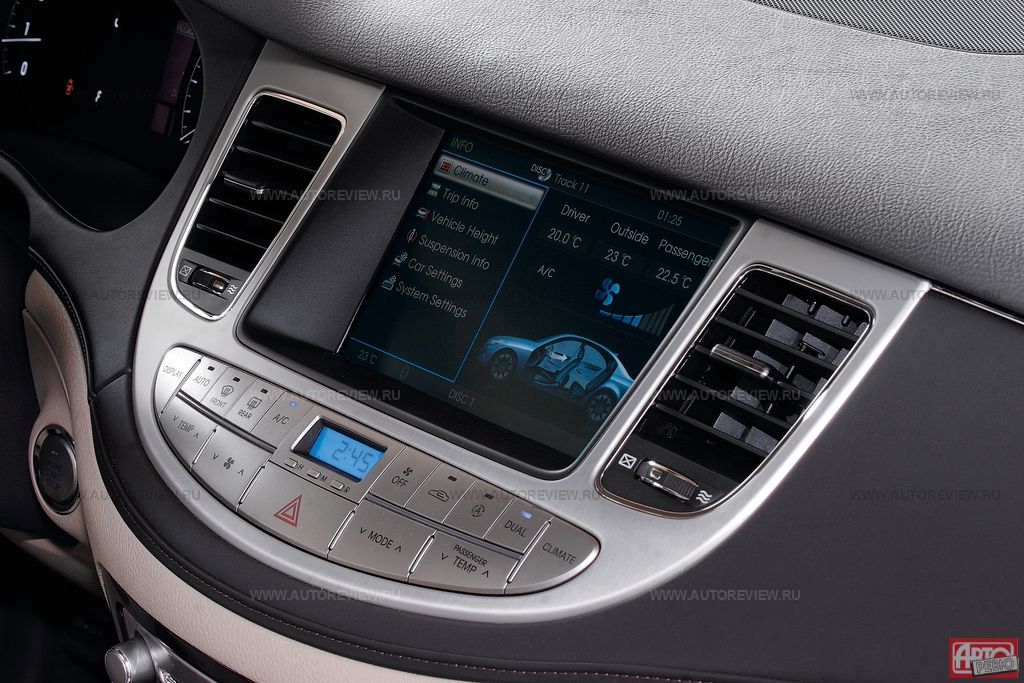 | 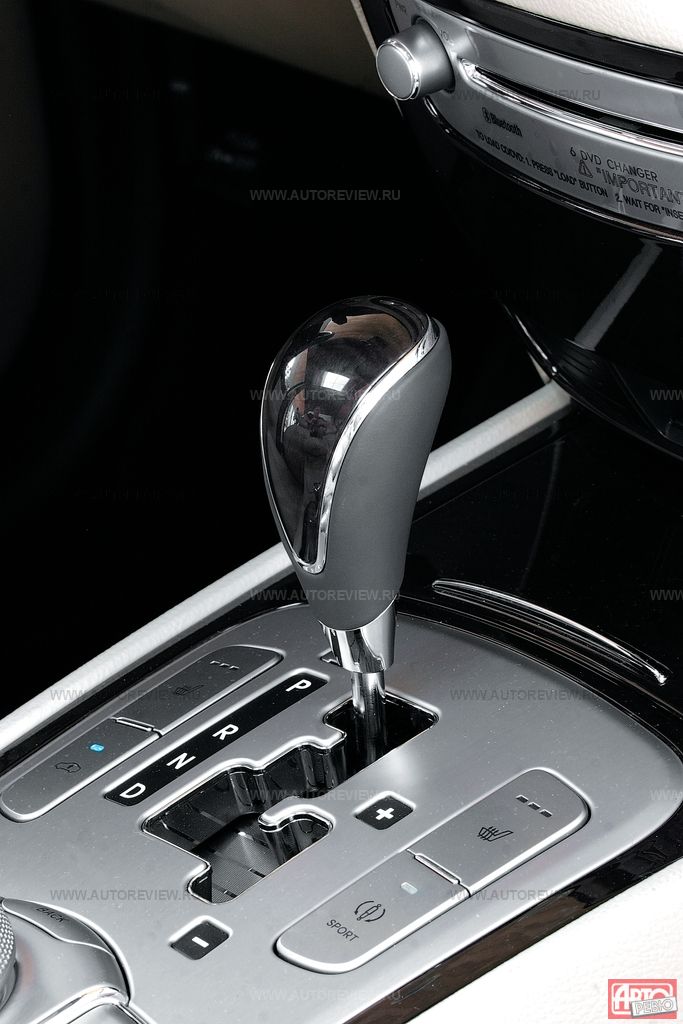 |
| Clear optitronic scales — a dead ringer for Lexus! | Microclimate control is inconvenient, and the fan is noisy even at minimum speed | The Aisin "automatic" shifts on its own even in "manual" and "sport" modes, and it is not particularly quick either |
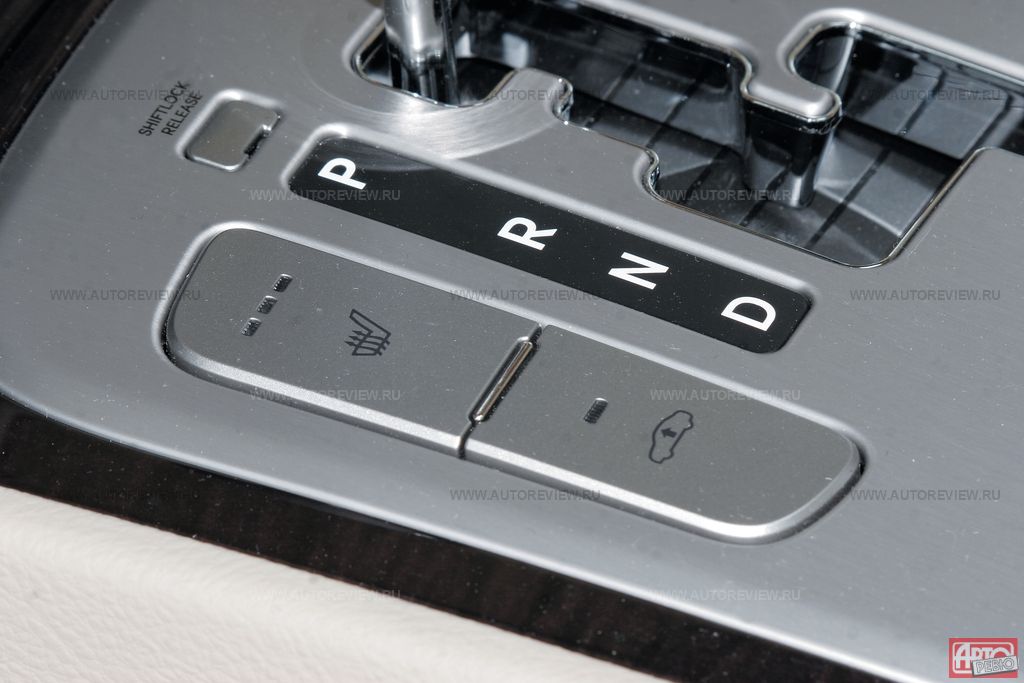 | 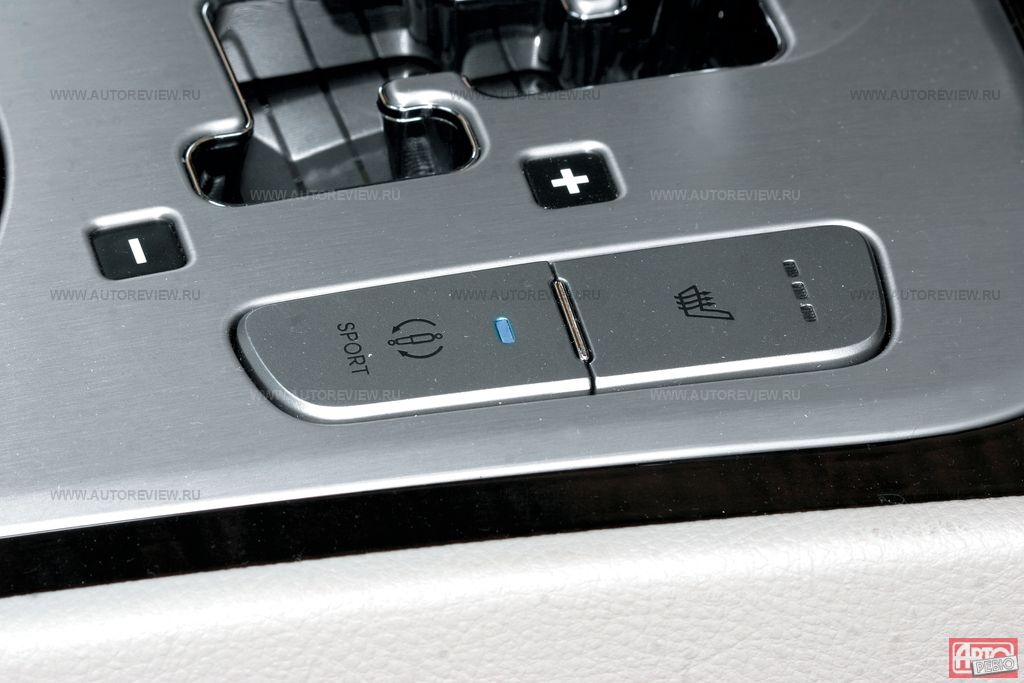 | |
| The button to the left of the "automatic" selector can "raise" the air suspension by 30 mm (up to 70 km/h), and the button on the right can "stiffen" the shock absorbers | ||
The landscapes, although reminiscent of Japanese ones, are still not Japan. Is it possible for garbage to lie in a Japanese ditch? For Japanese to run a red light, turn under a prohibitory sign, or honk at other drivers? But in Korea, this is common — you feel almost at home.
To liven up the car a bit, I started falling behind the convoy. I brake at a traffic light, and then — pedal to the floor!
The character of the all-aluminum 290-horsepower engine of the Lambda family with a displacement of 3.8 liters appealed to me immediately — it revs briskly and very smoothly. But the "automatic" even in manual mode shifts on its own after 5000 rpm (in first), and its gears are "extra-long". The gas pedal is damped moderately, shifts are smooth but unhurried... No, this is not a BMW or a Mercedes.
| At the rear, air vents are on the tunnel and on the middle pillars | |
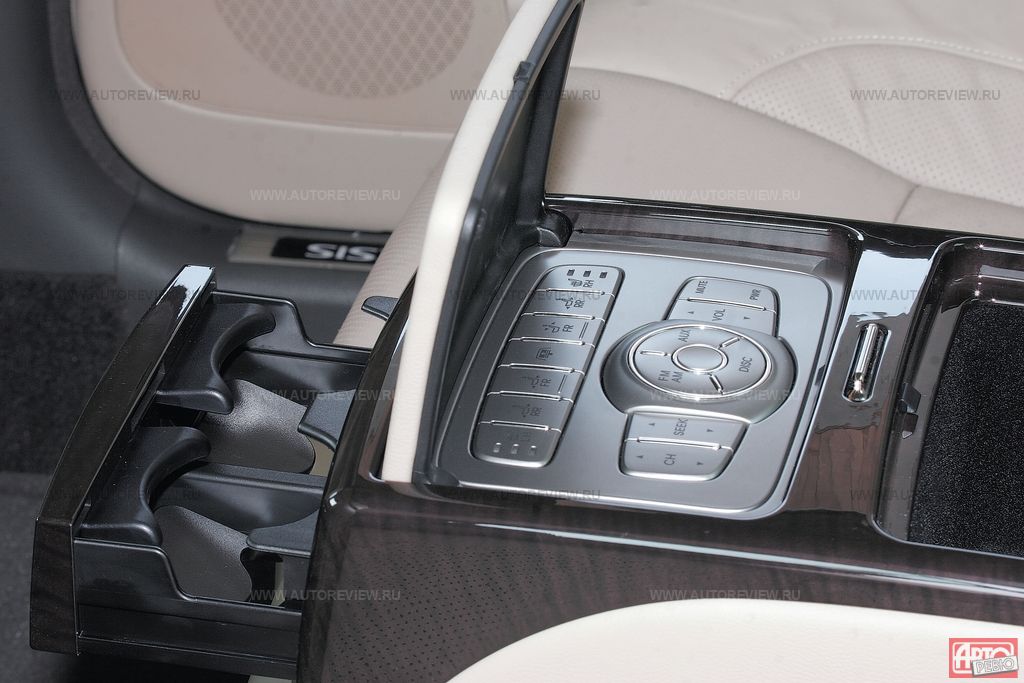 | 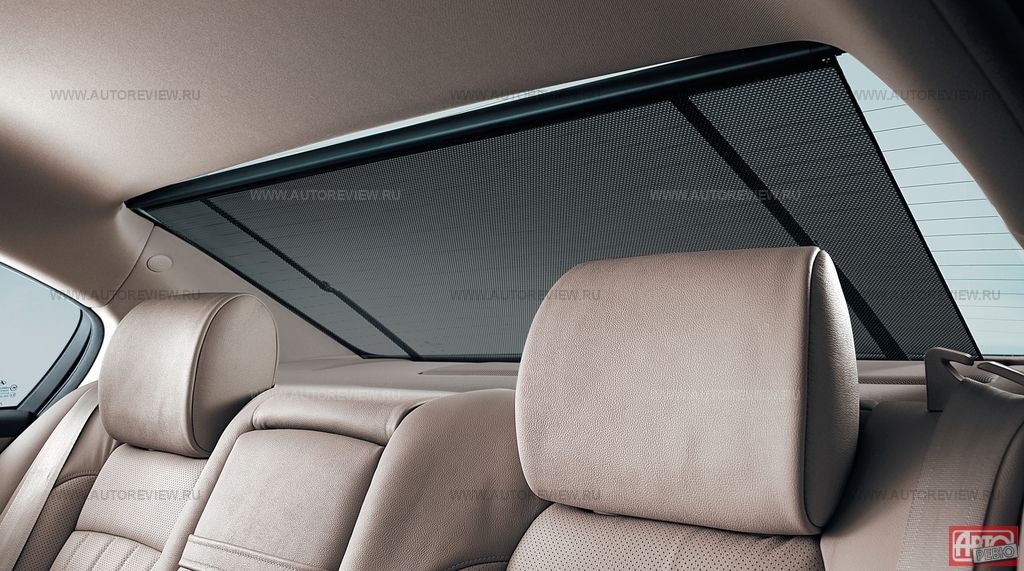 |
| From the remote in the armrest, you can move the rear seat and front passenger seat, and also control the music and the power sunshade on the rear window | |
And I have complaints about the brakes. The pedal feels too stiff: you press harder, but the deceleration is weak. However... When I decided to brake as usual at a yellow light, I almost regretted it. The "cleaner" behind me was braking with all his might — he clearly expected me to run the intersection!
According to the Koreans, the Genesis body structure is 74% high-strength steel, and with a torsional rigidity of 35,300 Nm/degree, it surpasses the BMW 5 Series and Mercedes E-Class. Up front is a classic double-wishbone suspension on a subframe, with aluminum arms and steering knuckles; at the rear is a five-link setup. The weight distribution is almost ideal — 52:48. The shock absorbers have adjustable resistance, and instead of springs, air elements are available for an extra charge.
I got a car with air suspension. On a high-speed straight, such a Genesis is imperturbable, but without Mercedes-like detachment. The steering is informative, the reactions are "correct." But it's far from the involvement of a BMW "five." Even if you press the Sport button, which "tightens" the shock absorbers, only vibrations increase, and the Genesis begins to replicate the road surface in more detail.
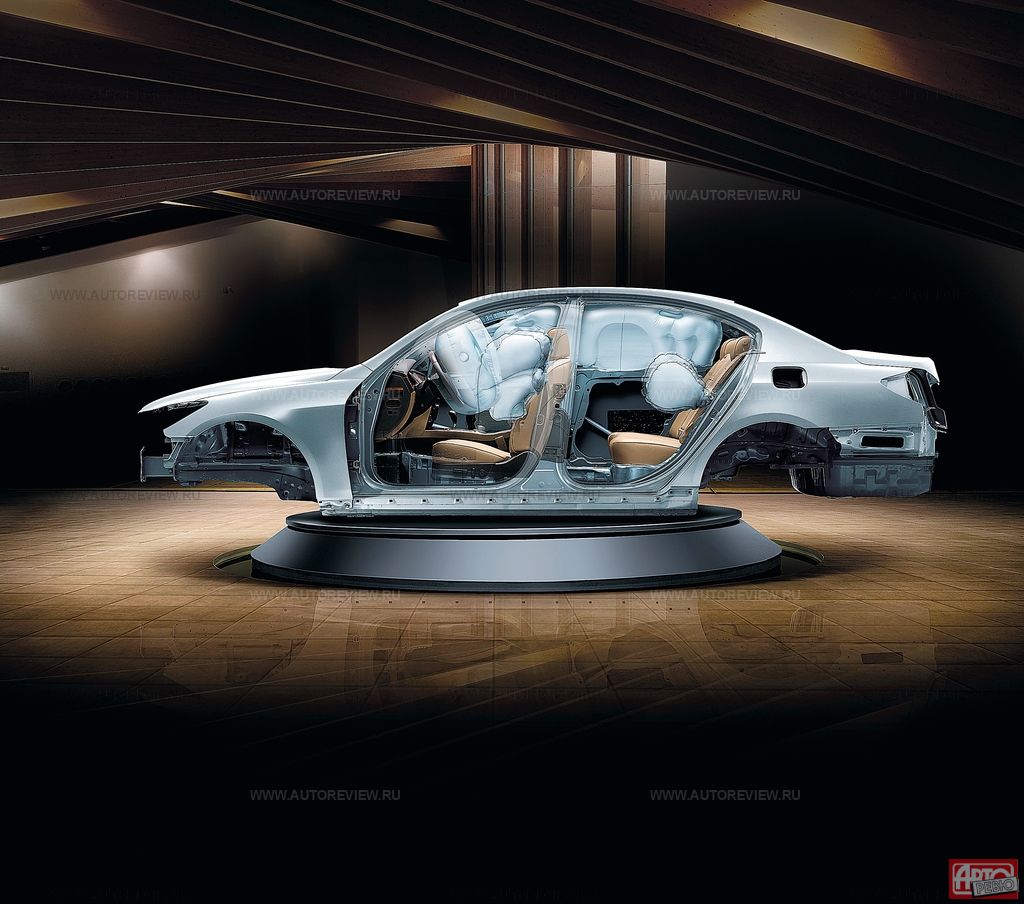 | 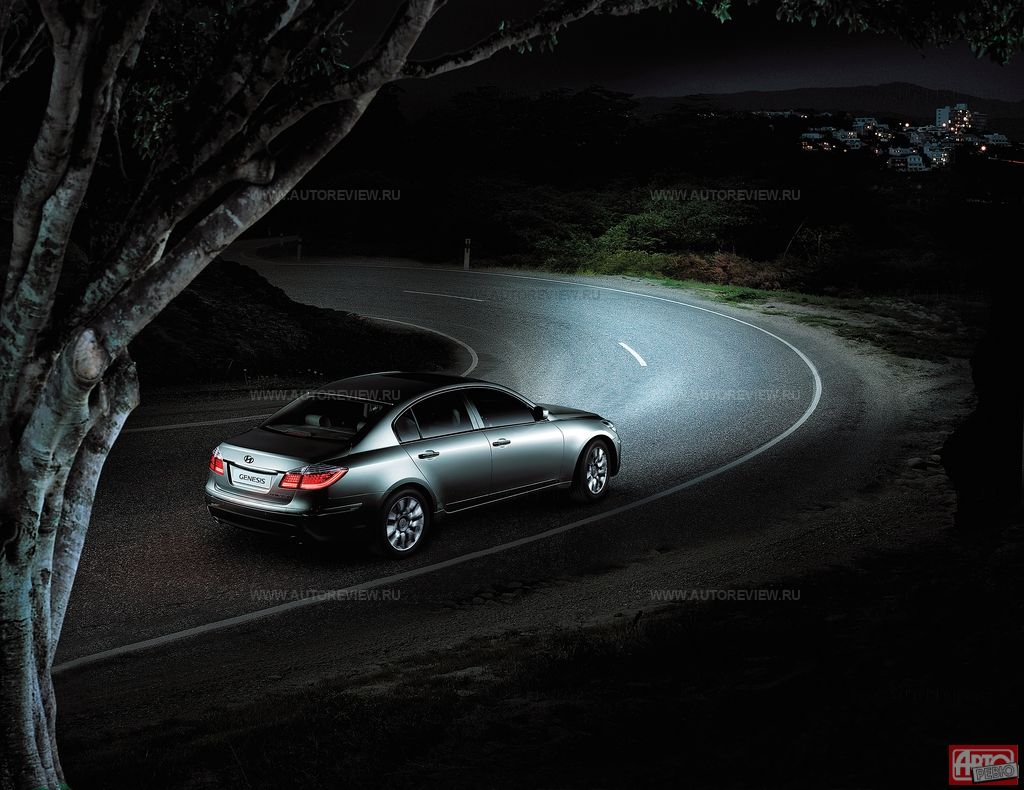 |
| Rigid "cage" of the cabin and eight airbags. Genesis intends to earn five stars under the EuroNCAP methodology | Among Korean cars, only the SsangYong Chairman and Hyundai Genesis have swiveling headlights |
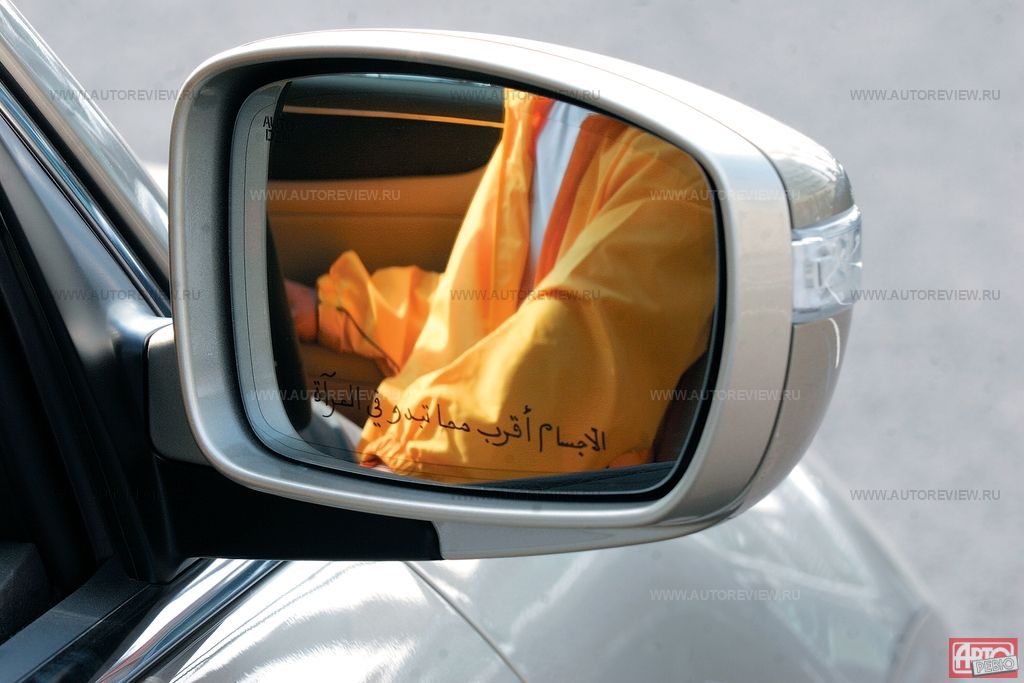 | 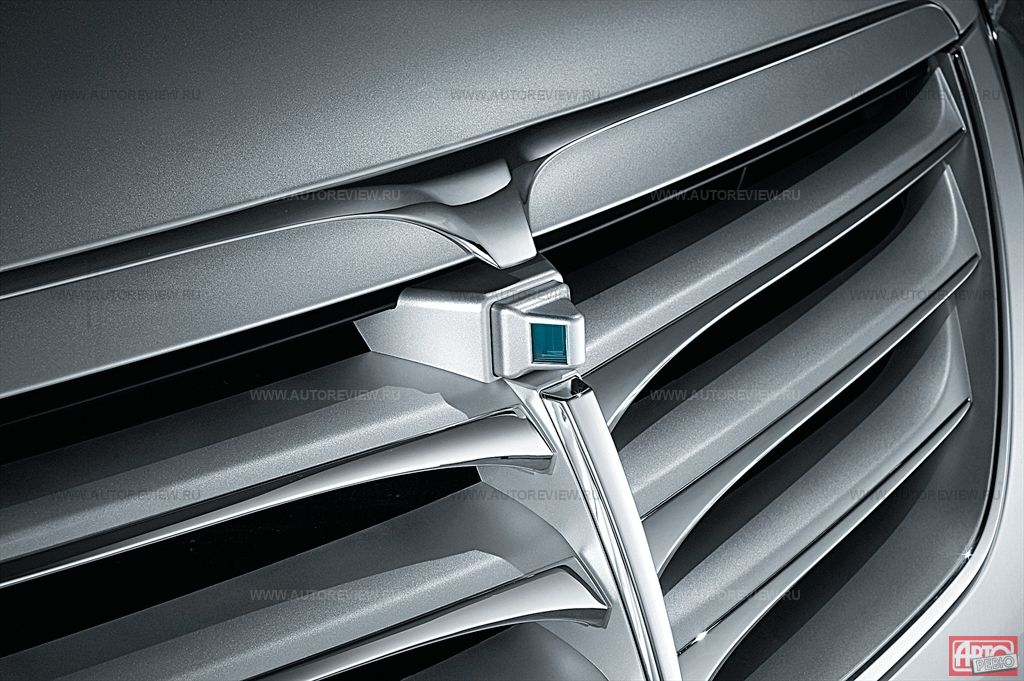 |
| Warning in Arabic script — on cars for the Middle East | Front side-view camera on the radiator grille will help when parking |
No, it's better to leave the suspension in normal mode — then the Genesis confidently swallows medium-sized Korean potholes and doesn't rock on road waves. By the way, the air suspension can raise the body by 30 mm (up to 70 km/h the car "deflates" back to normal ground clearance), and after 120 km/h the Genesis automatically lowers by 15 mm — for aerodynamics.
What about the regular spring suspension? I managed to ride in such a version only on a special road at the factory proving ground in Namyang. The Koreans set up a high-speed "lane change" and "slalom" on the site specifically for journalists, but limited the speed — no more than forty miles per hour. So I first lulled the instructor's vigilance with several calm passes, then accelerated to seventy miles per hour (about 110 km/h) — saying I wanted to check the brakes. But I wasn't going to brake...
"Wow!" — was all the Korean managed to shout. I also mentally exclaimed: the Genesis did everything right! The steering didn't "stumble," the reactions were moderately sharp, and the tendency to oversteer was small. I cast a sly glance at the instructor, and in response — a thumbs up and a nod of approval. Okay, 75 miles per hour is 120 km/h. I turn off the ESP stability control. The rear "floated" already at the entry, and in the second corridor the Genesis went sideways more strongly. But I managed to handle the slides — not least thanks to the precise steering.
And the ride comfort is not much worse than in the car with air suspension. It's hard to believe that the chassis tuning was "polished" by Americans from Hyundai's California research center. Quite a European level!
In short, let the Hyundai Genesis not yet be premium, but the claim has already been made. Moreover, in its homeland, the Genesis sedan is already sold without mentioning the Hyundai brand — as Genesis BH 330 and Genesis BH 380 (with "sixes" of 3.3 L and 3.8 L, respectively). And later, they say, on the same BH platform, the Koreans will build a stretched executive-class sedan that will replace the current flagship front-wheel-drive Hyundai Equus/Centennial from 1999, developed on the Mitsubishi platform.
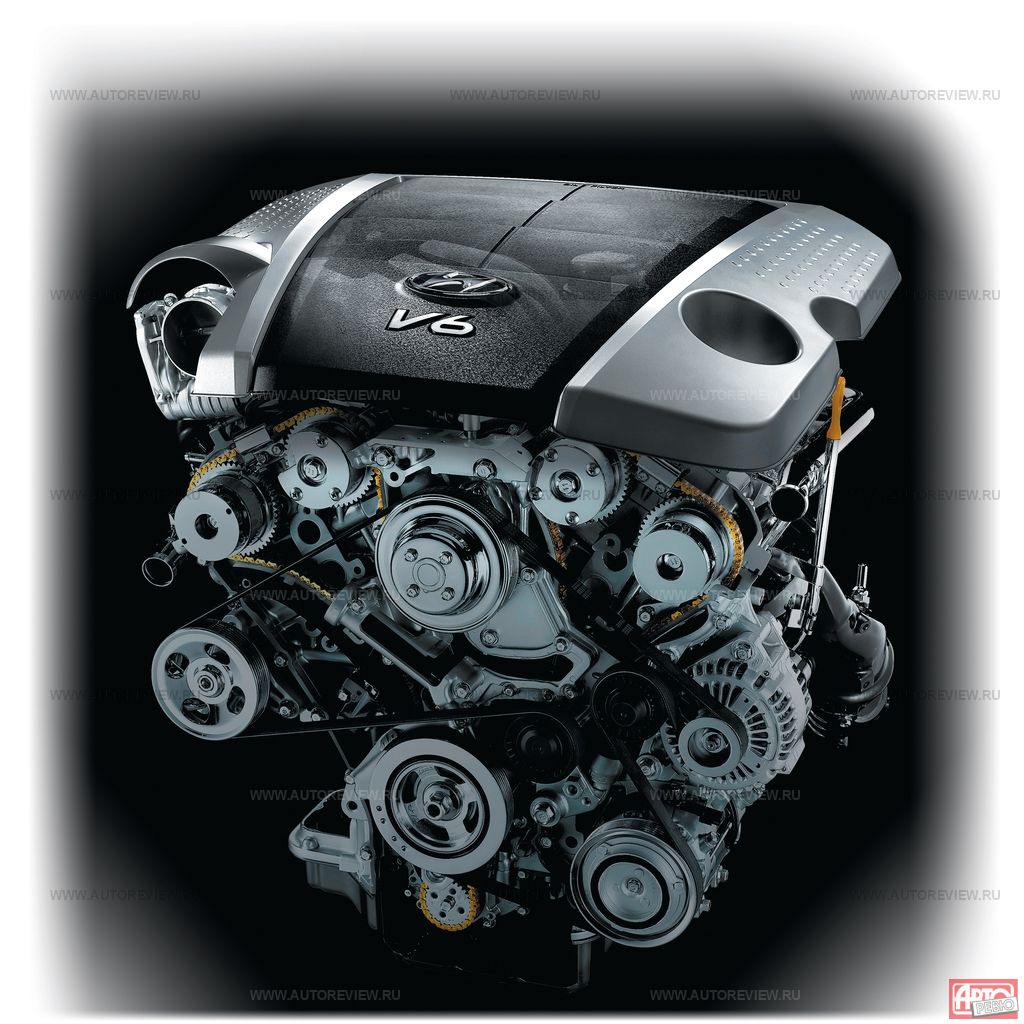 | 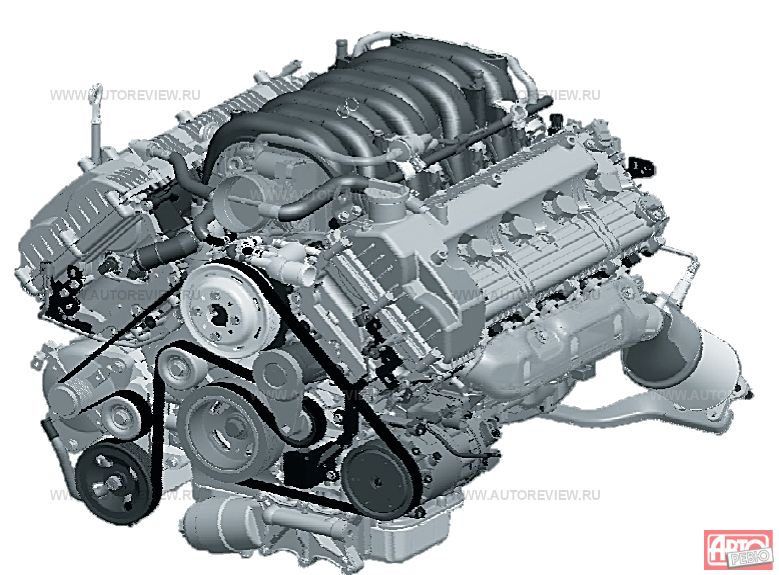 | 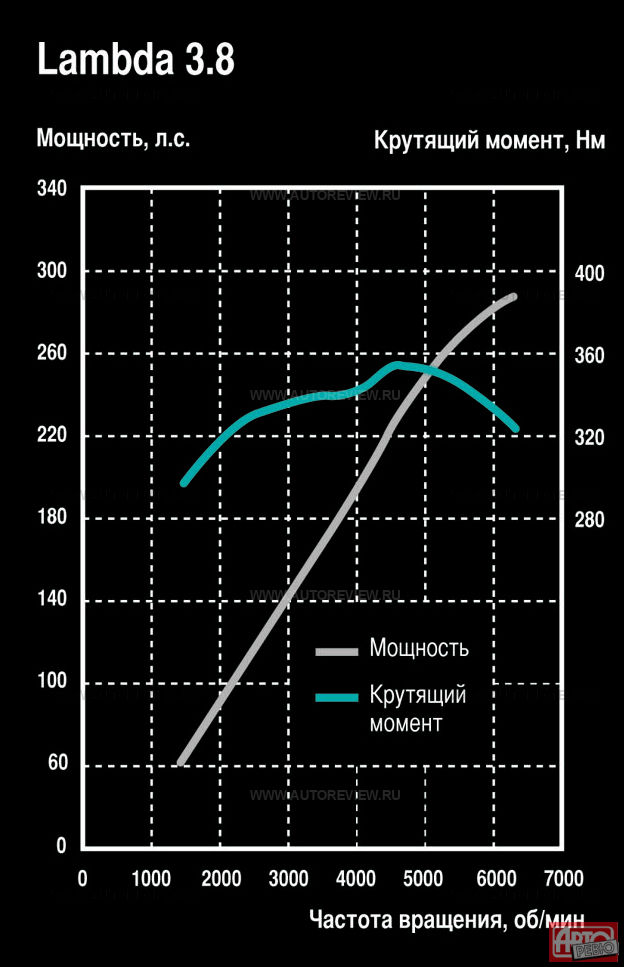 |
| The V6 engines of the Lambda family (3.3 L and 3.8 L) were introduced by the Koreans two years ago: aluminum block, variable-length intake manifold, and phase shifters on both camshafts. The engines are light (the 3.8 version weighs only 172.2 kg), torquey, and produce at least 75 hp per liter of displacement. | The new V-shaped "eight" of the Tau family is installed on the Genesis for the American and Middle Eastern markets. With 4.6 liters of displacement, the engine produces 375 hp and 451 Nm when running on AI-98 gasoline (on AI-95 fuel, power drops to 368 hp). The engine is created according to the canons of the Lambda family, weighs 216 kg, and in terms of liter power (81 hp/L) surpasses the BMW 550 (75 hp/L) and Lexus GS 460 (74 hp/L) — it's not for nothing that four years of work and $260 million were spent on it... |
And the name is chosen accordingly: after all, genesis is "genesis, origin, emergence, beginning."
Initial plans — 80 thousand Genesis cars per year. About 35 thousand of all cars assembled at the Ulsan plant will remain in Korea. About 15 thousand will go for export to China, other Southeast Asian countries, and the post-Soviet space — primarily to Russia and Ukraine. Russians will get about one and a half to two thousand cars, and the official debut will take place in August at the Moscow Auto Show. Then prices and trim levels will be announced. One can only assume that the Genesis will be priced on par with the "Americans" Cadillac CTS and Chrysler 300C (about 1.5 million rubles) — which is significantly more expensive than the top version of the front-wheel-drive Hyundai Grandeur 3.3 sedan (1 million 78 thousand rubles).
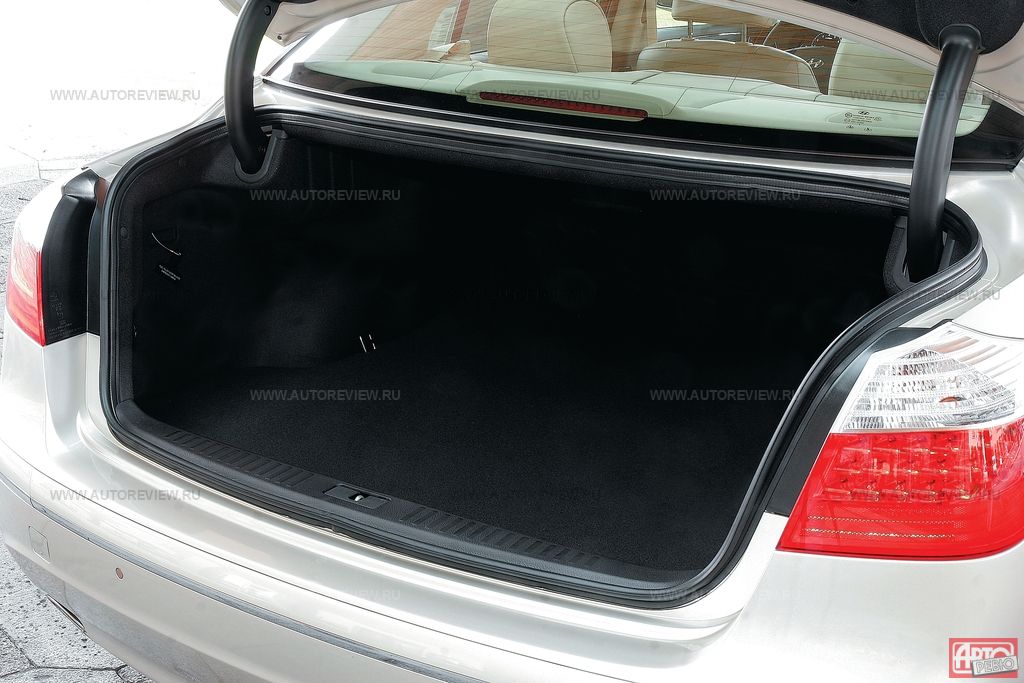 | 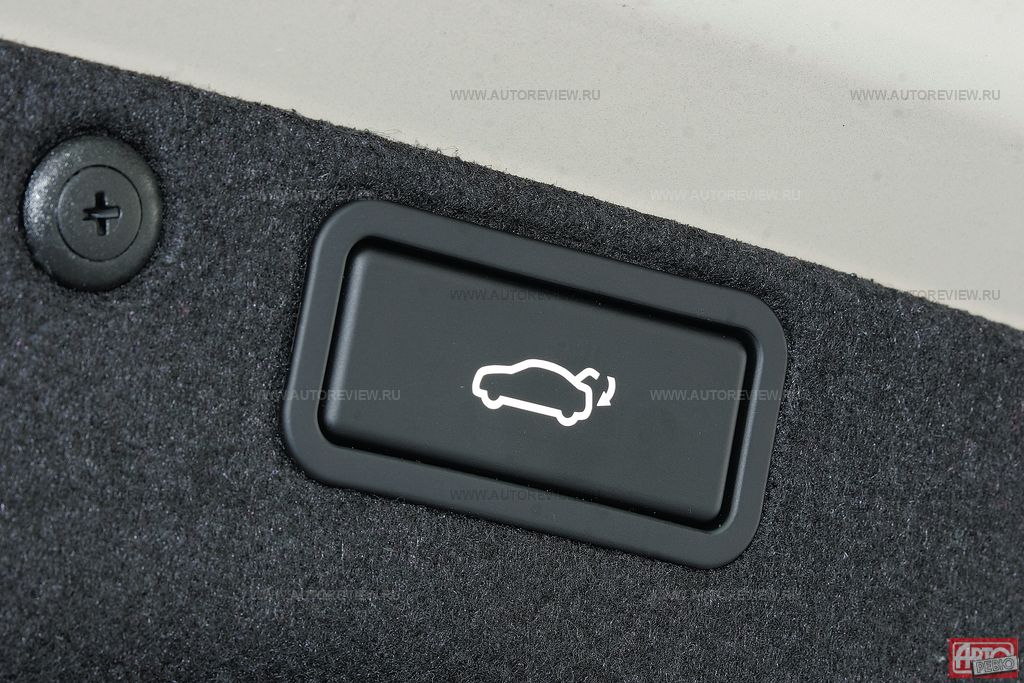 |
| The trunk is "at the level of the best world examples" — both in volume, materials, and ease of use. There is even a power drive for closing the lid | |
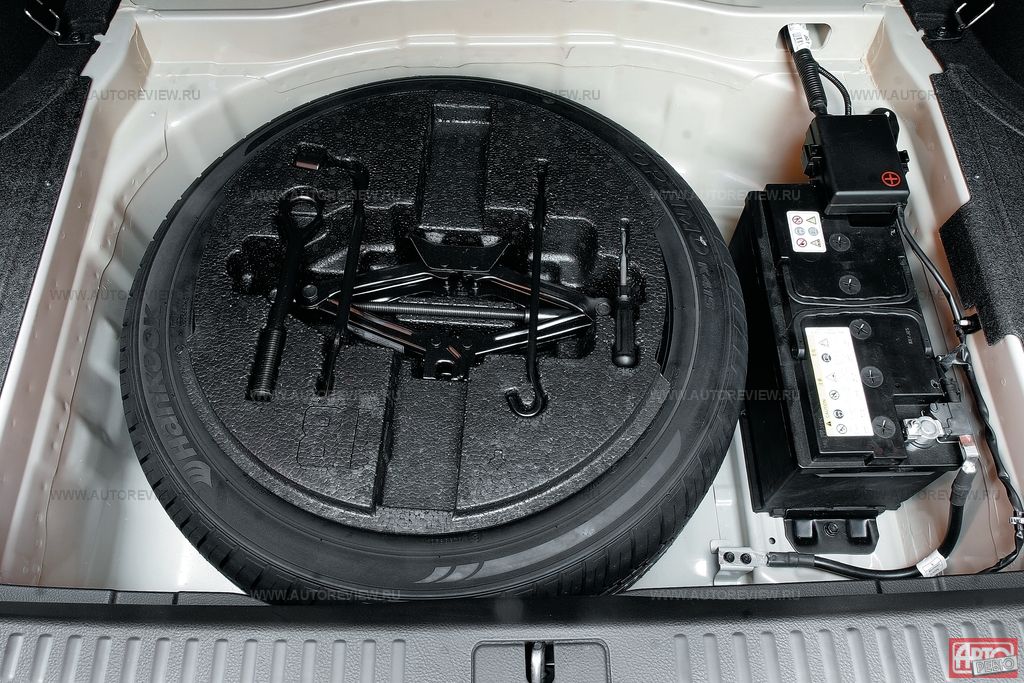 | |
| The buttons for opening the trunk and fuel filler flap are located in the German manner — on the door | The battery in the trunk helped achieve a 52:48 weight distribution, which is close to ideal |
The largest export market is America: about 30 thousand cars. And since in the States Hyundai is a brand for students, housewives, and middle managers, sedans with air suspension will not be supplied there: it's unlikely that anyone from the "target audience" would want to pay extra for this engineering refinement. As the Koreans assure, the Genesis with a price tag of about $30,000 will compete with full-size "Americans" Chrysler 300C and Pontiac G8 GT.
But the Koreans are still afraid to bring the Genesis to Europe. After all, even Lexus has a hard time breaking into the Old World with its most demanding clientele. What can we say about Hyundai...
| Specifications | |||||||||||||||||||||||||||||||||||||||||||||||||||||||||||||||||||||||||||
| Parameters | Vehicle | ||||||||||||||||||||||||||||||||||||||||||||||||||||||||||||||||||||||||||
| Hyundai Genesis | |||||||||||||||||||||||||||||||||||||||||||||||||||||||||||||||||||||||||||
| Modification | V6 3.8 | ||||||||||||||||||||||||||||||||||||||||||||||||||||||||||||||||||||||||||
| Body type | 4-door sedan | ||||||||||||||||||||||||||||||||||||||||||||||||||||||||||||||||||||||||||
| Number of seats | 5 | ||||||||||||||||||||||||||||||||||||||||||||||||||||||||||||||||||||||||||
| Dimensions, mm | |||||||||||||||||||||||||||||||||||||||||||||||||||||||||||||||||||||||||||
| length | 4975 | ||||||||||||||||||||||||||||||||||||||||||||||||||||||||||||||||||||||||||
| width | 1863 | ||||||||||||||||||||||||||||||||||||||||||||||||||||||||||||||||||||||||||
| height | 1480 | ||||||||||||||||||||||||||||||||||||||||||||||||||||||||||||||||||||||||||
| wheelbase | 2935 | ||||||||||||||||||||||||||||||||||||||||||||||||||||||||||||||||||||||||||
| track front/rear | 1575/1580 | ||||||||||||||||||||||||||||||||||||||||||||||||||||||||||||||||||||||||||
| Trunk volume, L | 450 | ||||||||||||||||||||||||||||||||||||||||||||||||||||||||||||||||||||||||||
| Curb weight, kg | 1700 | ||||||||||||||||||||||||||||||||||||||||||||||||||||||||||||||||||||||||||
Drag coefficient Faith in Veracruz
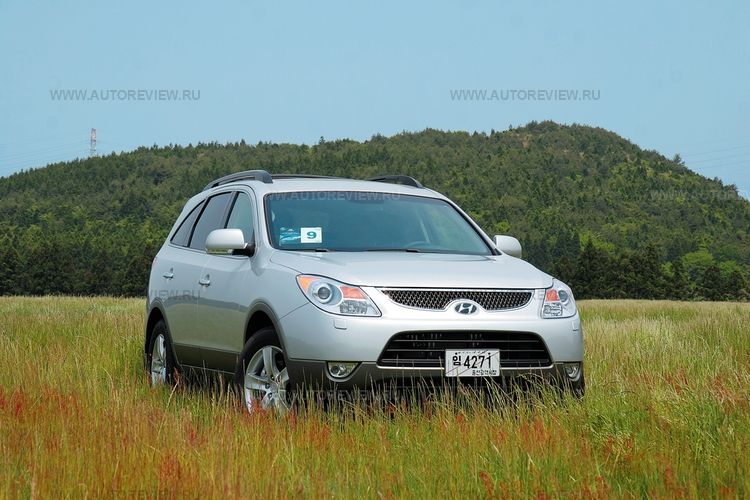
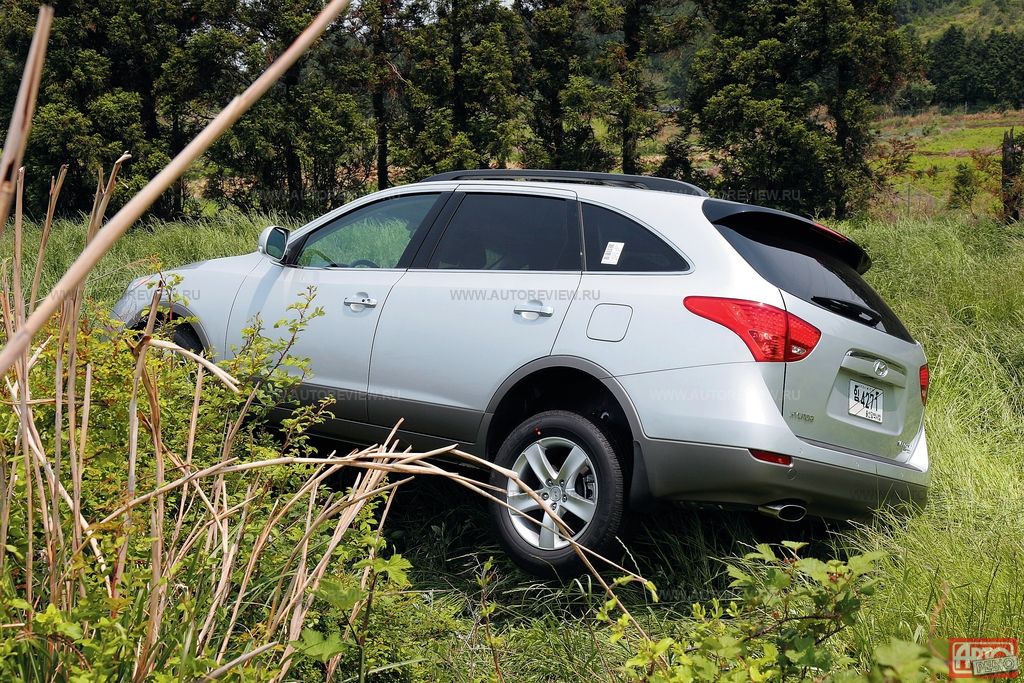
On the Korean island of Jeju, I got acquainted with the largest all-wheel-drive vehicle in the Hyundai lineup — the Veracruz crossover.
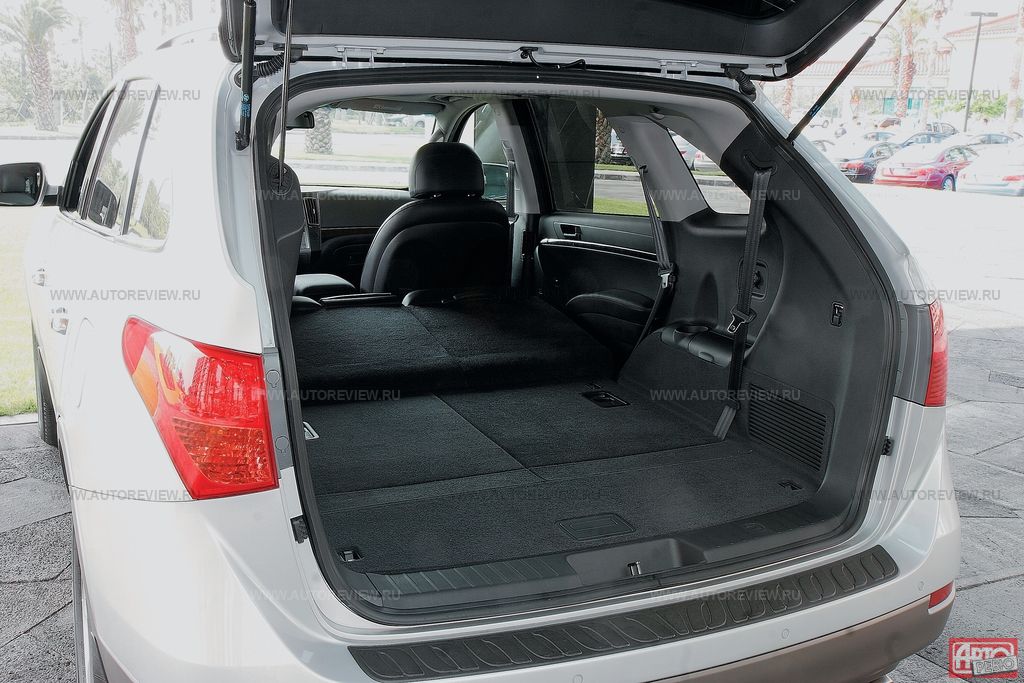
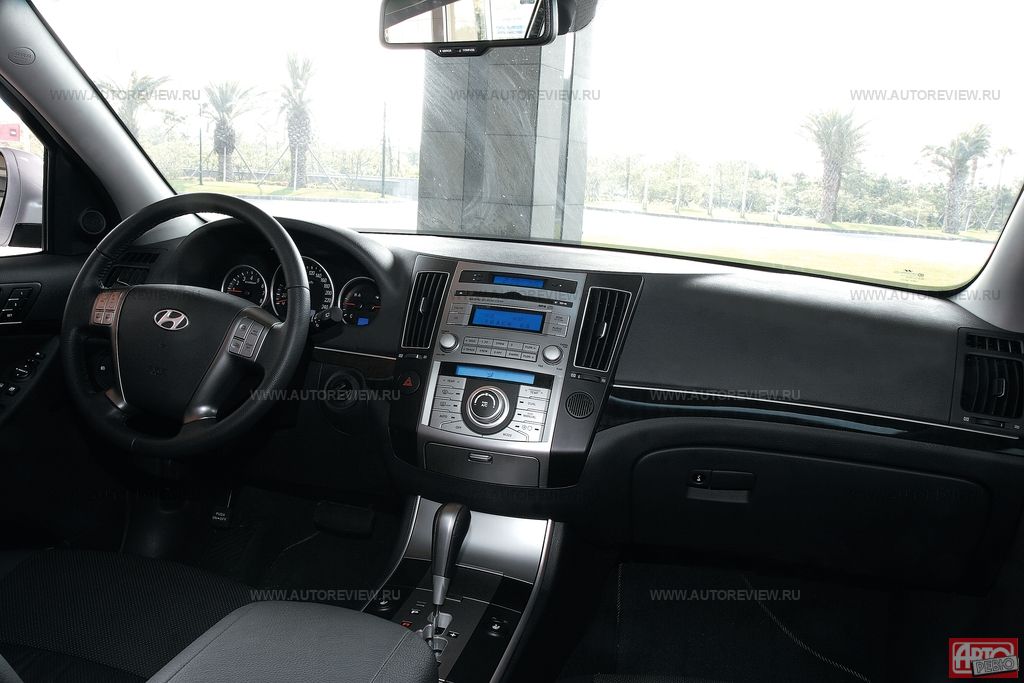
This rounded seven-seat giant from the front resembles a hippopotamus with puffy headlight-eyes. It is based on the Santa Fe platform, stretched by 105 mm, with MacPherson struts at the front and a multi-link at the rear. The front wheels are permanently driven, and the rear wheels are engaged automatically — this is handled by a Haldex coupling controlled by electronics. Veracruz, named after a Mexican state and city, has been sold in the US (main market) and Korea since 2007. Official sales in Ukraine started recently, and in Russia the model will appear closer to the end of the year. I liked the interior much more than the exterior. A modern angular console in the center, instruments without excesses in the form of blue rims... Of the ergonomic shortcomings familiar from the Santa Fe, only the short-arm steering column remains. The seating position is high and comfortable, the seat is firm and contoured, upholstered in perforated leather. Passengers have a real expanse here: the second row is spacious, with a separate climate control unit. Even an adult can fit in the third row. The huge trunk only adds points. It seems this is a big family's dream? Under the hood of my Veracruz was the same 3.8-liter gasoline V6 as in the Genesis, paired with an Aisin automatic. However, there is also a version with a 3.0-liter turbodiesel producing 240 hp. As expected, for such a behemoth, the dynamics are not impressive. The engine here is detuned to 260 hp, and the "long" gears are felt even more strongly than in the sedan. At 60 km/h, the Veracruz noticeably strains, climbing hills in second gear. But the unhurried shifts of the automatic are quite appropriate here. And there are no questions about the brakes. In terms of handling, the Veracruz is a true "American." It responds to corners leisurely, the steering wheel is light and completely uninformative, and when exceeding speed, the front wheels smoothly and hopelessly slide outward from the arc. Even on a straight line, it holds its course poorly, deviating on transverse bumps. Information from the steering wheel is zero; you have to steer intuitively. But comfort, including acoustic, is at a high level. Only vibrations from unsprung masses are annoying.
There is no point in going off asphalt in the Veracruz. The suspension is short-travel, the rear drive engages with a noticeable delay, there is no low range, and the bumpers are painted in body color... Its element is urban "parquet." In Russia, the segment of large crossovers is still empty. But soon Honda Pilot, Mazda CX-9, and other rivals of the Veracruz from the American market will arrive. And there it competes not too successfully, despite the attractive $28,600 for the all-wheel-drive version. After all, Mazda and Honda cost only one and a half thousand dollars more in the States, and they look significantly more impressive. How will the Veracruz be received in Russia? Let's look at the prices.
| |||||||||||||||||||||||||||||||||||||||||||||||||||||||||||||||||||||||||||