Hyundai claims in its advertising that the Genesis is a car with the looks of a BMW 5 Series, the space of a 7 Series, and the price of a 3 Series. But when you personally get acquainted with this sedan, a logical question arises: why didn't the Koreans mention Lexus in their marketing materials? The feeling of deja vu doesn't let go: I've already seen this ashtray somewhere, browsed a similar multimedia menu, and started the engine with a similar button. And the steering wheel with its viscous effort, and the clear eyes of the optitronic instruments — all of this is already familiar to me.
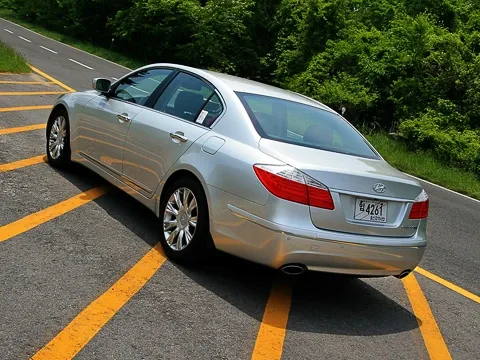
The rear looks somewhat plain, although if you want, you can find borrowed details in it too.
However, Lexus is not the only source of inspiration. The front panel clearly echoes the Infiniti M, and the large silver washer on the tunnel is an obvious nod to the Bavarian iDrive. But, unlike the original, this multimedia system selector has play, and the drive doesn't work as precisely as one would like, although the menu itself is quite convenient. Hyundai acts according to the classic Far Eastern scheme — unobtrusively borrowing and quoting. At one time, Toyota started building Lexus the same way, copying Mercedes. The Koreans, however, focus on the Japanese, who are closer to them, although they don't publicly admit it and prefer to compare themselves with BMW — apparently, the dislike for former colonizers takes its toll.
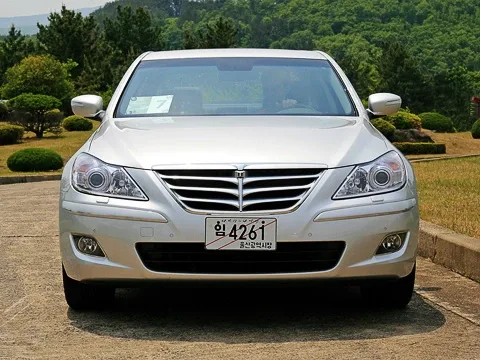
The contours of the fake radiator grille evoke thoughts of something prehistoric.
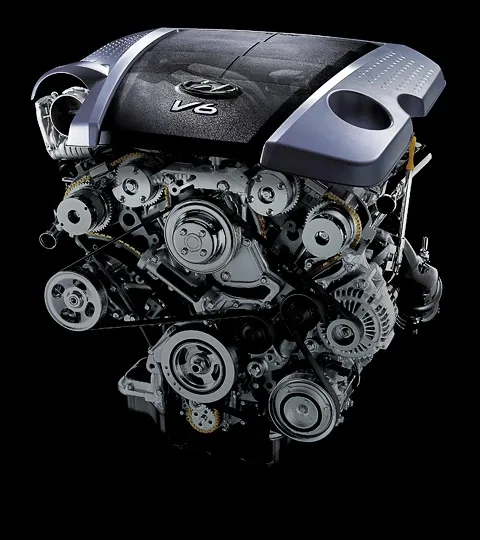
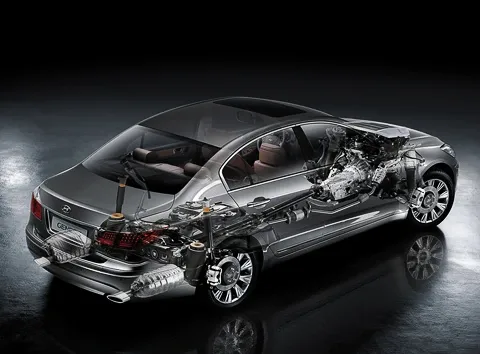
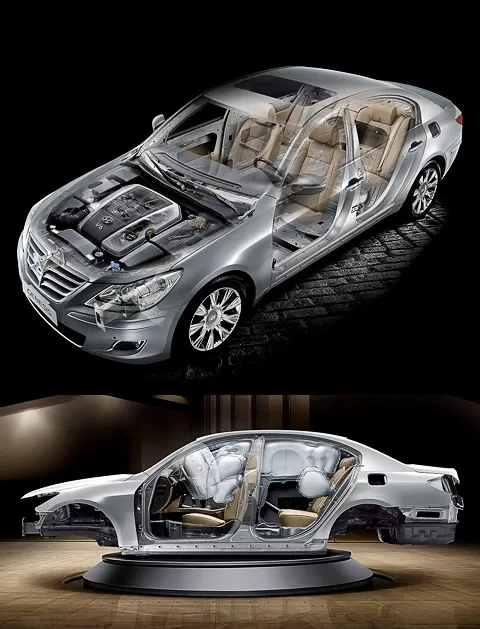
The Koreans worked on creating a premium sedan for a full five years. The task was so large-scale that it was solved comprehensively, not pointwise. The Genesis is built on a completely new platform, equipped with modern multi-link suspensions and a V8 engine created from scratch, which in terms of liter power surpasses German and Japanese competitors. Plus — thoughtful aerodynamics and passive safety, claiming five European stars. The only question is how tasty this cocktail of Korean ingredients, prepared according to a classic recipe, will turn out.
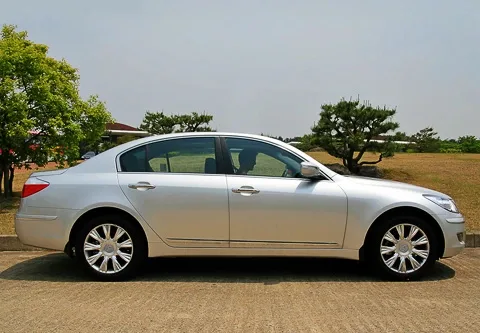
We spent the first part of the test in Namyang, near Seoul, where the Hyundai test site is located. The Koreans immediately took away our cameras — secret prototypes drive around the territory. There goes a camouflaged Kia Soul, and there's the new Getz (i20). It was here that the Genesis was created and refined, and on the home track the car brilliantly passes the "moose test." My sedan is in the American version: with a spring suspension, but with the same 290-horsepower V6 3.8 engine as for Russia (the version with the "eight" is intended only for the US and Middle East markets). The Genesis behaves impeccably: first a slight slide outward, then a smooth drift that is easily corrected before ESP intervenes. Top-class driving!
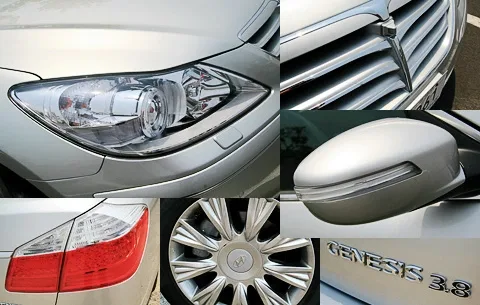
At the bottom of the fake radiator grille, a two-way camera is hidden, helping when exiting a corner and when parking. The headlights are adaptive.
There are practically no complaints about how the car drives. After the test site, we went to Jeju Island, where the organizers gathered test cars in a column and released them onto regular roads. At the same time, the Koreans listened to our comments with great interest. The only thing one could complain about was the gearbox. The six-speed automatic shifts smoothly, but thinks too long. Moreover, it has no sport mode — only a pseudo-manual one, in which the gearbox reluctantly responds to selector movements (there are no paddle shifters here) and decides on its own when to shift. Moreover, to downshift, you need not just push the lever, but hold it in that position — during dynamic driving, this is annoying.
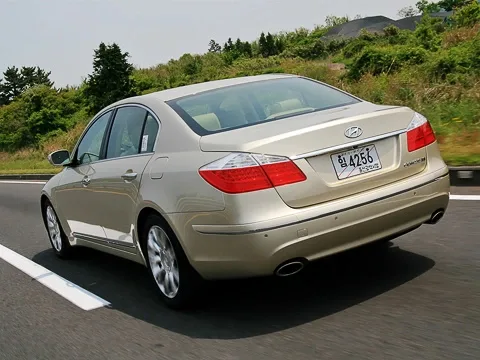
The rear-wheel-drive Genesis is a compromise between drive, comfort, and understandable handling.
But the engine is a real pleasure. It pulls from the very bottom and effortlessly accelerates the five-meter sedan. For a car weighing 1700 kilograms, the acceleration is very dense. The only thing missing is a more informative brake pedal feel. During emergency braking from speeds well over a hundred and fifty, I had to press the pedal to the floor too hard...
By some miracle, I managed to break away from the organized column and stay alone with the island landscapes. You can forget about the comfort mode — you can't fault the ride smoothness anyway. The car is already in "Russian" specification, that is, with air suspension. I set the dampers to Sport mode: show me, Genesis, what you're capable of outside the test site! But even when driving "for all the money," the Genesis doesn't demonstrate its own character. It resembles all cars of its class at once. It holds a straight line perfectly, enters corners willingly, despite the "long" steering wheel. Feedback is moderate but sufficient, so a series of bends is given to it without strain. Excitement and reliability go hand in hand here, but preference is still given to the latter.
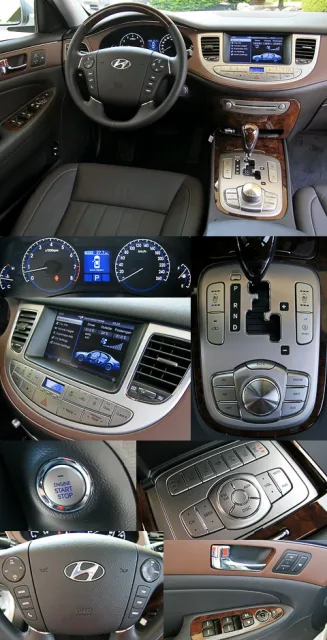
In the cabin, the first thing you notice is the leather front panel and the multimedia controller on the center tunnel. Optitronic instruments, a large display with graphics in the spirit of Lexus and Mercedes, adjustable rear seats — and above all this, the Hyundai logo proudly sits.
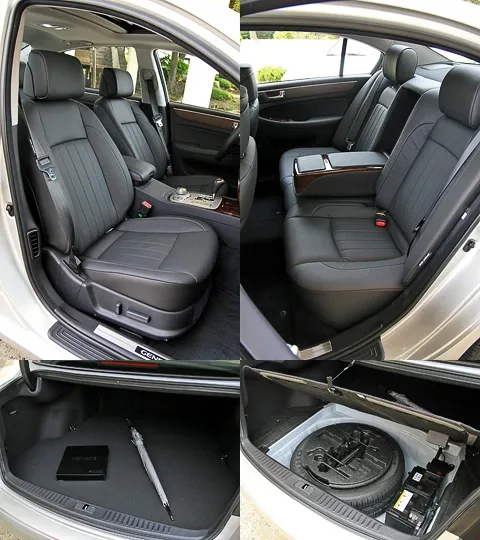
The profile of the ventilated front seats turned out well for the Koreans, but large people may lack adjustment ranges. In the back — more than spacious.
But I still couldn't get comfortable behind the wheel at my height of 190 cm: I want to lower the seat even more. And the black steering wheel, covered in slippery leather, as if from budget models, is clearly out of place here. But in the back row, it's probably more spacious than in the Infiniti M — and with "executive" options like controlling the front seat. But for the Koreans' first attempt to make something "expensive," I would give a "four" with a minus. The minus is for the lack of expressiveness. Everything is done solidly, everything is in its place, the seats are comfortable, the front panel is leather, but it doesn't grab you, no matter what. The main thing is missing — the zest. And the lack of traditions is acutely felt.
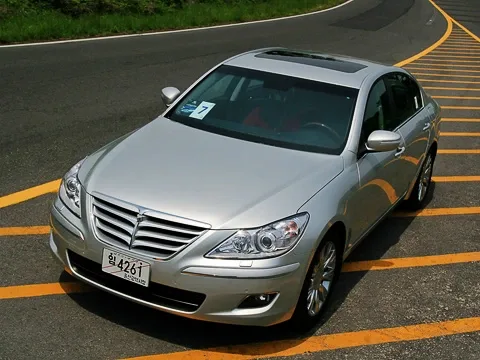
In South Korea, the Genesis sedan no longer surprises anyone: sales have been going on there since spring.
True premium is forged over the years. A car of this class must "mature" for two or three generations — there is no other way in the automotive industry. Therefore, it's too early to give a final assessment to the Genesis project: we don't yet know the Russian prices, and therefore the real competitors. Talk is talk, but it's unlikely that Hyundai will be able to compete on equal terms with the German-Japanese alliance. Private buyers in this class choose brands. So for now, the "Korean" is destined for the fate of an official car and a regular guest of elite taxi fleets. This doesn't mean the Genesis is bad, it's just that a solid foundation is needed for the ladder to the stars. Otherwise, what kind of genesis is it?
Technical specifications
* limited electronically
| Specifications | Hyundai Genesis V6 3.8 |
|---|---|
| Body | |
| Number of doors/seats | 4/5 |
| Length, mm | 4975 |
| Width, mm | 1863 |
| Height, mm | 1480 |
| Curb weight, kg | 1700 |
| Trunk volume, l | 450 |
| Engine | |
| Type | petrol, with distributed injection |
| Location | front, longitudinal |
| Number and arrangement of cylinders | 6, V-shaped |
| Number of valves | 24 |
| Displacement, cm3 | 3778 |
| Max power, hp/rpm | 290/6200 |
| Max torque, N•m/rpm | 358/4500 |
| Transmission | |
| Gearbox | automatic, six-speed |
| Drive | rear |
| Chassis | |
| Front suspension | independent, air, double wishbone |
| Rear suspension | independent, air, five-link |
| Front brakes | disc, ventilated |
| Rear brakes | disc |
| Performance characteristics | |
| Maximum speed, km/h | 210* |
| Acceleration time 0–100 km/h, s | 7.6 |
| Fuel consumption, l/100 km | |
| urban cycle | 13.6 |
| extra-urban cycle | 7.2 |
| combined cycle | n/a |
| Toxicity standard | Euro-4 |
| Fuel tank capacity, l | 73 |
| Fuel | AI-95 |
Technology