
ELANTRA NEW
Test drive
Hyundai Elantra
Engine: 2.0 DOHC
Displacement: 1975 cc
Max. torque:
190 Nm/4600 rpm
Max power: 143 hp/6000 rpm
Top speed: 190 km/h
Transmission: automatic
4-speed
Acceleration 0-100 km/h
10.5 sec.
Fuel consumption:
combined cycle - 8 l/100 km
Dimensions:
Length - 4505 mm
Width - 1775 mm
Height - 1490 mm
Ground clearance - 160 mm
Curb weight
- 1299 kg
Payload
- 475 kg
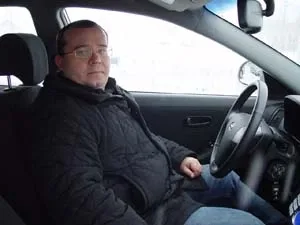
Marat, commercial director of OJSC “Inox”. Driving experience - 10 years.
I became the owner of a Hyundai Elantra in June 2004. I really liked the car, and parting with it was a bit sad. Over a couple of years of ownership, I spent about 15 thousand rubles on maintenance (and if it weren't for the severe frosts of the winter of 2005–2006, which caused the struts to fail, this amount would have been only 10 thousand for 45 thousand kilometers of mileage). During this time, I became convinced that the Elantra gives a lot for its modest money. Therefore, I went to test the new Elantra thinking I would see just an updated version, but I was presented with a completely different car!
On the outside, the car looks respectable, has become noticeably more solid and “richer.” Inside, it's a modern, even stylish interior. It's still spacious and comfortable. Rear passengers have plenty of room.
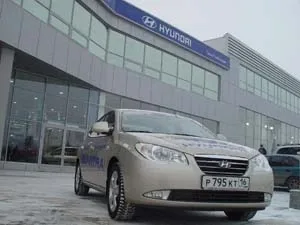
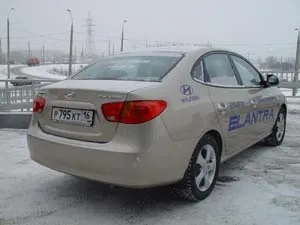
The new model is available with 1.6 and 2 liter engines. We got the top trim version, which cost about 682 thousand rubles. At first glance, this seems a bit expensive, but in my opinion, the car justifies its price. First, the steering has become slightly stiffer, and the longitudinal rocking that was present in the previous model is gone. The suspension works more composedly and eagerly. The electric power steering fills with weight at speed, which only benefits the car. Acceleration is confident, with a good pickup at low revs. The automatic transmission works quite briskly. Climate control works flawlessly. The presence of the ESP system noticeably simplifies driving on hard surfaces. No complaints about the brakes. From the driver's seat, visibility is excellent, and the seating position is very comfortable. The mirrors are large, with virtually no blind spots. The stock audio system sounds decent, and the music control buttons are on the steering wheel. Sound insulation is at a good level. From a buyer's perspective, it's an excellent car.
This car is in no way inferior to “purebred” Japanese cars — the Koreans have made such a technological leap in recent years that we can only dream of it. Starting with “licensed” models, Hyundai has over two decades become a full-fledged and independent manufacturer of real cars.
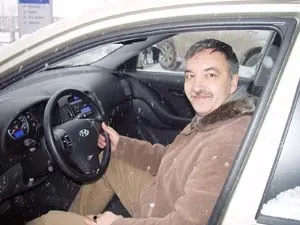
Vadim. Driving experience - 9 years.
I'll start my story about the new Elantra with the automatic transmission, because it plays the first fiddle in a car with a two-liter engine. So, mechanically, it's the good old 4-speed. But its “brains” are interesting. For instance, if you completely release the gas pedal, the revs drop to 800, i.e., to idle. In other words, engine braking is practically impossible here, but this saves fuel. Another feature: even with a slight press on the gas (even at normal revs), the gearbox tends to downshift. What does this mean in real life? The car becomes very lively during acceleration, creating a feeling of a huge power reserve, but you have to pay for it with increased appetite. One setting I particularly liked — the Elantra starts from a standstill just reactively. But when you sharply press the pedal to the floor, the revs first rise, the car slowly picks up speed, then there's a second-long pause (nothing can be done about the 4-speed automatic's thoughtfulness), then the gearbox shifts down, and there's a sharp jerk. Surprisingly, but true: I've never seen an outdated automatic transmission so successfully compensate for the shortcomings of a not-so-fresh engine. Bravo! The engine and gearbox combination works just brilliantly. True, you have to pay for this too: based on trips both in the city and on the highway, the onboard computer showed an average consumption of 14.6 l/100 km.
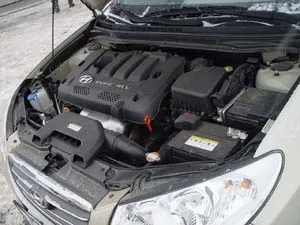
Let me say a few words about the engines. The younger one — 1.6, producing 122 hp at 6200 rpm, is equipped with a variable valve timing system. It would be interesting to test it. There's no 1.8 engine yet — it also appeared with a delay in the previous Elantra. I'll keep quiet about the 2.0 — there's nothing exciting about it. By the way, the situation resembles the Ford Focus2: a new 1.6 and an old 2.0.
Although, honestly, most buyers look primarily at the appearance and finish, not technical characteristics. Externally, the Elantra has become much more European, and the interior now looks like everyone else's. I think this is more of a plus than a minus. The interior is spacious, the finish is decent, the equipment is rich: what else is needed for success?

Alfred. Driving experience - 11 years.
I first saw the new Elantra at a dealership about a week before this test. Honestly, the car seemed strange to me — strange design, strange price. It differs from the previous model as much as a steam locomotive differs from a primus stove — nothing in common. They are united only by the bright blue backlighting of the instruments and the name. Otherwise, it's a completely different car. It seems to me that it's not entirely honest to use the good name of the Elantra, earned on the ideal balance of price and quality in the range up to $20,000, for another car. It was this quality that made the previous Elantra so popular: it's hard not to appreciate the huge comfortable interior and the necessary set of functions for about $16,000. It seems the Koreans got dizzy from success and decided to raise the bar. The zeal is commendable, but they forgot one thing — they are not Japanese or Germans. There's still not enough pedigree to sell a C-class car at a D-class price. Yes, it's noticeably larger, more comfortable, and better equipped, but it's still a Hyundai. I'm not saying it won't sell — it will, but not like the “real” Elantra.
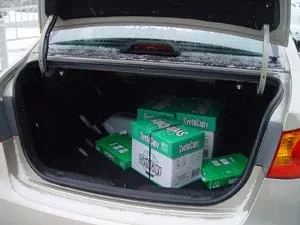
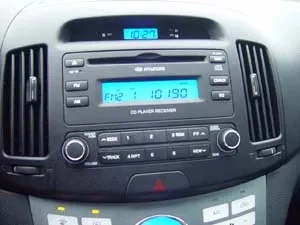
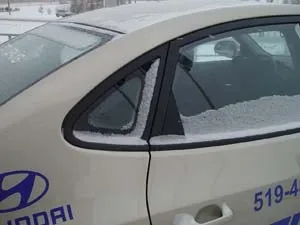
When I was choosing an angle for photography, I finally understood what exactly I don't like about the design. It's the rear side part around the window. I just don't like it — that's all! Surprisingly, each detail individually looks quite good. Look at the lines of the hood and side edges. Fashionable headlights and beautiful taillights, wheel arches, and a sloping roof — but there's no coherence. The picture turns out archaic, lacking integrity. There's no red line that would unite all elements into a single image. There's no charisma. The same goes for the interior. Individual solutions are interesting, but everything is somehow disjointed, with no common theme. I got out of the car and can't remember what it's like inside. I remember individual details (the bright blue oval of the climate control indicator, unusual white buttons on the console), but it's hard to recall the overall picture.
And how does this new Elantra drive? Contrary to my habit, I sat in the front passenger seat — it's more convenient to assess the quality of the plastic and the density of assembly. And it was there that I first had a thought that I logically came to at the end of the test: this car is made too well for its class. I hope the new Elantra doesn't suffer the fate of the VW Golf V… It also doesn't fit into its class in terms of characteristics, quality, and equipment. However, this also applies to the price. But at least it's high-bred. And what about the Elantra?
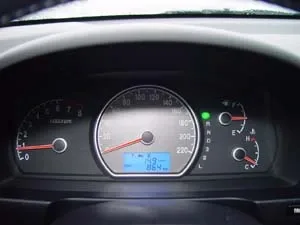
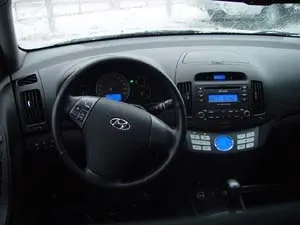
As for driving qualities, it, like its predecessor, pleases with a dense suspension and excellent sound insulation. The informative steering with electric power assist was very pleasing. Such feedback for an electric power steering is still rare — not all renowned manufacturers can boast of this. The car accelerates confidently and assertively, but sometimes there's a desire to manually shift to a higher gear. It's all about the automatic transmission's algorithm. The four-speed holds off shifting until the last moment. This setting allows the engine's potential to be unleashed, which is good for dynamics but bad for consumption. Braking force is easy to dose, and the ABS activates exactly when you expect it. But during intense deceleration, there are complaints about the brakes — the car pulls slightly. True, to be fair, it's worth noting that the road was like an ice rink.
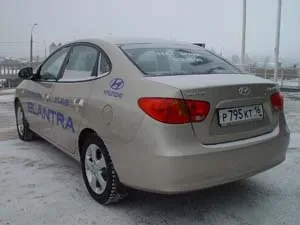
When I got into the car, I could barely stand on my feet — it was so slippery underfoot. The same thing happened when I had to sharply swerve away from a deep pothole: the rear noticeably braked and didn't immediately pick up the trajectory. I think on the "snake" the car will behave reluctantly, although one should make an allowance for today's icy conditions. But the side mirrors truly delighted me. Nowadays it's fashionable to sacrifice convenience for design, and it's often the mirrors that suffer — either they're tiny or the view is poor. Here everything is done wisely: both attractive on the outside and excellent picture. As for the interior, perhaps there's no need to elaborate — it's spacious, comfortable, and solidly assembled. But it was at this moment that I finally became convinced: a car of this class shouldn't be this good. Definitely, it will be chosen by those who don't need pomp, but need practicality and generous equipment.
Approximate
cost
maintenance:
15000 km - $149 (1 188 UAH)
30000 km - $254 (2 026 UAH)
45000 km - $210 (1 674 UAH)
60000 km - $470 (3 754 UAH)
75000 km - $149 (1 188 UAH)
90000 km - $389 (3 105 UAH)