
Hyundai Verna. Loyalty to Traditions
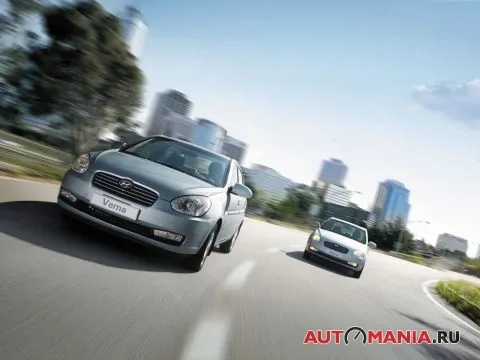
So, before us is the Verna. If we consider it the heiress of the Accent, then the step forward is obvious. There is no trace left of the former dull styling, for which the car was nicknamed "the bar of soap." Hardly anyone will argue that the car looks decent — at least at a good level even for the European market. The optics, bumper, hood, embossed side, and expressive rear — all this makes you forget about the gray past of the brand and immerses you in a stylish, lively, and confident present. But the main thing in this car is not the appearance. The creators of the new Accent focused on the interior. Anyone who has ever sat in the cabin of its predecessor needs no explanation: the dull gray plastic is a thing of the past, giving way to modern and safer materials that please both with their texture and the neatness of assembly. The fit of parts deserves praise, although, given the clear focus on Europe, this is expected. The only thing is that the upholstery could be a bit more noble, but this does not affect the overall impression.
Comfort is also at a high level. It is comfortable to sit, and there are enough adjustments to accommodate a person of any build behind the wheel. True, the high seating position may seem not ideal: the seat cushion and backrest for a tall driver are likely to be too short and too soft. On a long journey or in a long traffic jam, the legs and back begin to remind of themselves with unpleasant regularity. But there are no questions about ergonomics. The cabin layout resembles the interior of the Santa Fe SUV: all controls and compartments for small items are exactly where you expect them. The only difference is that the sedan feels more "subtle." By the way, about space: rear passengers are lucky, it is quite spacious for the B-class, although truly comfortable will be only for two. The trunk also pleased with its capacity, and if you fold the rear seat back in a 6:4 ratio, the volume can be increased.
Although the Verna range includes three engines — one turbodiesel and two petrol engines of 1.4 and 1.6 liters — currently only the 1.4-liter engine with 97 hp is available to buyers. It is paired either with a manual or a 4-speed automatic. It was the version with the automatic that I got for the test, and it did not disappoint. Contrary to expectations, the combination turned out to be quite lively. Of course, it is far from a sports car, but the car drives confidently. It is interesting how it behaves with the "stick"? Judging by the experience of dealing with the manual on the Getz, it is probably good, and perhaps excellent. Add to this an elastic engine, adequate gearbox operation, and fuel efficiency — and you get an almost ideal city car. But the ideal is unattainable, and the Verna confirms this. The brakes, or rather the ABS, are the weak point. I have not seen a system so sensitive to the quality of the asphalt for a long time: as soon as there is a slight unevenness, the pedal immediately begins to vibrate. This almost does not affect braking efficiency, but it does not add comfort.
Handling and suspension pleased more. Even with active maneuvering, the rolls are minimal, and potholes and joints are worked out clearly and collectedly, without "teeth-rattling." On serious obstacles, it noticeably shakes, but I suspect this is the price for a stiffer, adapted to our roads setting. But the suspension resource will be higher.
This is exactly how buyers will see the car. If they see it: managers in private conversations assess the model's prospects with caution. There are several reasons. First, the new product is not cheap. The base version for $14,290 (driver's airbag, power steering, central locking, immobilizer, and audio preparation) is a little, but a normally equipped car with power windows and air conditioning already costs $15,490. ABS, EBD, and electric mirror drive are available only in the third trim for $16,190. And the top version with an automatic will cost $17,790 — this is already not at all budget-friendly for the B-class.
The second reason follows from the first: the good old Accent, despite its modest appearance and basic equipment, still offers the best price-quality ratio in the class. And for most of our buyers, who vote with the ruble, this is still the main argument.
And the third reason is Turkish assembly. In the domestic market of Turkey, the Verna is wildly popular, even reaching a shortage. So if the forecasts of Korean marketers for demand for the Verna in Russia do not come true, not just a reduction in supplies is possible, but a complete withdrawal of the model from the market. Although, honestly, such an outcome is unlikely: in the price niche from $10,000 to $20,000, almost everything sells in our country. The exception is perhaps the outdated VW Pointer, but unlike the Hyundai Verna, there is no particular need to worry about it.
Technical specifications:
Dimensions:
Length (mm) 4280
Width (mm) 1695
Height (mm) 1470
Wheelbase (mm) 2500
Weight (kg) 1058
Trunk volume (l) n/a
Engine displacement (cm3) 1399
Max. power (hp) 97
Max. torque (Nm) n/a
Max. speed (km/h) 177
Acceleration 0—100 km/h (s) 12.3
Avg. fuel consumption (l/100 km) 5.1
Price ($) 14,290-17,790
Source – www.automania.ru